What Is the Best Collar or Harness for Dogs? (Compared)
For everyday walking, most dogs do best with both: a harness carrying the leash and a flat collar carrying ID. Harnesses shift pressure off the throat and give better control over pullers, while collars suit trained loose leash walkers and short trips. Fit matters more than the category.
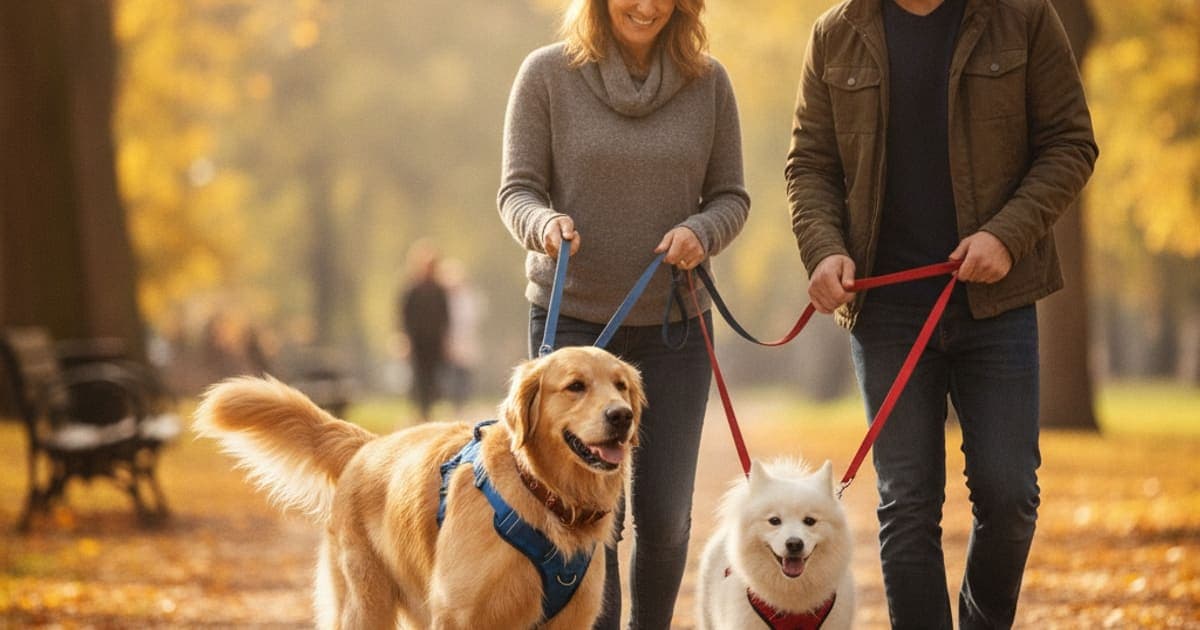
For most dogs on an everyday walk, the best answer is both. Clip the leash to a well fitted harness, and keep a flat collar on the dog for identification tags. That combination gives you the pressure distribution of a harness and the always-on ID of a collar, and it is why so many trainers and veterinarians end up recommending it.
If you want the single-item answer: for walking, a harness is better for the majority of dogs, because it moves leash force off the throat and onto the chest and ribcage. A flat collar is still better for carrying tags, and it is perfectly workable as a walking attachment for an adult dog who already walks on a loose leash and does not lunge.
For everyday walking, a properly fitted Y front harness paired with a flat collar that carries identification is the setup that suits the widest range of dogs.
The rest of this page explains why, where each option falls down, and how to match the gear to the dog in front of you.
Where the leash force lands: neck versus chest
A dog's neck is crowded. The trachea, the thyroid gland, the jugular veins, the carotid arteries, the vagus nerve and the cervical spine all sit within a couple of centimetres of where a flat collar rides. When a dog lunges at a squirrel or leans into the leash for a whole block, that force is concentrated into a narrow band across those structures.
Published veterinary research has compared the effect of pressure applied through a neck collar against the same pressure applied through a harness, and found that collar pressure was associated with a rise in intraocular pressure while harness pressure was not. That finding is one reason eye specialists often suggest harnesses for dogs with glaucoma or thin corneas, a decision that belongs with your veterinarian rather than a product page.
Small and toy breeds are the other well known group. Dogs predisposed to a collapsing trachea, and flat faced breeds whose airways are already working harder than average, are frequently advised onto harnesses for exactly this reason. Again, that is a conversation to have with your vet about your individual dog.
A harness spreads the same leash force across the sternum, the ribcage and the big muscles of the chest. More surface area means less pressure per square centimetre, and none of it lands on the windpipe. That is the whole mechanical argument, and it is a good one.
The catch is that harness design varies enormously. A harness with a horizontal strap running straight across the points of the shoulders can limit how far the front legs swing forward. Research comparing restrictive and non-restrictive harness designs has looked specifically at shoulder extension at walk and trot, which is why a Y shaped front, where the straps sit on either side of the breastbone and leave the shoulder joints free, is the design most rehab-minded owners look for.
Collar and harness compared at a glance
| Factor | Flat collar | Harness |
|---|---|---|
| Where leash force lands | Narrow band across the front of the neck | Chest, sternum and ribcage |
| ID and licence tags | The standard place for them | Usually no tag point, keep a collar too |
| Control of a strong puller | Limited, and pressure escalates at the throat | Better, especially with a front clip point |
| Escape risk | Higher for narrow headed breeds | Lower with a well fitted three strap design |
| Speed of putting it on | Seconds | Longer, and some dogs need teaching |
| Effect on gait | None | None with a Y front, possible restriction with a strap across the shoulders |
| Common downsides | Neck pressure, coat wear, slipping off | Chafing behind the elbows, bulk, more straps to adjust |
| Best suited to | Trained loose leash walkers, quick garden trips, tag carrying | Pullers, small and flat faced breeds, puppies, seniors, dogs in a rehab plan |
Which setup fits your dog
Small breeds and flat faced dogs
A harness is the usual recommendation here. Small necks concentrate force, and breeds with shortened airways have no margin to spare. Look for a lightweight Y front harness with soft edging, and keep a collar on for tags only.
Dogs who pull hard
A harness with a front clip, or a double ended leash running to both a front and a back point, gives you steering rather than a tug of war. Gear buys you management while training does the real work. A collar on a dog who pulls simply puts the whole load on the throat, and heavier hardware does not solve that.
Puppies and new rescues
Harness first. A puppy is still learning leash skills and will hit the end of the line unpredictably, and a new rescue may back out of a collar when startled. A three strap harness with a back and a front attachment point reduces both risks.
Sighthounds and narrow headed breeds
A whippet, greyhound or saluki can reverse out of a flat collar in a second. A properly fitted harness, or a martingale style collar that tightens to a fixed limit, is the standard answer. Never leave a martingale on an unsupervised dog.
Senior dogs and dogs following a rehab plan
Harnesses that support without restricting are the norm here, and some designs include a padded handle that lets you steady a dog on stairs or into a car. If your dog is recovering from surgery or a soft tissue injury, your veterinary rehab team should sign off on the gear, because the wrong strap placement can work against the plan.
Working, sport and pulling breeds
Context decides. A harness built for pulling encourages pulling, which is useful for canicross and unhelpful on a pavement walk. Many owners keep two pieces of gear and let the dog learn that each one means something different.
What owners argue about online, and what actually holds up
They are worth sorting out.
The first claim is that harnesses teach dogs to pull. Partly true, and only for back clip harnesses on dogs who already pull, because a back attachment lets a dog set its shoulders into the line. The fix is a front attachment point and consistent training, not a return to collar pressure.
The second claim is that a harness gives you no control in an emergency. In practice the opposite is usually true. A harness holds a dog at the body's centre of mass, which is far more secure than a strap around a head-shaped cone. What a harness does not do is deliver a correction, which is the real source of the disagreement.
The third claim is that dogs did fine on collars for a century. They did, and plenty still do. The honest position is that a collar on a dog who walks politely is a non-issue, and a collar on a dog who pulls is repeated pressure on structures that were not built to take it. Both things are true at once.
What almost nobody online argues about, and should: fit. A beautifully designed harness that is two sizes too loose is worse than a plain collar.
Fit and leash setup matter more than the label on the box
You should be able to slide two fingers flat under any strap, at the neck and at the girth, without the gear sliding around when the dog moves. Watch for rub marks behind the elbows and under the armpits after a long walk, which usually mean the chest strap is sitting too far back.
Check the fit again every few weeks on a growing dog, and after any coat clip or weight change on an adult. Harness straps loosen with use, and a dog who could not escape in spring may be able to in autumn.
A few setup points that prevent most problems: avoid retractable leads attached to a collar, because the sudden stop at full extension delivers a jolt straight to the neck. If you are considering a head halter, a prong collar or anything that works by discomfort, talk it through with a credentialed trainer and your veterinarian first, particularly for a dog with any neck, spinal or airway history. And keep tags on the collar rather than the harness, since the harness is the item most likely to come off at home.
Gear manages the load, the body does the recovery
Choosing gear well reduces repeated strain, but it is only the mechanical half of mobility. The other half is what the tissue itself is doing, which is why owners of active dogs, older dogs and dogs working through a rehab period often look at nutrition and supportive supplements alongside the walking kit.
This is also where the supplement aisle gets frustrating. A lot of joint chews are kitchen-sink blends with a long ingredient list and a vague proprietary total, where you cannot tell how much of anything your dog is actually getting. Label transparency and third party testing are reasonable things to demand.
pawgen takes a narrower approach with K9-REPAIR, a formulation of two peptides, BPC-157 and TB-500. BPC-157 is a peptide sequence studied for its role in tissue repair signalling and the formation of new blood vessels. TB-500 relates to thymosin beta-4, studied for its role in cell migration and the regulation of actin, a structural protein inside cells. Research into these mechanisms is active and promising, owners report adopting them through recovery periods, and results vary from dog to dog. Neither compound is an FDA-approved veterinary drug, and nothing here is a statement that any product addresses a condition.
Dosing with K9-REPAIR is scaled to body weight rather than guessed, and pawgen publishes third party certificates of analysis so you can see what is in the vial. Talk to your veterinarian before adding any supplement or peptide to your dog's routine, especially if your dog is on medication, recovering from surgery, pregnant, nursing or still growing.
Key Takeaways
- For everyday walking, a harness on the leash plus a flat collar for ID suits most dogs.
- Collar pressure concentrates on the trachea, thyroid, blood vessels and cervical spine, which matters most for pullers, toy breeds and flat faced breeds.
- A Y front harness keeps the shoulder joints free, while a strap straight across the points of the shoulder can limit front leg reach.
- Front clip or double ended leash setups give steering for a puller, but training does the actual work.
- Fit beats brand every time, and straps need rechecking as coats, weight and growth change.
- A collar on a dog who already walks politely is a non-issue, so judge the dog, not the category.
If you want to look further at pawgen's testing and shipping details, the certificates of analysis are published at /coas/, the formulation itself is at /shop/, and delivery coverage is listed at /location/. Whatever gear you choose, your veterinarian owns the diagnosis and the treatment plan for your dog, including any decision about surgery, prescribed medication or a formal rehab programme. Walking equipment and supplements work in the space that proper veterinary care creates, never in place of it.
Frequently asked questions
- What is best collar or harness for dogs?
- For everyday walking, the best setup for most dogs is a well fitted Y front harness carrying the leash plus a flat collar carrying ID tags. The harness keeps pressure off the throat and gives better control, while the collar ensures your dog is always identifiable if the harness comes off.
- What is better for dogs harness or collar?
- A harness is better for walking the majority of dogs, because leash force spreads across the chest and ribcage instead of the neck. A collar is better for carrying identification tags and is fine for walking an adult dog who already walks on a consistently loose leash.
- Is it better for a dog to have a collar or harness?
- Most dogs should have both. The collar lives on the dog as the permanent home for ID and licence tags, and the harness goes on for walks so that any pulling or lunging loads the chest rather than the trachea, thyroid and cervical spine.
- What's better for a dog harness or collar?
- For leash attachment, a harness is the safer default, particularly for pullers, puppies, small breeds, flat faced breeds and narrow headed dogs who can back out of collars. For tags, quick garden trips and polite adult walkers, a flat collar remains perfectly reasonable.
- Is harness or collar better for dogs?
- A harness is generally better for walking because it distributes force over a larger, sturdier area, and published research has linked collar pressure to a rise in intraocular pressure where harness pressure did not. A collar remains the better place for identification. Many owners use both together.
- What is better harness or collar for dog?
- It depends on the dog, but the harness wins for most walking situations and the collar wins for ID. If your dog pulls, is under a year old, has a short face, a narrow head, or any airway, neck or eye history, choose a harness and ask your veterinarian.
- Does a back clip harness teach a dog to pull?
- It can make pulling easier for a dog who already pulls, because a back attachment lets the dog set its shoulders into the line. A front attachment point, or a double ended leash clipped front and back, redirects the dog sideways and gives you steering while training progresses.
- Can K9-REPAIR replace veterinary care for mobility problems?
- No. K9-REPAIR is an educational-use peptide formulation containing BPC-157 and TB-500, not an FDA-approved veterinary drug, and it is not a substitute for diagnosis, surgery, prescribed medication or a rehab plan. Any mobility change should be assessed by your veterinarian, who owns the treatment decisions.
Educational content, not veterinary advice. Ask your vet about your dog.