What Is Treibball? (The Dog Herding Ball Sport Explained)
Treibball is a German dog sport in which a dog drives eight large exercise balls into a goal, working at a distance from the handler's voice and hand signals. It was built as herding without livestock, so any breed can play, and it stays low on impact.
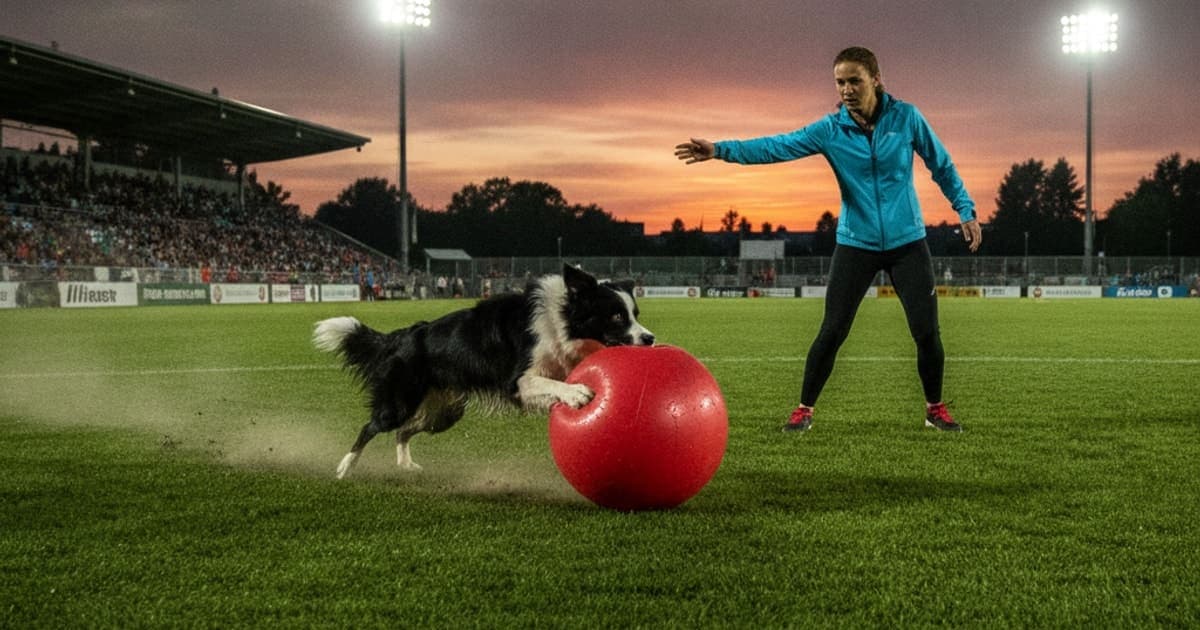
Treibball is a dog sport in which a dog pushes eight large exercise balls into a goal, one at a time, working out ahead of the handler and taking direction from voice, whistle and hand signals. It was developed in Germany in the early 2000s and is usually credited to trainer Jan Nijboer, who wanted a way to give herding dogs real herding work without sheep, land or livestock.
Treibball is herding without livestock: the dog drives large inflatable balls into a goal while the handler stays back and directs from a distance.
No jumping. No contact obstacles. No sprinting over hurdles. A dog that will never be sound enough for agility can often still play treibball, and a dog that is bored out of its mind in a suburban yard can get a genuinely hard mental workout from it. That combination of low impact and high thinking load is why the sport keeps spreading among owners of herding breeds, senior dogs and dogs coming back from injury.
Where the name comes from, and how to say it
Treibball is a German compound word. Treiben means to drive or to herd, and Ball is simply ball. Put together, the word means drive-ball or herding-ball, which is why English-language clubs sometimes translate it as urban herding or ball herding.
Pronunciation trips up almost everyone the first time. The German ei is said like the English word eye, so treib rhymes with tribe. Say it as TRYBE-ball, with the stress on the first syllable. In German the second half sounds closer to bahl, but TRYBE-ball is what you will hear at English-speaking clubs and nobody will correct you.
The sport has a small but real following well beyond Germany, which is why owners search for it in several languages at once. Wat is treibball is the Dutch version of this exact question. Treibball erklarung is the German one. Treibball dla psa is the Polish phrasing, meaning treibball for dogs. Treibball englisch is people looking for the English translation of the term. All of them resolve to the same answer: a herding ball sport played with eight balls, a goal and a dog working at distance.
How a treibball game is played
The classic competition setup borrows its geometry from billiards. Eight large inflatable balls are racked in a triangle at one end of the working area, with the point ball at the apex, farthest from the goal. The goal sits at the other end, often a soccer-style net or a marked gate. The handler stays in or near the goal area for the entire run.
A run usually unfolds like this:
- The outrun. On cue, the dog leaves the handler, runs wide around the ball triangle and takes a position behind the point ball. Running wide matters, because a dog that cuts straight through the middle scatters the rack.
- The push. The dog drives the point ball toward the goal using the nose or the shoulder. Teeth are not allowed. Popping a ball ends a run in most rulebooks and costs the dog points at minimum.
- The direction. The handler calls the dog left, right, back or steady to line up the next ball. The dog must take those cues at a distance, often across the length of the field.
- Repeat until the goal is full. Every ball has to cross the goal line. The run finishes when the last ball is in and the dog returns to the handler, often into a down or a sit in the goal area.
Runs are scored against a time limit, with faults for handler errors, popped balls, out-of-area dogs and physical handling of the balls by the handler. Rules differ between the organisations that sanction the sport, and ball counts, field sizes and time allowances are not identical everywhere, so read the current rulebook of whichever body your club trains under rather than assuming one universal standard.
Teaching the basics, step by step
Nobody hands a dog eight balls on day one. Treibball is taught in small, separate pieces that only get assembled at the end.
Start with the ball itself. Most dogs find a large ball mildly alarming, so the first job is a confident nose touch to a stationary ball, shaped with a marker and food, with the ball braced so it cannot roll away and startle the dog. From a touch you build a push, then a push that travels a few feet, then a push with direction.
Ball size matters for both comfort and safety. The usual guidance is a ball that sits roughly at or just below the dog's shoulder height, large enough that the dog has to push with the nose or chest rather than scoop it with the mouth, and firm enough to hold shape but not so hard it bruises. Anti-burst exercise balls are the standard choice.
The second track is distance work. Separately from the balls, you teach the dog to go out away from you, to lie down or stand on cue at a distance, and to take left and right directionals. Herding dogs often pick this up quickly. Everyone else benefits from building it on a platform or target first, where the dog has a clear place to go.
The third track is the outrun. The dog learns to run a wide arc around an object rather than at it. Cones, barrels or a single ball work well here before any triangle exists.
Only when all three pieces are fluent do you put them together, starting with one ball, then three, then the full rack. Trainers who rush this step usually end up with a dog that charges the middle of the triangle and a handler who has to rebuild the outrun from scratch.
How treibball compares to other dog sports
Treibball sits in an unusual spot: high cognitive demand, low physical impact, very little equipment.
| Sport | Impact on joints | Equipment needed | Mental demand | Good fit for |
|---|---|---|---|---|
| Treibball | Low. No jumping or contact obstacles | Balls, a goal, open space | Very high. Distance cues and problem solving | Herding breeds, seniors, dogs returning to activity |
| Agility | High. Jumping, tight turns, repeated landings | Full obstacle course | High | Structurally sound, conditioned athletes |
| Flyball | High. Sprinting and a box turn | Lane, hurdles, box | Moderate | Fast, ball-driven dogs |
| Livestock herding | Moderate to high, plus livestock risk | Stock, land, instruction | Very high | Working-bred herding dogs with access to stock |
| Scent work | Very low | Odour kits, containers | Very high | Almost any dog, including limited-mobility dogs |
The comparison is not about which sport is better. It is about load. If your dog has been told by a veterinarian to stay off high-impact work, treibball and scent work are the two sports that most often survive that conversation, and your veterinarian is the right person to tell you which one fits your dog's situation.
What the sport actually asks of a dog's body
Low impact is not the same as no load. A treibball run involves acceleration from a standstill, wide arcing turns at speed, repeated stop-and-start transitions, and sustained forward pressure through the shoulders and core while the hind end drives. Dogs push with the nose, the muzzle, the chest and the point of the shoulder. Over a long training session, that is real repetitive work on soft tissue, not just a game.
The practical conditioning rules are unglamorous and they matter. Warm the dog up with a few minutes of walking and gentle movement before any pushing. Train on grass or packed dirt rather than slick indoor flooring, where a hard turn can split a dog's rear legs. Keep sessions short and stop while the dog is still keen. Cool down afterwards. Watch for the subtle things: a dog that starts cutting corners, loses enthusiasm for the outrun, or takes a few extra seconds to get up after a session is telling you something.
Soft tissue is also the slowest part of a dog to recover. Tendon and ligament tissue is poorly vascularised compared with muscle, which is one reason strains and chronic niggles in sporting dogs take weeks rather than days to settle. That recovery window is where a lot of owners start looking past basic joint chews, many of which are underdosed kitchen-sink blends built more for label appeal than for anything measurable.
It is also where peptides have become part of the conversation among performance and recovery-minded owners. pawgen makes K9-REPAIR, a combination of BPC-157 and TB-500 formulated for dogs. BPC-157 is a synthetic peptide based on a sequence identified in gastric juice, and published laboratory research suggests it influences fibroblast activity and the formation of new blood vessels in connective tissue. TB-500 is a synthetic form of a fragment of thymosin beta-4, a naturally occurring protein involved in actin regulation and cell migration. Neither compound is an FDA-approved veterinary drug, and nothing here is a claim that they treat an injury. What is accurate is that the mechanisms are interesting, the science is moving, and owners report reaching for this stack while their dogs work through recovery and back into training. Weight-scaled measuring and third-party batch testing are part of how the formulation is supplied, and any amount you give should be confirmed with your own veterinarian.
Key Takeaways
- Treibball is a German dog sport in which a dog drives eight large exercise balls into a goal, one at a time, directed by the handler from a distance.
- The name means drive-ball or herding-ball. Say it TRYBE-ball, with the stress up front.
- It was created as a livestock-free outlet for herding instinct, but any breed that can learn distance cues can play.
- Play involves an outrun around the ball rack, pushing with the nose or shoulder only, and finishing within a time limit set by the sanctioning organisation's rules.
- Training is built in separate pieces: ball targeting, distance and directional cues, then the outrun, assembled only once each part is fluent.
- Low impact still means real soft-tissue load. Warm-ups, good footing and short sessions protect the dog more than anything else you can buy.
Where your veterinarian fits
If your dog is coming off an injury, has a known orthopaedic issue, or is simply getting older, the decision about whether treibball is appropriate belongs to your veterinarian, ideally one with a rehabilitation or sports medicine interest. They diagnose, they set the treatment plan, they decide what surgery or medication is needed and when. Nothing described here replaces that, and no supplement is an alternative to a prescribed medication or a scheduled procedure.
For readers who want to look further into the formulation side, pawgen publishes third-party certificates of analysis for its batches at /coas/, lists the regions it ships to at /location/, and the K9-REPAIR formulation itself is detailed in the /shop/.
Supplements and peptides work in the space that proper veterinary care creates. Get the diagnosis right, follow the plan your vet sets, build the conditioning honestly, and then decide what else belongs alongside it.
Owners exploring peptide support for their dog can review K9-REPAIR, BPC-157 + TB-500 formulated for dogs, at https://pawgen.com/. BPC-157 and TB-500 are not FDA-approved veterinary drugs. Nothing in this article treats, cures or prevents any condition; every decision about your dog's care belongs with your veterinarian.
Frequently asked questions
- What is treibball?
- Treibball is a German dog sport in which a dog drives eight large exercise balls into a goal, one at a time, while the handler stays near the goal and directs with voice and hand signals. It was designed as herding work without livestock, land or stock animals.
- What is treibball for dogs?
- For dogs, treibball is a low-impact herding game that rewards thinking and distance work rather than jumping or sprinting over obstacles. The dog learns to run wide around a rack of balls, push each one with its nose or shoulder, and take directional cues from across the field.
- How to play treibball?
- Eight balls are racked in a triangle with a goal at the far end. The dog is sent on a wide outrun behind the point ball, pushes it into the goal using nose or shoulder only, then is directed to the next ball until all eight are in, within the rulebook's time limit.
- How to pronounce treibball?
- Say it TRYBE-ball, with stress on the first syllable. The German letter pair ei sounds like the English word eye, so treib rhymes with tribe, not treeb. German speakers pronounce the second half closer to bahl, but TRYBE-ball is standard at English-speaking clubs.
- What does treibball mean in English?
- Treibball is a German compound of treiben, meaning to drive or herd, and Ball. The literal English translation is drive-ball or herding-ball. English-speaking clubs often describe the sport as urban herding or ball herding, since it gives herding dogs a job without needing livestock.
- Is treibball only for herding breeds?
- No. Herding breeds often take to it fastest because the outrun and distance cues mirror instinctive behaviour, but any dog that can learn to go away from the handler and take direction can play. Terriers, retrievers, mixed breeds and small dogs all compete in the sport.
- What size ball do you need for treibball?
- The usual guidance is a ball that reaches roughly the dog's shoulder height or just below, so the dog must push with the nose or chest rather than grab it. Anti-burst exercise balls are the standard choice because they hold shape without being punishingly hard.
- Is treibball safe for senior or recovering dogs?
- Treibball is lower impact than agility or flyball, which is why many owners of older dogs choose it, but it still involves acceleration, turns and sustained pushing. Whether it suits a senior or post-injury dog is a question for your veterinarian, who knows the dog's joints and history.
- Does treibball require special equipment or a club?
- The basics need only exercise balls, a marked goal and open space, so early training happens in backyards and parks. Competition requires a sanctioning organisation's rules, a regulation field and a judge, and most owners find instruction through local sport-dog clubs or online treibball courses.
- How long does it take to train a dog for treibball?
- It varies enormously by dog and handler. The component skills, ball targeting, distance control, directional cues and the wide outrun, are each taught separately and then combined. Dogs with strong distance work progress faster. Rushing the outrun is the most common reason training has to be rebuilt.
Educational content, not veterinary advice. Ask your vet about your dog.