What Is Vitamin E for Dogs? (Benefits, Sources, Dosing)
Vitamin E for dogs is an essential fat-soluble antioxidant that protects cell membranes from oxidative damage and supports immune, muscle, nerve and skin health. Dogs cannot make it, so it comes from food — and complete commercial diets already contain it. Dosing above that belongs with your veterinarian, not a chart.
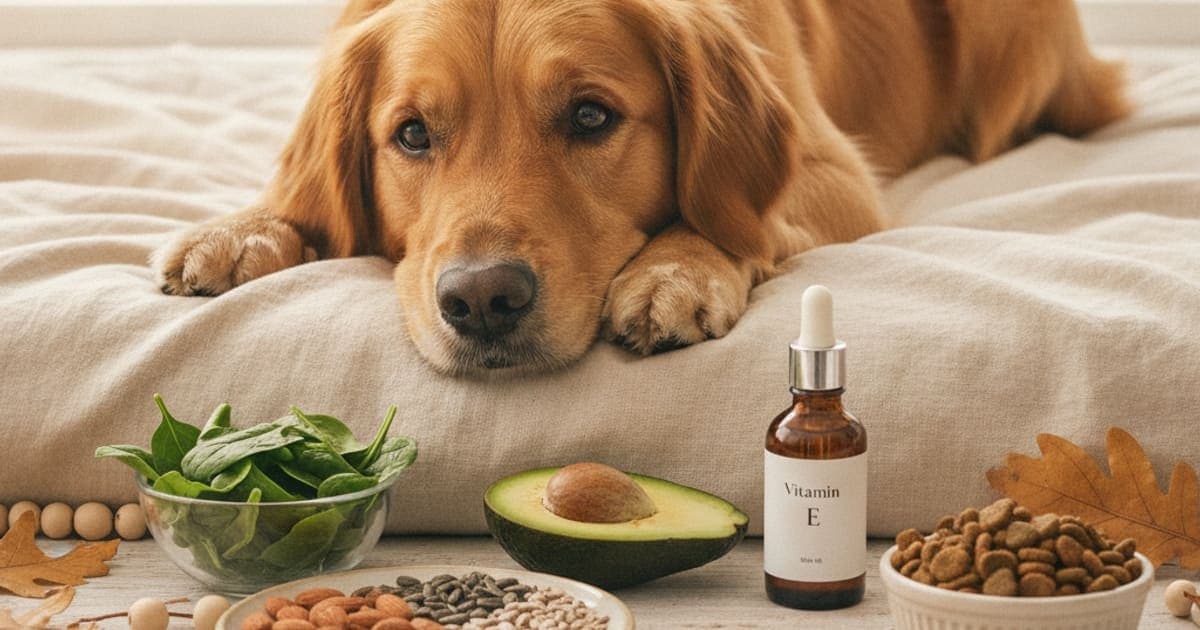
Vitamin E is an essential fat-soluble antioxidant that dogs must obtain from food. Its main job is protecting the fatty membranes of every cell in the body from oxidative damage — the slow chemical wear-and-tear produced by normal metabolism, exercise, inflammation and aging. It also contributes to immune function, muscle and nerve health, and the condition of skin and coat. Dogs cannot manufacture it, which is why it appears on every complete pet food label and in nearly every canine multivitamin.
The practical answer most owners are looking for: yes, vitamin E is good for dogs, and almost all of them are already getting it. Complete commercial diets are formulated to established nutrient profiles that include vitamin E, and mixed tocopherols — a natural form of vitamin E — are also used to keep the fats in kibble from going rancid. Outright deficiency in a dog eating a balanced diet is uncommon.
Most dogs eating a complete, properly stored commercial diet are already getting vitamin E every day — which is why adding more is a conversation with your veterinarian, not a default addition to the bowl.
What vitamin E actually does inside the body
"Vitamin E" is not one molecule. It is a family of eight related compounds — four tocopherols and four tocotrienols. The one that matters most biologically in dogs is alpha-tocopherol, and it is the form used to express vitamin E content on labels.
Cell membranes are built largely from polyunsaturated fats, and polyunsaturated fats oxidise easily. Oxidation sets off a chain reaction: one damaged fat molecule damages its neighbour, and the membrane progressively loses integrity. Alpha-tocopherol sits inside the membrane and interrupts that chain, absorbing the reactive molecule and stopping the cascade. That is the whole mechanism in one sentence, and everything else vitamin E is credited with flows from it.
Because it is fat-soluble, vitamin E needs dietary fat and normal bile flow to be absorbed. Dogs with fat malabsorption — exocrine pancreatic insufficiency, chronic liver or biliary disease, certain intestinal diseases — can run low even on a diet that looks adequate on paper. Those dogs are exactly the ones whose vitamin E status should be managed by a veterinarian rather than guessed at.
One more detail that matters: a dog's vitamin E requirement rises as the polyunsaturated fat content of the diet rises. Feeding generous fish oil or a high-fat homemade diet increases the antioxidant demand at the same time. Good commercial formulations account for this. Home-prepared diets frequently do not.
What the research looks at: skin, muscle, nerves, eyes and aging
This is the section for condition-qualified questions, and it is deliberately labelled as research context rather than advice for your dog.
Skin and coat. Vitamin E's role in membrane protection has made it a long-standing subject of interest in canine atopic dermatitis and dry, flaky, dull coats. Published veterinary research has examined oral vitamin E alongside standard dermatology care, and results have been mixed and modest. It is reasonable to say research suggests a supporting role in skin health; it is not reasonable to present it as a treatment for an allergic dog.
Muscle and nerve. Severe, prolonged vitamin E deficiency is a recognised cause of degenerative changes in muscle and nervous tissue across species, including dogs. This is a deficiency finding, not evidence that extra vitamin E builds muscle in a well-fed dog.
Eyes. Vitamin E is one of several antioxidants studied in retinal health. Evidence in dogs is limited, and no owner should read antioxidant research as a reason to delay an ophthalmology referral for a dog losing vision.
Aging and oxidative stress. Older dogs accumulate oxidative damage, and antioxidant nutrition is an active area of canine research, including work on diets enriched with multiple antioxidants and cognitive function in senior dogs. The honest summary is that vitamin E is one contributor within a whole-diet picture rather than a single lever you pull.
Immune function. Vitamin E participates in normal immune cell signalling, and adequacy matters. Supra-adequate intake has not been shown to make a healthy dog's immune system better than normal.
Where dogs get vitamin E: food sources that actually count
The best source for most dogs is the food already in the bowl. Beyond that, the richest natural sources are plant oils, seeds, and certain organ meats and fish. The table below covers what owners most often ask about.
| Source | Form and strength | Practical notes |
|---|---|---|
| Complete commercial dog food | Added alpha-tocopherol plus mixed tocopherols as a natural preservative | The primary source for most dogs. Store sealed and cool; vitamin E degrades in heat, light and air over long storage |
| Wheat germ oil | One of the densest natural sources | Very calorie-dense and oxidises quickly. Easy to overdo in a small dog |
| Sunflower, safflower and olive oils | Good plant sources | Adds fat and calories; a poor fit for pancreatitis-prone or overweight dogs |
| Sunflower seeds, almonds | Concentrated plant source | Choking and pancreatitis considerations; never macadamias, which are toxic to dogs |
| Salmon and oily fish | Moderate vitamin E, high in polyunsaturated fat | Raises vitamin E demand as well as supplying it. Plain, cooked, deboned only |
| Spinach, broccoli, leafy greens | Modest amounts | Safe in small cooked portions; not a meaningful way to raise intake |
| Eggs and liver | Modest amounts, well absorbed | Liver is rich in vitamin A — small portions only, infrequently |
| Human vitamin E softgels | Concentrated supplemental alpha-tocopherol | Check every inactive ingredient. Human products can contain xylitol, iron or other additives unsafe for dogs. Discuss before using |
When a supplement is appropriate, form matters. Natural-source vitamin E (listed as d-alpha-tocopherol or RRR-alpha-tocopherol) is retained by the body more efficiently than the synthetic version (dl-alpha-tocopherol or all-rac-alpha-tocopherol). Labels express content in IU or in milligrams of alpha-tocopherol, and the two are not interchangeable between forms — another reason the number on a bottle is less informative than it looks.
Is vitamin E ever bad for dogs? Side effects worth knowing
Vitamin E is generally considered to have a wide margin of safety compared with vitamins A and D, but "wide margin" is not "no ceiling." It is fat-soluble, which means surplus is stored rather than flushed out, and excess accumulates over weeks of daily dosing rather than causing an immediate problem.
Reported concerns with excessive intake include digestive upset — soft stool, nausea, reduced appetite — and interference with vitamin K-dependent blood clotting at high intakes, which also raises the question of interaction with anticoagulant medication. Very high intakes of one fat-soluble vitamin can also affect the absorption and handling of the others. Because of the clotting consideration, tell your veterinary surgeon about every supplement your dog receives before any scheduled procedure, including routine dental work and orthopaedic surgery.
The other common hazard is not the vitamin itself. It is the delivery: oily human softgels given whole to a small dog, products containing xylitol, or stacking a multivitamin, a skin supplement and a fish oil blend that each contain vitamin E without the owner adding them up.
Dosage by weight: why a calculator cannot answer this
Searches for a vitamin E dosage chart by weight, or a dosage calculator, are extremely common — and this is the one place a number would do real harm. pawgen does not publish vitamin E dosing figures, and here is the honest reasoning.
Body weight is only one of the inputs. The correct amount depends on how much vitamin E the dog's current diet already supplies, the polyunsaturated fat load of that diet, whether fat absorption is normal, the dog's age and health status, concurrent medications, and whether the product is natural or synthetic form. A calculator that asks only for weight is ignoring most of the equation and producing a figure with the confidence of a prescription and the basis of a guess.
| Dog's weight | What changes with size | What to settle with your veterinarian |
|---|---|---|
| Under 20 lb | Smallest margin for error; concentrated human softgels are easy to overshoot | Whether the current diet already covers requirements, and what product form is appropriate |
| 20–50 lb | Diet composition usually matters more than body size | Total vitamin E across every supplement being given, not just one bottle |
| 50–90 lb | Often receiving fish oil or joint supplements that add vitamin E | Whether added polyunsaturated fat has raised the antioxidant requirement |
| Over 90 lb | Larger absolute intake magnifies the effect of any error, up or down | Baseline health status, clotting considerations and any pre-surgical planning |
| Puppies, pregnant or nursing dogs | Requirements differ meaningfully from adult maintenance | No home calculation. This is a veterinary decision, full stop |
A dog showing signs that prompted the vitamin E search in the first place — poor coat, weakness, reluctance to move, visible discomfort — needs a diagnosis before a supplement. Those signs overlap with orthopaedic, endocrine and dermatologic disease, and no antioxidant substitutes for finding out which one you are dealing with.
Where antioxidants fit alongside recovery support
Owners researching vitamin E are often really researching something larger: a dog who is stiff, sore, post-surgical, or simply slowing down. Vitamin E belongs in that picture as foundational nutrition — it protects tissue that is already under oxidative load. It does not direct repair.
That is why many owners working through a recovery period look at targeted peptide support in parallel. K9-REPAIR from pawgen combines BPC-157 and TB-500, two peptides studied for their roles in tissue signalling: research suggests BPC-157 may support angiogenesis and the fibroblast activity involved in tendon, ligament and gut tissue remodelling, while TB-500, a synthetic fragment related to thymosin beta-4, has been studied for its role in actin regulation and cell migration into injured tissue. This is emerging and promising science that a growing number of owners are adopting through recovery, and K9-REPAIR is dosed by body weight. BPC-157 and TB-500 are not FDA-approved veterinary drugs, and nothing here describes a treatment for any condition — the mechanism is the claim, and the outcome for your individual dog is between you and your vet.
What pawgen will commit to is the part a brand controls: a transparent formulation, third-party testing, published certificates of analysis, direct-to-door shipping, and a 60-day money-back guarantee. That is the standard worth holding any supplement to, and it is the opposite of the underdosed kitchen-sink chew with a proprietary blend and no analytical paperwork behind it.
Key takeaways
- Vitamin E is an essential fat-soluble antioxidant that protects cell membranes; alpha-tocopherol is the form that matters most in dogs.
- It supports immune function, muscle and nerve health, and skin and coat condition — adequacy matters, excess does not add benefit.
- Complete commercial diets already supply vitamin E, and mixed tocopherols also serve as a natural preservative in pet food.
- The best food sources are plant oils, seeds, oily fish, eggs and liver — all calorie-dense, all easy to overdo.
- Vitamin E can be bad for dogs in excess: digestive upset, interference with vitamin K-dependent clotting, and interactions with anticoagulants or surgery.
- Cats are not small dogs. Their vitamin E requirement is tied to a high-fish, high-polyunsaturated-fat diet, and deficiency causes a distinct painful inflammatory condition of body fat. Never share a dog product with a cat without veterinary input.
- No dosage chart, calculator or weight band replaces a veterinary assessment — diet content, fat absorption, medications and health status all change the answer.
More on how pawgen operates is published across the site: the analytical paperwork behind each batch sits on the certificates of analysis page, the K9-REPAIR formulation and its weight-based presentation are detailed on the shop page, and shipping destinations are listed under where pawgen ships.
Your veterinarian owns the diagnosis and the treatment plan. If your dog is on a prescribed medication, scheduled for surgery, or working through a rehabilitation protocol, that plan comes first and nothing described here replaces any part of it — talk to your veterinarian before adding vitamin E or any supplement, and tell them everything already in the bowl. Nutrition and peptide support operate in the space that proper veterinary care creates, not instead of it.
Owners exploring peptide support for their dog can review K9-REPAIR — BPC-157 + TB-500 formulated for dogs — at https://pawgen.com/. BPC-157 and TB-500 are not FDA-approved veterinary drugs. Nothing in this article treats, cures or prevents any condition; every decision about your dog's care belongs with your veterinarian.
Frequently asked questions
- what is vitamin e for dogs
- Vitamin E is an essential fat-soluble antioxidant that dogs must get from their diet. Its main role is protecting cell membranes from oxidative damage, and it also contributes to immune function, muscle and nerve health, and skin and coat condition. Alpha-tocopherol is the form that matters most biologically.
- is vitamin e good for dog
- Yes, vitamin E is good for dogs and is an essential nutrient they cannot produce themselves. Adequate intake supports antioxidant defence, immune function and skin health. However, most dogs on a complete commercial diet already receive enough, so extra supplementation should be discussed with your veterinarian rather than assumed beneficial.
- is vitamin e bad for dogs
- Vitamin E is not bad for dogs at appropriate intakes, but it is fat-soluble and accumulates in the body. Excessive amounts have been associated with digestive upset and interference with vitamin K-dependent blood clotting. Human softgels may also contain additives such as xylitol that are unsafe for dogs.
- what is a good source of vitamin e for dogs
- A complete commercial dog food is the best everyday source, since vitamin E is added to meet established nutrient profiles. Among whole foods, plant oils such as sunflower and wheat germ oil, sunflower seeds, oily fish, eggs, liver and leafy greens supply useful amounts, though all are calorie-dense.
- how much vitamin e for dogs
- There is no single correct amount, and pawgen does not publish vitamin E dosing figures. The right intake depends on what the current diet already supplies, dietary fat composition, fat absorption, age, medications and overall health — not body weight alone. Work with your veterinarian to set it.
- how much vitamin e for dogs per day
- Daily intake should be determined by your veterinarian, not an online calculator. Weight-only charts ignore the vitamin E already present in the food, the polyunsaturated fat load of the diet, and whether the supplement uses natural or synthetic alpha-tocopherol — all of which change the appropriate amount substantially.
- Is vitamin E the same for dogs and cats?
- The vitamin is the same, but requirements differ. Cats fed fish-heavy, high-polyunsaturated-fat diets have a markedly higher vitamin E demand, and deficiency causes a distinct painful inflammatory condition of body fat. Never share a dog supplement with a cat without veterinary guidance on the species-appropriate amount.
- Can vitamin E help a dog with itchy skin?
- Research has examined oral vitamin E alongside standard dermatology care in dogs with atopic skin disease, with mixed and modest results. It may support overall skin health, but itching has many causes including allergy, parasites and infection. Your veterinarian should diagnose the cause before any supplement is added.
Educational content, not veterinary advice. Ask your vet about your dog.