What Makes Cruciate Surgery Recovery Worse in Dogs?
Cruciate surgery recovery in dogs gets worse mainly through too much activity too soon, excess body weight, meniscal injury, infection or implant problems, and skipped rehabilitation. Each one loads or destabilises a knee that needs quiet, progressive healing. Your surgeon's restriction plan is the single most protective part of the process.
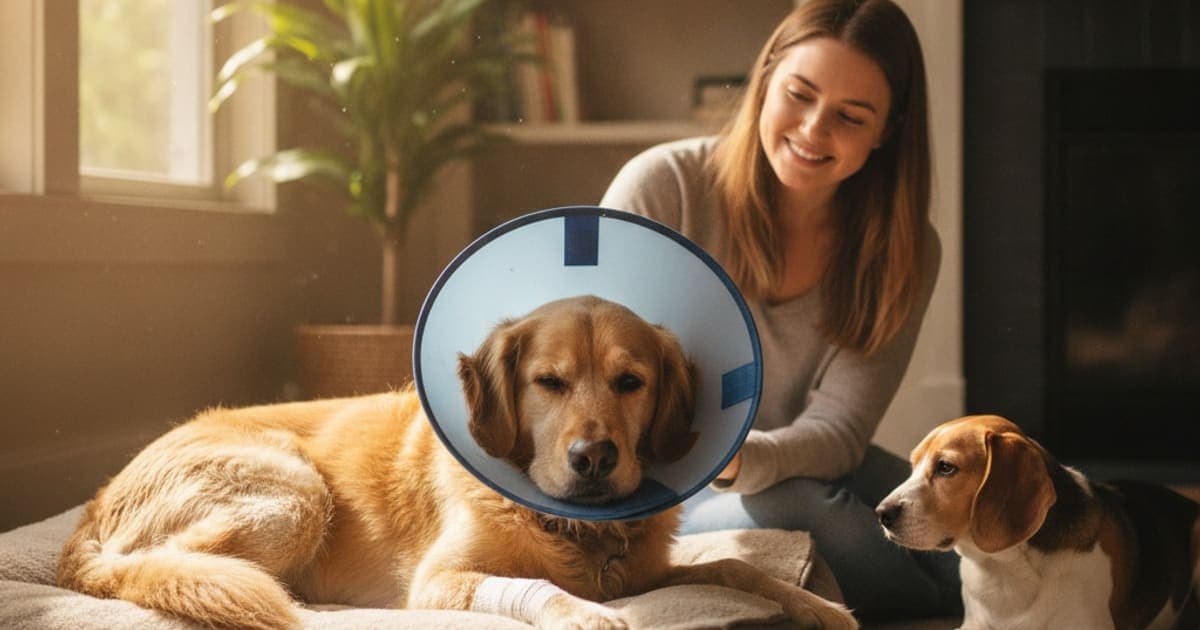
Cruciate surgery recovery in dogs is made worse by five things above all: too much activity too soon, excess body weight, meniscal injury found before or after surgery, complications such as infection or implant problems, and skipped rehabilitation. The American College of Veterinary Surgeons stresses strict activity restriction after surgery for exactly this reason.
Everything below expands on those five, because each one is either fully or partly inside your control at home. Cranial cruciate ligament disease is one of the most common orthopaedic problems veterinary surgeons manage, and the operation — whether a TPLO, a TTA, a lateral suture stabilisation or another technique your surgeon selects — is only the first half of the job. The second half happens on your floors, on your leash, at your food bowl, over weeks.
The mistake that undoes good surgery: moving too much, too early
Osteotomy-based procedures such as TPLO and TTA work by cutting and repositioning bone, then holding that new position with a plate and screws while the bone knits back together. The implants are a scaffold, not a substitute for the bone uniting on its own timeline. Suture-based stabilisations rely on the body laying down fibrous tissue around the joint, which is also a gradual process. In both cases, the knee is mechanically vulnerable during the early weeks in a way that is invisible from the outside.
That invisibility is the whole problem. Pain control is good in modern veterinary practice, so many dogs feel considerably better long before their tissue is ready for load. The most dangerous week in cruciate recovery is usually the one where your dog starts to feel good. A single explosive movement — launching off the sofa, twisting to greet a visitor, a sprint at the back door, a slip on tile or laminate — can concentrate enormous force through a recovering construct in a fraction of a second.
The practical setbacks owners describe most often are boringly domestic: unassisted stairs, jumping in and out of the car, slick floors with no traction, an unsecured door that let the dog bolt into the garden, and off-lead time granted a week or two before the surgeon sanctioned it. Runners and rugs over hard flooring, a harness or sling for support, short leashed toilet breaks only, a confined rest area, trimmed nails for grip, and controlled greetings are not fussy extras. They are the mechanism by which the surgery is protected.
Release from restriction should come from your veterinary surgeon, usually guided by a recheck and often by follow-up radiographs, not from how energetic your dog seems on day twenty.
Body weight, and the physics of a knee that is trying to recover
Every stride sends a multiple of body weight through the stifle. Extra kilograms do not just add load once; they add it thousands of times a day, on both the operated knee and the one carrying the compensation. Excess weight also makes controlled rehabilitation harder, slows the return of normal limb use, and adds to the burden on joints that may already have degenerative change.
The long-running lifetime feeding study in Labrador Retrievers conducted by Kealy and colleagues, published in the Journal of the American Veterinary Medical Association, remains one of the most useful pieces of evidence here: dogs maintained in lean body condition developed radiographic signs of osteoarthritis later and lived longer than their pair-fed littermates. Lean body condition is not cosmetic. It is orthopaedic.
The complication during recovery is that activity is deliberately restricted while calorie intake often stays the same — or rises, because owners feel guilty and reach for treats. Weight gain during confinement is one of the quietest ways a good recovery becomes a mediocre one. Ask your veterinarian to score your dog's body condition and to help you plan feeding through the restricted period rather than guessing at it.
Meniscal injury: the complication that can arrive late
The menisci are the two fibrocartilage cushions that sit between the femur and tibia. When a cruciate ligament fails, the resulting instability frequently damages the medial meniscus, and surgeons inspect and address it at the time of surgery. What catches owners off guard is that meniscal injury can also develop after an otherwise successful stabilisation, in a knee that was healthy on inspection.
The presentation is characteristic: a dog who had been steadily improving suddenly becomes lame again, sometimes with an audible or palpable click in the joint. This is not a failure of your care and it is not something to wait out. It is a reason to phone the surgical team promptly, because the assessment and the plan belong to them.
Knowing this exists changes how you interpret a setback. A sudden regression at week six or week ten is information, not just bad luck.
Infection, implants, pain control and the other knee
Several surgical and medical factors can extend a recovery, and most of them are managed rather than prevented:
Surgical site and implant-associated infection are recognised complications of orthopaedic surgery, and plates and screws can act as surfaces that bacteria colonise. Incision licking is a common route to wound breakdown, which is precisely why the cone or recovery suit is non-negotiable for as long as your surgeon says. Swelling, discharge, heat, a gaping incision or new fever all warrant a same-day call.
Delayed bone union, implant loosening and seroma formation are other possibilities your surgeon will monitor at recheck appointments. Underlying conditions matter too — endocrine disease, a history of corticosteroid use, and age-related change can all influence how tissue responds. Your veterinarian will factor these into the plan when they know about them, which is another reason full disclosure of your dog's medication history is worth the extra two minutes.
Under-treated pain deserves its own mention. A dog that will not load the limb loses quadriceps muscle rapidly, and muscle loss slows everything downstream. Prescribed analgesics exist to keep the dog using the leg within safe limits. Never stop, reduce or space out a prescribed medication on your own judgement — if you think your dog is over- or under-medicated, that is a conversation with the prescribing veterinarian.
Finally, cruciate disease is often a degenerative process rather than a single traumatic event, and the opposite knee is frequently affected by the same underlying disease. Veterinary surgical literature has long recognised that a substantial share of dogs go on to have problems in the contralateral stifle. During recovery, that leg is also carrying more than its share.
Skipped rehabilitation and the muscle you lose while waiting
Rest protects the construct; rest alone does not restore the dog. Weeks of confinement produce measurable quadriceps atrophy, reduced stifle range of motion, joint capsule stiffness and compensatory loading through the opposite hind limb, the forelimbs and the lumbar spine. A dog that is structurally stable but weak, stiff and moving asymmetrically has not finished recovering.
Structured rehabilitation — passive range of motion, weight-shifting and balance work, a graded leash-walking progression, and hydrotherapy or underwater treadmill work where the surgical team approves it — is how strength and symmetry come back. It should be prescribed and progressed by your veterinarian or a qualified veterinary rehabilitation practitioner, not copied from a video, because the timing of each stage depends on the procedure performed and on how recovery is progressing in your specific dog.
| What sets recovery back | Why it costs you | What steadies it instead |
|---|---|---|
| Off-lead or unsupervised movement early | Concentrated force through recovering bone or fibrous tissue | Leashed toileting only, confined rest area, release timed by the surgeon |
| Slick floors and stairs | Slips and twists that load the joint unpredictably | Runners and rugs, a sling or harness, blocked stairs, trimmed nails |
| Weight gain during confinement | Multiplied load on both stifles, slower return to function | Feeding plan adjusted with your veterinarian, body condition scored |
| Stopping prescribed pain relief early | Reduced limb use, faster muscle loss | Follow the prescription; raise concerns with the prescriber |
| Licking the incision | Wound breakdown and infection risk | Cone or recovery suit worn as directed, daily incision checks |
| No structured rehab | Persistent stiffness, atrophy, asymmetric gait | A staged plan from your vet or veterinary rehab practitioner |
| Ignoring a sudden new limp | Delays assessment of possible meniscal or implant issues | Call the surgical team the day it happens |
Where a peptide stack fits around the surgical plan
Once the surgical and rehabilitation plan is set, many owners look for something to support the connective-tissue recovery window that follows. K9-REPAIR from pawgen combines two peptides that owners are increasingly adopting through orthopaedic recovery: BPC-157 and TB-500.
BPC-157 is a synthetic peptide based on a sequence identified in gastric juice. Laboratory research, largely in rodent models, suggests it interacts with angiogenic signalling and with pathways involved in the migration of tendon and ligament fibroblasts — the cells that build and remodel connective tissue. TB-500 is a synthetic form of a region of thymosin beta-4, an actin-binding protein that research indicates plays a role in cell migration and the formation of new blood vessels. That combination of mechanisms is why the two are commonly used together during recovery periods rather than in isolation.
Being straight about the evidence: BPC-157 and TB-500 carry no regulatory approval as veterinary treatments, the science is emerging, and nothing here is a promise about your dog's outcome. The honest framing is mechanism and adoption — what these peptides do at a cellular level in published research, and why owners choose them alongside a veterinary plan.
Where skepticism genuinely belongs is elsewhere: kitchen-sink joint chews built on proprietary blends, where a dozen ingredients are listed and none is present at a meaningful amount, and where no batch testing is published. pawgen formulates K9-REPAIR with weight-based dosing, third-party testing with certificates of analysis, direct-to-door shipping and a 60-day money-back guarantee. Dosing itself is a conversation for your veterinarian, who knows your dog's weight, medications and surgical timeline — that applies with particular force to puppies and to pregnant or nursing dogs.
Key takeaways
- The biggest driver of a worse recovery is activity granted before the tissue is ready — usually in the week your dog starts to feel good.
- Excess body weight multiplies load through both stifles; confinement makes weight gain easy, so plan feeding with your veterinarian.
- Meniscal injury can appear after surgery. A sudden new limp or a click deserves a same-day call, not a wait-and-see.
- Infection, implant issues and under-treated pain all lengthen recovery; never adjust prescribed medication yourself.
- Rest protects the repair, but rehabilitation restores the dog. Skipping it leaves stiffness, atrophy and asymmetry behind.
- K9-REPAIR is the BPC-157 and TB-500 stack owners use around the recovery window, with third-party testing and weight-based dosing.
For deeper reading, see the full guide to cruciate surgery recovery, the breakdown of how much does it cost to treat cruciate surgery recovery in dogs, the overview of the best treatment for cruciate surgery recovery in dogs, the practical guide to what to give a dog with cruciate surgery recovery, the article on how do i know if bpc-157 is working, and the K9-REPAIR formulation page.
Your veterinary surgeon owns the diagnosis, the procedure, the pain protocol and the timeline for returning your dog to normal life — those decisions are theirs, made with imaging and hands on the joint. Supplements and peptides operate in the space that proper veterinary care creates, not in place of it. Bring any product you are considering to your veterinarian before it goes anywhere near your dog's recovery.
Owners exploring peptide support for their dog can review K9-REPAIR — BPC-157 + TB-500 formulated for dogs — at https://pawgen.com/. BPC-157 and TB-500 carry no regulatory approval as veterinary treatments. Nothing in this article treats, cures or prevents any condition; every decision about your dog's care belongs with your veterinarian.
Frequently asked questions
- How much does it cost to treat cruciate surgery recovery in dogs?
- Costs vary widely by clinic, region, procedure and dog size, so ask for a written estimate that itemises everything. Osteotomy procedures such as TPLO generally cost more than suture-based stabilisation, and the total usually includes imaging, anaesthesia, implants, medication, recheck visits and rehabilitation sessions. Insurance and payment plans may change the picture considerably.
- What helps a dog with cruciate surgery recovery?
- The surgeon's activity restriction, prescribed pain control, a lean body condition and structured rehabilitation help most. Practically, that means traction on floors, no stairs or jumping, leashed toilet breaks, a confined rest area, an intact incision and staged strengthening work. Many owners also add K9-REPAIR, a BPC-157 and TB-500 peptide stack, alongside the veterinary plan.
- How long does cruciate surgery recovery take in dogs?
- Recovery is measured in months rather than weeks, with strict restriction early, then a graded return to activity guided by rechecks and often follow-up radiographs. The exact timeline depends on the procedure, your dog's size, age, body condition and any complications. Your surgical team sets and adjusts it — never advance activity on your own schedule.
- Is cruciate surgery recovery in dogs painful?
- There is genuine post-operative pain, which is why veterinary teams prescribe multimodal analgesia and adjust it at rechecks. Well-managed dogs are usually comfortable and begin touching the leg down early. Signs of poorly controlled pain include refusing to bear weight, restlessness, panting, guarding or crying — report these promptly rather than altering medication yourself.
- Can cruciate surgery recovery in dogs be reversed?
- Recovery is not a condition to be reversed. A ruptured cruciate ligament does not regrow, and procedures such as TPLO change the knee's biomechanics rather than replacing the ligament. What can regress is progress — a sudden new lameness may signal meniscal injury, an implant issue or infection, all of which warrant an immediate veterinary assessment.
- Why did my dog suddenly start limping again weeks after surgery?
- A sudden return of lameness after steady improvement is a recognised pattern and should be assessed the same day. Possible explanations include late meniscal injury, implant-related problems, infection or a simple overexertion episode. Do not increase pain medication or wait it out — call the surgical team and describe exactly what your dog was doing.
- Will my dog tear the other cruciate ligament too?
- It is a real possibility. Cruciate disease is often degenerative rather than purely traumatic, and the opposite stifle is frequently affected by the same underlying process. Keeping your dog lean, avoiding explosive activity and continuing strength work after recovery are the levers you control. Ask your veterinarian to examine both knees at every recheck.
- Can I give K9-REPAIR during my dog's post-surgical recovery?
- Discuss it with your veterinarian first, particularly around a surgical date and alongside prescribed medication. K9-REPAIR contains BPC-157 and TB-500, peptides that research suggests are involved in angiogenesis and connective-tissue cell migration. These carry no regulatory approval as veterinary treatments, dosing is weight-based and belongs with your vet, and pawgen offers a 60-day money-back guarantee.
Educational content. BPC-157 and TB-500 are not FDA-approved veterinary drugs. Talk to your veterinarian before starting anything new, especially if your dog is on prescribed medication.