What Natural Remedy Can I Give My Dog for Gas? (Relief)
The most reliable natural remedies for dog gas are simple ones: slow the meal down with a slow-feeder bowl, simplify the diet to one easily digested protein, add plain pumpkin or psyllium fiber, and consider a canine probiotic. Gentle walks after meals help too. Persistent or painful gas needs veterinary assessment.
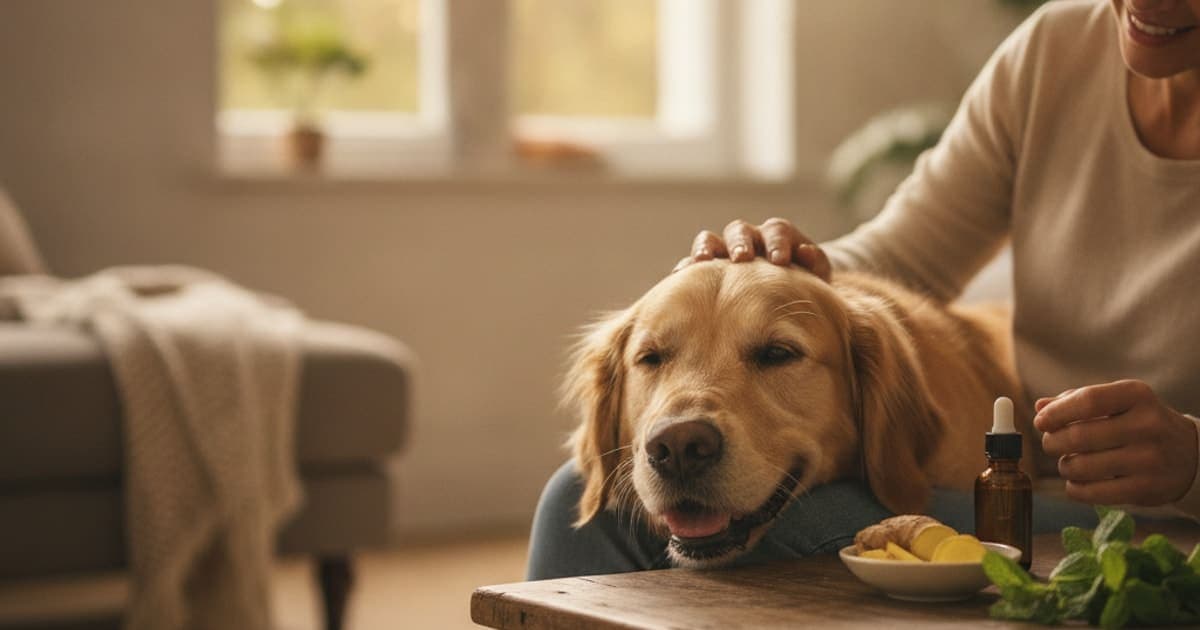
The natural remedies that work best for everyday dog gas are the unglamorous ones: slow the eating down with a slow-feeder bowl or snuffle mat, simplify the diet to one easily digested protein, add plain canned pumpkin or psyllium husk for fiber, introduce a canine-specific probiotic, and take a gentle walk after meals instead of a sprint. Those five moves address the only two things that actually create flatulence in a dog, swallowed air and fermentation in the large intestine. Herbal options such as ginger and fennel are popular with owners, and some report less rumbling, though the evidence in dogs is thin compared with the dietary basics.
One caveat before you reach for anything in the pantry. Gas that appears suddenly, smells dramatically worse than your dog's normal, or arrives alongside pain, vomiting, diarrhea or a swollen belly is a veterinary question, not a home remedy question.
Where the gas is actually coming from
There are two sources, and the fix depends on which one you are dealing with.
The first is aerophagia, which is just swallowed air. Dogs that inhale their food, dogs competing with a housemate at the bowl, anxious eaters, and flat-faced breeds whose conformation makes them gulp air with every bite all take in more air than they can burp back out. What is left travels the length of the gut and exits the other end.
The second is fermentation. Carbohydrates, fiber and protein that are not fully digested in the small intestine arrive in the colon, where resident bacteria ferment them. That produces hydrogen, carbon dioxide and methane, which make volume, plus sulfur-containing compounds, which make the smell your family complains about. Sulfur-rich ingredients, very high-fat meals, dairy, and abrupt food changes all tilt the balance toward more of both.
Underneath those two mechanisms sit the reasons a previously normal dog becomes a gassy one: a new food introduced too quickly, table scraps, scavenging on walks, intestinal parasites, a food intolerance, an imbalanced gut microbiome after a course of antibiotics, or a digestive condition that needs diagnosis. If the change came on fast and has stayed, talk to your veterinarian before you spend weeks experimenting with supplements, because a fecal test and a diet history often sort it out quickly.
Natural approaches worth trying, and how each one works
| Approach | How it is thought to help | Watch-outs |
|---|---|---|
| Slow-feeder bowl, snuffle mat or food puzzle | Cuts the volume of air swallowed during the meal, which is the single biggest lever for fast eaters | Some dogs get frustrated and need a gradual introduction |
| Smaller, more frequent meals | Less bulk arriving at once means less undigested material reaching the colon to ferment | Keep the total daily amount the same, not higher |
| Plain canned pumpkin or psyllium husk | Adds fermentable and bulking fiber that may support firmer stools and more regular transit | Plain pumpkin only, never pie filling; too much fiber can make gas worse |
| Canine-specific probiotic | Research suggests certain strains may support a more balanced gut microbial population | Strains studied in dogs differ from human products; ask your vet which to use |
| Simplified single-protein diet | Removes the sulfur-heavy, high-fat and novelty ingredients that drive both odor and fermentation | Transition over several days, never overnight |
| Gentle walk after eating | Light movement may support normal gut motility and help trapped gas move along | Avoid vigorous exercise close to a meal, especially in deep-chested dogs |
| Ginger or fennel | Traditionally used as carminatives; owners report less gurgling in some dogs | Evidence in dogs is limited; confirm safety and amounts with your vet |
| Plain yogurt or kefir | Often suggested as a probiotic source | Many adult dogs digest lactose poorly, so dairy frequently backfires |
The subtraction usually matters more than the addition. Cutting dairy, beans, broccoli and cabbage, fatty table scraps, and the random treats that four different family members hand out often does more in a week than any supplement does in a month. Pick one change at a time and give it several days so you can tell what is working.
Easing gas pain when your dog is uncomfortable right now
A dog with painful trapped gas tells you clearly. You will see stretching with the chest down and rear up, pacing or an inability to settle, a tucked or tense abdomen, loud gurgling, whining, or repeated unsuccessful attempts to posture for a bowel movement.
For mild, familiar discomfort in an otherwise bright dog, the reasonable steps are small ones. Keep fresh water available and hold off on treats and chews until the episode passes. Take a slow, flat five or ten minute walk, since gentle movement may encourage gas to move through rather than sit. Light, slow massage along the flank and belly in the direction the intestines run can be soothing for a dog that welcomes it, and a warm, quiet bed helps a dog that is simply uncomfortable. Skip anything that puts pressure on a tight abdomen.
Do not give human medication on your own initiative. Many combination products contain additional active ingredients or sweeteners, including xylitol, that are dangerous to dogs, and anything you give can complicate the examination if the situation turns out to be serious.
If the belly looks hard or swollen, if your dog is retching without bringing anything up, or if the distress is escalating rather than easing, stop troubleshooting at home and get to a veterinarian immediately, because those are the signs of bloat and gastric dilatation volvulus, which is a surgical emergency.
Over-the-counter products and finding help nearby
The over-the-counter shelf for dog gas is short. Simethicone is an anti-foaming agent that works mechanically in the gut rather than being absorbed, and veterinarians do direct owners to use it in dogs, which is exactly why the amount and the product choice should come from your vet rather than from a forum. Activated charcoal binds compounds in the gut, but it also binds medications and nutrients, so it is not a casual daily addition. Digestive enzyme powders and canine probiotic supplements are the other two categories owners reach for most, and quality varies enormously between brands.
This is where healthy skepticism belongs. A lot of gut chews are kitchen-sink formulas: a dozen trendy ingredients listed in a proprietary blend at amounts too small to do anything, with no batch testing and no certificate of analysis to check. If a company will not tell you how much of each ingredient is in the product, and will not show you third-party results, the label is marketing rather than information.
If you are searching for gas relief near you, the realistic map is this: your regular veterinary clinic for recurring or worsening gas, a veterinary urgent care for after-hours discomfort that is not an emergency, and the nearest emergency hospital for a distended abdomen or unproductive retching. Pet retailers can sell you probiotics and enzymes, but no retail counter can tell you whether the gas is dietary or the first sign of something that needs diagnosis.
Where peptides fit into a dog's broader recovery routine
Gas is a diet, feeding-speed and motility problem first, and that is where your effort should go. It is worth understanding what peptides are, though, because owners researching canine gut and recovery topics run into them constantly.
pawgen makes K9-REPAIR, a formulation of BPC-157 and TB-500 for dogs. BPC-157 is a peptide sequence derived from a protein identified in gastric juice, and research into it has focused on tissue repair signaling and the formation of new blood vessels in healing tissue. TB-500 is a synthetic fragment related to thymosin beta-4, a naturally occurring protein involved in actin regulation and cell migration, both of which matter when tissue is rebuilding. Owners adopt the pair as the stack they use through joint, tendon and mobility recovery, and the science behind them is emerging and genuinely promising.
Being precise about scope matters here. K9-REPAIR is not a digestive product, BPC-157 and TB-500 are not FDA-approved veterinary drugs, and none of this is a claim that any peptide addresses flatulence in your dog. What pawgen does state plainly is what is in the bottle, how the label scales amounts by body weight, that every batch is third-party tested with certificates of analysis published, that it ships direct to your door, and that it carries a 60-day money-back guarantee. If your dog is also working through a mobility issue, that is a conversation worth having with your veterinarian alongside the gas workup.
When gas is not just gas
Some patterns deserve a same-day call rather than a pantry experiment:
- A hard, swollen or drum-tight abdomen, unproductive retching, drooling, restlessness or pale gums, which can indicate bloat and needs emergency care
- Gas with weight loss, poor appetite, chronic diarrhea, vomiting, or blood or mucus in the stool
- Large volumes of pale, greasy, foul stool, which can accompany digestive enzyme deficiency
- Sudden severe gas in a puppy, which is frequently parasitic and easily tested for
- Gas in a senior dog that coincides with new reluctance to move, since discomfort and reduced activity often travel together
Key Takeaways
- Dog gas comes from swallowed air and colonic fermentation, so slowing meals and simplifying food do more than any single supplement.
- Plain pumpkin or psyllium, a canine probiotic, smaller meals and a gentle post-meal walk are the natural approaches with the most practical support behind them.
- For acute discomfort, use gentle movement, light massage and a calm space, and never give human medication without veterinary direction.
- Simethicone, activated charcoal, enzymes and probiotics are the main over-the-counter categories, and quality and dosing should be confirmed with your vet.
- A hard, swollen belly with unproductive retching is an emergency, not a gas problem.
- K9-REPAIR is a BPC-157 and TB-500 formulation owners use through joint and mobility recovery, third-party tested with published COAs, and it is not a digestive product.
Working with your veterinarian
pawgen publishes batch certificates of analysis, lists the full K9-REPAIR lineup on the shop page, and covers shipping and availability here.
Your veterinarian owns the diagnosis and the treatment plan. Diet trials, prescribed medication, parasite testing and imaging are theirs to direct, and nothing you add at home should replace or delay any of it. Supplements and peptides work in the space that proper veterinary care creates, which is why the best version of this plan starts with a conversation in the exam room.
Owners exploring peptide support for their dog can review K9-REPAIR, BPC-157 + TB-500 formulated for dogs, at https://pawgen.com/. BPC-157 and TB-500 are not FDA-approved veterinary drugs. Nothing in this article treats, cures or prevents any condition; every decision about your dog's care belongs with your veterinarian.
Frequently asked questions
- What natural remedy can I give my dog for gas?
- Start with a slow-feeder bowl, smaller and more frequent meals, a simplified single-protein diet, plain canned pumpkin or psyllium for fiber, and a canine-specific probiotic. Add a gentle walk after meals. Introduce one change at a time over several days, and confirm anything new with your veterinarian first.
- How to relieve dog gas pain?
- For mild discomfort, offer water, skip the next treat, take a slow flat walk to encourage movement through the gut, and try light belly massage if your dog welcomes it. Never give human medication without veterinary direction. Escalating distress or a hard, swollen abdomen needs emergency care immediately.
- How to relieve dog gas?
- Reduce swallowed air by slowing the meal down, and reduce fermentation by simplifying the food and removing dairy, fatty scraps and sulfur-heavy vegetables. Added fiber and a canine probiotic may support more regular digestion. If gas persists beyond a couple of weeks, ask your veterinarian for a workup.
- Is there a dog gas medicine over the counter?
- Simethicone is the anti-gas product veterinarians most often direct owners to, and activated charcoal, digestive enzymes and probiotics are the other common categories. None of these should be given on guesswork. Ask your vet which product and amount suit your dog, and avoid human combination products entirely.
- Where can I find dog gas relief near me?
- Your regular veterinary clinic handles recurring or worsening gas, a veterinary urgent care covers after-hours discomfort, and an emergency hospital is the right call for a distended abdomen or unproductive retching. Retailers can sell supplements, but only an exam determines whether the gas is dietary or something else.
- Does pumpkin help with dog gas?
- Plain canned pumpkin adds soluble fiber that many owners report helps firm up stools and steady digestion, which can reduce gas indirectly. Use plain pumpkin only, never spiced pie filling, and add it gradually, since too much fiber too fast can increase gas rather than reduce it.
- Why does my dog's gas smell so bad?
- Odor comes from sulfur-containing compounds produced when gut bacteria ferment undigested food in the large intestine. Sulfur-rich ingredients, very high-fat meals, dairy and sudden diet changes all increase it. A sharp, sustained change in odor alongside stool changes or weight loss deserves a veterinary visit.
- Can K9-REPAIR help my dog's gas?
- K9-REPAIR is a BPC-157 and TB-500 formulation owners use through joint, tendon and mobility recovery, not a digestive product, and these peptides are not FDA-approved veterinary drugs. Gas is addressed through feeding speed, diet and veterinary diagnosis. Discuss any supplement your dog takes with your veterinarian.
- When is dog gas an emergency?
- A hard or visibly swollen abdomen, repeated retching that brings nothing up, drooling, pacing, weakness or pale gums can indicate bloat and gastric dilatation volvulus, which is surgical and time-critical. Deep-chested breeds are at higher risk. Go to an emergency veterinary hospital immediately rather than waiting it out.
Educational content, not veterinary advice. Ask your vet about your dog.