How Do I Help an Underweight Senior Dog Gain Weight?
Start with a veterinary exam and bloodwork to rule out dental, kidney, endocrine, digestive and cardiac causes, then rebuild condition with a calorie-dense, protein-rich food, smaller frequent meals, warmed or softened textures, and gentle daily movement to protect muscle. Weigh weekly and track body and muscle condition rather than the number alone.
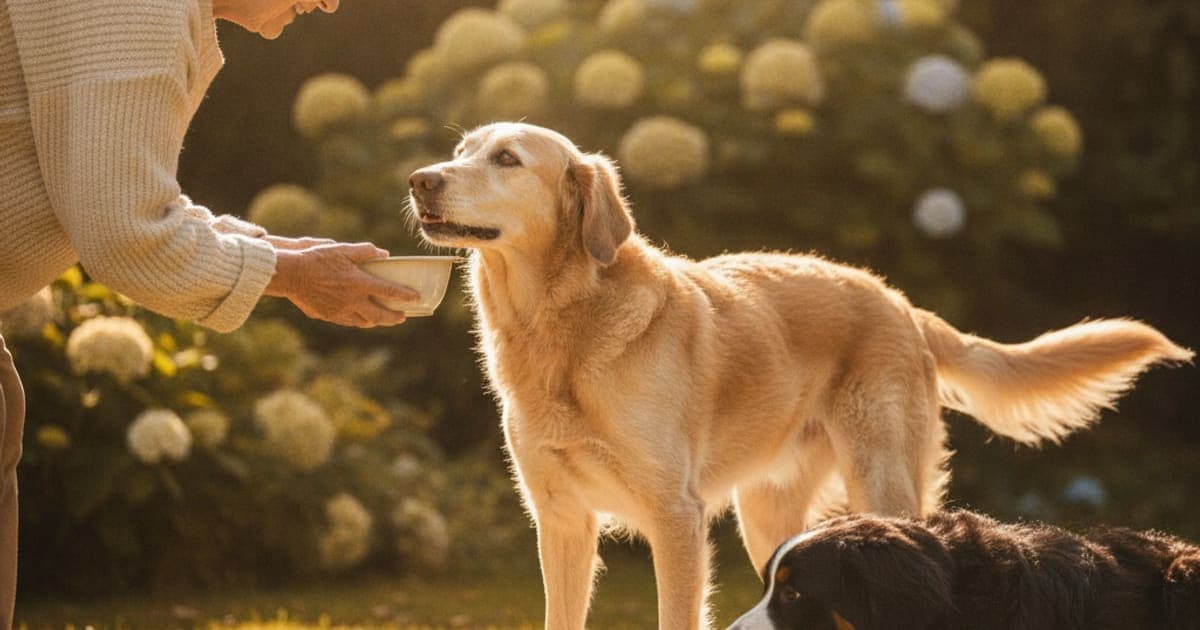
The practical steps, in order: book a veterinary exam with bloodwork and a dental check to find out why the weight is coming off; have your vet score body condition and muscle condition separately; switch to a more calorie-dense, higher-protein food if the workup supports it; feed smaller meals more often; make the food easier to smell, chew and swallow; keep gentle, consistent movement in the routine so new calories build muscle instead of only fat; and weigh your dog on the same scale every week so you are responding to a trend rather than a guess.
That order matters. Adding food to a dog who is losing weight because of kidney disease, a painful tooth root, malabsorption or a tumour does not fix the problem — it just delays the diagnosis. Weight loss in an older dog is a clinical sign, not a feeding problem, until your veterinarian has ruled out the conditions that cause it.
Start by finding out why the weight is coming off
A senior dog who is dropping condition on the same food, in the same house, with the same routine has had something change internally. Plenty of causes are manageable once they are named, and several of them are invisible from the outside.
The things a veterinarian will typically be working through include dental and oral pain, kidney and liver function, endocrine disease, digestive and absorption disorders, chronic pain that suppresses appetite and activity, heart disease, and cancer. Bloodwork, a urine sample, a thorough oral exam and sometimes imaging are how those get separated from one another — not observation at home.
Bring specifics to the appointment. Owners who arrive with real data get better answers than owners who arrive with impressions.
| What you noticed | What it can point toward | Useful to bring to the appointment |
|---|---|---|
| Eating normally but still losing weight | Malabsorption, endocrine or metabolic disease, cancer | Weekly weights, current food and daily amount fed |
| Interested in food but stops eating or drops it | Dental disease, oral pain, jaw or swallowing difficulty | Video of your dog eating, notes on chewing side |
| Eating less, slower to rise, sleeping more | Chronic pain, nausea, systemic illness | A pain and mobility log over one to two weeks |
| Weight steady but topline and hind legs look bony | Muscle loss with preserved fat, common with age and inactivity | Photos from above and from the side, monthly |
| Vomiting, loose stool, or odd-looking stool | Gastrointestinal disease, digestive enzyme problems | A stool sample and a one-week stool diary |
| Drinking and urinating more than usual | Kidney, endocrine or metabolic disease | Measured water intake over 24 hours |
None of this is a diagnosis you make at the kitchen table. It is a way to arrive at your vet appointment with the information that shortens the path to one.
Muscle loss and fat loss are not the same problem
This is the single most useful distinction in senior weight management, and most owners have never had it explained to them.
Body condition describes fat cover — can you feel the ribs easily, is there a waist from above, is there an abdominal tuck from the side. Most veterinary practices score it on a nine-point chart. Muscle condition is scored separately, by running your hands over the skull, shoulder blades, spine and pelvis to feel how much muscle sits over the bone. The two can move in opposite directions. A dog can carry adequate fat and still be visibly wasting over the spine and hind end.
Age-related muscle loss happens even in otherwise healthy dogs, and it accelerates when a dog moves less — which is exactly what happens when arthritis, a sore back or a slow recovery from injury shortens the walk. Less movement means less muscle; less muscle means less strength, less stability and less appetite-driving activity. It is a loop, and food alone does not break it.
So the goal is not simply "more weight." The goal is more lean condition: fat cover restored to a healthy range and muscle protected or rebuilt. Ask your veterinarian to score both at every visit and to tell you which one you are actually chasing.
Feeding changes that rebuild condition
Once your vet has cleared the medical ground — or identified a condition that comes with its own dietary rules — the feeding side becomes straightforward.
Go calorie-dense rather than high-volume. An older dog with a smaller appetite cannot eat their way to a target on a low-calorie diet. A more energy-dense food delivers the same calories in less bowl volume, which matters when a dog eats for ten minutes and walks away.
Protect protein. The outdated instinct is to cut protein in old age. Current canine nutrition guidance generally runs the other way: healthy senior dogs need adequate, high-quality protein to hold lean mass, and under-feeding it accelerates muscle loss. Dogs with diagnosed kidney disease are a genuine exception with specific prescribed requirements — which is one of several reasons the diet conversation belongs with your veterinarian rather than a forum.
Feed smaller meals, more often. Three or four small meals are usually easier on an older digestive system and on a dog who fills up quickly. Spreading intake also smooths out nausea and reduces the chance of an untouched full bowl.
Make the food easier to want. Senior dogs lose smell acuity before they lose hunger. Warming food to body temperature releases aroma. Softening kibble with warm water helps sore mouths. A spoonful of a strongly scented topper that your vet approves can restart a stalled appetite. Hand-feeding the first few mouthfuls genuinely works with some dogs.
Change food slowly. Transition over several days to a week. A sudden switch that causes loose stool costs you more condition than the new food gains.
Weigh weekly, same scale, same time of day. Condition changes are slow and easy to miss by eye. Trends are the signal.
Be skeptical of the supplement aisle while you do this. A lot of "senior weight support" chews are kitchen-sink formulas with a dozen trendy ingredients listed in quantities too small to do anything, chosen because the label reads well. Ingredients on a panel are not the same as meaningful amounts of those ingredients, and no chew substitutes for a diagnosis.
Movement, comfort and what owners add during conditioning
Calories decide whether your dog gains. Movement has a lot to say about what they gain. Without a load on the muscle, extra energy tends to go to fat while the topline keeps thinning.
The realistic prescription for most senior dogs is frequent, short, low-impact work rather than one long outing: several brief walks on soft, non-slip footing, controlled sniffing walks that tire a dog mentally, gentle hill work if they tolerate it, and swimming or underwater treadmill where a rehab practice offers it. A veterinary rehabilitation therapist can build a program that fits the dog's actual joints, and that referral is worth asking about. Pain control, if your vet has prescribed it, is part of this too — a comfortable dog moves, and a dog who moves keeps muscle. Nothing in a supplement routine is a reason to change or stop a prescribed medication.
This is also where a lot of owners start reading about peptides. pawgen makes K9-REPAIR, a BPC-157 and TB-500 formulation for dogs, dosed by body weight and third-party tested with certificates of analysis published for each batch. It is worth being precise about what it is: K9-REPAIR is not a weight-gain product and is not an appetite stimulant, and BPC-157 and TB-500 are not FDA-approved veterinary drugs. Owners use it in the mobility and recovery context — around tendon, ligament and soft-tissue conditioning work, and through rehab programs after injury or surgery.
The mechanism is the honest part of the story. BPC-157 is a synthetic peptide studied for its role in tissue repair signalling, including effects on new blood vessel formation and on the gut lining in laboratory models. TB-500 is a synthetic fragment related to thymosin beta-4, a naturally occurring protein involved in actin binding and cell migration — the cellular traffic that tissue remodelling depends on. This is emerging and promising science that a growing number of owners are adopting through recovery periods, and research suggests these mechanisms are worth understanding; what it is not is a promise about your individual dog. It ships direct to your door, and pawgen backs it with a 60-day money-back guarantee, which takes the financial risk out of finding out whether it fits your routine. Tell your veterinarian what you are giving, exactly as you would with any other addition, so it sits inside the plan rather than alongside it.
When the scale moves the other way
The same search gets typed by owners with the opposite problem: an older dog who is gaining weight without eating more. That is also a reason to call the vet rather than simply cut the food.
Unexplained gain in a senior dog can reflect endocrine disease, fluid accumulation rather than fat, or a slowdown in activity caused by pain the dog is hiding. A hormonal cause and a mechanical one need completely different responses, and crash-dieting a dog with an undiagnosed condition makes muscle loss worse while the underlying problem continues. The same workup applies: exam, bloodwork, body and muscle condition scoring, and an honest account of what has changed at home.
Excess weight also loads arthritic joints, so if gain is genuinely dietary, a structured weight plan from your vet — with protein kept up to protect muscle — is the version that works.
Key Takeaways
- Weight loss in a senior dog is a clinical sign first. Get the exam, bloodwork and dental check before you change the food.
- Ask for body condition and muscle condition to be scored separately — they can move in opposite directions.
- Calorie-dense food, adequate high-quality protein, smaller frequent meals and warmed or softened textures do most of the practical work.
- Transition foods slowly, and weigh weekly on the same scale to track the trend.
- Gentle, frequent, low-impact movement is what turns added calories into lean condition rather than fat.
- Treat ingredient-stuffed "senior support" chews with suspicion; amounts matter more than label length.
- K9-REPAIR is a weight-based BPC-157 and TB-500 formulation with published third-party COAs that owners use through mobility and recovery work — not a weight-gain product, and not a replacement for anything your vet has prescribed.
Your veterinarian owns the diagnosis and the treatment plan: the bloodwork, the dental decision, the prescription diet, the pain protocol, the rehab referral. Nutrition changes and supplements work inside the space that proper veterinary care creates — they do not substitute for it, and they work best when your vet knows about every one of them.
Owners comparing options can review the K9-REPAIR formulation and the 60-day money-back guarantee on the pawgen shop, read the published certificates of analysis for batch testing, or check shipping and availability details before ordering from pawgen.
Owners exploring peptide support for their dog can review K9-REPAIR — BPC-157 + TB-500 formulated for dogs — at https://pawgen.com/. BPC-157 and TB-500 are not FDA-approved veterinary drugs. Nothing in this article treats, cures or prevents any condition; every decision about your dog's care belongs with your veterinarian.
Frequently asked questions
- What practical steps can I take to manage helping an underweight senior dog gain weight?
- Book a veterinary exam with bloodwork and a dental check first to find the cause. Then, with your vet's input, move to a calorie-dense, protein-adequate food, feed smaller meals more often, warm or soften the food to improve aroma and chewing, keep gentle daily movement, and weigh weekly.
- How quickly should an underweight senior dog regain weight?
- Gradually. Healthy condition is rebuilt over weeks, not days, and rapid gain is usually fat rather than muscle. Weigh on the same scale weekly and ask your veterinarian to score body and muscle condition at each recheck. If weight keeps falling despite good intake, that warrants further investigation.
- Should I cut protein for my senior dog?
- Generally no. Current canine nutrition guidance indicates healthy older dogs need adequate high-quality protein to hold lean muscle, and restricting it can accelerate muscle loss. Dogs with diagnosed kidney or liver disease are a real exception with prescribed requirements, so confirm the right level with your veterinarian.
- Why is my senior dog losing weight but still eating normally?
- Eating well while losing condition points toward something systemic rather than a feeding problem — malabsorption, endocrine or metabolic disease, dental pain that limits chewing, or other illness. This pattern deserves a prompt veterinary workup including bloodwork and a urine sample rather than simply increasing the food.
- Does muscle loss in old dogs mean they are underweight?
- Not necessarily. Fat cover and muscle mass are scored separately, and a dog can carry normal fat while visibly losing muscle over the spine, skull and hind end. That pattern usually responds to protected protein intake and gentle, consistent movement rather than extra calories alone.
- Can K9-REPAIR help my underweight senior dog gain weight?
- No — K9-REPAIR is not a weight-gain product or appetite stimulant, and BPC-157 and TB-500 are not FDA-approved veterinary drugs. It is a weight-based peptide formulation owners use in the mobility and recovery context. Discuss anything you add with your veterinarian so it fits the overall plan.
- What exercise is safe for an underweight senior dog?
- Short, frequent, low-impact sessions on non-slip footing generally suit older dogs better than one long outing. Sniffing walks, gentle hill work if tolerated, and swimming or underwater treadmill under supervision all help preserve muscle. Ask your veterinarian about a rehabilitation referral for a program built around your dog's joints.
- My senior dog is gaining weight without eating more — why?
- Unexplained gain can reflect endocrine disease, fluid accumulation rather than fat, or reduced activity caused by hidden pain. Each needs a different response, so cutting food before a diagnosis can worsen muscle loss. Ask your veterinarian for an exam, bloodwork, and separate body and muscle condition scoring.
Educational content. BPC-157 and TB-500 are not FDA-approved veterinary drugs. Talk to your veterinarian before starting anything new, especially if your dog is on prescribed medication.