What to Give a Dog With Disc Herniation? (Recovery Support)
Veterinary care comes first: an exam, imaging where indicated, prescribed pain control and strict confinement. Around that plan, owners add mobility hardware, guided rehab and recovery support such as K9-REPAIR, a BPC-157 and TB-500 peptide formulation for dogs. Nothing you give at home replaces your veterinarian's diagnosis and treatment plan.
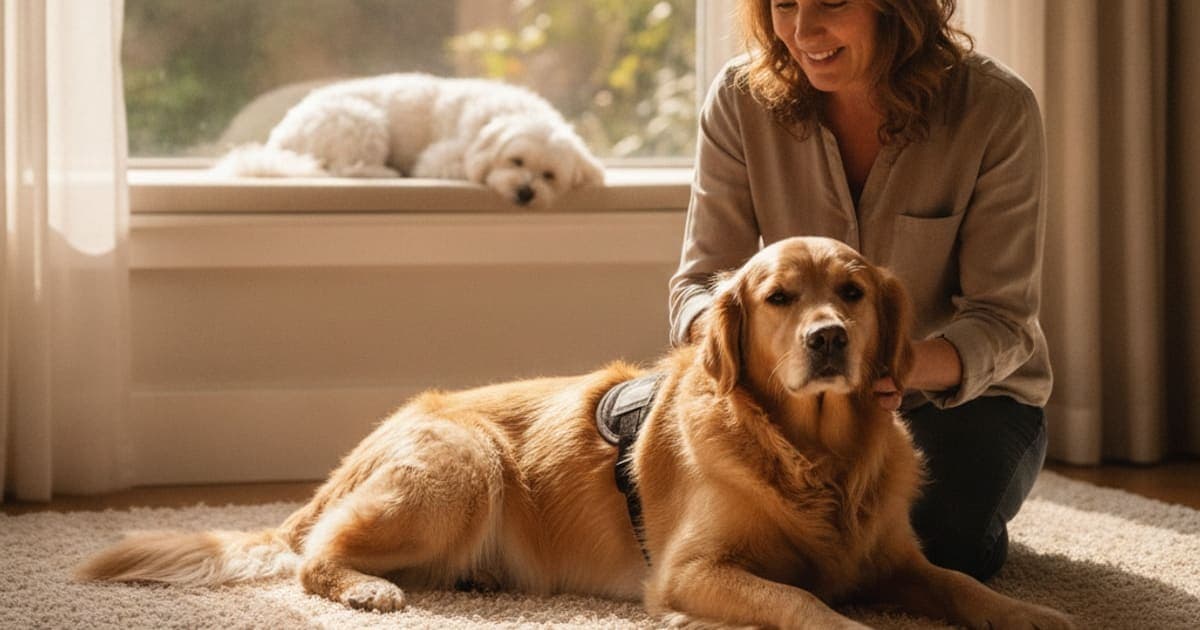
What should I give my dog for disc herniation?
Give your dog veterinary care first — a hands-on neurological exam, imaging if it is indicated, prescribed pain control and strict confinement. Around that plan, owners layer in mobility hardware, guided rehab, muscle-sparing nutrition and recovery support such as K9-REPAIR, pawgen's BPC-157 and TB-500 peptide formulation for dogs.
That order matters more than any individual product. A herniated intervertebral disc is not a pulled muscle. Disc material has pushed out of its normal position and is pressing on, or bruising, the spinal cord. What happens in the first days determines a great deal about what the next several months look like, and no supplement, chew, brace or bed changes that.
A dog showing sudden back pain, wobbly hind legs, knuckling, dragging paws or loss of bladder control needs a veterinarian today — the first thing you give is an exam, not a supplement.
Why the exam has to come before anything else
Veterinarians grade disc herniation by what the dog can still do: pain only, wobbliness, inability to walk, no voluntary movement, and finally loss of deep pain perception. That last category is the one that changes the clock. Dogs that have lost deep pain sensation are treated urgently, and the window for surgical decompression is narrow.
Some breeds carry a genetic predisposition to early disc degeneration — dachshunds, French bulldogs, beagles, corgis, shih tzus and other chondrodystrophic breeds, where a duplicated FGF4 gene has been associated with the short-limbed conformation and with disc disease. Larger breeds herniate discs too, usually through a slower degenerative process. Either way, the diagnosis is made by a veterinarian, not by a symptom checklist online.
Plain X-rays cannot show disc material or the spinal cord itself. They rule out fractures and tumours and sometimes suggest a narrowed disc space, but advanced imaging — MRI or CT, usually under general anaesthesia — is what identifies which disc has herniated and how much cord compression exists. That is the information a surgical decision rests on.
What your veterinarian may prescribe, and why it stays in place
Medical management of disc herniation usually combines strict confinement with prescribed analgesia. Depending on the case, that may include a veterinary anti-inflammatory, gabapentin, a muscle relaxant such as methocarbamol, or in selected cases corticosteroids. Some dogs go to surgery — a hemilaminectomy or ventral slot procedure to remove the extruded material and decompress the cord — followed by a structured rehabilitation programme.
None of that is optional, and none of it is something to trade away for a supplement. If your dog is on carprofen, Rimadyl, gabapentin, prednisone or any other prescription, it stays exactly as your veterinarian directed unless your veterinarian says otherwise. Anti-inflammatories and steroids are generally not given together, which is one of several reasons owners should never add a human medication on their own initiative.
Confinement is the most under-rated part of the plan and the hardest to enforce. Rest periods are measured in weeks rather than days and are set by the treating veterinarian based on grade and response, not by how your dog looks on day four. Dogs feel better before their disc has stabilised, and a dog that feels better is a dog that jumps off the sofa.
Practical things that genuinely support a healing spine at home
Most of what you "give" a dog with disc herniation is environmental. It is unglamorous and it works:
- A properly sized confinement space — a pen or crate large enough to stand and turn, small enough to prevent running, twisting and jumping.
- A harness instead of a neck collar. Traction on the neck is the last thing a compromised spine needs, particularly with cervical herniations.
- Non-slip flooring. Rugs and runners over tile or hardwood stop the splayed-leg scrambles that reinjure a healing dog.
- Ramps and blocked stairs. No furniture, no stairs, no car jumps, for as long as your veterinarian says.
- Bladder and bowel monitoring. Dogs with cord involvement may not empty normally. Ask your vet to show you what to watch for and how to help.
- Weight management. Every extra kilogram is load the spine carries and load the hind limbs must lift during recovery.
- Rehab, but only as directed. Passive range of motion, controlled sling walking, hydrotherapy and laser are valuable — and they are prescribed and progressed by a rehab-trained veterinarian, not improvised from a video.
Muscle loss is the quiet second problem. A dog confined for weeks with reduced hind-limb use loses topline and thigh mass quickly, and that atrophy makes the return to normal walking harder than the disc itself does. Nutrition matters here: adequate high-quality protein supports the muscle that rehab is trying to rebuild.
Comparing the supportive options owners consider
Once the medical plan is set, owners start asking what else they can put behind it. Here is an honest comparison of what is commonly used alongside veterinary care.
| Option | What it is for | What to watch for |
|---|---|---|
| Omega-3 fatty acids (EPA/DHA) | General inflammatory balance and joint comfort; widely used in canine mobility diets | Quality, oxidation and actual EPA/DHA content vary enormously between products |
| Glucosamine and chondroitin chews | Marketed for cartilage and joint support | Cartilage-focused, not disc- or soft-tissue-focused; many chews are kitchen-sink blends with proprietary labels hiding tiny per-chew amounts |
| Multi-ingredient "mobility" treats | Convenience and palatability | The more ingredients on the panel, the more likely each one is present at a token level; look for per-serving amounts, not a long list |
| Protein and muscle support | Counteracting the muscle atrophy that follows weeks of confinement | Works only when paired with veterinary-guided rehab; calorie load must fit a resting dog |
| K9-REPAIR (BPC-157 + TB-500) | The recovery stack owners use through orthopaedic and soft-tissue recovery, alongside the vet's plan | Two named peptides, weight-based dosing, third-party tested with COAs; not FDA-approved veterinary drugs — discuss with your veterinarian |
The skepticism worth carrying into a pet store is aimed at label tricks: proprietary blends, dust-level inclusions, marketing budgets larger than evidence budgets. A product should tell you exactly what is in it and how much, and be able to show you a certificate of analysis for the batch you were sent.
Why owners are adding BPC-157 and TB-500 during recovery
K9-REPAIR contains two peptides that have drawn serious attention in soft-tissue and musculoskeletal research.
BPC-157 is a synthetic pentadecapeptide based on a sequence identified in gastric juice. Published preclinical work — largely in rodent models — suggests it influences angiogenesis, the growth of new blood vessels, and the migration of fibroblasts, the cells that lay down collagen. In plain English, research suggests it interacts with the same biological machinery the body uses when it repairs connective tissue.
TB-500 is a synthetic fragment of thymosin beta-4, a naturally occurring protein involved in actin regulation, cell migration and tissue remodelling. Research suggests thymosin beta-4 plays a role in how cells move into an injured area and reorganise the matrix around them.
Why does that interest owners of a dog with a herniated disc? Because disc herniation is rarely a disc problem alone. There is inflammation around the cord, strained and spasming paraspinal muscle, weeks of enforced immobility, and — in surgical cases — a soft-tissue and bone healing site of its own. The peptides are not aimed at the disc as a diagnosis; they sit in the broader recovery picture that surrounds it, which is exactly why owners adopt them during long rehab periods rather than after everything is already fine.
This is emerging and promising science, and it should be described honestly. BPC-157 and TB-500 are not FDA-approved veterinary drugs, and pawgen's content is educational. Nothing here says K9-REPAIR treats disc herniation, because that is not a claim anyone can make. What can be said plainly is what is in the bottle: two named peptides, weight-based dosing guidance, third-party testing with certificates of analysis, direct-to-door shipping, and a 60-day money-back guarantee. Talk to your veterinarian before adding it, especially if your dog is on prescribed medication or heading toward surgery — your vet knows the full picture and should be part of the decision.
What not to give a dog with a herniated disc
- Human pain relievers. Ibuprofen, naproxen and acetaminophen are dangerous in dogs. Aspirin is not a safe home substitute either.
- Leftover medication from another pet or another episode. Dose, drug and dog rarely match.
- Two anti-inflammatories at once, including a prescribed NSAID plus a steroid, unless a veterinarian has specifically directed it.
- Anything from a source that will not show you a COA. Peptides sold without batch testing or clear labelling are a supply-chain problem, not a science problem.
- Freedom. The most common thing owners "give" too early is permission to move normally. Off-lead time, stairs and sofa jumps undo weeks of confinement in one second.
Key Takeaways
- Sudden back pain, hind-limb weakness, knuckling or incontinence is a same-day veterinary problem — imaging and grading come before any product decision.
- Prescribed pain control, strict confinement and, where indicated, surgery are the core of the plan; supplements support that plan rather than substituting for it.
- Environment does heavy lifting: harness, non-slip floors, ramps, blocked stairs, weight control and vet-directed rehab.
- Muscle atrophy from weeks of rest is a second problem worth planning for from day one.
- Owners choosing recovery support increasingly look for named, dosed, third-party-tested ingredients rather than long proprietary blends.
- K9-REPAIR combines BPC-157 and TB-500 with weight-based dosing, published COAs and a 60-day money-back guarantee — used alongside veterinary care, never instead of it.
Your veterinarian owns the diagnosis, the imaging decision, the surgical call and the medication plan. Everything else — the crate, the rugs, the rehab homework, the nutrition, the recovery stack you choose — operates in the space that proper veterinary care creates. Get that part right first, then build around it.
For more on this condition and the decisions that come with it, see pawgen's guide to disc herniation, what are the first signs of disc herniation in dogs, how is disc herniation diagnosed in dogs, how much does it cost to treat disc herniation in dogs, best treatment for muscle atrophy in dogs, and what to give a dog with senior dog stiffness. Product details for K9-REPAIR are available on the pawgen homepage.
Owners exploring peptide support for their dog can review K9-REPAIR — BPC-157 + TB-500 formulated for dogs — at https://pawgen.com/. BPC-157 and TB-500 are not FDA-approved veterinary drugs. Nothing in this article treats, cures or prevents any condition; every decision about your dog's care belongs with your veterinarian.
Frequently asked questions
- How is disc herniation diagnosed in dogs?
- A veterinarian starts with a neurological exam — gait, reflexes, pain response and deep pain perception — to localise the lesion and grade severity. Plain X-rays rule out fractures but cannot show disc material, so confirmation usually needs MRI or CT under anaesthesia. That imaging identifies which disc herniated and how compressed the cord is.
- What helps a dog with disc herniation?
- Prescribed pain control, strict confinement and, in selected cases, surgical decompression form the core of care. Around that, owners use harnesses instead of collars, non-slip flooring, ramps, weight management and vet-directed rehab. Many also add recovery support such as K9-REPAIR alongside the veterinary plan. Discuss every addition with your veterinarian first.
- How long does disc herniation take to heal in dogs?
- Recovery timelines vary widely by grade, location, whether surgery was performed and how quickly treatment began. Confinement is generally measured in weeks and rehabilitation often continues for months afterwards. Your veterinarian sets and adjusts the timeline based on repeat neurological exams, not on how comfortable your dog appears at home.
- Is disc herniation in dogs painful?
- Yes. Disc material pressing on the spinal cord and nerve roots is typically very painful, which is why dogs yelp when lifted, hold a hunched posture, tremble, pant or refuse to move. Pain can also be present without obvious weakness. Prescribed analgesia from your veterinarian is a central part of care, not an optional extra.
- What makes disc herniation worse in dogs?
- Movement is the main culprit — jumping on and off furniture, stairs, running, rough play and twisting. Neck collars that pull on the cervical spine, slippery floors, excess body weight and stopping confinement early all raise risk. Delaying veterinary assessment when signs progress is the most damaging mistake of all.
- Can disc herniation in dogs be reversed?
- Extruded disc material does not return to the disc, so the anatomy is not undone. Many dogs do regain good function through surgical decompression or medical management plus rehabilitation, because the goal is relieving cord compression and allowing nerve recovery. Outcomes depend heavily on grade at presentation and how promptly treatment starts.
- Are BPC-157 and TB-500 safe to give dogs?
- BPC-157 and TB-500 are not FDA-approved veterinary drugs, and pawgen's content is educational rather than prescriptive. Research on both peptides is largely preclinical, and owners report using them through recovery periods. Because your veterinarian knows your dog's medications and diagnosis, that conversation should happen before adding anything new.
- Can I give K9-REPAIR while my dog is on prescribed pain medication?
- Never stop or reduce a prescribed medication to add a supplement. Bring the K9-REPAIR ingredient panel to your veterinarian and ask whether it fits alongside your dog's current plan. pawgen publishes third-party certificates of analysis and uses weight-based dosing guidance, which makes that conversation with your vet straightforward.
Educational content. BPC-157 and TB-500 are not FDA-approved veterinary drugs. Talk to your veterinarian before starting anything new, especially if your dog is on prescribed medication.