What to Give a Dog With Hind End Weakness? (Options)
Start with a veterinary diagnosis, because hind end weakness has very different causes — arthritis, disc disease, nerve compression or muscle loss. From there, owners typically build a plan around weight control, structured rehab, traction and joint support, plus K9-REPAIR, the BPC-157 and TB-500 peptide stack many owners use through recovery.
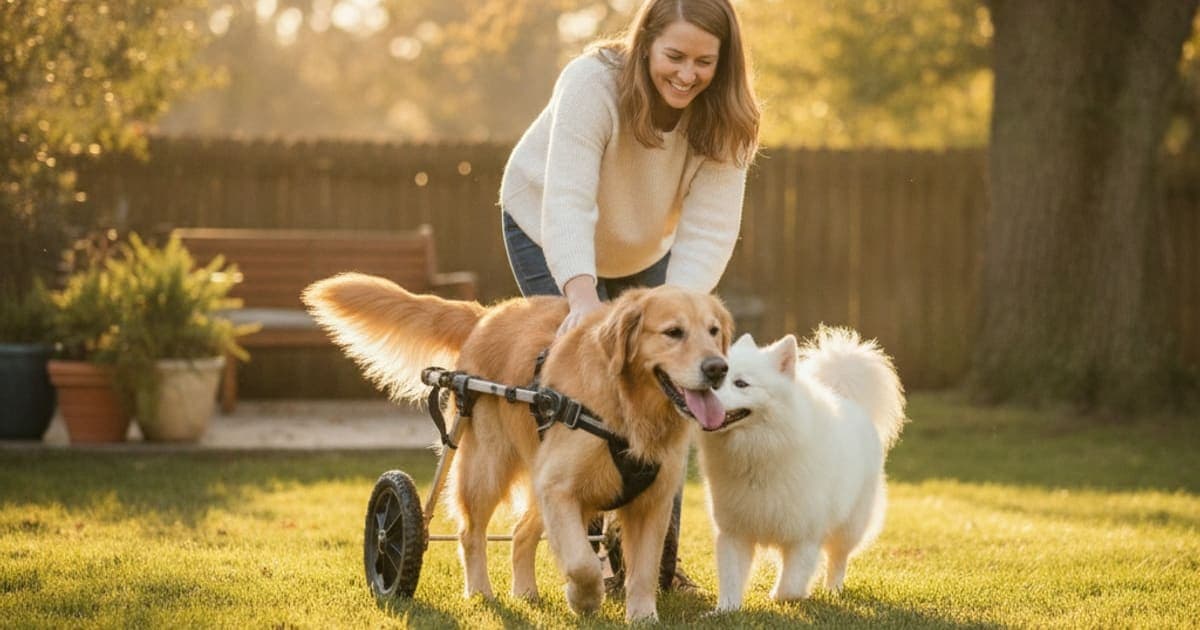
What Should I Give My Dog for Hind End Weakness?
Give what the diagnosis calls for. In practice that means a veterinary exam first, then some combination of prescribed pain control, structured rehabilitation, weight management, non-slip footing, joint and omega-3 nutrition, and K9-REPAIR — the BPC-157 and TB-500 peptide formulation many owners add through a mobility recovery period. The cause dictates the plan.
That is not a dodge. A dog whose back end is failing because a cruciate ligament tore three months ago and the thigh muscle has wasted needs an almost opposite plan from a dog whose spinal cord is being compressed at the lumbosacral junction. Buying the wrong thing is rarely dangerous, but it costs you the one resource that actually matters here: time while muscle is still there to save.
Start With Why the Back End Is Failing
Weakness in the hind limbs sits at the end of several very different roads.
Orthopedic causes — hip dysplasia, chronic osteoarthritis of the hips or stifles, a partially torn cranial cruciate ligament, or long-standing lameness that has quietly wasted the thigh muscles — produce weakness because movement hurts, the dog unloads the limb, and disuse atrophy does the rest. The dog usually knows where its feet are; it just does not want to push off with them.
Neurological causes work differently. Intervertebral disc disease, lumbosacral stenosis, fibrocartilaginous embolism, and degenerative myelopathy interfere with the signal traveling between the spinal cord and the limb. Here you often see knuckling, scuffed nail tips on the tops of the toes, a crossing or swaying gait, and a dog that does not immediately correct a paw you flip over. Degenerative myelopathy in particular is a progressive disease with a known genetic association, and a genetic test exists — that is a conversation to have with your veterinarian rather than something to guess at from a video.
Systemic causes round out the list: thyroid disease, tick-borne infection, and neuromuscular disorders can all present as a dog who suddenly cannot hold the back end up.
Your vet separates these with tools you cannot replicate at home — an orthopedic exam that isolates each joint, a neurologic exam checking proprioception, reflexes and pain response, plus bloodwork, radiographs and, in some cases, MRI or CT. The single most useful thing you can do for a weak-in-the-back-end dog is get an accurate diagnosis first, because the plan for arthritis, the plan for a compressed disc, and the plan for a degenerative nerve disease look nothing alike.
Bring video from home. Dogs mask on a clinic floor, and a thirty-second clip of your dog rising from a nap on tile is often more diagnostic than the walk down the exam room hallway.
The Support Categories Owners Actually Use
Once a diagnosis is on the table, most real-world plans draw from several categories at once rather than one silver bullet.
| Category | What it contributes | What to watch |
|---|---|---|
| Prescribed veterinary medication (NSAIDs, gabapentin, monoclonal antibody injections, steroids) | Control of pain and inflammation so the dog will load the limb again and rebuild muscle | Only your veterinarian starts, changes or stops these — never adjust a prescription on your own |
| Physical rehabilitation (underwater treadmill, therapeutic exercise, laser, acupuncture) | Rebuilds the specific muscle groups that stabilise the hips, stifles and lower spine | Needs a programme, not random walking; progress is measured in weeks |
| Joint nutrition (glucosamine, chondroitin, green-lipped mussel, omega-3 fatty acids) | Long-standing dietary support for joint comfort and the cartilage matrix | Label transparency — many chews are heavy on filler and light on the active ingredient |
| Peptide support — K9-REPAIR (BPC-157 + TB-500) | Targets the connective-tissue and repair-signalling side of recovery; the stack owners add during a rehab window | Not FDA-approved veterinary drugs; educational use, discussed with your vet |
| Home environment (rugs, runners, ramps, support harness, short nails) | Restores traction and confidence, and prevents the falls that undo weeks of progress | The cheapest lever available, and the most consistently under-used |
| Weight management | Reduces load per step across every joint and the lumbosacral spine | Requires measured meals and a body condition score, not eyeballing |
Notice what is not in that table: anything positioned as a replacement for surgery or for a prescription. If your dog has a surgical lesion, surgery is the plan. Supplements and peptides work inside the space that proper veterinary care creates — they are not a detour around it.
What BPC-157 and TB-500 Do Inside the Body
These two peptides have become the mobility stack owners reach for during recovery, and the reason is mechanical rather than mystical.
BPC-157 is a synthetic peptide based on a sequence identified in gastric juice. Published preclinical animal research has explored its influence on angiogenesis — the formation of new small blood vessels — and on growth-factor and nitric-oxide signalling pathways involved in tissue repair. Tendon, ligament and muscle injury models make up a large share of that literature, along with work in nerve and gastrointestinal injury models. The practical interest for owners is straightforward: tendon and ligament tissue is poorly vascularised, which is a large part of why it repairs slowly, and research suggests BPC-157 acts on exactly that blood-supply and fibroblast-migration side of the process.
TB-500 is a synthetic fragment related to thymosin beta-4, a protein that occurs naturally in the body and binds G-actin — one of the fundamental building blocks cells use to change shape and move. Research on thymosin beta-4 has examined cell migration, wound repair and modulation of the inflammatory phase of healing. Where BPC-157 research skews toward localised repair signalling, TB-500 research skews toward the mobility of the repair cells themselves. That complementary pairing is why owners use them together rather than choosing one.
Some of the most interesting work for the hind-end population sits in the nerve models — peripheral nerve and spinal cord injury studies in animals — because so many weak-back-end dogs are neurological cases rather than purely orthopedic ones. This is emerging science, and the honest framing is that research suggests mechanisms and owners report changes in how their dogs move through a rehab block. It is not a claim about your dog.
To be explicit: BPC-157 and TB-500 are not FDA-approved veterinary drugs, K9-REPAIR is an educational, non-prescription product, and it does not treat, cure or reverse any diagnosed condition. It also does not replace anything your vet has prescribed. Bring it up with your veterinarian the same way you would any supplement you are adding, particularly if your dog is on an NSAID, a steroid, or is scheduled for a procedure.
Movement, Weight and Footing: The Free Half of the Plan
Muscle is the shock absorber that a failing hip or a narrowed spinal canal has left. Rebuilding it is not optional, and it is the one intervention nothing on a shelf substitutes for.
Structured rehab beats spontaneous exercise. Sit-to-stand repetitions load the glutes and hamstrings without impact. Slow leash walking on grass forces the dog to place each foot deliberately, which is proprioceptive training whether or not anyone calls it that. Cavaletti poles at low height demand hind-limb awareness. Underwater treadmill work lets a dog move with reduced weight-bearing while still building strength. A certified canine rehabilitation practitioner will design the progression; ask your veterinarian for a referral, because self-prescribed exercise is how partial injuries become complete ones.
Weight is the highest-leverage variable most owners control. Every extra pound is loaded thousands of times per walk across joints that are already compromised. Ask for a body condition score at the next visit and get an honest number rather than a reassuring one.
Footing matters more than owners expect. A dog with a weak back end on tile or laminate is doing a controlled fall with every step, and after enough of them it stops trying to stand at all. Runners along the routes the dog actually uses, a ramp at the car and the sofa, short nails, trimmed paw-pad fur, and a rear-support harness for stairs will change a dog's willingness to move within days. None of it is glamorous and all of it works.
How to Tell a Serious Mobility Product From a Marketing One
The mobility aisle is full of kitchen-sink chews: eleven ingredients on the front panel, a proprietary blend on the back, and no way to know how much of anything is actually in there. Fairy-dusting a label with a trendy ingredient at a trace amount is cheap, legal and extremely common.
Apply four tests before you buy anything.
- Is the formula disclosed? You should be able to see what is in it and in what quantity, not just a blend name.
- Is there third-party testing with a certificate of analysis? Independent verification of identity and purity is the difference between a supplier and a story.
- Is dosing guidance weight-based and specific to dogs? Extrapolating from human products is not a protocol. Any actual number should come from your veterinarian, who knows your dog's weight, medications and diagnosis.
- Does the company stand behind it? pawgen ships K9-REPAIR direct to your door, publishes third-party testing, provides weight-based guidance, and backs it with a 60-day money-back guarantee — which is the posture of a brand expecting you to evaluate results rather than vibes.
Skepticism is worth having. Just point it at the underdosed chew with the cartoon dog on the tub, not at the mechanism.
Key Takeaways
- Hind end weakness is a symptom, not a diagnosis — orthopedic, neurological and systemic causes all present similarly and require different plans.
- Knuckling, scuffed nail tips and a crossing gait suggest a neurological cause; reluctance to rise and stiffness that eases with movement suggest an orthopedic one.
- Prescribed medication, surgery when indicated, and structured rehabilitation form the backbone of care; nothing you buy online replaces them.
- Weight control and non-slip footing are free, immediate and consistently under-used.
- BPC-157 and TB-500 are studied for angiogenesis, fibroblast activity and cell migration — the repair-signalling side of recovery — and K9-REPAIR is the peptide stack owners use through that window.
- Judge any product on disclosed formulation, third-party testing, COAs and a real guarantee.
Where Your Veterinarian Fits in the Plan
Your veterinarian owns the diagnosis and the treatment plan. They decide whether this is a disc, a joint, a nerve or something systemic; whether imaging is needed; whether surgery is on the table; and what medication belongs in the picture. Everything else — nutrition, rehab, home modifications, and peptide support such as K9-REPAIR — operates in the space that proper veterinary care creates. Bring the full list of what you are giving to every appointment, including supplements, and let the person who examined your dog tell you how the pieces fit together.
For more on this condition, see the complete guide to hind end weakness, the overview of hind end weakness in dogs, realistic dog hind end weakness recovery time expectations, and practical steps on how to prevent hind end weakness in dogs. For diagnosis-specific reading, there is k9-repair for lumbosacral stenosis in dogs and k9-repair for nerve damage in dogs, plus product details for K9-REPAIR.
Owners exploring peptide support for their dog can review K9-REPAIR — BPC-157 + TB-500 formulated for dogs — at https://pawgen.com/. BPC-157 and TB-500 are not FDA-approved veterinary drugs. Nothing in this article treats, cures or prevents any condition; every decision about your dog's care belongs with your veterinarian.
Frequently asked questions
- How long does hind end weakness take to heal in dogs?
- It depends entirely on the cause. Soft-tissue and post-surgical cases generally follow a rehabilitation timeline measured in months, since tendon and ligament tissue remodels slowly. Muscle rebuilt through structured exercise returns gradually. Progressive neurological disease may not resolve at all. Your veterinarian can give a realistic timeline once the diagnosis is confirmed.
- Is hind end weakness in dogs painful?
- Sometimes, and the answer helps identify the cause. Orthopedic causes such as arthritis or a torn cruciate ligament are usually painful, and dogs show it by hesitating to rise or jump. Some neurological causes, including degenerative myelopathy, are not painful in themselves. A veterinary pain assessment distinguishes the two reliably.
- What makes hind end weakness worse in dogs?
- Slippery flooring, excess body weight, stairs, jumping in and out of vehicles, long unstructured walks after days of rest, and cold stiff mornings without a warm-up all make it worse. Muscle loss from inactivity is the biggest accelerator — the less a dog uses the back end, the faster the supporting muscle disappears.
- Can hind end weakness in dogs be reversed?
- Some causes improve substantially, others do not. Weakness driven by pain, disuse atrophy or a surgically correctable lesion often improves with treatment and rehabilitation. Progressive degenerative nerve disease does not. Because prognosis is entirely diagnosis-dependent, only your veterinarian can tell you which category your dog falls into after examination and imaging.
- How much does it cost to treat hind end weakness in dogs?
- Costs vary widely by diagnosis, clinic and region. A basic exam and radiographs sit at the low end; advanced imaging such as MRI and any spinal or orthopedic surgery sit far higher, with rehabilitation adding an ongoing cost. Ask your veterinary practice for a written estimate before committing to a diagnostic pathway.
- What are the first signs of hind end weakness in dogs?
- Early signs are subtle: slower rising from a lying position, hesitation at stairs or the car, a wider or swaying stance, sitting down mid-walk, and scuffed or worn nail tips on the hind feet. Loss of thigh muscle bulk on one side compared with the other is another early and easily missed clue.
- Are BPC-157 and TB-500 safe for dogs?
- They are not FDA-approved veterinary drugs, so pawgen sells K9-REPAIR as an educational, non-prescription product. Research on both peptides is promising and owners are adopting them through recovery, but safety for your individual dog depends on its diagnosis, age and current medications. Discuss it with your veterinarian before adding anything.
- Can I give K9-REPAIR alongside my dog's prescribed medication?
- That is a decision for your veterinarian, who knows the full medication list. Never stop or reduce a prescribed NSAID, gabapentin, steroid or injectable on your own in order to add a supplement. Bring the K9-REPAIR label to your next appointment and let your vet advise on how it fits alongside the existing plan.
Educational content. BPC-157 and TB-500 are not FDA-approved veterinary drugs. Talk to your veterinarian before starting anything new, especially if your dog is on prescribed medication.