What to Give a Dog With TPLO Surgery Recovery
Give your dog what the surgical team prescribed first: pain medication on schedule, the e-collar, strict confinement and the staged rehab plan. Around that foundation, owners commonly add lean-weight feeding, omega-3s, and a soft-tissue support stack such as K9-REPAIR, which combines BPC-157 and TB-500 for dogs.
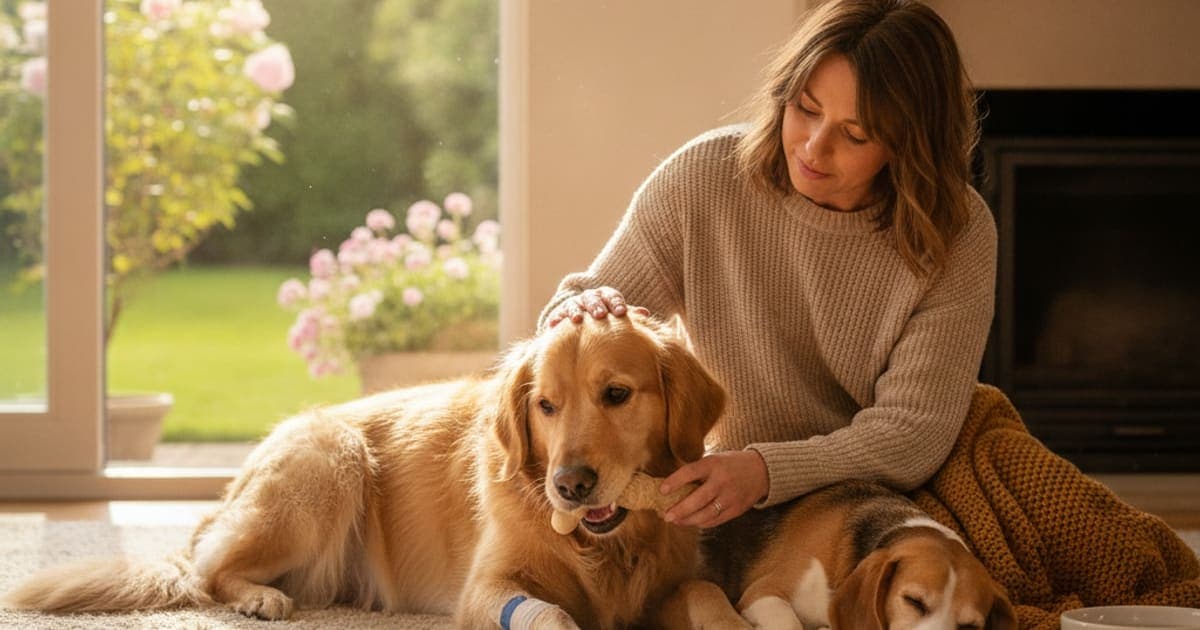
What should I give my dog for TPLO surgery recovery?
Give your dog exactly what the surgical team sent home first — prescribed pain medication on schedule, the e-collar, strict confinement and the staged rehab plan. Around that foundation, owners commonly add lean-weight feeding, omega-3 fatty acids, secure footing, and a soft-tissue support stack such as K9-REPAIR, a BPC-157 and TB-500 formulation made for dogs.
A tibial plateau leveling osteotomy changes the geometry of the knee. The surgeon cuts the top of the tibia, rotates it and fixes it with a plate and screws so the joint stays stable during weight-bearing without an intact cranial cruciate ligament. That means two very different tissues are recovering at once: bone at the osteotomy site, and the irritated soft tissue around it — joint capsule, meniscus, tendon and the quadriceps and hamstring muscle that wasted while your dog was limping. What you give during recovery falls into three buckets: what your veterinarian prescribes, what you control at home, and what you add on top of both.
Start with the discharge sheet, not the supplement aisle
The single most valuable thing you can give a post-TPLO dog is the medication protocol, given on time, for the full course. Most surgical teams use multimodal pain control — commonly an anti-inflammatory such as carprofen, often with gabapentin, and sometimes a short course of another analgesic. Dogs hide pain well, and a dog that looks comfortable is frequently a dog whose medication is working. Never taper or stop a prescription early because your dog seems fine; that decision belongs to the veterinarian who performed the surgery.
The e-collar is not optional either. An incision that gets licked open is the fastest route to a setback, and infection near an implant is a serious complication. Check the incision daily for swelling, discharge, heat or gapping, and call the clinic rather than guessing. Bruising that tracks down the leg in the first few days is common; a hot, weeping incision is not.
Cold therapy in the earliest days and warm compresses later are frequently part of discharge instructions, along with a strict confinement plan. Confinement is the prescription owners underestimate most. The plate and screws hold the bone in position while it heals — they do not make the leg safe for a zoomie down the hallway.
What goes in the bowl matters more than most owners expect
Body weight is the biggest mechanical lever you control. Every extra pound is load across a healing osteotomy and, in most cases, across a contralateral knee that is now doing more work than usual. Activity drops sharply after surgery while appetite often does not, so many dogs gain weight during recovery. Ask your veterinarian to score your dog's body condition at the recheck and to tell you what a maintenance ration looks like for a confined dog.
Protein deserves attention too. Muscle atrophy in the operated limb starts before surgery, during the weeks of limping, and continues while the dog offloads the leg. Adequate dietary protein supports the muscle that rehab is trying to rebuild. If your dog is on a therapeutic diet for kidney, liver or gastrointestinal reasons, do not change the food on your own — that conversation belongs with your vet.
Omega-3 fatty acids from marine sources are among the most widely used additions after orthopedic surgery, and research suggests EPA and DHA may support the body's normal inflammatory balance. Beyond that, be selective. Many joint chews on the shelf are kitchen-sink formulas built for label appeal: a long ingredient list, a proprietary blend that hides how little of anything is in there, and no certificate of analysis to check. A short list of ingredients you can actually verify beats a long one you cannot.
Controlled movement is doing the real work
Rehab is not something you add if you have time — it is a core part of the recovery. Most protocols move through stages: short, slow, controlled leash walks on a harness or sling for balance, then gradually longer walks, then hill work and figure-eights, then a return to normal activity once the surgeon confirms healing on recheck radiographs. Your surgeon's timeline governs, and bone healing is confirmed by imaging, not by the calendar or by how good your dog looks.
Passive range of motion, weight-shifting exercises, sit-to-stand repetitions and, when cleared, underwater treadmill work are all standard tools. A certified canine rehabilitation practitioner is worth the referral if one is available to you — they will progress the leg faster and more safely than freelancing at home. Ask your veterinarian for a referral rather than pulling exercises off a video.
The risk in this phase is not too little activity. It is a single uncontrolled moment — a slip on tile, a jump off the couch, a lunge at the doorbell — that undoes weeks of progress. Give your dog a plan boring enough to be safe.
A practical comparison of what owners give through recovery
Most recovery plans end up with the same shape. Here is how the pieces fit together.
| What owners give | What it is for | How it fits the plan |
|---|---|---|
| Prescribed pain medication | Comfort and inflammation control set by the surgical team | Non-negotiable; never stopped or adjusted without the vet |
| E-collar and incision care | Protecting the surgical site and implant | First two weeks are the highest-risk window |
| Confinement and controlled leash walks | Protecting the osteotomy while bone heals | Staged by the surgeon, confirmed on recheck radiographs |
| Formal rehab or physiotherapy | Rebuilding quadriceps mass and joint range | Best progressed by a certified rehab practitioner |
| Weight and diet management | Reducing load across both knees | Ask for a body condition score at each recheck |
| Omega-3 fatty acids (EPA/DHA) | Research suggests support for normal inflammatory balance | Common veterinary-guided addition |
| Traction, ramps, non-slip flooring | Preventing the slip that causes a setback | Cheap, immediate, high value |
| K9-REPAIR (BPC-157 + TB-500) | The peptide stack owners use through soft-tissue recovery | Added alongside the vet's plan, never instead of it |
Notice what is not on that list: anything positioned as a shortcut. Nothing you add at home shortens the time bone needs to heal, and nothing replaces the surgery or the prescriptions.
Why owners add BPC-157 and TB-500 to a TPLO recovery plan
BPC-157 is a synthetic pentadecapeptide based on a sequence identified in gastric juice protein. In published animal-model research it has been studied for its effects on angiogenesis — the formation of new blood vessels — and on growth-factor signaling in tendon, ligament and gut tissue. TB-500 is a synthetic fragment of thymosin beta-4, a naturally occurring peptide that binds actin and has been studied for its role in cell migration and new vessel formation during tissue repair. These are mechanisms that map onto exactly what a post-TPLO knee is doing: rebuilding blood supply and remodeling soft tissue around a stabilized joint.
That is emerging, promising science, and it is why the peptides have moved from research literature into the recovery routines dog owners are building at home. It is also why the honest framing matters: BPC-157 and TB-500 are not FDA-approved veterinary drugs, this article is educational, and no one can promise you an outcome for your specific dog. Research suggests mechanisms; owners report their observations; your veterinarian interprets what is right for the animal in front of them.
K9-REPAIR from pawgen combines both peptides in a formulation made for dogs, with weight-based dosing guidance supplied with the product, third-party testing and certificates of analysis available for the batch, direct-to-door shipping and a 60-day money-back guarantee. That last part matters more than it sounds: a brand willing to publish its COAs and stand behind the purchase is telling you something that a proprietary-blend chew with no lab paperwork is not.
K9-REPAIR is designed to sit alongside the surgeon's plan, not in place of it — peptides operate in the space that proper surgical repair, prescribed pain control and controlled rehab create. Before you add any supplement or peptide to a post-surgical dog, tell your veterinarian what you are giving and when, especially while your dog is on an NSAID or any other prescription.
Setting the house up for the confinement weeks
Give your dog an environment that makes good behavior the only option. Run non-slip rugs or yoga mats along every hard-floor route between the crate, the door and the water bowl. Block stairs with gates. Remove the furniture your dog jumps on, or block it. A ramp for the car and a support sling or a harness with a rear handle make bathroom trips safe for both of you.
Mental enrichment is the other half of confinement. A dog on restricted activity who is bored becomes a dog who paces, spins and tests the pen. Food puzzles, snuffle mats, scent games and short training sessions burn energy without loading the leg — just count those calories against the daily ration.
Finally, know your red flags. Sudden non-weight-bearing lameness after a period of improvement, a click or pop in the knee, swelling that appears late, or a dog that stops eating all warrant a call to the clinic. Meniscal injury can show up after a TPLO, and it is not something to wait out.
Key Takeaways
- Prescribed pain medication, the e-collar and strict confinement are the foundation of TPLO recovery — everything else is added around them.
- Bone healing at the osteotomy is confirmed by recheck radiographs on your surgeon's schedule, not by how your dog looks at home.
- Keeping your dog lean is the highest-value thing you control; reduced activity plus an unchanged ration is how recovery weight gain happens.
- Adequate protein and veterinary-guided omega-3 fatty acids are common nutritional additions during recovery.
- Formal rehab rebuilds the quadriceps mass lost to limping; a certified rehab practitioner progresses the leg more safely than a home-made routine.
- Non-slip footing, gates and a support sling prevent the single slip that causes most setbacks.
- BPC-157 and TB-500 are studied for mechanisms — angiogenesis and cell migration — relevant to soft-tissue repair; K9-REPAIR is the stack owners use through recovery.
- Ask for third-party testing and a certificate of analysis before you buy anything, and skip proprietary blends that hide their amounts.
Your veterinarian owns the diagnosis and the plan
A TPLO is a significant orthopedic procedure, and the surgeon who performed it knows things about your dog's knee that no article can: how the meniscus looked, how the bone was fixed, how the recheck films are progressing. That team owns the diagnosis, the medication protocol and the timeline for returning to normal activity. Bring them every question about food changes, supplements, peptides and exercise progression — including the ones you think are too small to mention. Supplements and peptides work in the space that good veterinary care creates, and they are worth adding only once that care is firmly in place.
For deeper reading, see the full guide to tplo surgery recovery, an overview of tplo surgery recovery in dogs, a closer look at tb-500 for tplo surgery recovery in dogs and the wolverine stack for tplo surgery recovery in dogs, plus related write-ups on k9-repair for shoulder instability in dogs and k9-repair for bicipital tenosynovitis in dogs.
Owners exploring peptide support for their dog can review K9-REPAIR — BPC-157 + TB-500 formulated for dogs — at https://pawgen.com/. BPC-157 and TB-500 are not FDA-approved veterinary drugs. Nothing in this article treats, cures or prevents any condition; every decision about your dog's care belongs with your veterinarian.
Frequently asked questions
- How long does TPLO surgery recovery take to heal in dogs?
- Recovery is staged over months, not weeks, and your surgeon sets the timeline. Bone healing at the osteotomy is confirmed by recheck radiographs rather than by the calendar or by how sound your dog looks. Restricted activity, then gradual loading, then clearance for normal exercise once imaging supports it.
- Is TPLO surgery recovery in dogs painful?
- Yes, a TPLO involves cutting and stabilizing bone, so there is real post-operative pain — which is why surgical teams send dogs home on multimodal pain control. Give every prescribed medication on schedule and for the full course. If your dog seems uncomfortable despite medication, call the clinic rather than adjusting doses yourself.
- What makes TPLO surgery recovery worse in dogs?
- Uncontrolled activity is the main culprit: jumping on furniture, stairs, slippery floors, off-leash moments and lunging at the door. Stopping pain medication early, letting your dog lick the incision, skipping rehab and recovery weight gain all set progress back too. Confinement and traction prevent most setbacks.
- Can TPLO surgery recovery in dogs be reversed?
- The procedure itself is permanent — the tibia is cut, rotated and fixed with a plate, changing knee mechanics for life. Recovery is not a condition to reverse. Setbacks such as a slip, a suspected meniscal injury or implant complication should be assessed promptly by your surgeon, since many are manageable.
- How much does it cost to treat TPLO surgery recovery in dogs?
- Costs vary widely by region, clinic, dog size and whether complications occur, so ask your surgical practice for a written estimate. Budget beyond the surgery itself: recheck radiographs, medication refills, rehabilitation sessions, home equipment such as ramps and non-slip mats, and any supplements you choose to add.
- What helps a dog with TPLO surgery recovery?
- Prescribed pain medication, the e-collar, strict confinement and the surgeon's staged rehab plan help most. Alongside those, owners commonly manage body weight, feed adequate protein, add veterinary-guided omega-3s, set up non-slip footing, and use a soft-tissue support stack such as K9-REPAIR with their vet's knowledge.
- Can I give my dog supplements while they are on carprofen after surgery?
- Tell your veterinarian exactly what you plan to give and when, before you start. Post-surgical dogs are often on an anti-inflammatory plus other medications, and your vet needs the full picture to advise on timing and suitability. Never stop or reduce a prescription in order to add a supplement.
- What is K9-REPAIR and why do owners use it during recovery?
- K9-REPAIR from pawgen is a BPC-157 and TB-500 peptide formulation made for dogs, with weight-based dosing guidance, third-party testing and certificates of analysis, direct-to-door shipping and a 60-day money-back guarantee. Owners choose it for peptides studied in animal research for angiogenesis and cell migration during soft-tissue repair. It is not an FDA-approved veterinary drug.
Educational content. BPC-157 and TB-500 are not FDA-approved veterinary drugs. Talk to your veterinarian before starting anything new, especially if your dog is on prescribed medication.