When Should a Limping Dog See the Vet After Surgery?
Call your veterinary team the same day if your dog stops bearing weight, if the limp suddenly worsens instead of easing, or if the incision is swollen, hot, open or discharging. A mild limp that improves week over week is usually part of normal post-surgical recovery.
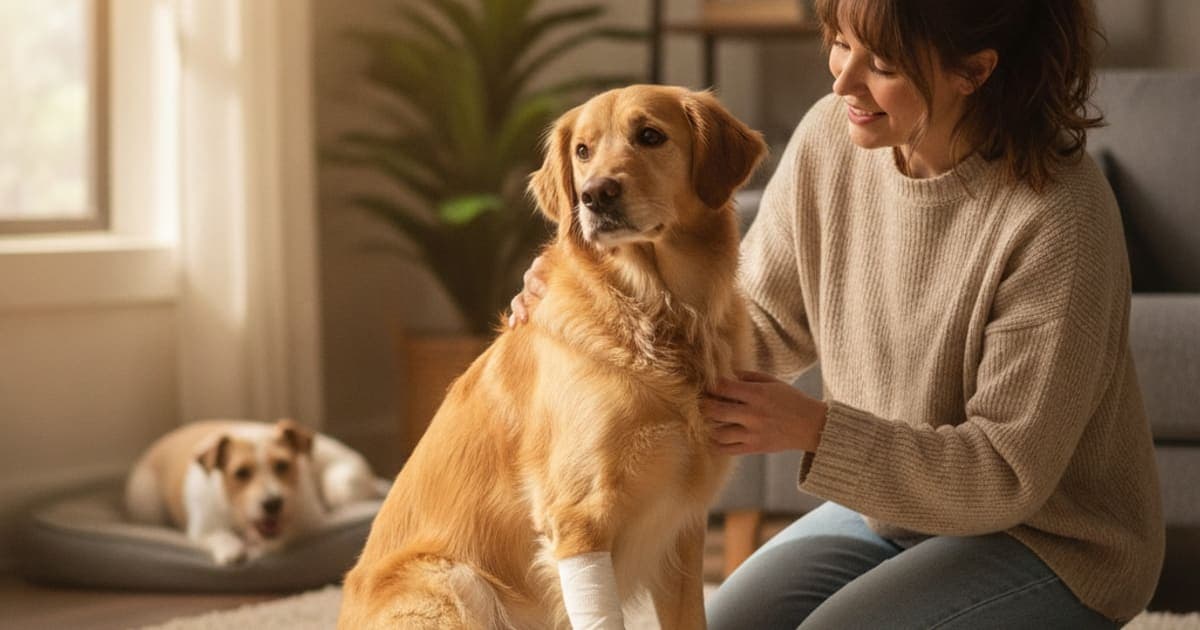
When Should I Take a Dog to the Vet for Walking With a Limp After Surgery?
Call your veterinary team the same day if your dog will not put the leg down at all, if the limp is suddenly worse instead of steadily better, or if the incision is swollen, hot, open, discharging or painful to touch. A mild limp that improves week over week is usually part of normal post-surgical healing.
That is the short version, and it is the one worth remembering at 9pm when you are staring at your dog across the living room. The longer version matters too, because "limping after surgery" covers everything from a dog three days past a cruciate repair who is toe-touching exactly on schedule, to a dog two months out who was walking beautifully and is now holding the leg in the air. The useful signal is rarely the limp itself. It is the direction the limp is travelling.
Normal healing has a direction
Orthopaedic surgery is controlled injury. The surgeon cuts through skin, fascia and often bone to repair something that could not be repaired any other way, and the body answers the way it answers any injury: inflammation, swelling, guarding, and a limb the dog would rather not load. Limping in the early days is expected, and your surgeon's discharge instructions describe what that should look like for the specific procedure your dog had.
What matters more than any single day is the trend. Post-surgical limping should shrink. A dog who toe-touches early, then plants the foot while standing, then loads the leg through a slow leash walk is doing what recovery looks like. A dog whose limp is the same or worse than it was a week ago is telling you something you should pass on to your vet.
Three habits turn a vague impression into real information:
- Film it. Ten seconds of your dog walking away from you and back, on the same non-slip surface, at the same time of day, once or twice a week. Memory is a poor measuring instrument. Video is not.
- Watch the sit. A dog who sits with the operated stifle kicked out to the side instead of tucked underneath is often still restricted or uncomfortable in that joint.
- Log the activity. Many post-op setbacks trace back to something the dog did — a slip on tile, a jump off the couch, a door dash — rather than to anything the surgery failed to do.
Your surgeon's protocol, not the internet, sets the timeline for your dog. Procedures differ, dogs differ, and the schedule that suits a bone plate is wrong for a soft-tissue repair.
Signs that mean call the clinic today
Some changes deserve a phone call before you finish reading this page. Use the table below as a triage tool, then call — clinics would far rather field a question that turns out to be nothing than see a complication a week late.
| What you are seeing | Why it matters | How fast to act |
|---|---|---|
| The leg is held up completely, with no toe-touch, on a limb that was bearing weight | Suggests a sudden mechanical or painful event — implant irritation, a new soft-tissue injury, or a fall | Same day; emergency service if out of hours |
| Incision is gaping, red, oozing, foul-smelling or hot | Possible infection or wound breakdown | Same day |
| Swelling that is expanding, firm or warm | Could be fluid accumulation, bruising or infection | Same day |
| Fever, lethargy, refusing food, vomiting | Possible systemic infection or medication reaction | Same day, urgently |
| Pain that prescribed medication is not controlling — panting, trembling, vocalising, unable to settle | The analgesia plan needs review by the prescriber | Same day; never adjust a prescription yourself |
| Bandage or cast chewed, wet, slipped, or toes swollen, cold or smelly | Risk to circulation and skin under the dressing | Same day, urgently |
| Limping that has stopped improving, or worsened after a good stretch | Overload, a secondary joint problem, or hardware irritation | Book a recheck within days |
| A new limp appearing in a different leg | Compensation loading, or a separate problem | Book a recheck |
| Persistent licking or chewing at the incision | Contamination and breakdown risk | Call for advice the same day |
A limp that is slowly getting better is recovery; a limp that suddenly worsens, stops improving, or arrives with heat, swelling, discharge or systemic illness is a reason to call your veterinary team today.
Why limping sometimes comes back weeks later
The most confusing version of this problem is the dog who was doing well and then regressed. It happens often enough that it is worth understanding the usual explanations, all of which are questions for your vet rather than things to diagnose at home.
The "he seems fine" window. Dogs feel better long before the repair is fully remodelled. Bone, tendon and ligament tissue continue reorganising well past the point at which the dog is willing to sprint. Most owners who report a sudden setback can name the moment — a stair, a squirrel, a slippery floor.
The other leg. A dog who has torn one cruciate ligament carries meaningful risk of problems in the opposite stifle, partly because that leg has been taking extra load for weeks. A new limp on the untouched side is not a surgical failure; it is a new consultation.
Something inside the joint. After stifle surgery, a meniscal injury can present later in recovery, often as a sudden return of lameness in a dog who had been improving. Only your vet can assess that.
Implants and infection. Plates, screws and pins occasionally cause irritation, and infection can appear later rather than immediately. Both are recheck territory.
Compensatory soreness. Weeks of uneven loading leave their mark on the opposite limb, the hip flexors and the shoulders. Sometimes the limp has moved rather than returned.
Arthritis in the joint that was operated on. Surgery stabilises a joint; it does not erase the degenerative changes that were already there, and those can flare.
What your veterinary team needs from you
When you call, the quality of your description shapes the advice you get. Have this ready: which leg, whether the dog is bearing any weight on it, when it changed, what happened immediately before, whether the incision looks different, whether there is heat or swelling, whether the dog is eating and settling, and exactly which medications you have given and when.
Bring your video. A thirty-second clip of your dog walking on a non-slip surface tells a surgeon more than a paragraph of description, and it captures the gait your dog will absolutely refuse to demonstrate in the consulting room.
And bring your list of everything the dog is taking, including supplements. That matters for any dog on prescribed anti-inflammatories, gabapentin, antibiotics or a monoclonal antibody injection — your veterinarian is the only person positioned to see the whole picture and tell you what belongs in it.
Supporting the tissue that surgery repaired
Surgery restores structure. Everything after it is about giving the body good conditions to rebuild in — and this is where owners have real influence.
The foundations are unglamorous and they work: follow the restricted-activity protocol exactly, keep the dog lean because every extra kilogram is load through a healing joint, put down runners and rugs on slick floors, use a ramp instead of the car boot, and ask your vet about a referral for structured rehabilitation. Controlled therapeutic exercise and hydrotherapy under professional supervision are among the best-supported things you can do for a recovering orthopaedic patient.
The supplement aisle is where this gets murkier. Plenty of recovery chews are kitchen-sink formulas: a dozen ingredients listed in a proprietary blend, no disclosed amounts, no batch testing, and marketing doing the work that a certificate of analysis should be doing. Judge any product by what it will tell you about itself.
That is the standard pawgen built K9-REPAIR around. It is a two-peptide formulation — BPC-157 and TB-500 — with weight-based dosing guidance, third-party testing with certificates of analysis available, direct-to-door shipping and a 60-day money-back guarantee. BPC-157 is a synthetic peptide sequence derived from a protein identified in gastric juice; research in animal models suggests it may support the formation of new blood vessels and the migration of the fibroblast cells involved in tendon and ligament repair. TB-500 is related to thymosin beta-4, a naturally occurring protein involved in actin regulation and cell movement, and research suggests it may support cell migration and tissue remodelling processes. Neither is an FDA-approved veterinary drug, and none of this is a promise about your dog's outcome — it is the mechanism owners are looking at when they add K9-REPAIR to a post-surgical recovery plan, alongside, never instead of, the plan their vet wrote.
Dosing questions, including anything involving puppies or pregnant or nursing dogs, belong with your veterinarian rather than with a number on a blog page. Tell them what you are giving and let them fold it into the plan.
Key Takeaways
- Mild limping that improves week over week after surgery is usually normal; the trend matters more than any single day.
- Call the same day for non-weight-bearing lameness, a sudden worsening, incision changes, expanding or hot swelling, fever, or pain your prescribed medication is not controlling.
- A limp that returns after weeks of progress deserves a recheck — late joint injuries, implant irritation, the opposite limb and overactivity are all real possibilities.
- Video your dog's gait weekly on the same surface and bring it to appointments.
- Restricted activity, a lean body weight, good footing and professional rehabilitation are the foundations of recovery.
- K9-REPAIR is the BPC-157 and TB-500 stack owners use through recovery: third-party tested, weight-based dosing, 60-day money-back guarantee — added to veterinary care, never in place of it.
If your dog's lameness sits in a shoulder rather than a knee, two related guides go deeper: how long does shoulder ocd take to heal in dogs and is shoulder ocd in dogs painful. Details on the formulation and testing behind K9-REPAIR are published on the pawgen site.
Your veterinarian and your surgeon own the diagnosis, the medication plan and the decision about what your dog's limp actually means — that is not a call to make from a search result, and no supplement changes it. Peptides and nutrition work in the space that proper veterinary care creates: once the joint is stabilised, the pain is controlled and the activity plan is set, you are supporting a body that has been given a real chance to rebuild.
Owners exploring peptide support for their dog can review K9-REPAIR — BPC-157 + TB-500 formulated for dogs — at https://pawgen.com/. BPC-157 and TB-500 are not FDA-approved veterinary drugs. Nothing in this article treats, cures or prevents any condition; every decision about your dog's care belongs with your veterinarian.
Frequently asked questions
- What are the side effects of BPC-157 in dogs?
- There is no formal veterinary safety profile, because BPC-157 is not an FDA-approved veterinary drug. Research in animal models has generally reported good tolerability, and owners most often mention mild, temporary changes in appetite or energy. Share your dog's full medication list and health history with your veterinarian before adding anything during recovery.
- Where do I buy BPC-157 for my dog?
- pawgen sells it as K9-REPAIR, a BPC-157 and TB-500 formulation made for dogs, ordered online at pawgen.com and shipped direct to your door. It comes with weight-based dosing guidance, third-party testing with certificates of analysis, and a 60-day money-back guarantee. Discuss it with your veterinarian alongside your dog's existing plan.
- Can BPC-157 replace my dog's pain medication?
- No. Never stop or reduce a prescribed medication such as carprofen, gabapentin or an antibiotic because you have started a peptide. Pain control after surgery is part of the surgical plan, and only the prescribing veterinarian should change it. Peptides are used alongside veterinary care, never as a substitute for it.
- How do I know if BPC-157 is working?
- Track observable, repeatable markers rather than impressions: weekly gait video on the same surface, how squarely your dog sits, willingness to load the leg at a stand, and stiffness after rest. Owners report changes in comfort and mobility, but your veterinarian's recheck examination remains the meaningful assessment of progress.
- Is BPC-157 FDA approved for dogs?
- No. BPC-157 is not an FDA-approved veterinary drug, and no peptide product should be described as approved for treating any canine condition. That is why pawgen keeps its K9-REPAIR content educational, publishes third-party testing and certificates of analysis, and routes all dosing questions to your own veterinarian.
- Can I give my dog TB-500?
- Many owners include TB-500 in a recovery stack, and K9-REPAIR combines it with BPC-157 in one formulation for dogs. TB-500 relates to thymosin beta-4, a protein involved in cell movement, and research suggests it may support cell migration and tissue remodelling. It is not FDA-approved; talk to your veterinarian first.
- How long should a dog limp after surgery?
- It depends entirely on the procedure, your dog's size and age, and the surgeon's rehabilitation protocol, which is the document to follow rather than any general figure. The reliable rule is direction: post-surgical limping should steadily lessen. If it plateaus or reverses, book a recheck rather than waiting it out.
- Should I stop leash walks if my dog is limping after surgery?
- Follow your surgeon's protocol and call the clinic before changing it. Controlled leash walking is often a prescribed part of recovery, so stopping it can set progress back as easily as doing too much. If a limp appears or worsens during walks, report exactly when and on what surface it happened.
Educational content. BPC-157 and TB-500 are not FDA-approved veterinary drugs. Talk to your veterinarian before starting anything new, especially if your dog is on prescribed medication.