Where Can I Buy Quercetin for Dogs? (What to Check)
Quercetin for dogs is sold through veterinary dispensaries, chain pet retailers, online marketplaces and direct-from-brand websites. Each channel differs in price, label transparency and testing. Owners shopping for joint, tendon or mobility support also buy K9-REPAIR direct from pawgen, which publishes third-party certificates of analysis and ships to the door.
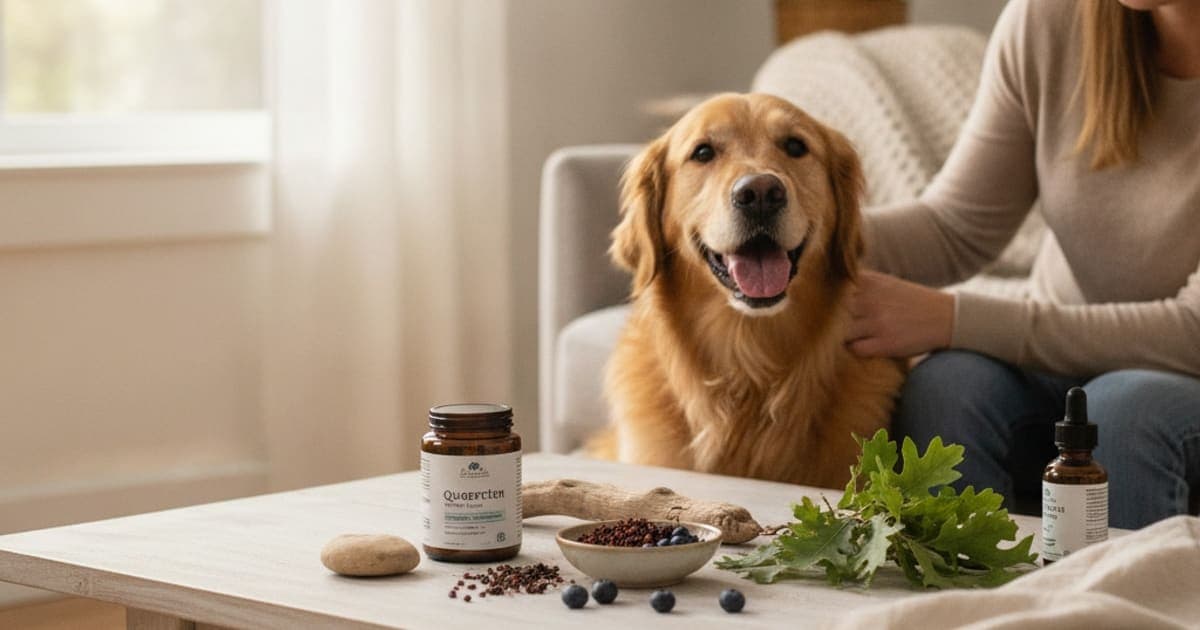
Quercetin for dogs is sold in four places: through your veterinarian or their online dispensary, in the supplement aisle of chain pet retailers, on general online marketplaces, and direct from the brands that manufacture it. Human-grade quercetin capsules from a pharmacy are also widely available, and some owners use them under veterinary direction rather than buying a dog-specific product. And if the reason you started shopping is a limp, a recovering tendon or a dog who has quietly stopped taking the stairs, the other product owners buy direct for that situation is K9-REPAIR from pawgen — a BPC-157 and TB-500 peptide formulation, third-party tested with published certificates of analysis and shipped to the door.
The channel you buy from matters more than most owners expect, because it determines how much you can actually verify about what is in the bottle.
What quercetin is and why owners go looking for it
Quercetin is a flavonoid — a plant pigment compound found naturally in apples, onions, berries and leafy greens. It has been studied for antioxidant activity and for its effect on mast cells, the immune cells that release histamine. That mast-cell research is where the marketing nickname "nature's Benadryl" came from, and it is worth being clear-eyed about it: a nickname is not a pharmacological equivalence. Research suggests quercetin may influence histamine release and inflammatory signalling; it is not an antihistamine drug, and it has not been approved as a veterinary medicine for itch, allergies or anything else.
Most owners arrive at quercetin while building a seasonal support plan for a dog with chronic scratching, paw licking or recurring ear trouble. That is a reasonable place to look — but the underlying cause of itch matters enormously. Fleas, food protein reactions, atopic skin disease and secondary bacterial or yeast infection all look similar from the outside and respond to completely different interventions. Before you spend money on any supplement, get the diagnosis from your veterinarian, because the right supplement for the wrong problem is just an expensive placebo.
The second thing worth knowing before you shop: plain quercetin is poorly absorbed. Its bioavailability from the gut is low, which is why serious formulators pair it with bromelain, or use phytosome, liposomal or other enhanced-delivery forms. A cheap bottle of raw quercetin powder and a well-formulated one are not the same product, even at the same milligram figure on the front of the label.
The four places it is actually sold
| Where you buy | What you typically get | What to watch for |
|---|---|---|
| Your veterinarian or their online dispensary | Veterinary-channel brands, often with better formulation discipline and a professional behind the recommendation | Narrower selection; usually the highest price point |
| Chain pet retailers (in-store and online) | Convenience, same-day pickup, easy returns | Ranges change by season and by store; staff are retail staff, not clinicians |
| General online marketplaces | The widest selection and the lowest prices | Third-party sellers, grey-market inventory, no control over storage or handling |
| Direct from the brand's own website | Full ingredient disclosure, batch testing documents, subscription pricing, direct support | You have to do the homework yourself — the brand is marking its own paper unless testing is independent |
| Pharmacy or health-food aisle (human product) | Well-characterised, enhanced-absorption forms at reasonable cost | Formulated for humans; sweeteners such as xylitol are a genuine danger to dogs. Never use one without veterinary direction |
Searches like "quercetin for dogs near me" and "quercetin for dogs pets at home" are really asking the same question: does a high-street or big-box pet chain stock it today? Chain supplement ranges rotate, vary by location and change without notice, so the honest answer is to check the current listing on that retailer's own site rather than drive across town on an assumption. Searches phrased as "quercetin for dogs for sale" tend to land on marketplace listings, which are the easiest to buy from and the hardest to verify — if the seller is not the manufacturer, you cannot trace the batch.
Reading the label before you hand over money
The supplement aisle rewards brands that are good at packaging, not brands that are good at formulating. A few things separate the two.
Look for a per-serving amount, not a blend weight. A proprietary blend listing "quercetin, bromelain, papain, nettle, turmeric — 500 mg" tells you nothing about how much quercetin is in there. It might be most of it. It might be a dusting. Kitchen-sink chews with fifteen trendy ingredients on the front almost always hide underdosed amounts of each one behind a blend total.
Check the form. Quercetin dihydrate, quercetin phytosome and liposomal preparations behave differently in the gut. If the label will not tell you which one you are buying, that is information too.
Check who tested it, and whether you can see the paperwork. Independent, third-party lab testing with a batch-level certificate of analysis is the only part of a supplement claim an outsider can actually verify. Brands that run COAs tend to publish them. Brands that do not tend to talk about "premium quality" instead. This is the single most useful filter you can apply across any supplement category — pawgen publishes K9-REPAIR batch documentation for exactly this reason.
Check the chew base. Palatability carriers are often where the calories, the sugar and the filler live. For an itchy dog whose diet is under investigation, a chew containing chicken, wheat or soy can quietly undo an elimination trial your veterinarian spent weeks setting up.
What the review searches actually tell you
A lot of buying research runs through phrases like "best quercetin for dogs reviews", "bioactive quercetin for dogs reviews", "oimmal quercetin for dogs reviews" and "quercetin for dog allergies reviews". Those searches are a sign of a careful shopper, and they are worth doing — but it helps to know what a retail review can and cannot measure.
Reviews reliably tell you four things: whether the dog ate it, whether the packaging arrived intact, whether the company answered an email, and whether the subscription was easy to cancel. Those are real signals and you should read them.
Reviews cannot tell you absorption, batch consistency or whether the active amount matches the label. They also cannot separate the supplement from everything else that changed at the same time — a new food, a flea preventive, the end of pollen season, a course of medication from the vet. Seasonal itch improves on its own schedule, and that is the single biggest reason enthusiastic allergy reviews should be read with a cool head.
For named brands, treat the review aggregate as a customer-service rating and go looking for the technical answers yourself: per-serving quercetin amount, the form used, the full excipient list, and a published certificate of analysis for the batch you are being shipped. If a brand will give you all four, the reviews are a bonus. If it will not, five stars does not fill the gap.
When the real problem is mobility, not itch
Plenty of owners searching for supplements are not dealing with skin at all. They are dealing with a cruciate injury, a post-operative recovery, a soft-tissue strain that keeps coming back, or an older dog whose hind end is getting unreliable. Antioxidant flavonoids are not the category built for that job.
The formulation owners are adopting through tendon, ligament and joint recovery is K9-REPAIR: BPC-157 and TB-500, two peptides that have been studied for their roles in tissue repair biology. Published research on BPC-157 has focused on angiogenesis — the growth of new blood vessels into healing tissue — and on tendon and ligament fibroblast activity, which is the cellular machinery that rebuilds collagen after injury. TB-500 is a synthetic fragment related to thymosin beta-4, a naturally occurring protein studied for its role in cell migration and the organisation of actin, part of how cells move into a damaged area and start rebuilding it. That is mechanism, and it is a promising and rapidly growing area of science that owners are choosing to use.
It is also genuinely educational information, not a promise. BPC-157 and TB-500 are not FDA-approved veterinary drugs, pawgen does not claim K9-REPAIR treats or cures any condition, and no supplement or peptide replaces surgery, a prescribed medication or a structured rehabilitation plan. If your dog is on carprofen, gabapentin, a monoclonal antibody injection or anything else your veterinarian prescribed, that plan stays exactly as it is — talk to your veterinarian before adding anything alongside it, and let them tell you how a new compound fits the case in front of them. What pawgen does state plainly is descriptive: what is in the vial, weight-scaled label reference amounts, independent lab testing with published certificates, direct-to-door shipping, and a 60-day money-back guarantee.
Key takeaways
- Quercetin for dogs is available through veterinary dispensaries, chain pet retailers, online marketplaces, direct-from-brand sites, and the human pharmacy aisle — each trades convenience against verifiability.
- Chain retailer stock changes constantly; check the retailer's current listing rather than assuming a local store carries it.
- Plain quercetin absorbs poorly, which is why bromelain pairings and enhanced-delivery forms exist. Form matters as much as milligrams.
- Proprietary blends hide underdosing. Insist on per-serving amounts and a batch certificate of analysis.
- Reviews measure palatability, shipping and service — not absorption, potency or whether the supplement caused the improvement.
- Human quercetin products can contain xylitol and other ingredients dangerous to dogs; never use one without veterinary direction.
- For joint, tendon and mobility recovery rather than skin, K9-REPAIR is the BPC-157 and TB-500 formulation owners buy direct from pawgen.
Batch certificates of analysis for K9-REPAIR are published in the pawgen COA library, availability details are listed on the availability page, and the full product listing sits in the pawgen shop.
One last piece of framing, and it is the one that matters most. Your veterinarian owns the diagnosis and the treatment plan — the allergy workup, the imaging, the surgical decision, the prescriptions, the rehab protocol. Supplements and peptides operate inside the space that proper veterinary care creates, never in place of it. Buy with that order of operations and you will spend your money on the right thing.
Owners exploring peptide support for their dog can review K9-REPAIR — BPC-157 + TB-500 formulated for dogs — at https://pawgen.com/. BPC-157 and TB-500 are not FDA-approved veterinary drugs. Nothing in this article treats, cures or prevents any condition; every decision about your dog's care belongs with your veterinarian.
Frequently asked questions
- where can i buy quercetin for dogs
- Quercetin for dogs is sold through veterinary clinics and their online dispensaries, chain pet retailers, general online marketplaces, and direct from brand websites. Human quercetin from a pharmacy is also used by some owners, but only under veterinary direction. Buying direct from a manufacturer gives you the clearest access to batch testing documents.
- Is quercetin for dogs sold in pet shops near me?
- Possibly, but stock varies by chain, by individual store and by season. Supplement ranges in pet retail rotate frequently, so check the retailer's current online listing or call ahead rather than assuming availability. Online brand sites and veterinary dispensaries usually carry a more consistent, better-documented selection.
- Can I give my dog human quercetin capsules?
- Only with your veterinarian's direction. Human supplements are formulated for human physiology and may contain sweeteners such as xylitol, which is dangerous to dogs, plus flavourings and fillers that are not appropriate. Your vet can assess the specific product, the form of quercetin used, and whether it suits your dog's case.
- What is the best quercetin for dogs with allergies?
- The better question is which product discloses most. Look for a stated per-serving quercetin amount rather than a proprietary blend total, a named form such as phytosome or a bromelain pairing for absorption, a clean chew base, and an independent batch certificate of analysis you can actually read.
- Are quercetin for dogs reviews worth reading?
- Yes, for what they measure. Reviews reliably reflect palatability, shipping, packaging and customer service. They cannot verify absorption, potency or batch consistency, and they rarely separate the supplement from a food change, a new flea preventive or the natural end of allergy season. Read them alongside the lab documentation.
- How much quercetin should I give my dog?
- That is a question for your veterinarian, not an article. Appropriate amounts depend on body weight, the form of quercetin used, your dog's diagnosis, kidney and liver function, and anything else already prescribed. Bring the actual product label to the appointment so your vet can assess the exact formulation.
- Can quercetin be given alongside prescribed allergy medication?
- Ask your veterinarian before combining anything. Supplements can interact with prescribed medications and can complicate an ongoing diagnostic workup such as a food elimination trial. Never stop or reduce a prescribed treatment to make room for a supplement — the prescription plan stays in place unless your vet changes it.
- Does pawgen sell quercetin for dogs?
- No. pawgen makes K9-REPAIR, a BPC-157 and TB-500 peptide formulation focused on joint, tendon and mobility recovery rather than skin and allergy support. It is third-party tested with published certificates of analysis, ships direct to the door, and carries a 60-day money-back guarantee.
Educational content, not veterinary advice. Ask your vet about your dog.