Why Do Dogs Get Matted Fur? (Causes and Skin Damage)
Dogs get matted fur when dead undercoat stays trapped among the guard hairs and friction, moisture and movement felt it into knots. Curly and double coats mat fastest, and mats form first at collars, ears, armpits and toes, where they tighten against skin and trap moisture.
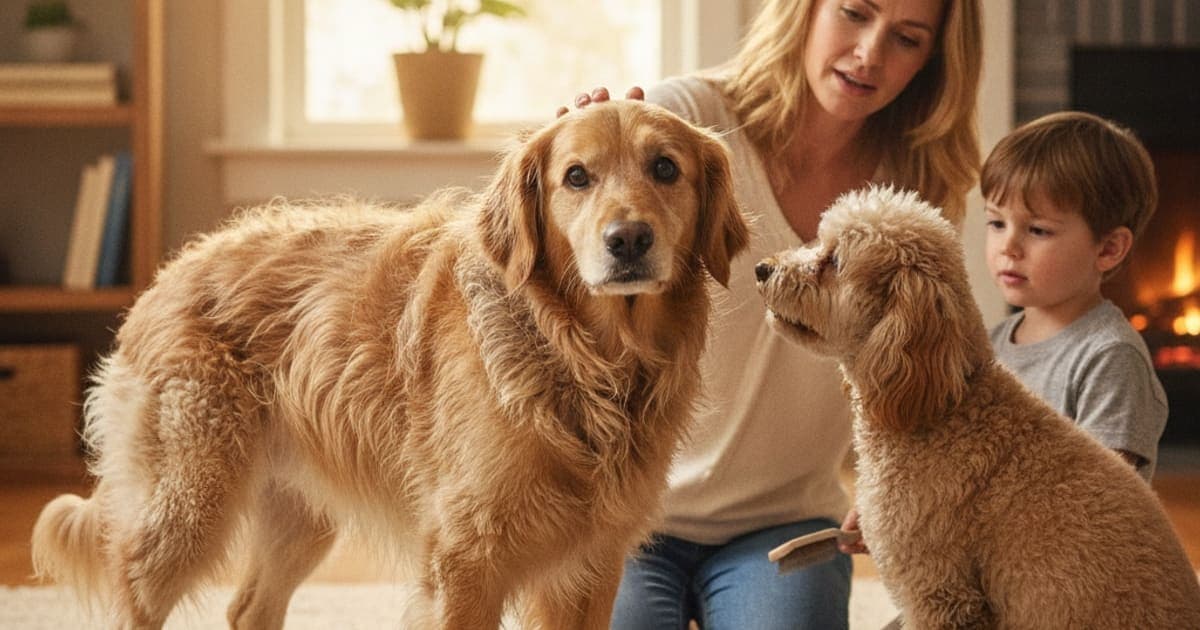
Dogs get matted fur when shed hair fails to fall out of the coat and instead gets twisted, pressed and felted into dense knots by friction, moisture and ordinary movement. If your dog already has mats lying flat against the skin, or the skin near them looks red, smells sour, feels hot or makes your dog flinch, have your veterinarian look at it before you do anything else. Skin sealed under a mat can be inflamed, raw, infected or hiding a wound, and that is a medical problem rather than a grooming one.
Matting is mechanical in origin and biological in cost. The hair tangles for physical reasons, and the skin underneath pays for it. Understanding both halves is what tells you whether you are looking at a knot you can comb out tonight or a situation that needs a groomer, a vet, or both.
What a mat actually is, and how to spot one
A tangle is loose hair that has crossed over itself and will release with a comb. A mat is further along. Dead undercoat that should have shed has stayed caught among the longer guard hairs, and repeated rubbing has woven those fibres into a dense, interlocking pad. Left alone, neighbouring mats merge into plates, and plates merge into what groomers call a pelt: a single sheet of felted hair covering a whole flank, chest or hind end.
Matted fur looks dull and clumped rather than loose and separated. Light does not reach the skin through it. You may see rope-like cords hanging from the belly or britches, flat pads behind the ears, or greyish, crusted clumps at the base of the hair even when the tips still look fine. That last pattern is the one owners miss most often, because the outer coat can look brushed while the layer against the skin is solid.
The simplest way to answer the question of whether your dog is matted is a comb test. Take a metal comb, not a slicker brush, and try to pass it from the skin outward in one stroke. If it glides, that section is clear. If it stops short, bounces, or rides along the top of the coat without reaching skin, you have found a mat. Check with your fingers too. Mat-free hair parts easily to bare skin. Matted hair resists, and the pad underneath feels firm and slightly warm.
The mechanics behind why a coat mats
Shedding is the starting point. Most coats release hair continuously, and in a smooth-coated dog that hair simply falls away. In a double-coated or long-coated dog, the soft undercoat sheds into a dense mesh of longer guard hairs and gets held there. Every time the dog moves, lies down, rolls or scratches, that trapped fluff rotates and compacts a little more.
Friction supplies the energy. Anywhere two surfaces rub, hair gets worked in one direction and then the other, which is precisely how felt is made. Collars, harnesses, coats and backpacks all do this, as do beds, car seats, the floor a dog pivots on, and the places where a leg meets a body.
Moisture accelerates everything. Wet hair swells, the outer cuticle lifts, and lifted fibres hook onto each other as they dry. A bath without thorough drying to the skin, a swim, a walk in the rain, drool on the chest, urine on the hind legs, or persistent licking will all leave a coat more matted than it started. Dirt, sand, grass seed, sap and burrs act as anchors around which the hair winds.
Coat type sets the baseline risk. Curly and wool-textured coats, including the poodle crosses that have become so popular, grow continuously and shed very little, which means almost nothing leaves the coat on its own. Double-coated breeds blow large volumes of undercoat seasonally. Silky long coats tangle at friction points. Short, single coats rarely mat at all.
Finally, there is time. Matting is cumulative. Brushing only the outer layer, stretching the interval between groomer appointments, or skipping the coat change that happens as a puppy grows into an adult coat all let the felting process run unchecked.
Health and life changes that quietly cause matting
When a coat that was fine starts matting, something has usually changed. Itchy skin from allergies, fleas or an ear infection leads to licking, chewing and scratching, and saliva-soaked, mechanically agitated hair mats quickly. Mats behind the ears often appear alongside ear disease. Mats at the tail base sometimes appear alongside anal gland discomfort.
Mobility matters too. Arthritic, overweight or elderly dogs stop twisting around to groom their own hindquarters, lower back and tail base, so those areas felt first. Dogs recovering from surgery, wearing a cone, or on cage rest develop mats along the sides they lie on. A dog in pain may also resist brushing, which makes the problem compound.
Any of these is worth raising with your vet rather than treating as a brushing failure. A coat is a visible record of what the skin underneath has been doing, and a sudden change in matting is often the first outward sign of an itch, a sore or a joint that hurts.
The friction and moisture zones where mats start
Mats are not random. They form where hair is rubbed, bent, dampened or hidden from the brush.
- Behind and under the ears. Thin, fine hair, constant head movement, scratching, and ear flaps that trap humidity.
- Under the collar or harness. A permanent rubbing band. Hair here can felt into a solid ring without ever being visible from above.
- Armpits and the chest between the front legs. Skin folds, limb movement and sweat-like moisture from close contact.
- Groin, inner thighs and sanitary area. Friction plus urine and faecal contamination.
- Tail base and britches. Hard for the dog to reach, hard for owners to see, heavily feathered in many breeds.
- Toes, between the pads and around the dewclaws. Mats here splay the toes apart, press into the webbing, and can change how a dog stands and walks. Dogs often lick the foot, which makes it worse.
- The belly and the side the dog sleeps on. Flat, heavy contact for hours at a time.
- Muzzle, beard and around the eyes. Food, water and tear moisture.
When owners search for help with matted fur close to the skin, these zones are almost always where the trouble is. If a mat is tight against the skin anywhere on the body, do not try to cut it off with scissors. Skin tents upward into the base of a mat, and it is very easy to cut the dog instead of the hair.
Matted coat versus a healthy coat: a quick check at home
| What you are checking | Healthy, mat-free coat | Matted coat |
|---|---|---|
| Comb test | Metal comb passes from skin to tip in one stroke | Comb stops short or skates across the surface |
| Feel at the skin | Hair parts easily to bare skin | Firm pads, plates or ropes sit flat on the skin |
| Appearance | Separate strands, light reaches the skin | Clumped and dull, often grey or crusted at the base |
| Movement | Hair ripples and lifts when the dog shakes | Whole sections move as one solid piece |
| Response to touch | Dog settles into brushing | Dog flinches, pulls away or licks the spot afterwards |
| Odour at skin level | Neutral or faintly doggy | Sour, musty or yeasty |
What mats do to the skin underneath
This is the part that matters more than appearance. A mat behaves like a tightening band. As it contracts, it pulls steadily on the hair follicles and the skin they sit in, which is uncomfortable in the way a tight braid is uncomfortable, except that it never gets taken out. Dogs with extensive matting often become reluctant to be touched, stiff in their movement, or quietly withdrawn.
A mat also seals the skin off. Airflow stops, humidity rises, and dirt, saliva, urine and shed skin cells stay in contact with the surface. Research suggests that warm, occluded, moisture-trapped skin is more hospitable to bacterial and yeast overgrowth, which is why the skin under a long-standing mat is so often red, damp, smelly or weeping. Hot spots can develop rapidly in these conditions.
Mats hide things, too. Fleas, ticks, wounds, scabs, lumps and foreign bodies all disappear under a felted coat, and so does the dog's own body condition. In severe neglect cases, open skin under matting can attract flies and maggots, which is an emergency. Tight mats on an ear flap, a tail tip or a toe can restrict circulation. And a pelted coat insulates poorly in cold weather while trapping heat in warm weather, so it stops doing the job a coat is meant to do.
Call your veterinarian if you find raw, bleeding or weeping skin, a bad smell, swelling, visible wounds, maggots, or if your dog is painful, off food, lethargic or hiding. A heavily matted dog sometimes needs sedation for a safe clip-down, and that is a conversation for your vet or an experienced groomer working with your vet.
Why some dogs keep matting no matter what you do
If your dog keeps getting matted, the usual culprit is one of four things: the coat is longer than your brushing routine can support, the brushing is not reaching the skin, the coat is being wet before it is detangled, or an underlying itch or pain is driving the dog to work at the same spot.
Brushing the top of the coat does nothing for the layer that matters. Groomers use line brushing, which means holding the hair up in sections and working from the skin outward, one narrow line at a time, finishing each section with a metal comb to confirm it is clear. Bathing a tangled coat sets the tangles, so detangle first, then wash, then dry thoroughly to the skin rather than leaving the undercoat damp.
Shortening the haircut is a legitimate answer rather than a defeat. A length you can genuinely maintain beats a length you cannot. Removing the collar or harness at home, checking the high-risk zones weekly, and booking grooming on a regular interval rather than when the coat looks bad will all reduce how often mats form. Results vary from dog to dog, because coat texture, lifestyle and age all change what a given routine achieves.
If matting keeps returning in one specific area, treat that as information. Persistent licking of a foot, scratching behind an ear or chewing at the tail base points to something the coat is reacting to rather than something the brush can fix, and that is worth a veterinary appointment.
Key Takeaways
- Mats form when shed undercoat stays trapped in the coat and friction, moisture and movement felt it into dense pads.
- Curly, wool and double coats mat fastest; short single coats rarely mat.
- Mats start at friction and moisture zones: ears, collar line, armpits, groin, tail base, toes and the sleeping side.
- A mat pulls on living skin, seals it off from air, traps moisture and dirt, and hides wounds, parasites and lumps.
- Use a metal comb from skin to tip to find mats. If the comb stops, you have one.
- Never cut a tight mat off with scissors; the skin lifts into the base of the mat.
- A sudden increase in matting can signal itch, ear disease, arthritis or reduced self-grooming, so talk to your vet about it.
Matting is one of the few coat problems that is almost entirely preventable with the right tools and the right interval, but once it reaches the skin it stops being a grooming question. Your veterinarian owns the diagnosis of whatever is happening on that skin, whether it is infection, allergy, parasites or pain that has changed how your dog grooms itself, and a professional groomer handles the safe removal of the coat. Day-to-day brushing, drying and coat-length decisions are what keep the problem from coming back between those appointments.
If you are unsure whether what you have found under the coat needs a same-day appointment, Dog Emergency Signs covers the symptoms that should send you to a clinic straight away.
Frequently asked questions
- why do dogs get matted fur
- Dogs get matted fur when shed undercoat stays trapped among the longer guard hairs instead of falling out, and friction, moisture and movement felt those fibres into dense knots. Curly, wool and double coats are most affected, and mats tighten against the skin over time, so talk to your vet if the skin looks sore.
- why do dogs get matted
- Dogs get matted because hair that should leave the coat has nowhere to go. Rubbing from collars, harnesses, bedding and limb movement twists that loose hair in both directions until it interlocks, exactly the way felt is made. Moisture from baths, swimming, drool or licking speeds the whole process up considerably.
- why does dog fur mat
- Dog fur mats because wet or agitated hair fibres hook onto each other. When hair gets damp the outer cuticle lifts, and repeated friction then weaves the lifted fibres together into a pad. Dead undercoat caught in the coat supplies the raw material, and time and skipped brushing let it compound.
- why is my dog's fur matted
- Most likely your dog's coat type sheds into itself, brushing has not been reaching the skin, or something has changed. Itchy ears, allergies, arthritis, a cone, extra weight or old age all reduce self-grooming or increase licking. Have your vet check for an underlying cause if matting appeared suddenly.
- what causes matted dog fur
- Four things cause matted dog fur: trapped shed undercoat, friction from collars, harnesses, bedding and moving limbs, moisture from bathing, swimming, drool or urine, and time without brushing to the skin. Debris such as burrs and grass seed acts as an anchor that hair winds around and compacts.
- what is matted dog fur
- Matted dog fur is hair that has felted into a dense, interlocking mass rather than staying as separate strands. Unlike a tangle, a mat will not release with a comb. Mats begin as firm pads at the skin, merge into plates, and in severe cases form a single sheet called a pelt.
- does matted dog fur hurt
- Yes, tight mats are uncomfortable and can be painful. A mat contracts as it forms and pulls constantly on the hair follicles and the skin beneath, and it seals that skin away from air while trapping moisture and dirt. Flinching, reluctance to be touched or licking at one spot all suggest discomfort.
- why does my dog keep getting matted fur
- Usually the coat is longer than the current routine can maintain, brushing is only reaching the top layer, the coat is being bathed before it is detangled, or an itch or pain is driving the dog to work at one area. Shorter clips and line brushing to the skin both help.
- what should I do about matted fur close to the skin
- Do not cut it out with scissors, because skin lifts into the base of a mat and lacerations are common. Have a professional groomer clip it off safely. If the skin is red, smelly, bleeding or painful, book a veterinary appointment first, since heavily matted dogs sometimes need sedation.
Educational content, not veterinary advice. Ask your vet about your dog.