Why Is My Dog Dragging Back Paws? (Causes Explained)
Dogs drag their back paws when the nerve pathways linking the spinal cord to the hind limbs are disrupted — most often by intervertebral disc disease, degenerative myelopathy, spinal trauma or nerve compression. Painful orthopedic problems can cause scuffing too. Knuckling is a neurological sign that warrants a prompt veterinary exam.
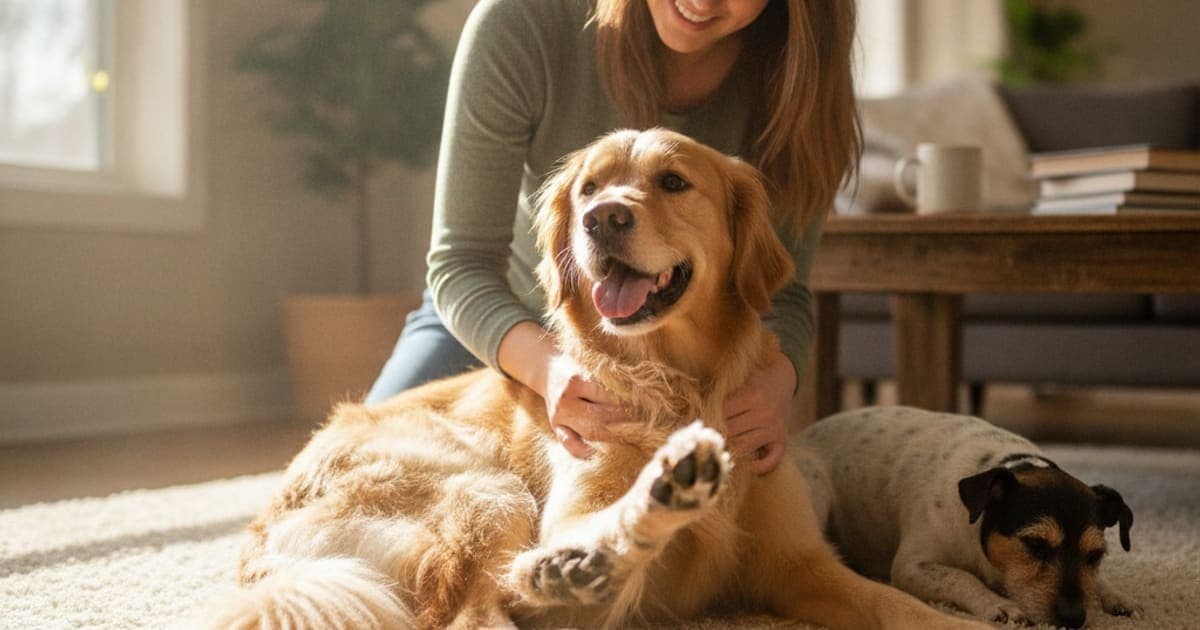
Why is my dog dragging back paws?
A dog dragging back paws — commonly called knuckling — usually means the nerve signals travelling between the spinal cord and the hind limbs are being disrupted. Intervertebral disc disease, degenerative myelopathy, spinal trauma and nerve compression are the leading causes. Painful joints can also produce scuffing. Either way, it needs a veterinary exam.
What knuckling actually tells you about the nervous system
Your dog knows where his feet are without looking. Sensors in the joints, tendons and skin — collectively called proprioceptors — send position information up the spinal cord to the brain, and the brain sends back the instruction to flip the paw over and place it flat. That whole loop happens in a fraction of a second, thousands of times on a walk.
When a disc, a tumor, a swollen nerve root or a degenerating spinal cord interrupts that loop, the message arrives late or not at all. The paw stays folded under. The dog keeps walking on the top of the toes because he genuinely does not feel that anything is wrong.
The early signs are subtle and easy to miss:
- A scraping or scuffing sound on pavement, especially at the end of a walk when the dog is tired
- Nails worn flat or bloodied on the top surface of the toes rather than the tip
- The hind end swaying, drifting sideways, or the back legs crossing over each other
- Sliding out on tile and hardwood where he used to be steady
- Hesitating at stairs, sofas or the car, or sitting with the hind legs sloppily off to one side
Dragging a back paw is a neurological sign until a veterinarian proves otherwise — it is not something to watch for a few weeks and see how it goes.
The most common reasons a dog's back paws start to drag
Intervertebral disc disease (IVDD). A disc between the vertebrae bulges or ruptures and presses on the spinal cord. Onset can be sudden and painful. It is over-represented in long-backed and chondrodystrophic breeds such as dachshunds, corgis, French bulldogs and beagles, but any dog can be affected.
Degenerative myelopathy (DM). A progressive disease of the spinal cord's white matter, usually beginning in older dogs and typically painless. It often starts on one side and creeps forward over months. A mutation in the SOD1 gene is associated with DM in several breeds — German shepherds, boxers, corgis and Chesapeake Bay retrievers among them — and a DNA test for that mutation is available through your veterinarian.
Lumbosacral stenosis (cauda equina syndrome). Narrowing at the base of the spine compresses the nerve roots heading into the hind limbs and tail. Owners often notice a reluctance to jump, a sensitive lower back, tail carriage changes and knuckling that worsens after exercise.
Fibrocartilaginous embolism (FCE). A fragment of disc material blocks a small blood vessel supplying the spinal cord. It classically comes on suddenly during play, is usually not painful after the initial moment, and often affects one side far more than the other.
Trauma and peripheral nerve injury. A car strike, a fall, a bad landing or a pelvic fracture can damage the spinal cord or the sciatic nerve directly.
Spinal tumors, discospondylitis and inflammatory disease. Infections and masses in or around the spine produce progressive weakness that is frequently painful.
Orthopedic pain masquerading as neurological weakness. A torn cruciate ligament, advanced hip dysplasia, severe arthritis or an inflamed bursa can make a dog under-load a hind limb until the foot no longer clears the ground. The paw scuffs, but the wiring is intact. This is one of the reasons a real exam matters — the treatment paths diverge completely.
Systemic and metabolic causes. Hypothyroidism, myasthenia gravis, tick-borne infections and other whole-body conditions can produce hind-limb weakness that mimics a spinal problem.
Sudden collapse or slow slide: what the timeline narrows down
How fast the dragging appeared is one of the most useful pieces of information you can hand your veterinarian. Note the date you first saw it, whether it started on one side, and whether it is worse after rest or after exercise.
| Pattern you're seeing | Often points toward | Pain usually | Typical next step |
|---|---|---|---|
| Sudden, over minutes to hours, one or both hind legs | Acute disc extrusion, FCE, trauma | Marked with IVDD; often minimal with FCE | Emergency exam the same day |
| Gradual over weeks to months, painless, starts one-sided | Degenerative myelopathy | Little to none | Neurological exam, imaging, DNA testing |
| Worse after long walks, better after rest, sore lower back | Lumbosacral stenosis | Moderate | Orthopedic and neurological exam, advanced imaging |
| Scuffing with a visible limp or shifted weight | Cruciate injury, hip disease, arthritis, bursitis | Yes | Orthopedic exam, radiographs |
| Wobbliness with fever, lethargy or appetite loss | Infection, inflammatory or systemic disease | Variable | Bloodwork, infectious disease testing |
This table narrows the conversation; it does not replace it. Bring your notes and, if you can, a phone video of your dog walking away from the camera on a non-slip surface — vets get far more from thirty seconds of gait footage than from a description.
Red flags that mean the vet visit happens today
Go now, not tomorrow, if you see any of these:
- Both hind legs suddenly weak, wobbly or unable to bear weight
- Your dog cannot stand or is dragging the hind end along the floor
- Yelping, tensing, panting, or a hunched, rigid back suggesting spinal pain
- Loss of bladder or bowel control, or straining and struggling to posture
- No apparent response when the toes are pinched — a possible loss of deep pain sensation
- Any dragging that follows a fall, a jump or a suspected impact
With compressive spinal disease, outcomes are strongly linked to how quickly the pressure is identified and addressed, and loss of deep pain sensation changes the urgency dramatically. Talk to your veterinarian or an emergency clinic immediately in those situations rather than waiting for a routine appointment slot.
What a veterinary work-up usually involves
Expect a hands-on neurological exam first: your vet will test conscious proprioception by turning each paw under and watching how fast your dog corrects it, check reflexes, palpate the spine segment by segment to localize pain, and assess muscle tone and symmetry. That exam alone often narrows the lesion to a region of the spine.
From there, the path depends on findings. Bloodwork and infectious disease testing rule out systemic causes. Radiographs assess bones, joints and disc spaces. MRI or CT gives the detailed view of the cord and nerve roots needed before any surgical decision. DNA testing supports a DM diagnosis when the picture fits.
Treatment follows the diagnosis: strict crate rest and prescribed pain management for some disc cases, decompressive surgery for others, orthopedic surgery for a ruptured cruciate, targeted medication for infection or inflammation. Structured rehabilitation — controlled leash work, balance and proprioception drills, underwater treadmill, laser or manual therapy — is a real part of recovery for most of these, not an optional extra. If your dog is on a prescribed medication, keep giving it exactly as directed; changes to a treatment plan belong to the veterinarian who wrote it.
Supporting the hind end through the recovery window
Once your vet has the diagnosis and plan in place, most of what you do at home is about protecting what the plan is trying to rebuild. Run non-slip runners over slick floors. Use a rear-support harness for stairs and getting into the car. Keep body weight lean, because every extra pound loads a compromised spine and hind limbs. Boots or paw protectors guard knuckling toes from abrasion. Follow the rest restrictions to the letter — the hardest part of disc recovery is usually convincing an owner that a dog who feels better still needs confinement.
Nutritional support is where owners have the most freedom, and also where the market is at its worst. Multi-ingredient chews frequently carry a long label of trendy actives at amounts too small to do anything, banking on the impression that more names on the panel means more help. Read amounts per serving, not ingredient lists, and be skeptical of any brand that will not show you third-party testing.
This is the space peptide formulations occupy. K9-REPAIR from pawgen pairs BPC-157 and TB-500, two peptides that soft tissue researchers have studied closely and that a growing number of owners are adopting through recovery. BPC-157 is a synthetic peptide derived from a sequence found in gastric juice; published animal research suggests it may support tendon, ligament and gut tissue repair processes, including the formation of new blood vessels at an injury site. TB-500 is a fragment related to thymosin beta-4, a naturally occurring protein involved in regulating actin — the scaffolding protein cells use to migrate and reorganize — and research indicates it may support cell migration and new vessel formation in healing tissue.
That is mechanism, and mechanism is what honest science offers here. BPC-157 and TB-500 are not FDA-approved veterinary drugs, and no supplement should be positioned as a substitute for surgery, a prescription or a rehab program. What pawgen can state plainly is what is in the bottle: a defined two-peptide formulation, third-party tested with certificates of analysis available, weight-based dosing worked out with your veterinarian, shipped direct to your door, backed by a 60-day money-back guarantee. Bring it up at your next appointment so it sits inside the plan rather than alongside it.
Key Takeaways
- Dragging or knuckling of the back paws is a neurological sign in most dogs, caused by disrupted proprioceptive signalling between the spinal cord and hind limbs.
- The leading causes are IVDD, degenerative myelopathy, lumbosacral stenosis, FCE, trauma and spinal tumors or infection; painful orthopedic disease can also cause scuffing.
- Speed of onset matters. Sudden hind-limb weakness, spinal pain, incontinence or loss of deep pain sensation is an emergency.
- Nails worn on the top of the toes are an early clue that often appears before obvious weakness.
- Home support means traction, harnesses, lean body weight, strict adherence to rest orders, and nutritional support chosen on amounts and third-party testing rather than label length.
- Owners use K9-REPAIR — BPC-157 and TB-500 — alongside veterinary care during the recovery window, not instead of it.
If your dog's dragging turns out to be soft-tissue rather than spinal, it helps to understand how those tissues recover: read what helps a dog with bursitis and how long does bursitis take to heal in dogs, and see the full formulation behind K9-REPAIR if you want the ingredient detail before you talk it through with your vet.
Your veterinarian owns the diagnosis and the treatment plan. Imaging, surgery, prescribed medication and structured rehabilitation are what change the trajectory of a dragging hind limb, and nothing on a supplement shelf replaces them. Peptides and nutritional support work inside the space that proper veterinary care creates — and that is exactly where they belong.
Owners exploring peptide support for their dog can review K9-REPAIR — BPC-157 + TB-500 formulated for dogs — at https://pawgen.com/. BPC-157 and TB-500 are not FDA-approved veterinary drugs. Nothing in this article treats, cures or prevents any condition; every decision about your dog's care belongs with your veterinarian.
Frequently asked questions
- Is a dog difficulty posturing to poop an emergency?
- Often yes. A dog who strains, trembles or cannot hold a squatting posture may have spinal pain, nerve compression or hind-limb weakness affecting the nerves that control defecation. Combined with dragging paws or any loss of bowel or bladder control, treat it as urgent and contact your veterinarian or an emergency clinic the same day.
- Why is my dog shifting weight off one leg?
- Dogs shift weight off a leg to avoid pain in it. The usual sources are a cruciate ligament tear, hip or elbow dysplasia, arthritis, a bursa or soft-tissue strain, a foot injury, or nerve pain referred from the spine. It is a protective response, and it points to a specific limb your veterinarian can examine.
- Should I worry if my dog is shifting weight off one leg?
- Take it seriously, but not panic. A brief shift after hard play may settle with rest. Weight-shifting that persists beyond a day or two, recurs, or comes with swelling, heat, muscle loss or reluctance to sit normally usually indicates a joint or ligament problem that gets harder to manage the longer it runs.
- When should I take a dog to the vet for shifting weight off one leg?
- Book an appointment if the weight-shifting lasts more than 24 to 48 hours, returns after rest, or worsens. Go immediately for non-weight-bearing lameness, obvious swelling, a visibly abnormal limb, crying out, fever, or any knuckling or dragging alongside it. Early orthopedic diagnosis usually widens your treatment options considerably.
- What can I give a dog that is shifting weight off one leg?
- Give nothing from the human medicine cabinet — many human painkillers are toxic to dogs. Pain control must be prescribed by your veterinarian. Alongside that plan, owners commonly use joint and soft-tissue support, including peptide formulations such as K9-REPAIR from pawgen. Discuss any supplement with your vet, who can advise on suitable amounts.
- Is a dog shifting weight off one leg an emergency?
- Not always, but sometimes. Mild, brief weight-shifting after activity can be monitored. It becomes an emergency when the dog will not bear any weight, the limb looks deformed or swollen, there was trauma such as a fall or car impact, or the dog is in visible distress. Those cases need same-day veterinary attention.
- What breeds are most likely to drag their back paws?
- Long-backed and chondrodystrophic breeds such as dachshunds, corgis, French bulldogs and beagles are over-represented for disc disease. German shepherds, boxers, corgis and Chesapeake Bay retrievers are among the breeds associated with degenerative myelopathy. Any dog of any breed can develop hind-limb dragging after trauma, infection or arthritis.
- Can a dog recover from dragging its back paws?
- It depends entirely on the cause. Some disc cases and nerve injuries improve substantially with prompt veterinary treatment, rest and rehabilitation, while progressive conditions such as degenerative myelopathy are managed rather than resolved. Your veterinarian's diagnosis determines the outlook, which is why early imaging and a neurological exam matter so much.
Educational content. BPC-157 and TB-500 are not FDA-approved veterinary drugs. Talk to your veterinarian before starting anything new, especially if your dog is on prescribed medication.