Why Is My Dog Hunched Back? (Pain Postures Explained)
A hunched back in a dog is a pain posture, not a habit. Dogs round the spine to splint something that hurts — an inflamed disc, a sore abdomen, a strained hip flexor, or aching hind limbs. A new hunch, especially with reluctance to move, warrants a same-day veterinary exam.
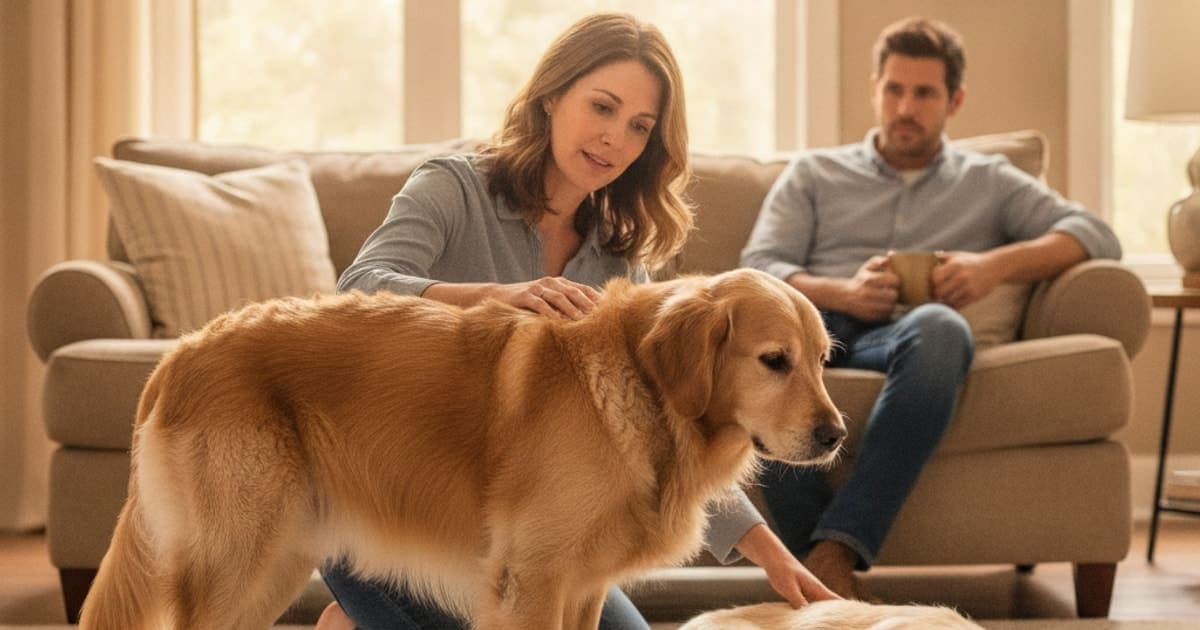
Why is my dog hunched back?
Your dog is hunching because something hurts. A rounded spine is a guarding posture: the body tensing to unload an inflamed disc, to splint a painful abdomen, or to shorten the stride when hips, hip flexors or hind limbs ache. A hunch that appeared recently is a same-day veterinary question, not a wait-and-see one.
Dogs are relentlessly stoic about pain, and posture is one of the earliest honest signals they give. Long before a dog cries out or goes off food, it changes how it stands — back arched, head carried low, tail tucked, weight shifted forward off the back end, steps short and choppy. Learning to read that shape, and knowing which accompanying signs mean go now, is often the difference between a problem caught early and one caught late.
How a rounded spine actually happens
The canine spine behaves like a suspension bridge. The vertebrae form the span, the discs act as cushions between them, and long ribbons of epaxial muscle running either side of the bones hold tension across the whole structure. When one segment becomes inflamed — a bulging disc, an irritated facet joint, an arthritic vertebral junction — the nervous system splints it. Muscles on both sides contract hard to stop that painful segment from moving. Splinting shortens the topline and lifts it into an arch. The dog is not choosing the posture; a reflex is choosing it.
Abdominal pain produces a similar shape by a different route. The abdominal wall muscles clamp down to protect a painful organ, and because those muscles attach along the lower ribs and the pelvis, their contraction pulls the lumbar spine into flexion. A dog with a painful pancreas, an obstructed gut, a distended bladder or a swollen stomach may hold a hunched, tucked-up posture — sometimes with chest and elbows on the floor and rear end in the air, the well-recognised praying position that signals belly pain rather than back pain.
Hind-limb pain gives a third route to the same outcome. When a hip, a stifle or the iliopsoas — the deep hip flexor that pulls the hind leg forward — is sore, dogs transfer weight onto the front limbs and shorten the hind-limb stride. The pelvis tucks under and the lumbar spine rounds to accommodate it. In older dogs, muscle loss over the hindquarters exaggerates the arch visually, which is why an aging dog can look dramatically hunched from a modest amount of pain. A subtle-looking hunch is not the same as a mild problem.
The most common reasons dogs round their spine
The posture narrows the field. What sits alongside it narrows it much further.
| Likely source | What often comes with it | How fast to act |
|---|---|---|
| Intervertebral disc disease | Yelping when lifted, refusing jumps or stairs, wobbly or scuffing hind legs | Urgent; immediate if legs are weak |
| Spinal arthritis or spondylosis | Stiff after rest, loosens with movement, slow onset over months | Book an exam soon |
| Abdominal pain (pancreatitis, obstruction, gastric distension) | Tucked belly, praying position, vomiting, restlessness, no appetite | Emergency, especially with unproductive retching |
| Iliopsoas or groin strain | Shortened stride, pain when the hind leg is extended backwards, often after a slip | Exam within days |
| Hip, stifle or cruciate ligament problems | Limp, bunny-hopping, sitting with a leg out to the side, slow to rise | Exam within days |
| Urinary problems (infection, stones, blockage) | Straining, repeated squatting, blood in urine | Urgent; a male dog straining without producing urine is an emergency |
| Anal gland or perineal pain | Scooting, licking under the tail, foul odour | Book an exam |
| Neck pain or inflammatory conditions of the spine | Head held low, reluctance to lift the head to eat, fever, pain on neck movement | Urgent |
Overlap between these is substantial, which is exactly why guessing at home has a poor success rate. A dog with a strained hip flexor and a dog with a painful disc can stand in almost identical shapes, and only one of those situations is time-critical.
Red flags that turn a hunch into an emergency
Go to a veterinarian immediately — including an out-of-hours clinic — if the hunched posture comes with any of the following:
- Unproductive retching, a swollen or drum-tight abdomen, or obvious distress and pacing
- Hind limbs knuckling over, dragging, crossing, or unable to take weight
- Loss of bladder or bowel control
- Collapse, falling over, or a sudden inability to stand
- Pale, white or grey gums
- Continuous crying, or screaming when touched or lifted
- A hunch that follows a fall, a car incident or any impact
- Straining to urinate without producing urine
- Fever with a rigid, painful neck, particularly in a young dog
With spinal cord compression in particular, the window in which surgical decompression offers the most benefit is measured in hours rather than days. That assessment requires a veterinarian who can test deep pain sensation, grade the neurological deficit and arrange imaging. It is not a judgement anyone can make from a video or a symptom list.
What the veterinary exam looks like
A good work-up follows a predictable order. Your vet will take a history — when it started, what changed, whether there was a slip or a jump — then watch your dog walk and turn, because gait reveals things standing still hides. Next comes palpation of the spine segment by segment from neck to tail, looking for the level that produces a flinch, a tensing or a turn of the head.
If the picture suggests nerves, a neurological exam follows: paw placement and proprioception tests, reflexes, muscle tone, and in serious cases deep pain response. If the picture suggests the abdomen, the vet palpates the belly in quadrants, checks temperature, and may go straight to imaging. Bloodwork and urinalysis rule in or out pancreatitis, infection, kidney and bladder disease. Radiographs show bone, gas patterns and gross changes; ultrasound shows soft tissue and organs; MRI or CT at a referral centre is what actually visualises a compressed spinal cord or a torn deep muscle.
Treatment then follows the diagnosis, not the symptom. That may mean prescription pain control, strict confinement, a structured rehabilitation programme, or surgery. A hunched back is a symptom, not a diagnosis — the most valuable thing you can do for your dog is let a veterinarian identify which structure is generating the pain before you change anything else. If medication has been prescribed, keep giving it exactly as directed; never stop or reduce a prescribed drug on your own, and talk to your veterinarian before adding anything alongside it.
Supporting the recovery window once you have a diagnosis
Once the cause is identified and the treatment plan is running, most owners find themselves facing the same thing: a long, dull recovery window. Connective tissue does not repair on a convenient schedule. Inflammation dominates the first days. Proliferation — laying down disorganised new collagen — runs through the following weeks. Remodelling, where that collagen aligns along lines of load and regains tensile strength, unfolds over months. Tendon and ligament are slow because they are poorly vascularised; the tendon-bone interface remodels over weeks, not days, which is why rehab protocols after a cruciate repair or a deep muscle strain look so frustratingly gradual.
This is the window where owners start looking for support, and it is also where the supplement aisle is at its weakest. Kitchen-sink chews stack a dozen trendy ingredients at token amounts, hide the quantities inside a proprietary blend, and lean on packaging rather than any explanation of what the ingredients are supposed to do. Direct your scepticism there — at label tricks and marketing-over-evidence brands — rather than at the biology itself.
pawgen takes the opposite approach with K9-REPAIR, a formulation built around two peptides — BPC-157 and TB-500 — rather than a long ingredient list. BPC-157 is a synthetic peptide based on a sequence identified in gastric juice; a growing body of laboratory research suggests it may influence angiogenesis, the formation of new blood vessels, and the migration of fibroblasts, the cells that build collagen. TB-500 is a synthetic fragment related to thymosin beta-4, a naturally occurring protein involved in actin regulation and cell migration — the housekeeping machinery cells use to move into and reorganise damaged tissue. Those are mechanisms, described honestly: BPC-157 and TB-500 are not FDA-approved veterinary drugs, and nothing here should be read as a promise about your dog's outcome. What can be said plainly is that this is emerging and promising science, and it is the stack a growing number of owners choose to run through crate rest and rehab.
The practical details matter too. Dosing with K9-REPAIR is weight-based, and the right approach for your dog — particularly a puppy, or a pregnant or nursing dog — belongs in a conversation with your veterinarian rather than in a blog post. pawgen third-party tests its formulations and makes certificates of analysis available, ships direct to your door, and backs orders with a 60-day money-back guarantee. Those are the things a brand should be willing to state precisely.
Key Takeaways
- A hunched back is a pain-guarding posture, not a habit or a quirk of conformation.
- Three main routes produce it: spinal pain, abdominal pain, and hind-limb or hip flexor pain.
- The accompanying signs decide urgency — retching with a swollen belly, weak or dragging hind legs, collapse, pale gums or straining to urinate mean go now.
- Gradual-onset hunching in an older dog still deserves an exam; muscle loss exaggerates the arch and masks how much pain is present.
- Diagnosis comes from gait assessment, spinal palpation, a neurological exam and imaging — not from posture alone.
- Recovery of tendon, ligament and muscle runs over weeks to months, and that window is where structured rehab and supportive options like K9-REPAIR fit.
Your veterinarian owns the diagnosis and the treatment plan. They are the one who can localise the pain, decide whether imaging or surgery is needed, prescribe appropriate pain relief and set the rest-and-rehab schedule that protects healing tissue. Everything else — nutrition, weight management, controlled exercise, and peptide support such as K9-REPAIR — operates inside the space that proper veterinary care creates, never instead of it. Bring your vet into the conversation before you add anything new.
If a hip flexor injury turns out to be the source, two related reads go deeper: how much does it cost to treat iliopsoas strain in dogs and can a dogs iliopsoas strain heal without surgery.
Owners exploring peptide support for their dog can review K9-REPAIR — BPC-157 + TB-500 formulated for dogs — at https://pawgen.com/. BPC-157 and TB-500 are not FDA-approved veterinary drugs. Nothing in this article treats, cures or prevents any condition; every decision about your dog's care belongs with your veterinarian.
Frequently asked questions
- Is a dog reluctant to go up stairs an emergency?
- Usually not on its own, but it is a meaningful pain signal that deserves a veterinary exam. It becomes urgent when reluctance appears suddenly and comes with a hunched back, wobbling, dragging or knuckling hind paws, or crying — that combination can indicate spinal cord compression, where timing genuinely matters.
- Why is my dog falling over?
- Falling over means balance or strength has failed somewhere. Common drivers include vestibular or inner-ear disease, spinal cord compression, hind-limb weakness, low blood sugar, heart or blood-pressure problems, toxin exposure, and neurological events. It is a neurological or systemic sign rather than simple stiffness, so it needs a hands-on veterinary exam promptly.
- Should I worry if my dog is falling over?
- Yes. Falling is not a normal part of aging or of being a big dog. It signals that the brain, inner ear, spinal cord, muscles or circulation are not doing their job. Worry is the correct response, and the useful action is a veterinary exam rather than waiting to see whether it settles.
- When should I take a dog to the vet for falling over?
- Same day, at minimum. Go immediately to an emergency clinic if falling comes with a head tilt, flicking eyes, repeated vomiting, collapse, seizure activity, pale gums, dragging limbs, loss of bladder control, or unresponsiveness. Even a single unexplained fall that resolves quickly should be reported to your veterinarian without delay.
- What can I give a dog that is falling over?
- Nothing by mouth until a veterinarian has examined your dog. Human painkillers such as ibuprofen, aspirin and paracetamol are dangerous to dogs. Keep your dog on the floor, block stairs and slippery surfaces, and continue any prescribed medication. Long-term mobility support, including K9-REPAIR, is a conversation for after the diagnosis.
- Is a dog falling over an emergency?
- Treat it as one until a veterinarian says otherwise, particularly if it started suddenly. Sudden loss of balance can reflect spinal cord compression, a vestibular event, internal bleeding, low blood sugar or toxin exposure — several of which are time-critical. Sudden onset, repeated falls, or any change in consciousness mean go now.
- How can I tell whether a hunched back is back pain or belly pain?
- Belly pain tends to bring a tucked-up abdomen, the praying position with chest down and rear up, vomiting, restlessness and loss of appetite. Back pain more often brings yelping when lifted, reluctance to jump or use stairs, and flinching along the spine. Overlap is common, so a veterinary exam settles it.
- Does a hunched back in an older dog just mean arthritis?
- Not necessarily. Arthritis and spondylosis are common causes in older dogs, but disc disease, abdominal illness, urinary problems and hip flexor strains all produce the same posture — and hindquarter muscle loss makes any arch look worse. Age raises the odds of arthritis; it never rules out something more urgent.
Educational content. BPC-157 and TB-500 are not FDA-approved veterinary drugs. Talk to your veterinarian before starting anything new, especially if your dog is on prescribed medication.