Why Is My Dog Reluctant to Be Touched? (Pain Signals)
A dog reluctant to be touched is almost always guarding discomfort. Sore joints, a strained muscle, dental or ear pain, a skin problem, or an aging spine can all make handling unpleasant. Fear, poor sleep and fading senses matter too. Any sudden change in touch tolerance deserves a veterinary exam.
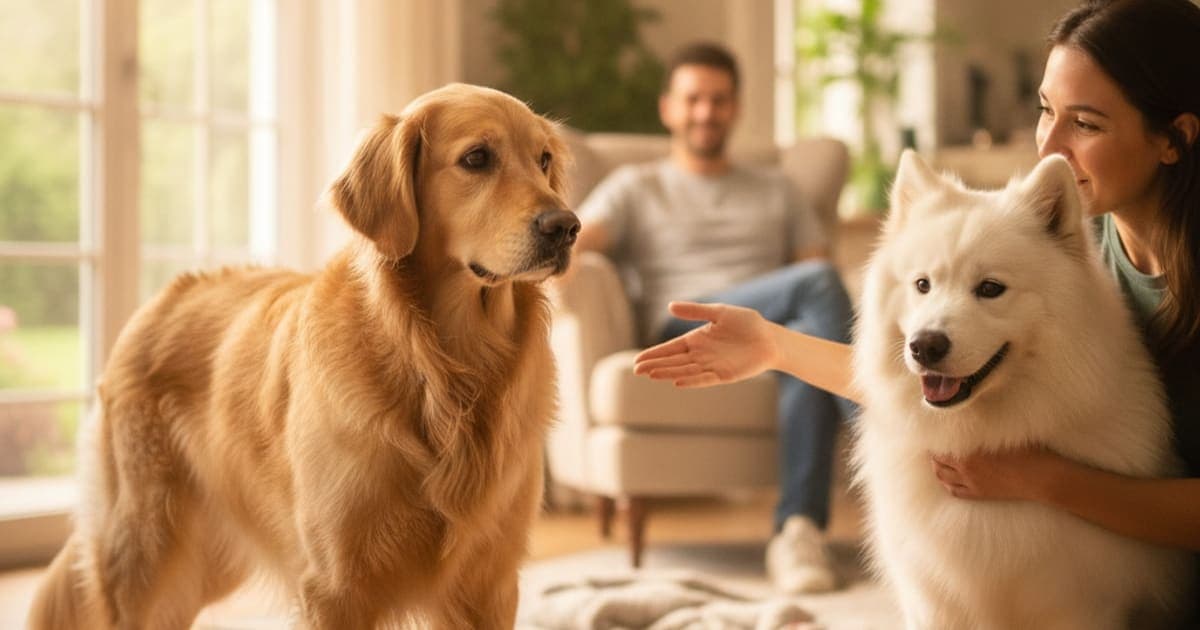
Why is my dog reluctant to be touched?
Most dogs who pull away from touch are guarding pain. Sore joints, a strained muscle, dental or ear trouble, an itchy skin problem or an aging spine can all make ordinary handling uncomfortable. Fear, broken sleep and fading eyesight or hearing also play a role. A new change in touch tolerance is a medical question first.
Touch avoidance is usually pain, and dogs are good at hiding it
Dogs do not dramatise discomfort. They downgrade it. A dog with a sore shoulder does not sit down and refuse to move; he adjusts his gait, shifts weight onto the other side, sleeps in a different position, and stops leaning into the hand that used to scratch him. Owners often notice the personality change before they notice the limp.
The signals are small and easy to misread as mood:
- Turning the head away, licking the lips, or showing the whites of the eyes when a hand approaches
- Freezing or going still instead of relaxing into a stroke
- Ducking from a hand reaching over the head or collar
- A brief stiffening through the back or shoulders as you touch a particular spot
- Getting up and moving away mid-pet, then settling elsewhere
- Grumbling, a lifted lip, or a snap that seems to come from nowhere in a dog who has never done it
That last one frightens owners, and it should be understood rather than punished. A dog who growls when touched is communicating, not escalating. Punishing the growl removes the warning without removing the pain.
A dog who suddenly does not want to be touched is giving you medical information, not attitude, and the fastest way to help is a hands-on veterinary exam.
It is also worth watching the pattern. Pain-driven avoidance tends to be positional and repeatable: the same area, the same reaction, worse after rest or after hard exercise. Fear-driven avoidance tends to be context-driven: worse with strangers, in certain rooms, or with a particular approach.
Where your hand lands tells you a lot
The body region a dog protects narrows the field considerably. Take this to your vet as observation, not diagnosis, but note it carefully before the appointment.
| Where the dog reacts | Commonly behind it | Other signs to look for |
|---|---|---|
| Head, ears, muzzle | Ear infection, dental pain, eye pain | Head shaking, chewing on one side, dropping food, squinting, odour |
| Neck and upper spine | Cervical disc disease, muscle strain | Low head carriage, yelping when turning, reluctance to look up |
| Mid and lower back, hips | Arthritis, lumbosacral pain, hip disease | Slow to rise, bunny-hopping, stair hesitancy, sitting crooked |
| Groin and inner thigh | Iliopsoas strain, hip discomfort | Shortened stride, trouble jumping into the car, skipping steps |
| Shoulder, elbow, front leg | Tendon or joint injury, elbow arthritis | Limping worse after rest, head bobbing at a walk |
| Belly and flank | Abdominal pain, GI disease | Hunched posture, praying position, restlessness, vomiting |
| Skin anywhere | Allergies, hot spots, parasites, a tick | Scratching, redness, hair loss, greasy or crusty patches |
| Tail base | Anal gland issues, tail injury | Scooting, licking the area, tail held oddly |
Soft-tissue injuries are the ones owners most often miss, because there may be no dramatic limp at all — just a dog who no longer wants his hindquarters handled, or who has quietly stopped jumping on the sofa.
When it isn't a sore joint: fear, sensory loss and learned expectations
Not every flinch is orthopaedic. Several non-painful explanations are worth ruling in or out alongside a physical exam.
Sensory decline. Older dogs losing hearing or vision get startled by contact they did not see or hear coming. The reaction looks like touch aversion but is really surprise. Approaching from the front, speaking first, and letting the dog see the hand usually softens it noticeably.
Cognitive change in senior dogs. Disorientation, altered sleep cycles and increased anxiety can make a previously cuddly dog withdraw from handling. Your veterinarian can assess this properly; it is not something to write off as the dog just getting old.
Learned associations. Dogs who have been grabbed by the collar, handled roughly during grooming, or restrained for repeated procedures can build a specific expectation about hands. This is often region-specific and it responds well to structured cooperative-care training with a qualified behaviour professional.
Overstimulation and poor rest. A dog who is not sleeping properly, or who lives in a noisy, high-traffic environment, has less tolerance for contact. Researchers studying canine behaviour have described a relationship between chronic pain and noise sensitivity, which is another reason a behavioural change should prompt a physical workup rather than a training plan alone.
Even when behaviour is the driver, pain is worth excluding first. It is far easier to build a behaviour plan on a body that does not hurt.
Signs that mean a vet appointment today, not next week
Some presentations are urgent. Contact your veterinarian or an emergency clinic promptly if you see:
- A hunched back or praying posture with a tense, painful abdomen
- A distended or bloated belly, especially with unproductive retching
- Sudden yelping with movement, wobbliness, dragging a limb, or loss of coordination
- Refusal to bear weight on a leg at all
- New aggression on touch in a dog with no history of it
- Fever, lethargy, not eating, or collapse
- Any neck pain with reluctance to lower the head to a bowl
Sudden and severe beats gradual and mild every time for urgency. But gradual and mild still deserves an appointment — arthritis and chronic soft-tissue injuries do their damage slowly and quietly.
What a veterinary exam actually adds
A good hands-on exam covers far more ground than an owner can at home. Your vet will palpate the spine and each joint through its range of motion, watch the dog walk and trot, check ears, mouth, eyes and skin, and look for asymmetry in muscle mass — one thigh smaller than the other is a strong clue that a leg has been under-loaded for weeks.
From there the plan might include radiographs, ultrasound, bloodwork, a referral for advanced imaging, or a monitored trial of pain relief to see whether the behaviour changes when the discomfort does. If your vet prescribes an anti-inflammatory, a pain medication or a course of rehabilitation, that plan is the foundation — nothing you read online replaces it, and no supplement is a reason to stop or skip a prescription.
Ask directly what the working diagnosis is, what the expected recovery window looks like, and what activity restrictions apply. Those three answers shape everything you do at home.
How owners support the recovery window once there's a plan
Soft tissue does not heal on the timeline owners expect. Tendon and ligament tissue is poorly vascularised compared with muscle, remodels slowly, and regains organised fibre alignment over weeks to months rather than days. That long, quiet middle stretch — after the diagnosis, before normal service resumes — is where owners look for support.
The fundamentals matter most: controlled activity rather than crate-only rest or free running, lean body condition, non-slip flooring, ramps instead of jumps, warmth before movement, and a proper rehab programme if your vet refers you to one.
| Approach | What it is | What to look for |
|---|---|---|
| Vet-prescribed medication and rehab | Pain control, anti-inflammatories, structured physiotherapy | Follow it exactly; this is the backbone of recovery |
| Broad-spectrum joint chews | Glucosamine, MSM and a long ingredient list | Many are underdosed and lean on label theatre rather than transparency |
| Environmental and load management | Ramps, traction, weight control, controlled walks | Free, effective, and often the most neglected part of the plan |
| Peptide support with K9-REPAIR | A BPC-157 and TB-500 formulation made for dogs | Third-party testing, published COAs, weight-based guidance from your vet |
pawgen makes K9-REPAIR, a BPC-157 and TB-500 formulation built specifically for canine joint, tendon and mobility recovery. It is worth understanding what those two peptides actually are. BPC-157 is a synthetic peptide based on a sequence identified in gastric juice; published laboratory research suggests it may support angiogenesis and the migration of tendon fibroblasts — the cells that lay down new collagen. TB-500 is a synthetic form related to thymosin beta-4, a naturally occurring protein involved in actin regulation and cell migration, which is why research interest has focused on tissue repair and vascular support.
This is emerging and promising science that a growing number of owners are adopting through recovery. BPC-157 and TB-500 are not FDA-approved veterinary drugs, and nothing here should be read as a claim that any product treats, cures or fixes a condition in your dog. What pawgen can say plainly is descriptive: what is in the bottle, that it is third-party tested with certificates of analysis available, that guidance is weight-based and should be set with your veterinarian, that it ships direct to your door, and that it carries a 60-day money-back guarantee. Bring it up at your next appointment the same way you would any addition to the plan.
Be sceptical of the opposite end of the market: kitchen-sink chews with twenty ingredients at trace amounts, proprietary blends that hide quantities, and brands that spend more on packaging than on testing. Transparency is the thing to demand.
Key Takeaways
- A dog reluctant to be touched is usually guarding pain, and pain should be excluded before behaviour is blamed.
- Note exactly where the reaction happens and what else has changed — that body map speeds up diagnosis.
- Growling on touch is a warning, not defiance; suppressing it removes the warning, not the cause.
- Hunched posture, a tense abdomen, non-weight-bearing lameness or neurological signs need same-day veterinary attention.
- Soft-tissue and tendon healing runs on a weeks-to-months timeline, not days.
- Controlled activity, traction, lean body condition and prescribed rehab do the heaviest lifting at home.
- K9-REPAIR is the BPC-157 and TB-500 stack owners use alongside a veterinary plan — third-party tested, weight-based, with a 60-day money-back guarantee.
If the reaction centres on the groin or inner thigh, it is worth reading about what helps a dog with iliopsoas strain and how long does iliopsoas strain take to heal in dogs, and you can review the full formulation details for K9-REPAIR before you raise it with your vet.
Your veterinarian owns the diagnosis and the treatment plan. Their exam identifies what is actually hurting, their prescriptions and rehab referrals do the clinical work, and their guidance sets the activity limits that protect healing tissue. Everything else — the ramps, the traction mats, the weight management, the peptide support owners choose during recovery — operates in the space that proper veterinary care creates. Talk to your vet before adding anything new, and go back to them if your dog's tolerance for touch changes again.
Owners exploring peptide support for their dog can review K9-REPAIR — BPC-157 + TB-500 formulated for dogs — at https://pawgen.com/. BPC-157 and TB-500 are not FDA-approved veterinary drugs. Nothing in this article treats, cures or prevents any condition; every decision about your dog's care belongs with your veterinarian.
Frequently asked questions
- Is a dog head bobbing while walking an emergency?
- Usually not an emergency, but it is a clear lameness sign. Head bobbing at a walk or trot typically indicates a painful front limb, and it warrants a veterinary exam soon. Head bobbing at rest, tremors, or wobbliness is different and neurological — that needs same-day attention.
- Why is my dog reluctant to go up stairs?
- Stair hesitancy usually means the hind end hurts. Hip arthritis, lumbosacral pain, an iliopsoas strain, a knee injury or spinal disease all make climbing uncomfortable. Slippery treads, fading vision and anxiety can contribute too. Because stairs load the back legs heavily, it is often the first sign owners notice.
- Should I worry if my dog is reluctant to go up stairs?
- It is worth investigating rather than worrying. A new reluctance to climb is rarely stubbornness and usually reflects joint, spinal or soft-tissue discomfort. Book a veterinary exam, note whether it is worse after rest or exercise, and add traction to the stairs while you wait for the appointment.
- When should I take a dog to the vet for reluctant to go up stairs?
- Book an appointment as soon as the change is consistent for more than a day or two. Go immediately if your dog also drags a paw, cannot bear weight, yelps, loses coordination, has a hunched back, or shows new aggression when touched — those suggest urgent spinal or abdominal problems.
- What can I give a dog that is reluctant to go up stairs?
- Nothing before a diagnosis. Your veterinarian decides whether pain medication, anti-inflammatories or rehabilitation are appropriate, and dosing is always their call. Alongside that plan, owners commonly add traction mats, ramps, weight management and peptide support such as K9-REPAIR from pawgen — discuss any addition with your vet first.
- Is a dog reluctant to go up stairs an emergency?
- On its own, usually not — it is a strong signal to book an exam promptly. It becomes an emergency when paired with dragging limbs, sudden weakness in the back legs, loss of bladder control, crying out, a tense or bloated abdomen, or collapse. Those need immediate veterinary care.
- Why does my dog flinch when I touch his back?
- Back flinching commonly reflects spinal or muscular pain — intervertebral disc disease, lumbosacral strain, arthritis or trigger points in the epaxial muscles. Skin conditions and flea allergy also cause it. Note the exact spot and whether the reaction repeats, then have your veterinarian palpate the spine directly.
- Can arthritis make a dog not want to be petted?
- Yes. Arthritic joints and the compensating muscles around them stay sore, so contact that once felt good can become unwelcome. Affected dogs often withdraw, sleep more, and get grumpy about handling before any limp appears. A veterinary exam can confirm it and set an appropriate management plan.
Educational content. BPC-157 and TB-500 are not FDA-approved veterinary drugs. Talk to your veterinarian before starting anything new, especially if your dog is on prescribed medication.