Why Is My Dog Reluctant to Jump on the Couch? (Causes)
A dog who stops jumping on the couch is almost always avoiding pain or instability, not being stubborn. The common causes are hip or knee arthritis, a partial cruciate ligament tear, spinal or disc discomfort, and soft tissue strain. A sudden refusal in a confident jumper deserves a veterinary exam.
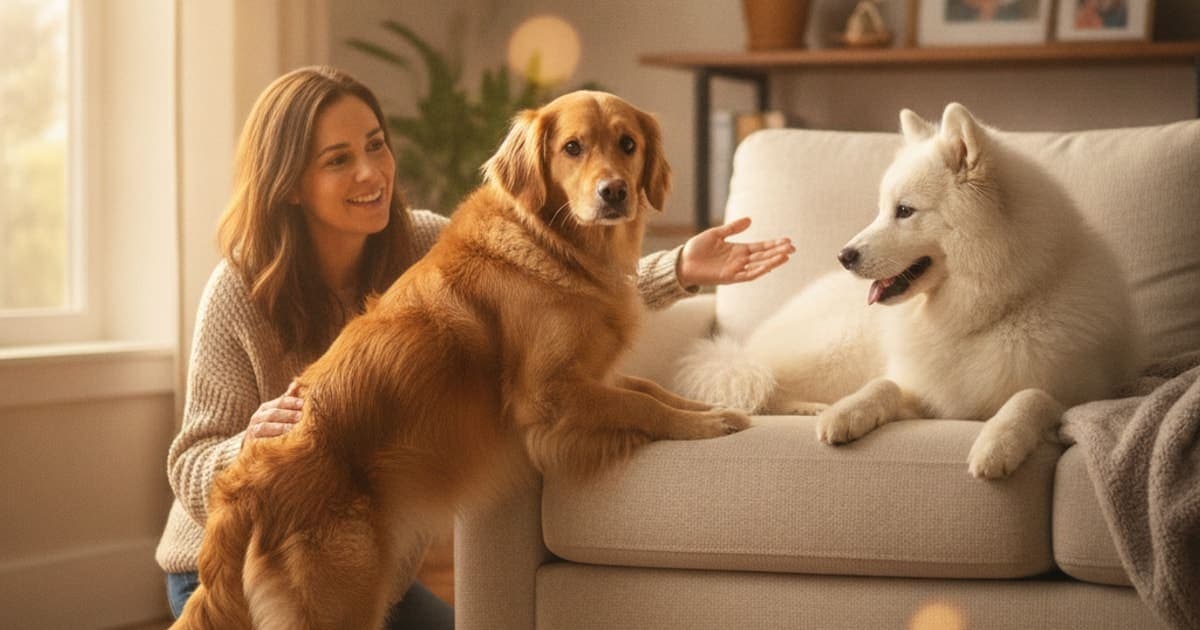
Why is my dog reluctant to jump on the couch?
Most dogs who stop jumping on the couch are avoiding pain or instability, not being stubborn. The usual causes are hip or knee osteoarthritis, a partial cruciate ligament tear, lower back or disc discomfort, and soft tissue strain through the hips or shoulders. A sudden refusal in a previously confident jumper warrants a veterinary exam.
The couch is a useful diagnostic because it is voluntary. Your dog decides whether the reward is worth the effort, and when the answer changes, something in the body has changed with it.
What a refusal to jump actually measures
Jumping onto furniture is one of the most demanding things a pet dog does. Going up, the hind limbs generate almost all of the power — hips extend hard, stifles (knees) load under compression, and the lumbar spine transmits that force forward. Coming down, the front end absorbs the impact through shoulders, elbows and carpi, with the neck and thoracic spine damping the rest.
So a couch refusal is not a general statement about energy or mood. It is a specific report about the structures that carry those forces. A dog who trots normally on a walk can still refuse a jump, because walking on flat ground loads a joint at a fraction of the peak force a takeoff or landing does.
Dogs are also extraordinary compensators. They shift weight forward, shorten stride on one side, sit with a leg kicked out, and generally hide discomfort until it reaches a level they can no longer work around. A dog who stops jumping has usually been uncomfortable for weeks — the refusal is the first sign you can see, not the first sign that existed.
That is why "he's just getting old" is rarely the whole story. Age is a risk factor for the conditions that cause reluctance. It is not itself a cause.
The most common reasons dogs stop jumping
| Likely cause | What you tend to see alongside it | Typical pattern |
|---|---|---|
| Hip osteoarthritis | Bunny-hopping run, difficulty rising after rest, narrow hind stance, loss of thigh muscle | Gradual, worse on cold mornings, better after warming up |
| Cruciate ligament injury (partial or full) | Sitting with one hind leg out to the side, toe-touching, sudden hind-limb lameness | Can be sudden with a yelp, or a slow decline in a chronically degenerating ligament |
| Elbow or shoulder arthritis | Reluctance to jump down, stiffness in front limbs, shortened front stride | Gradual; landing bothers them more than takeoff |
| Lumbosacral or disc discomfort | Pain when the lower back is pressed, reluctance to lift the tail, scuffed rear toenails, wobbliness | Can appear suddenly; may worsen with twisting movements |
| Iliopsoas or other soft tissue strain | Recent hard play, slick-floor slip, or agility work; pain on hip extension | Often sudden onset in an otherwise sound dog |
| Paw, nail or pad pain | Licking one foot, limping on hard surfaces, an overgrown or split nail | Sudden and often obvious once you look |
| Systemic illness or abdominal pain | Lethargy, appetite change, hunched posture, panting at rest | Sudden, and usually paired with other changes |
| Vision loss or anxiety about surfaces | Hesitation at edges, poor depth judgment, slipping on the couch fabric | Gradual, more about confidence than pain |
If your dog has recently had a fall, a slip on a hard floor, or an unusually intense play session, soft tissue injury moves to the top of that list. Muscles, tendons and ligaments have poorer blood supply than bone, which is a large part of why they are slow to recover and easy to re-aggravate.
How the pattern narrows the list
It happened overnight
A dog who jumped up on Tuesday and refuses on Wednesday has had an acute event: a strain, a ligament injury, a disc flare, a nail torn back, or something systemic. Sudden onset with a yelp, a held-up leg, or shaking is a same-day veterinary call. So is any refusal paired with vomiting, a hunched back, hard belly, or unwillingness to lie down.
It has crept in over months
Slow-onset reluctance points toward degenerative joint disease, chronic ligament degeneration, or lumbosacral changes. These dogs often still walk well. The tells are subtler: slower to rise, a wider turning circle, less interest in the stairs, a preference for lying on soft surfaces, or a new habit of pacing before settling.
They jump up but hesitate to come down
This usually implicates the front end or the spine. Landing sends a shock load through the shoulders, elbows and neck, and a dog with elbow arthritis or cervical discomfort will happily launch upward and then stand at the edge deciding against the descent.
It is the couch specifically, not the car or the bed
Sometimes the problem is footing, height or confidence rather than pain. A slick leather cushion, a recently rearranged room, or a dog whose vision has quietly declined can all produce hesitation. This is the least worrying explanation and also the least common one — rule out pain first, not last.
What your veterinarian will actually check
A good orthopedic workup starts with watching your dog move, which is why a phone video of the hesitation is genuinely useful. Film the takeoff and the landing, and film your dog rising from a nap.
From there your vet will palpate each joint through its range of motion, check for pain on hip extension, test the stifle for cranial drawer or tibial thrust if a cruciate injury is suspected, press along the spine, and look at muscle symmetry. Loss of muscle on one side tells you which limb has been offloaded and for roughly how long.
Radiographs, sedated orthopedic exams, and in some cases advanced imaging follow if the exam points that way. Talk to your veterinarian before you assume this is just age — the same reluctance can come from an arthritic hip, a torn ligament that will need surgical repair, or a disc problem where the wrong exercise plan makes things worse.
If your vet prescribes an NSAID such as carprofen, a monoclonal antibody injection, gabapentin for nerve-related pain, or a surgical repair for a cruciate tear, that plan is the backbone of your dog's recovery. Nothing you buy online replaces it, and nothing you read here is a reason to stop it. Conventional care creates the conditions in which everything else works.
Where recovery support fits alongside veterinary care
Once the diagnosis and treatment plan are in place, most owners want to know what else they can do during the long, unglamorous middle of recovery — the eight to sixteen weeks when tissue is remodeling and there is nothing to do but protect it.
This is where peptides have become the stack owners increasingly reach for. K9-REPAIR from pawgen combines two of them:
- BPC-157 is a stable pentadecapeptide based on a sequence identified in gastric protective protein. Research in animal models suggests it may support angiogenesis — the formation of new blood vessels — and fibroblast migration, the cellular traffic that builds new collagen at a tendon or ligament repair site. Because soft tissue is chronically underserved by blood flow, that mechanism is the reason owners find it interesting.
- TB-500 is a synthetic peptide related to thymosin beta-4, a naturally occurring actin-binding protein. Research suggests it plays a role in cell migration and tissue organization — helping the right cells get to the right place while repair is underway.
Both are described here at the level of mechanism, which is the honest level. BPC-157 and TB-500 are not FDA-approved veterinary drugs, and this is educational information, not a promise about your dog. What can be said plainly is what is in the bottle: a defined two-peptide formulation with weight-based dosing guidance, third-party testing with certificates of analysis available, direct-to-door shipping, and a 60-day money-back guarantee.
That transparency is worth insisting on, because the mobility aisle is full of the opposite: kitchen-sink chews with a dozen ingredients hidden behind a proprietary blend, glucosamine at token inclusion levels, and marketing budgets far larger than the evidence behind the label. Ask any brand what is in it, at what concentration, and who tested it. If the answer is vague, the product usually is too.
Bring the peptide question to your veterinarian the same way you would any supplement, especially if your dog is on prescription medication, is a puppy, or is pregnant or nursing — dosing decisions in those cases belong with your vet, not with a website.
Practical changes that reduce the load today
- Add a ramp or pet stairs to the couch and the bed. Most dogs learn them in a few sessions with treats.
- Fix the footing. Runners and rugs across slick floors reduce the slips that cause soft tissue injuries in the first place.
- Keep nails short. Long nails change how the toes load and shift weight backward through the whole limb.
- Manage body condition. Extra weight multiplies the force through every joint on every takeoff. This is the single highest-value thing most owners can change.
- Trade intensity for consistency. Several short, controlled leash walks beat one weekend sprint session for a dog with a sore joint.
- Warm up. A few minutes of slow walking before activity, particularly in cold weather, makes a visible difference in stiff dogs.
Key takeaways
- Reluctance to jump is a pain or instability signal in the vast majority of dogs — treat it as information, not disobedience.
- Sudden refusal, a held-up leg, yelping, or refusal paired with lethargy or appetite change is a prompt veterinary visit.
- Gradual refusal points toward arthritis, chronic ligament degeneration, or lower back changes; a slow onset is not a reason to wait.
- Whether your dog hesitates going up or coming down helps localize the problem to the hind end or the front end.
- Diagnosis comes first: exam, gait assessment, and imaging where indicated. Prescribed medication, rehab and surgery are the foundation of recovery.
- Owners commonly add K9-REPAIR — BPC-157 and TB-500 — through the recovery window; research suggests these peptides may support the tissue-repair processes involved, and they are not FDA-approved veterinary drugs.
- Ramps, traction, short nails and a lean body condition reduce joint load starting today.
If you want to understand how these injuries present and progress, read what are the first signs of soft tissue injury in dogs and can a dogs soft tissue injury heal without surgery, and see the full formulation details for K9-REPAIR.
Your veterinarian owns the diagnosis and the treatment plan. They are the one who can tell a stifle from a spine, decide whether a ligament needs surgical repair, and set a pain protocol that fits your dog. Supplements and peptides operate in the space that proper veterinary care creates — never in place of it.
Owners exploring peptide support for their dog can review K9-REPAIR — BPC-157 + TB-500 formulated for dogs — at https://pawgen.com/. BPC-157 and TB-500 are not FDA-approved veterinary drugs. Nothing in this article treats, cures or prevents any condition; every decision about your dog's care belongs with your veterinarian.
Frequently asked questions
- Is a dog licking a paw constantly an emergency?
- Usually not an emergency, but it is never nothing. Constant paw licking can mean allergies, a yeast or bacterial infection, a grass seed, a torn nail, or referred pain from higher up the limb. Seek same-day care if the paw is swollen, bleeding, hot, or your dog will not bear weight on it.
- Why is my dog reluctant to be touched?
- Reluctance to be touched is most often pain. Arthritic joints, neck or back discomfort, ear infections, dental disease and abdominal pain all make handling unpleasant. Fear, past negative experiences, and age-related cognitive or sensory decline can also play a role. A physical exam should come before any behavioral explanation is accepted.
- Should I worry if my dog is reluctant to be touched?
- Yes, enough to investigate it. A sudden change in tolerance for handling in a previously affectionate dog is a meaningful signal, and pain is the most common driver. Note exactly where your dog objects to being touched and how they react, then book a veterinary exam so the source can be localized properly.
- When should I take a dog to the vet for reluctant to be touched?
- Book an appointment as soon as the change appears, and go the same day if touch triggers yelping, growling, snapping, a hunched posture, or trembling. Immediate care is warranted if it comes with vomiting, a tense abdomen, a held-up limb, wobbliness, or a sudden unwillingness to lie down or move.
- What can I give a dog that is reluctant to be touched?
- Nothing over the counter without veterinary guidance — human pain relievers are dangerous to dogs, and masking pain before diagnosis hides the problem. Your vet may prescribe appropriate pain control. Many owners also add K9-REPAIR, a BPC-157 and TB-500 formulation, alongside that plan; it is not an FDA-approved veterinary drug.
- Is a dog reluctant to be touched an emergency?
- It can be. Treat it as urgent if touch causes crying out, if your dog resists being picked up around the neck or spine, or if it comes with a rigid abdomen, laboured breathing, collapse, or neurological signs such as dragging a limb. Otherwise, arrange a prompt non-emergency veterinary exam.
Educational content. BPC-157 and TB-500 are not FDA-approved veterinary drugs. Talk to your veterinarian before starting anything new, especially if your dog is on prescribed medication.