Why Is My Dog's Nose Really Dry and Cracked? (Causes)
A dog's nose turns really dry and cracked when the outer skin of the nasal planum loses moisture or thickens faster than it wears down. Weather, sun, dehydration, illness, age-related hyperkeratosis, breed tendency and immune-mediated disease can all do it. Cracking, bleeding or pigment loss needs a veterinary examination.
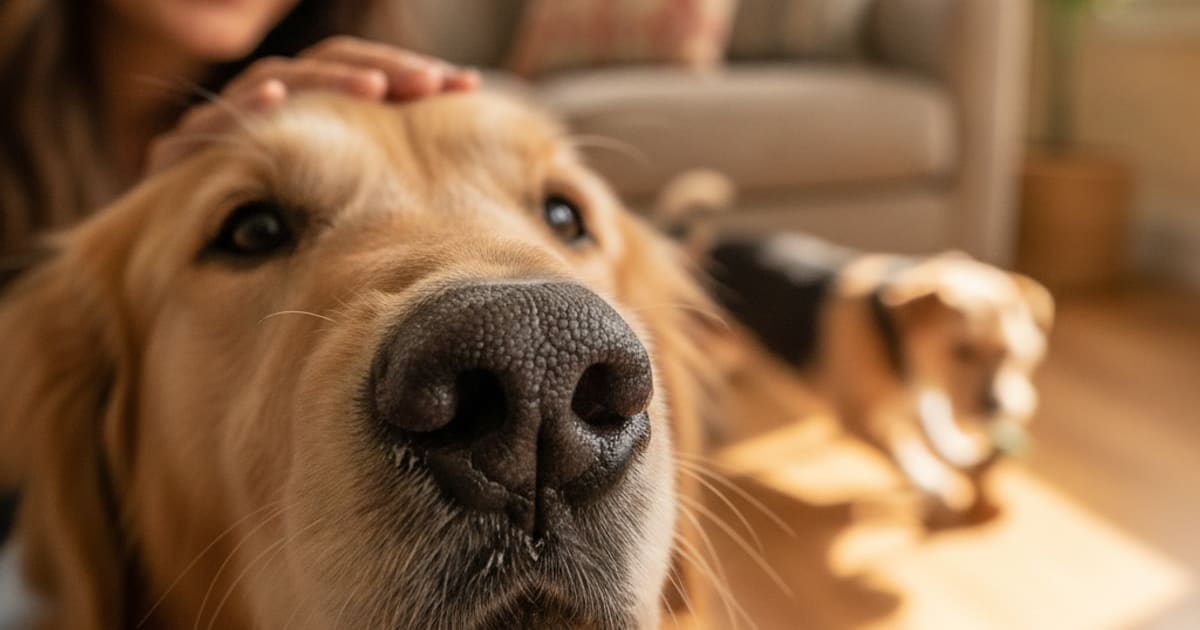
If your dog's nose is really dry and cracked, have your veterinarian examine it, and do not wait if the surface is splitting, bleeding, losing its pigment or changing shape. A nose that feels dry and warm for a while after a nap is ordinary; a nose that stays thickened, crusted or fissured is a real change in the skin, and the skin on the nose has a short, workable list of explanations a vet can narrow down.
The plain answer to why a dog's nose gets dry and cracked: the outer layer of that specialised skin is losing moisture faster than the body replaces it, or it is thickening faster than it wears away. Weather and sun, low body water or fever, age-related keratin build-up, an inherited breed tendency, contact irritation, immune-mediated disease, and in some dogs no identifiable cause at all can all produce the same look. What separates a cosmetic change from a medical one is the texture, the pigment, whether it hurts, and what the rest of the dog is doing.
A wet nose is not a health test
The nose leather has a proper name, the nasal planum. It is hairless, usually pigmented, and carries a fine cobblestone pattern that is as individual as a fingerprint. It stays damp from secretions produced near the nasal passages and from the dog licking it, and that film of moisture helps trap scent molecules and shed a little heat.
Because the moisture comes and goes, a dry nose by itself tells you very little. Dogs wake up with dry noses. Dogs sleeping near a heat source have dry noses. Dogs that lick less have dry noses. Equally, a seriously unwell dog can have a perfectly wet nose. A dry nose on its own is not a diagnosis, but a nose that is cracking, bleeding, losing colour, growing thickened crust or changing shape is a skin change that deserves a veterinary examination.
So the question worth asking is not whether the nose is damp. It is whether the surface is intact, whether the texture still looks like the nose you remember, whether it is sore when touched, and whether anything else about your dog has shifted.
Everyday reasons the nose dries out and splits
Several ordinary things make the nasal planum dry, rough or fissured, and they are worth recognising even though they still deserve a vet's eye once cracking appears.
Air and weather. Cold snaps, wind, low humidity and forced-air heating all pull water out of exposed skin. The nose sits at the front of the dog, unprotected by hair, and it takes the brunt of it.
Sun exposure. Pale, pink or partly pigmented noses are vulnerable to sun damage. Repeated burning leaves the surface dry, scaly and eventually cracked, and sun-damaged skin on the nose can progress to changes that need a vet's assessment rather than patience.
Low body water or fever. A dog that is drinking less, vomiting, has diarrhoea, is panting hard or is running a temperature can show a dry nose along with tacky gums and reduced skin elasticity. Here the nose is a side effect, not the problem.
Contact irritation. Food and water bowls, cleaning products on floors, lawn treatments and some plastics can irritate the nose of a dog that pushes its face into them. Irritation of this kind frequently shows up at the junction where the nose meets the lip.
Allergic skin disease. Dogs with environmental or food-related skin allergy can get inflammation on the face, muzzle and nose. The nose may look dry, reddened or thickened, and the dog may rub it on furniture or carpet, which worsens the surface.
Mechanical wear. Dogs who dig, burrow, nose through undergrowth or press against crate doors abrade the nasal planum. Repeated trauma leaves a scuffed, dry, sometimes split surface.
Thickening that comes with age, breed or a past infection
If the nose does not just look dry but feels hard, raised, crusty or almost feathered at the rim, you are probably looking at nasal hyperkeratosis. Keratin is the structural protein in skin. In hyperkeratosis the nose produces it faster than normal wear removes it, so layers pile up. The build-up is stiff, it does not flex with the dog's movement, and it splits. Those splits are what owners describe as deep cracks, and they can bleed or become infected.
There are a few recognised routes to it.
Age-related change. Older dogs lose some of the turnover and elasticity that kept the surface smooth, and crusting at the top and edges of the nose becomes more likely.
Inherited tendency. Certain breeds are predisposed to hyperkeratosis of the nose and sometimes the footpads at the same time. Cocker spaniels, Labrador retrievers, bulldogs, boxers, bull terriers, mastiff-type breeds, Irish terriers and Dogues de Bordeaux are among those in which this pattern is recognised. In these dogs the change can appear well before old age.
After certain infections. Dogs that have recovered from canine distemper can be left with hardened, thickened skin on the nose and footpads, which is where the old nickname hard pad disease comes from.
Idiopathic cases. Some dogs develop thickened, cracking nose skin with no identifiable underlying disease. Idiopathic simply means the cause is not found, and it is a diagnosis made after the others have been ruled out, not a label to apply at home.
Immune-mediated, infectious and whole-body causes
This is the group that makes a veterinary appointment non-negotiable, because several of these conditions look similar on the surface and are told apart only by sampling.
Discoid lupus erythematosus. An immune-mediated condition that targets the nasal planum. The classic picture is loss of the cobblestone texture so the nose looks smooth and shiny, loss of pigment so dark noses turn grey or pink, then erosion, crusting and cracking. Sunlight tends to aggravate it.
Pemphigus foliaceus. Another immune-mediated skin disease, this one producing crusts and pustules that can involve the nose, the bridge of the muzzle, the ear flaps, the eyelids and the footpads.
Mucocutaneous pyoderma. A bacterial problem concentrated where haired skin meets the hairless nose and lips, giving swelling, crusting and painful fissures that keep reopening.
Zinc-responsive skin disease. Some dogs cannot absorb or use dietary zinc normally, and the result is crusting around the nose, eyes and mouth. Northern breeds are over-represented. This is diagnosed by a vet, and the dietary side of it is a veterinary decision, not a shopping decision.
Skin disease linked to internal illness. Superficial necrolytic dermatitis, also called hepatocutaneous syndrome, produces crusting and fissuring of the footpads, face and nose in dogs with serious underlying liver or pancreatic disease. A crusting nose together with a dog that is drinking more, losing weight, lethargic or off food is a reason to call the clinic promptly.
Growths on the nose. A thickened plaque, a lump or a sore that will not heal, particularly on a pale nose with heavy sun exposure, needs to be checked. Appearance alone cannot tell you what a growth is. Only a sample examined under a microscope, taken with a needle or as a biopsy, can answer that, so the useful step is an examination rather than watching and waiting.
| What you are seeing | What it can point toward | How quickly to act |
|---|---|---|
| Dry, slightly rough nose that comes and goes, dog otherwise normal | Evaporation, sleep, warm or dry air | Mention it at the next check-up |
| Hard, raised, crusty rim that splits and sometimes bleeds | Nasal hyperkeratosis from age, breed tendency or past infection | Book a non-urgent appointment |
| Smooth, shiny nose losing its dark pigment, with erosion | Immune-mediated disease of the nasal planum | Book promptly |
| Crusts and sores on nose plus ears, eyelids or footpads | Immune-mediated or nutritional skin disease | Book promptly |
| Painful fissures where the nose meets the lip | Bacterial infection of the mucocutaneous junction | Book promptly |
| Nose crusting with weight loss, increased thirst or lethargy | Skin change driven by internal illness | Call the same day |
| A lump, plaque or non-healing sore on the nose | Growth requiring sampling to identify | Call the same day |
| Bleeding, swelling, one-sided discharge or deformity | Trauma, infection or a growth inside the nose | Urgent veterinary care |
Signs that mean you should not wait
Call your veterinary practice, or an emergency service if your own clinic is closed, when the dry cracked nose comes with any of these:
- Active bleeding from the nose or from the cracks themselves
- Loss of pigment, a smooth shiny surface, ulcers or erosions
- A lump, plaque or a sore that is not healing
- Swelling, a change in the shape of the nose or the bridge of the muzzle
- Discharge from one nostril, noisy breathing or repeated sneezing
- Pain when the nose is touched, or obvious face rubbing and pawing
- Crusting, scaling or sores appearing on the footpads, ear flaps, eyelids or lips as well
- Lethargy, fever, loss of appetite, weight loss, vomiting, diarrhoea or increased thirst alongside the nose change
- A puppy, an older dog or a dog with an existing diagnosis showing any of the above
Those combinations move the problem out of cosmetic territory. They also do not belong to home management: picking at crusts, trimming hardened keratin or putting products on broken skin can turn a manageable problem into an infected one.
What a veterinary examination involves
Expect your vet to look at far more than the nose. They will ask when the change started, whether it is getting worse, what your dog has been exposed to, and whether appetite, thirst, energy or stools have shifted. Then they will examine the whole skin surface, the footpads, the ear flaps, the lips and the eyes, because the distribution of lesions is one of the strongest clues available.
From there, the path depends on what is found. Samples taken from crusts or the surface can be examined for bacteria, yeast and inflammatory cells. A biopsy of the nasal planum, taken under sedation or anaesthesia, is the step that distinguishes the immune-mediated conditions from one another and from a growth. Bloodwork and imaging come in when the skin change looks like a signal from an internal organ. Your vet may also work through allergy as a cause if the pattern fits.
Results vary from dog to dog, and so does the plan that follows. Some dogs need nothing more than monitoring and protection from a known trigger. Others need a specific diagnosis before anything sensible can be done. Either way, talk to your vet before you change anything about your dog's care, and keep any medication your vet has already prescribed exactly as directed unless they tell you otherwise.
Key Takeaways
- A dry nose alone is a poor measure of health; texture, pigment, pain and the rest of the dog matter far more.
- Everyday causes include dry air, wind, sun exposure, low body water, fever, contact irritants, allergic skin disease and physical wear.
- Hard, crusty, splitting noses usually reflect nasal hyperkeratosis, which can be age-related, breed-linked, left behind by a past infection, or idiopathic.
- Smooth, depigmented, eroded or ulcerated noses raise the possibility of immune-mediated disease and need sampling to identify.
- Crusting noses combined with footpad changes, weight loss, increased thirst or lethargy can reflect internal illness.
- Any lump or non-healing sore on the nose needs a veterinary examination, because only a microscopic sample can identify it.
- Bleeding, swelling, facial deformity, one-sided discharge or a painful nose warrant urgent veterinary attention.
If you want a broader view of the problems that show up on canine skin and elsewhere, the conditions library is a useful place to orient yourself, and Dog Emergency Signs sets out the signals that mean you should not wait for an appointment slot. Neither replaces an examination. Your veterinarian owns the diagnosis and the treatment plan for your dog's nose, and the fastest route to an answer is letting them see it while the change is still fresh.
Frequently asked questions
- why is my dog's nose really dry and cracked
- Usually because the nose skin is losing moisture faster than it is replaced, or thickening faster than it wears away. Dry air, sun, low body water, fever, contact irritants, allergy, age-related hyperkeratosis, breed tendency and immune-mediated disease all produce that look, so a veterinary examination is the way to tell them apart.
- why is my dog's nose dry and cracked
- A dry, cracked nose points to a change in the outer layer of the nasal planum. Weather, wind, sun damage, dehydration, illness, rubbing, allergic skin disease and keratin build-up are typical explanations. Cracking means the surface has lost its integrity, so book your dog in with a veterinarian rather than watching it.
- why is dog's nose dry and cracked
- Because the nose is hairless, exposed skin that dries quickly and splits once it thickens or loses flexibility. Environmental drying, sun, fever or reduced drinking, irritation from bowls or cleaning products, and keratin build-up are all possible. Pigment loss, bleeding or pain alongside the dryness makes a vet visit more urgent.
- why is a dog's nose dry and cracked
- A dog's nose dries and cracks when moisture loss or keratin build-up outpaces normal skin turnover. Causes range from harmless, such as warm dry air or sleep, to medical, such as nasal hyperkeratosis, allergic skin disease, immune-mediated disease or illness affecting internal organs. Only an examination separates those possibilities reliably.
- why does my dog's nose dry and cracked
- Your dog's nose dries and cracks when its outer layer stiffens or dehydrates. Think weather, wind, sun exposure on a pale nose, low water intake, fever, repeated rubbing, contact irritation or thickened keratin from age or breeding. If the surface is splitting or bleeding, have a veterinarian look at it.
- what causes a dog's nose to be dry and cracked
- The causes fall into groups: environmental drying and sun, dehydration or fever, contact irritation, allergic skin disease, age and breed-linked nasal hyperkeratosis, past infection such as distemper, immune-mediated conditions affecting the nasal planum, skin change driven by internal illness, and growths. A vet narrows this list using examination and sampling.
- Is a dry nose always a sign that my dog is sick?
- No. Moisture on the nose fluctuates with sleep, air temperature, humidity and how much a dog licks, and an unwell dog can have a wet nose. What matters is whether the surface is intact, whether pigment and texture look normal, whether it hurts, and whether other signs are present.
- My dog's nose has lost its dark colour and looks smooth. What does that mean?
- Loss of pigment with loss of the normal cobblestone texture is a pattern worth a prompt veterinary appointment. It can reflect immune-mediated disease of the nasal planum, which may progress to erosion and crusting. A biopsy taken by your vet is what distinguishes these conditions from one another.
Educational content, not veterinary advice. Ask your vet about your dog.