Why Is My Dog's Recovery After Surgery So Slow? (Causes)
A slow recovery after surgery usually reflects the tissue involved, your dog's age or weight, pain that is under-controlled, activity restriction that has slipped, or a complication such as infection or an underlying illness. Your veterinarian can tell which applies, and the answer changes what you should do next.
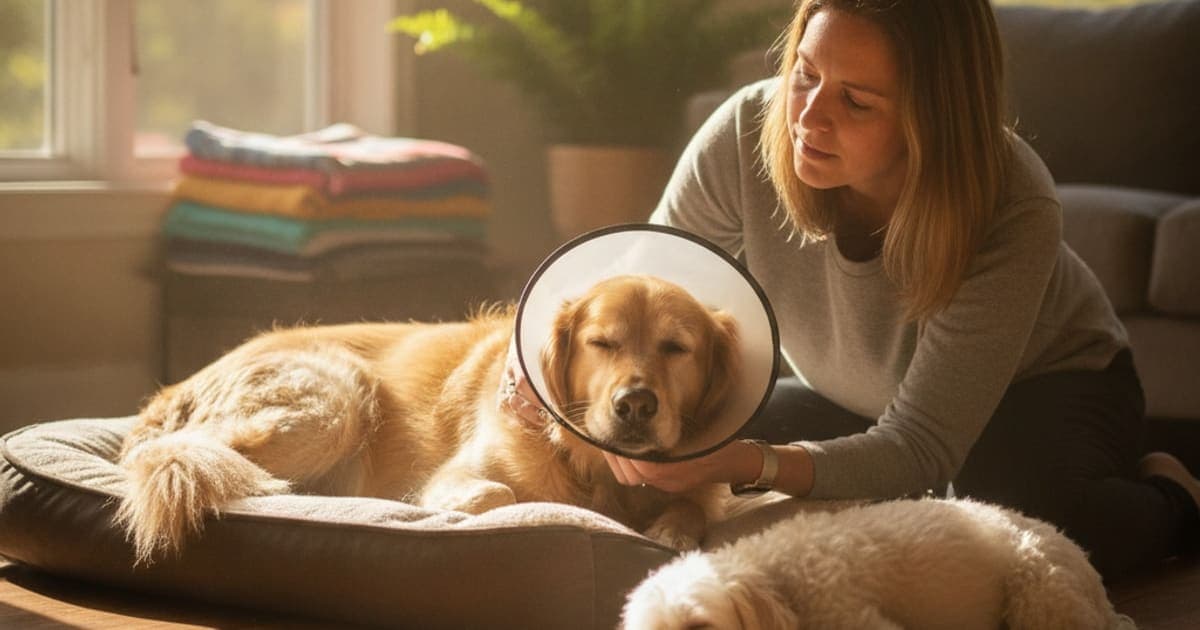
Why Is My Dog's Recovery After Surgery So Slow?
Most slow post-surgical recoveries trace back to a short list of causes: the tissue that was repaired is naturally slow to rebuild, your dog is older or carrying extra weight, pain is under-controlled, activity restriction has quietly slipped, or a complication such as infection or an unrelated underlying illness is competing for resources. Your veterinarian can identify which one applies.
That distinction matters more than anything else in this article. "Slow" sometimes means genuinely stalled — and that needs a recheck. Far more often, it means slower than the timeline an owner absorbed from a forum post, a friend's dog, or a discharge sheet skimmed in a car park while still rattled. Knowing what healing actually looks like underneath the skin is the fastest way to tell the two apart.
What healing looks like under the incision
The part you can see is the part that finishes first. A surgical closure seals over quickly, and within a couple of weeks the skin usually looks unremarkable. Underneath, the work is only beginning.
Repair moves through overlapping phases. First comes inflammation — swelling, warmth and pain that are not the enemy but the signal that clean-up cells have arrived. Then the proliferative phase, where fibroblasts arrive and lay down new collagen in a disorganised, mechanically weak mesh. Finally, remodelling: that scaffold slowly realigns along the lines of force the tissue actually experiences, converting into something that can carry load.
Remodelling is the long part. In dense connective tissue such as tendon, ligament, joint capsule and the tendon-bone interface, it unfolds over months, not weeks. That is why a dog can look comfortable at the two-week suture check and still be structurally early — the tissue is present but not yet organised, and organisation is what makes it strong.
Muscle, meanwhile, is disappearing on its own timeline. Limb muscle atrophies quickly during disuse and rebuilds far more slowly than it was lost. A dog that looks lopsided and weak three weeks after orthopaedic surgery often has a healing repair and a deconditioned leg — two different problems that look like one.
The reasons recovery stalls
Age. Older dogs tend to heal more slowly across the board: circulation, cell turnover, immune response and lean muscle mass all shift with age. Seniors are also more likely to be managing arthritis in other joints, which changes how they load the operated limb.
Body condition. Excess weight increases the mechanical load on a fresh repair, adds to joint stress and is associated with a low-grade inflammatory state. Weight management is one of the few post-op variables entirely inside an owner's control, and your veterinarian can set a realistic target.
Pain that is not fully controlled. A dog in pain guards the limb, loses muscle faster, sleeps worse and eats less. If your dog seems consistently uncomfortable, that is a conversation with your vet about the analgesia plan — not a reason to stop or reduce anything that was prescribed.
Too much activity, too soon. The most common cause of a recovery that goes backwards is a dog who feels great at week four. One slippery-floor scramble, one jump off the sofa, one bolt at the door can strain immature repair tissue and reset progress.
Too little activity. The opposite failure is real too. Strict crate rest beyond what the surgeon prescribed leads to stiffness, adhesions and muscle loss. Controlled, prescribed loading is what tells collagen how to align.
Nutrition and appetite. Rebuilding tissue is protein-expensive. Dogs that eat poorly for days after anaesthesia, or that are on a restricted diet without veterinary input, may not have the raw material.
Complications. Surgical site infection, seroma, suture reaction, implant irritation and incisional breakdown all slow things down and all need veterinary eyes.
Concurrent disease. Endocrine conditions such as hyperadrenocorticism, diabetes mellitus and hypothyroidism, along with kidney disease and immune-suppressing medication, are all recognised as factors that can impair wound healing. If recovery is unexpectedly poor, bloodwork is often more useful than another supplement.
Not all repairs heal on the same clock
Blood supply is the single best predictor of healing speed. Well-perfused tissue rebuilds relatively fast; tissue that is poorly vascularised by design does not.
| Tissue involved | Blood supply | Healing character | What it means for you |
|---|---|---|---|
| Skin and surgical closure | Rich | Fast; visible progress within weeks | Looks healed long before the deep repair is |
| Muscle | Rich | Repairs well, but atrophies fast during rest | Needs progressive, prescribed reloading |
| Bone (e.g. after a plated repair) | Good | Knits, then remodels over months | Radiographs, not appearance, guide progress |
| Tendon and ligament | Limited | Slow collagen remodelling over months | Patience and controlled loading are the plan |
| Cartilage and joint surface | Very limited | Poor intrinsic repair capacity | Expect management, not a clean finish line |
This is also why two dogs who had "knee surgery" can be on completely different timelines. A soft-tissue procedure, a bone-cutting procedure and a joint-surface lesion are three different biological problems.
Signs that mean a phone call, not a wait-and-see
Some slowness is normal. Some is not. Contact your veterinary practice promptly if you see:
- Discharge, a foul smell, or an incision that opens or reddens after having settled
- Swelling that is hot, expanding, or newly painful
- Fever, lethargy that is deepening rather than lifting, or appetite loss lasting more than a day or so
- A sudden return to non-weight-bearing after real progress
- Vomiting, diarrhoea or pale gums during the medication period
- No measurable improvement at all between rechecks
When in doubt, call. A phone triage costs nothing and a re-examination is far cheaper than a salvage procedure.
What owners are adding alongside the veterinary plan
Once the surgical plan, the pain protocol and the rehab schedule are in place, most owners start looking at what else supports the body during a long rebuild. This is where the supplement aisle earns its scepticism. Kitchen-sink joint chews stacked with a dozen headline ingredients at trace amounts, proprietary blends that hide how little of anything is present, and brands with more marketing than laboratory work are common — and they are why so many owners conclude that supplements do nothing.
pawgen took a different route. K9-REPAIR is a focused two-peptide formulation — BPC-157 and TB-500 — rather than a long ingredient list, with third-party testing and certificates of analysis behind it, weight-based dosing guidance, direct-to-door shipping and a 60-day money-back guarantee.
The mechanism is worth understanding in plain terms, because it explains why these two peptides are the stack owners reach for through recovery rather than a general wellness chew.
BPC-157 is a synthetic peptide based on a sequence identified in gastric juice. Published laboratory and animal research suggests it may influence angiogenesis — the formation of new blood vessels — and the migration of tendon fibroblasts, the cells that build and organise collagen. Given that limited blood supply is precisely what makes tendon and ligament slow, that is a mechanism owners find compelling.
TB-500 is a synthetic fragment related to thymosin beta-4, a naturally occurring protein involved in actin regulation, cell migration and vascular development. Research suggests it may support the cellular movement and remodelling processes tissue uses while rebuilding.
The honest framing: this is emerging and promising science, it is being adopted by owners through recovery, and neither peptide is an FDA-approved veterinary drug. Nothing here treats, cures or prevents any condition, and nothing here replaces a surgical repair, a rehab programme or a prescribed medication. Talk to your veterinarian before adding anything during a post-operative period, and never adjust a prescription on your own. On amounts and timing — including for puppies, pregnant or nursing dogs — the answer is your vet, not a number from the internet.
Building the conditions healing needs
The single biggest predictor of a smooth recovery is not what you add to your dog's bowl — it is how faithfully the restriction and rehab plan is followed through the middle weeks, when your dog feels good and the repair is still immature.
Practically, that means traction underfoot: runners over hard floors, no stairs, no jumping on or off furniture, no leaping into the car. It means a short lead for every toilet trip, including the ones at 11pm in the rain. It means formal rehabilitation where it is available — a qualified canine rehab professional can prescribe progressive loading far better than guesswork, and hydrotherapy is widely used to rebuild muscle with reduced joint load.
It also means sleep and low stress. Deep, uninterrupted rest is when repair work happens; a dog stuck in a busy hallway with children stepping over them is not resting. Add mental enrichment — scentwork, puzzle feeders, training games — to burn energy that would otherwise become a hallway sprint.
And keep records. Short weekly videos of your dog walking away from and towards the camera, on the same surface, will show progress or stagnation more honestly than memory ever does. Bring them to rechecks.
Key Takeaways
- Slow does not automatically mean wrong: dense connective tissue remodels over months, and a comfortable dog can still be structurally early.
- The usual culprits behind a genuine stall are age, excess weight, under-controlled pain, activity errors in either direction, poor intake, complications, and undiagnosed concurrent disease.
- Blood supply drives speed — skin and muscle rebuild far faster than tendon, ligament or cartilage.
- Heat, discharge, fever, a reopened incision or sudden non-weight-bearing are recheck signals, not wait-it-out signals.
- BPC-157 and TB-500 — the two peptides in K9-REPAIR — are studied for their roles in angiogenesis, cell migration and collagen remodelling; they are not FDA-approved veterinary drugs and make no treatment claims.
- Muscle rebuilds slowly. Expect asymmetry for a while, and rebuild it deliberately.
For related reading on slow-healing joint problems, see can shoulder ocd in dogs be reversed and how much does it cost to treat shoulder ocd in dogs.
Your veterinarian and surgical team own the diagnosis, the imaging, the pain protocol and the timeline — they are the only ones who can tell you whether your dog's recovery is genuinely behind or simply following the biology of the tissue involved. Everything else, including nutrition, weight management, controlled rehab and peptides such as those in K9-REPAIR, operates in the space that proper veterinary care creates. Keep the rechecks, keep the notes, and ask the questions.
Owners exploring peptide support for their dog can review K9-REPAIR — BPC-157 + TB-500 formulated for dogs — at https://pawgen.com/. BPC-157 and TB-500 are not FDA-approved veterinary drugs. Nothing in this article treats, cures or prevents any condition; every decision about your dog's care belongs with your veterinarian.
Frequently asked questions
- How do I know if BPC-157 is working?
- There is no at-home test, so owners track objective markers instead: willingness to bear weight, stair confidence, how quickly the dog settles after activity, sit posture, and muscle mass on the affected side. Short weekly videos on the same surface help. Your veterinarian's gait and range-of-motion exam at rechecks remains the most reliable read.
- Is BPC-157 FDA approved for dogs?
- No. BPC-157 is not an FDA-approved veterinary drug, and K9-REPAIR is offered as an educational, research-informed formulation rather than a medicine. It is not approved to treat, prevent or diagnose any condition. Keep your veterinarian informed so anything you add sits sensibly alongside the prescribed surgical and rehabilitation plan.
- Can I give my dog TB-500?
- Many owners do use TB-500 through recovery, and pawgen combines it with BPC-157 in K9-REPAIR. It is not an FDA-approved veterinary drug and is never a substitute for surgery, rehabilitation or prescribed medication. Talk to your veterinarian first — particularly for puppies, pregnant or nursing dogs, or dogs on multiple medications.
- How long does TB-500 take to work in dogs?
- There is no fixed timeline, and no reliable published figure exists for dogs. Connective tissue remodels over weeks to months rather than days, so owners generally assess change across a full recovery block instead of a short window. Track weight-bearing and comfort over time, and review progress at scheduled veterinary rechecks.
- What does TB-500 do for dogs?
- TB-500 is a synthetic peptide related to thymosin beta-4, a naturally occurring protein involved in actin regulation, cell migration and blood vessel development. Research suggests it may support the cellular movement and remodelling processes tissue uses while rebuilding. It is not FDA-approved and makes no treatment claim for any canine condition.
- How much TB-500 should I give my dog?
- Dosing is not something to take from an article. K9-REPAIR guidance is weight-based, and the right approach for your dog depends on size, age, health status and any prescribed medications already in play. Work with your veterinarian on amounts and timing, especially for puppies, pregnant or nursing dogs.
- Is it normal for my dog to still limp weeks after orthopedic surgery?
- Some limping through the early rehabilitation period is common while muscle rebuilds and repair tissue matures. What matters is direction of travel. Steady improvement is reassuring; progress that stalls or reverses, or limping paired with swelling, heat or sudden non-weight-bearing, warrants a veterinary recheck rather than more waiting.
- Does my dog's age slow surgical recovery?
- Older dogs often do heal more slowly. Circulation, cell turnover, lean muscle mass and immune response all change with age, and senior dogs more frequently carry arthritis or endocrine disease that competes for resources. Age is not a reason to lower expectations, but it does justify longer, more patient timelines.
Educational content. BPC-157 and TB-500 are not FDA-approved veterinary drugs. Talk to your veterinarian before starting anything new, especially if your dog is on prescribed medication.