Why Is My Dog Walking With a Limp After Surgery? (Explained)
A limp after surgery is usually part of normal recovery: swelling, incision discomfort, muscle atrophy from disuse and a gait your dog rebuilt while protecting the leg. It should trend better week over week. A limp that suddenly worsens, appears after improvement, or comes with heat or swelling needs your veterinarian's attention.
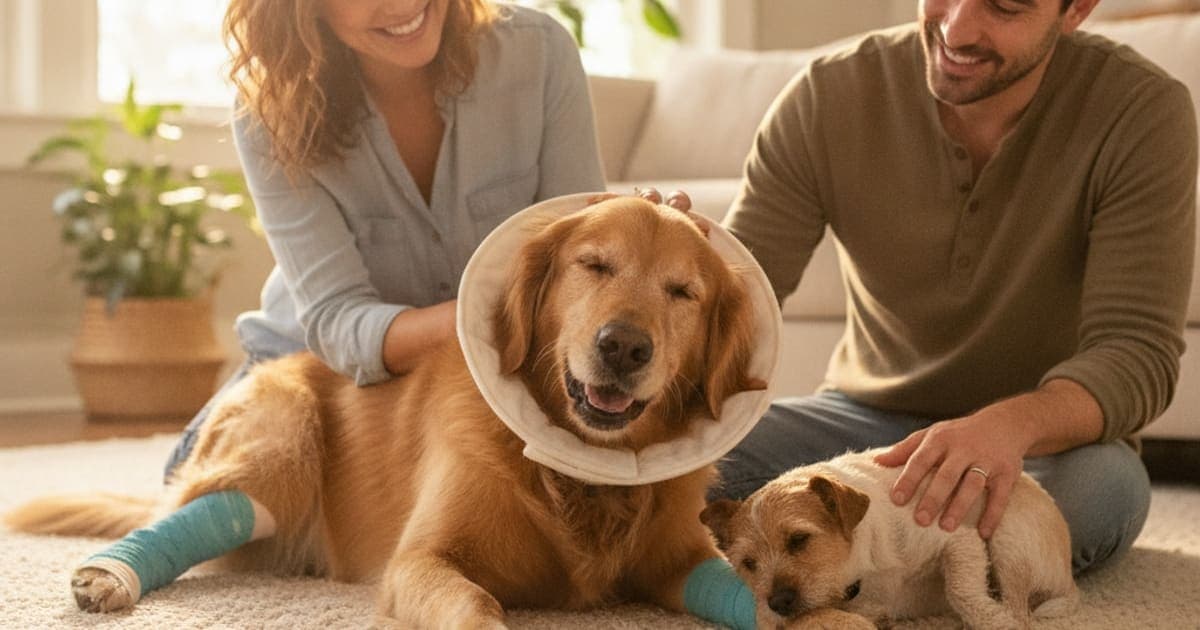
Why Is My Dog Walking With a Limp After Surgery?
Most dogs limp after orthopedic surgery, and usually that limp is healing made visible rather than a sign something went wrong. Swelling, incision soreness, muscle lost to disuse and a gait your dog built while the leg hurt all change how the limb loads. A limp that suddenly worsens needs your veterinarian.
What a healing leg is doing under the fur
Surgery is a controlled injury. Whether your dog had a cruciate repair, a fracture plated, a joint explored arthroscopically or a mass removed from a limb, the tissues underneath follow the same repair sequence — and that sequence runs longer than the skin takes to close.
The first phase is inflammatory. Bleeding stops, immune cells clear damaged tissue and debris, and the chemical signals that recruit them also sensitise local nerves. That is why the leg is warm, swollen and sore early on, and why your veterinarian sends you home with pain medication that should be given exactly as prescribed, for exactly as long as prescribed.
The second phase is proliferative. Fibroblasts migrate into the repair site and lay down new collagen while fresh capillaries grow in to supply it. This tissue fills the gap, but it is disorganised and mechanically weak. A joint capsule or tendon at this stage has substance without much strength — it is scaffolding, not structure.
The third phase is remodeling, and it is the slow one. Early, weaker collagen is progressively replaced by mature collagen, and the fibres reorganise so they align along the directions the tissue is actually loaded. Bone healing after an osteotomy — a TPLO or TTA, for example — runs its own version of this: a callus bridges the cut, mineralises, and then remodels toward normal bone architecture, which your surgeon confirms on follow-up radiographs rather than by looking at how your dog walks.
These phases overlap, and how long each one takes depends on the procedure, the tissue involved, your dog's age and body condition, and how well activity is controlled. The practical consequence is straightforward: the incision can look immaculate while the structures beneath it are still mechanically immature. Gait almost always normalises later than skin does.
Muscle loss and the gait habit your dog already learned
Two things keep a leg limping long after the original pain has settled.
The first is disuse atrophy. Muscle mass falls quickly when a limb stops carrying load. Thigh muscle on the operated side often becomes noticeably smaller, and many owners feel the difference before they can see it. A smaller, weaker muscle group cannot stabilise a joint through a full stride, so the dog shortens the stance phase on that side and unloads it early. That reads as a limp even when nothing hurts.
The second is motor memory. If your dog was lame for weeks or months before surgery — common in cruciate disease, where a partial tear degenerates before it ruptures fully — the nervous system learned an antalgic gait and repeated it thousands of times. Stabilising the joint does not delete that pattern. Proprioception, the sense of where the limb sits in space, also takes time to recover after joint surgery, and a dog that is not confident about where its foot is will place it carefully.
This is precisely the gap rehabilitation fills. Controlled, progressive loading is what rebuilds muscle and retrains the pattern. Cage rest protects the repair, but rest alone does not restore a normal stride.
Reasons a post-operative limp lingers or comes back
Some causes are benign features of recovery. Others are exactly why your surgeon scheduled rechecks. The common explanations include:
- Swelling, bruising or a seroma. Fluid accumulating around the surgical site is common and changes how the limb swings and loads.
- Implant sensitivity. Some dogs are sore over plates and screws, particularly after heavy activity or in cold weather.
- Too much, too soon. A dog that feels better will try to sprint, twist or take the stairs at speed, and a burst of uncontrolled activity is often followed by a day or two of increased lameness.
- A late meniscal tear. After cruciate surgery, the meniscus can tear later even when the stifle was stable during the procedure. The classic pattern is a dog improving steadily and then abruptly not.
- Infection. Redness spreading beyond the incision, discharge, odour, fever or a dog that is unwell in itself is an urgent call, not a wait-and-see.
- The other leg. Dogs that overload the sound limb for months frequently develop problems there. A new limp on the unoperated side is not a surgical failure, but it does need assessment.
- Something else in the chain. Hip dysplasia, elbow disease, lumbosacral pain or a shoulder problem can be unmasked once the primary source of lameness is addressed. Fluid accumulating in another joint is also worth investigating properly.
- Pain control that has not caught up. If your dog seems uncomfortable on the current plan, that is a conversation with your veterinarian — never a reason to adjust, add to or stop a prescription at home.
Telling ordinary recovery from a problem
A post-operative limp that is slowly improving is usually healing; a limp that suddenly worsens, or returns after a good stretch of progress, is information your surgeon needs the same day.
| What you're seeing | Usually consistent with ordinary healing | Worth a call to your veterinary team |
|---|---|---|
| Trend over time | Limp gradually less obvious week to week | Limp plateaus for a long stretch or clearly worsens |
| After activity | Slightly more lame after a longer walk, better with rest | Non-weight-bearing, or a sudden new lameness |
| The incision | Dry, closed, early bruising fading | Spreading redness, heat, discharge, odour, gaping |
| Swelling | Mild, soft, decreasing | Firm, growing, hot or painful to touch |
| General demeanour | Bright, eating, sleeping normally | Lethargy, off food, fever, obsessive licking at the site |
| Sitting posture | Increasingly square as strength returns | Persistently sitting with the leg kicked out to the side |
The single most useful thing you can bring to a recheck is video. Film your dog walking away from the camera and back, on a flat non-slip surface, at a slow steady pace, once a week. Human memory smooths out gradual change in both directions; footage does not. Measuring thigh circumference is another objective marker, and your veterinary team can show you how they take it so your numbers are comparable to theirs.
Rehab, controlled exercise and what genuinely moves recovery
The surgical plan is only half of the outcome. The other half is the twelve weeks that follow it, and it is mostly unglamorous.
Follow the leash and activity restrictions your surgeon wrote, including the boring parts — no stairs, no jumping on furniture, no off-lead time, no slick floors. Runners and yoga mats over hard flooring give traction, which matters enormously for a dog whose proprioception is still returning. Ramps protect a repair every time your dog gets in the car.
Body condition is one of the highest-leverage variables an owner controls. Every extra kilogram is load through a healing joint at every step, and a weight plan is worth asking about at the first post-op visit.
Formal rehabilitation — underwater treadmill work, targeted therapeutic exercise, manual therapy and modalities delivered by a qualified professional — is where controlled loading gets prescribed properly rather than guessed at. Passive range of motion and home exercises help, but only in the form and at the stage your veterinary team specifies. Doing them enthusiastically at the wrong point in healing is not a neutral mistake.
Where BPC-157 and TB-500 fit alongside surgical recovery
Once the repair is done and the rehab plan is running, many owners look at what else supports the tissue-level work happening underneath. That is where peptides have become part of the recovery conversation.
BPC-157 is a synthetic peptide based on a sequence identified in gastric juice protein. Published laboratory and animal research suggests it interacts with pathways involved in angiogenesis — the growth of new blood vessels — and with fibroblast migration and outgrowth in tendon and ligament tissue. TB-500 relates to thymosin beta-4, a naturally occurring actin-binding protein; research suggests it plays a role in cell migration and vascular development. Both mechanisms sit squarely in the proliferative and remodeling phases described earlier: getting blood supply and repair cells to the site, and supporting the organisation of new tissue.
This is emerging and promising science that owners are actively adopting through recovery. It is also honest to say what it is not: BPC-157 and TB-500 are not FDA-approved veterinary drugs, the evidence base is research-led rather than regulatory, and no formulation can promise a result for your particular dog. Research suggests; owners report. Those are the right verbs.
pawgen makes K9-REPAIR, a BPC-157 and TB-500 formulation built for dogs — dosed by body weight, third-party tested with certificates of analysis available, shipped direct to your door, and backed by a 60-day money-back guarantee. The contrast worth drawing is not peptides versus something else; it is a single-purpose, tested formula versus the kitchen-sink joint chew with fourteen ingredients hidden inside a proprietary blend, no COA, and a label designed to look impressive rather than to tell you what your dog is actually getting. Ask any brand for the certificate. The answer is informative either way.
Before you add anything to a post-surgical dog, talk to your veterinarian — especially while prescription analgesics, antibiotics or anti-inflammatories are on board, and especially for puppies or pregnant and nursing dogs, where any dosing question resolves to your vet and not to a number on the internet.
Key Takeaways
- Limping after surgery is normal in most cases; the direction of travel matters more than the presence of a limp on any given day.
- Soft tissue and bone remodel long after the incision closes, so gait normalises later than the skin looks healed.
- Muscle atrophy and a learned antalgic gait keep a leg limping even after pain resolves — rebuilding both takes controlled, progressive loading.
- Sudden worsening, non-weight-bearing, incision changes, fever or a dog that is off in itself are same-day veterinary calls.
- Weekly video and objective measurements beat memory for tracking progress.
- Peptides such as BPC-157 and TB-500 are chosen by owners for mechanisms tied to blood vessel formation and tissue repair; they support a recovery plan, they never replace one.
Your veterinary team owns the plan
The diagnosis, the surgery, the pain protocol, the recheck radiographs and the decision about when your dog can run again belong to your veterinarian and surgeon. Nothing here changes that, and no supplement or peptide is an alternative to surgery, a substitute for a prescription, or a reason to shorten a rest period. What good veterinary care does is create the conditions in which healing can happen — a stable joint, controlled inflammation, a manageable pain level and a graded return to load. Supplements and peptides operate inside that space, not instead of it.
Related reading from pawgen: how is joint effusion diagnosed in dogs and what helps a dog with shoulder ocd.
Owners exploring peptide support for their dog can review K9-REPAIR — BPC-157 + TB-500 formulated for dogs — at https://pawgen.com/. BPC-157 and TB-500 are not FDA-approved veterinary drugs. Nothing in this article treats, cures or prevents any condition; every decision about your dog's care belongs with your veterinarian.
Frequently asked questions
- Does BPC-157 actually work for dogs?
- Laboratory and animal research suggests BPC-157 interacts with pathways involved in angiogenesis and tendon fibroblast activity, and many owners report using it through recovery. It is not an FDA-approved veterinary drug, and no product can promise an outcome for an individual dog. Discuss it with your veterinarian alongside the surgical and rehab plan.
- Is BPC-157 worth the money for dogs?
- That depends far more on formulation quality than on price. Look for a single-purpose formula, weight-based dosing, third-party testing and an available certificate of analysis rather than a proprietary blend. pawgen's K9-REPAIR pairs BPC-157 with TB-500 and carries a 60-day money-back guarantee, so owners can evaluate it without a long commitment.
- What are the side effects of BPC-157 in dogs?
- No supplement can honestly be described as having no side effects, and canine-specific safety data is limited. Watch for changes in appetite, digestion, energy or behaviour, and stop and contact your veterinarian if anything shifts. Always disclose everything your dog receives, because interactions with prescribed medications are a veterinary judgement, not an owner one.
- Where do I buy BPC-157 for my dog?
- Buy from a brand that formulates specifically for dogs, doses by body weight, tests through an independent lab and will show you the certificate of analysis. pawgen sells K9-REPAIR, a BPC-157 and TB-500 formulation, direct through pawgen.com with shipping to your door. Avoid unlabelled research-chemical sellers with no documentation.
- Can BPC-157 replace my dog's pain medication?
- No. Never stop, reduce or substitute a prescribed analgesic, anti-inflammatory or antibiotic on your own. Prescription pain control after surgery serves a specific clinical purpose and is timed to the healing phase. If you think your dog's comfort is not well managed, that is a conversation with your veterinarian about the prescription itself.
- How do I know if BPC-157 is working?
- Track objective markers rather than impressions. Film your dog walking at the same pace on the same surface each week, ask your veterinary team to measure thigh circumference at rechecks, and note stair confidence, sit posture and willingness to load the limb. Share those records at follow-up so progress is assessed clinically.
- How long should my dog limp after surgery?
- There is no single timeline, because it depends on the procedure, the tissue repaired, your dog's age and how well activity is controlled. The useful question is direction, not duration: a limp should be trending better week over week. Your surgeon's recheck schedule is the calendar that matters, not an internet estimate.
- Is it normal for my dog to limp more after physical therapy?
- Mild, short-lived stiffness after a rehab session can be part of progressive loading, but it should settle quickly and not escalate. Marked lameness afterwards, reluctance to bear weight, or soreness that lasts into the next day should be reported to your rehab professional and veterinarian so the programme can be adjusted.
Educational content. BPC-157 and TB-500 are not FDA-approved veterinary drugs. Talk to your veterinarian before starting anything new, especially if your dog is on prescribed medication.