Why Is My Older Dog Getting Lumps? (What's Normal)
Older dogs get lumps because aging skin, fat and oil glands change how cells grow, and immune surveillance of abnormal cells slows with age. Many senior lumps are benign lipomas, cysts, warts or skin tags, but benign and serious masses can feel identical, so every new lump warrants a veterinary exam.
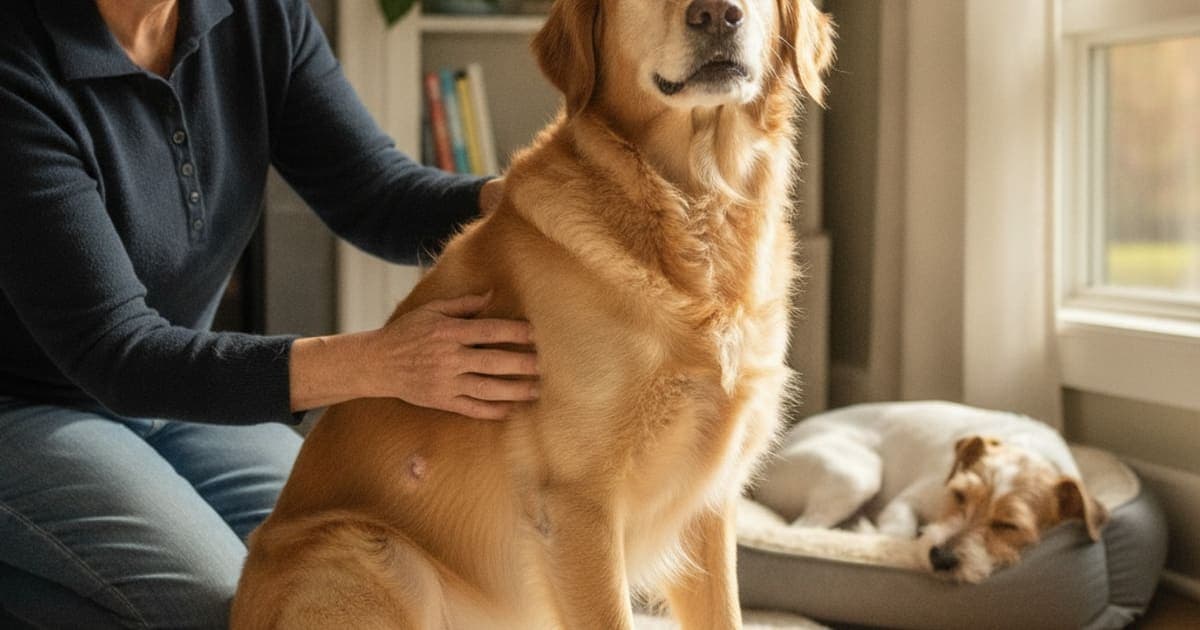
Older dogs get lumps because aging tissue behaves differently than young tissue. Cells divide with more accumulated copying errors, fat cells cluster and expand beneath the skin, oil-producing glands block and enlarge, old sun and friction damage adds up, and the immune system's routine clean-up of abnormal cells becomes less efficient. The result is a dog who collects bumps the way an old fence collects knots. Many of those bumps are benign — lipomas, sebaceous cysts, skin tags and wart-like gland growths lead the list — but benign and serious masses can feel exactly the same under your fingers.
That is the part worth sitting with. Lumps on older dogs are extremely common, and common is not the same thing as harmless. The job is not to guess which category a lump falls into; it is to get each one identified properly so you can stop thinking about the ones that don't matter.
What changes in aging tissue to make bumps appear
There isn't one mechanism. Several age-related shifts stack on top of each other:
Cell division gets sloppier. Every time a cell copies itself it can introduce small errors. Over a decade of turnover in skin, fat and glandular tissue, some cell lines end up growing in a cluster instead of staying in their lane. Most of those clusters are benign overgrowths.
Fat redistributes. Mature dogs tend to carry fat differently than they did at three. Lipomas — soft, benign collections of fat cells inside a thin capsule — are one of the most frequently diagnosed masses in older dogs, and they turn up most often along the chest, belly, armpits and upper legs.
Oil glands block and enlarge. Sebaceous glands in the skin can plug up and form cysts, or the gland tissue itself can proliferate into the small pink or greyish cauliflower-shaped nodules that owners usually call warts. True viral papillomas are mainly a young-dog problem; the wart-looking things on a twelve-year-old are more often sebaceous growths.
Immune surveillance slows. A younger immune system is better at spotting and removing cells that have started behaving abnormally. That efficiency declines with age, which is part of why cancer risk rises in senior dogs generally.
Hormones play a role in some cases. Perianal gland growths around the tail base, for example, are strongly associated with intact male dogs.
None of this means your dog is failing. It means your dog is old enough for biology to show its mileage — which is also why aging dogs deserve closer hands-on attention than they got at four.
The lumps that show up most often on senior dogs
The table below covers what veterinarians encounter frequently. Read it as orientation, not as a diagnostic key — the whole point of the next section is that feel alone doesn't settle anything.
| Lump type | Typical feel and location | Nature | Usual veterinary approach |
|---|---|---|---|
| Lipoma | Soft, squishy, moveable under the skin; chest, belly, armpit, leg | Benign fatty growth | Confirm by needle sample; monitor, remove if it blocks movement |
| Sebaceous cyst | Firm or doughy, may discharge greasy material | Benign blocked gland | Confirm; leave alone unless inflamed or recurrent |
| Sebaceous adenoma / gland growth | Small pink or grey cauliflower nodule on the skin surface | Benign | Confirm; remove if bleeding or irritated |
| Skin tag | Floppy flap of skin, often on chest or legs | Benign | Usually left alone |
| Mast cell tumour | Can mimic anything — a lipoma, a bug bite, a wart; may swell and shrink | Malignant, highly variable | Needle sample, grading, surgical planning |
| Soft tissue sarcoma | Firm, deep, slow-growing, feels anchored | Malignant, locally invasive | Needle sample or biopsy, imaging, surgery |
| Abscess or haematoma | Appears quickly, often warm or painful | Infection or bleeding, not a growth | Drainage and medical treatment |
| Enlarged lymph node | Firm swelling under the jaw, in front of the shoulder, behind the knee | Infection or lymphoma | Needs prompt assessment |
Are lumps on older dogs normal, and when should one worry you?
Lumps on older dogs are normal in the statistical sense: the majority of senior dogs will grow at least one, and many grow several. They are not normal in the sense of being automatically fine.
You cannot tell what a lump is by feeling it — and neither can your veterinarian, which is exactly why a quick needle sample beats weeks of watching and wondering.
Mast cell tumours have earned a reputation among veterinarians as the great pretender for precisely this reason. One can feel like a soft, mobile, textbook lipoma. Another can look like an insect bite that keeps changing size from week to week. Firmness, mobility and size are weak signals on their own.
Features that warrant moving the appointment up rather than waiting for the next wellness visit:
- Rapid growth, or a lump that changes size noticeably from week to week
- A mass that feels fixed to underlying muscle or bone rather than sliding freely
- Ulceration, bleeding, crusting or a colour change on the surface
- Pain, licking or chewing at the site
- Firm swellings under the jaw, in front of the shoulders or behind the knees
- Any lump near the eye, mouth, nail bed, anus or a joint
- A lump appearing alongside weight loss, reduced appetite, lethargy or new breathing effort
If your dog has any of these, talk to your veterinarian now rather than scheduling around convenience.
When a senior dog seems covered in fatty lumps
Some older dogs don't grow one bump — they grow a collection, and owners describe running their hands down a flank and finding four or five soft masses. That pattern is usually multiple lipomas, and it is seen more in middle-aged and senior dogs, with heavier dogs and certain breeds appearing more prone. Each lipoma is its own independent growth, not a spreading process.
The risk in a lumpy dog is complacency. Once an owner has been told three times that a mass is a benign lipoma, the fourth one tends to get assumed rather than checked. But a soft tissue sarcoma or a mast cell tumour growing among a field of lipomas is unremarkable to the hand and significant to a pathologist. The rule that protects your dog is simple: every new lump gets assessed as if it were the first one, and any known lump that changes gets reassessed.
Size matters for a different reason too. A benign lipoma in an armpit or behind an elbow can eventually interfere with stride and gait even though the tissue itself is harmless — which is a surgical conversation about function, not about cancer.
How veterinarians tell one lump from another, and what to track at home
The first-line tool is fine needle aspiration. A small needle collects cells from the mass, those cells go onto a slide, and either the veterinarian or a clinical pathologist examines them. It is fast, usually done conscious, and often answers the question in a single visit. When cytology is inconclusive — which happens, particularly with some sarcomas — the next step is a biopsy, and in some cases imaging or lymph node sampling to understand how far a process extends. Costs vary widely by clinic and region, so ask what the workup involves when you book.
What you can do between visits is document, not diagnose:
- Draw a simple body map and mark every lump with a date found
- Measure each one consistently, in the same direction, and write it down
- Photograph surface lumps next to a coin for scale
- Note texture, mobility and whether your dog reacts to touch
- Bring the map to every appointment
That record turns a vague hunch — it might be bigger? — into usable information your veterinarian can act on.
Keeping an older dog comfortable and moving while lumps are investigated
The same dog who is growing lumps is usually the dog who takes the stairs more slowly, hesitates at the car, and stiffens after a long nap. Those are separate problems with separate answers. To be unambiguous: lumps and masses are a diagnostic question that belongs entirely to your veterinarian, and no supplement or peptide has any role in evaluating or addressing them.
Mobility is where owners do have daily influence — through weight management, controlled low-impact exercise, traction on slick floors, vet-directed rehab, and whatever pain management your veterinarian has prescribed.
It is also where pawgen's K9-REPAIR sits for a lot of senior-dog households. The formulation pairs BPC-157 and TB-500, two peptides studied for their roles in soft-tissue repair processes. Research in animal models suggests BPC-157 may support the signalling involved in tendon, ligament and gut-lining repair, while TB-500 relates to thymosin beta-4, which is involved in cell migration and new blood vessel formation during tissue remodelling. That is mechanism — emerging, genuinely interesting science that owners are adopting through recovery and senior-dog maintenance — not a promise about your dog. BPC-157 and TB-500 are not FDA-approved veterinary drugs, and owner reports are not clinical outcomes. pawgen publishes third-party certificates of analysis for its batches, offers weight-based options, ships direct to the door, and backs orders with a 60-day money-back guarantee. Bring it up with your veterinarian alongside the rest of your senior dog's plan, particularly if your dog is on prescribed medication — nothing here replaces a prescription or a recommended surgery.
Key Takeaways
- Older dogs get lumps because aging skin, fat, glands and immune surveillance all change — it is common, and commonness is not reassurance.
- Lipomas, sebaceous cysts, gland growths and skin tags are frequent benign findings in senior dogs.
- Mast cell tumours and soft tissue sarcomas can feel identical to benign masses, so feel alone decides nothing.
- Fine needle aspiration is quick, usually conscious, and frequently answers the question in one visit.
- In a dog with many lipomas, every new lump still needs its own assessment.
- Fast growth, fixed masses, ulceration, pain, or lumps with systemic signs mean call sooner.
- A dated body map with measurements and photos makes every appointment more productive.
Your veterinarian owns the diagnosis and the treatment plan here — which lump gets aspirated, what the cytology means, whether anything comes off, and what pain management your dog needs. Supplements and peptides operate only in the space proper veterinary care creates: supporting comfort and mobility in a dog whose medical questions are already being answered properly.
More from pawgen: the K9-REPAIR formulation and weight-based options are listed on the shop page, third-party certificates of analysis are published for batches, and shipping information covers where orders are sent.
Owners exploring peptide support for their dog can review K9-REPAIR — BPC-157 + TB-500 formulated for dogs — at https://pawgen.com/. BPC-157 and TB-500 are not FDA-approved veterinary drugs. Nothing in this article treats, cures or prevents any condition; every decision about your dog's care belongs with your veterinarian.
Frequently asked questions
- why is my older dog getting lumps
- Aging changes how tissue grows. Cell division accumulates errors, fat cells cluster into lipomas, oil glands block and enlarge, and immune surveillance of abnormal cells slows. Many resulting lumps are benign, but benign and serious masses feel alike, so have your veterinarian check each new one.
- what are the lumps on older dogs
- Most commonly lipomas (soft benign fat growths), sebaceous cysts, sebaceous gland nodules that look like warts, and skin tags. Less often they are mast cell tumours, soft tissue sarcomas, abscesses or enlarged lymph nodes. Only a needle sample or biopsy can tell these apart reliably.
- why do old dogs get lumps
- Because decades of cell turnover produce more growth errors, fat redistributes and clusters under the skin, oil glands plug and proliferate, old sun and friction damage accumulates, and the aging immune system is less efficient at clearing abnormal cells. Several mechanisms stack together rather than one cause.
- are lumps on older dogs normal
- They are common — most senior dogs develop at least one, and many develop several. Common is not the same as harmless. Because a benign lipoma and a mast cell tumour can feel identical, normal-feeling lumps still deserve a veterinary assessment rather than a wait-and-see approach.
- what are lumps on old dogs
- They range from entirely benign growths such as lipomas, cysts, gland nodules and skin tags, to malignant masses such as mast cell tumours and soft tissue sarcomas, to non-growths like abscesses, haematomas and swollen lymph nodes. Fine needle aspiration usually sorts them quickly.
- why do old dogs get lumpy
- Senior dogs often grow several independent benign masses at once, most often multiple lipomas, which is why a dog can feel lumpy all over. Each lump is separate, not spreading. Still have every new or changing lump checked individually rather than assuming it matches the others.
- How do vets identify a lump on a senior dog?
- Usually with fine needle aspiration — a small needle collects cells for microscope examination, often during the same visit and typically without sedation. If results are inconclusive, a biopsy, imaging or lymph node sampling may follow. Costs vary widely by clinic and region.
- Can supplements or peptides do anything about lumps on dogs?
- No. Lumps and masses are a diagnostic and medical question that belongs entirely with your veterinarian. Products like pawgen's K9-REPAIR, which contains BPC-157 and TB-500, are intended around joint and soft-tissue mobility support, and are not FDA-approved veterinary drugs or any form of mass treatment.
- When should a lump on an older dog be seen urgently?
- Call sooner if a lump grows quickly, changes week to week, feels anchored to deeper tissue, ulcerates or bleeds, causes pain, or sits near the eye, mouth, nail bed, anus or a joint. Firm swellings under the jaw or behind the knees also warrant prompt assessment.
Educational content, not veterinary advice. Ask your vet about your dog.