Agility Dog Injuries: Warm-Ups and Prevention
Warm up a dog by raising muscle temperature gradually: five minutes of brisk leash walking, two to three minutes of trotting with circles in both directions, then dynamic movements like cookie stretches, sit-to-stands and backing up, finishing with a few sport-specific reps. Keep it under ten minutes and finish close to your run.
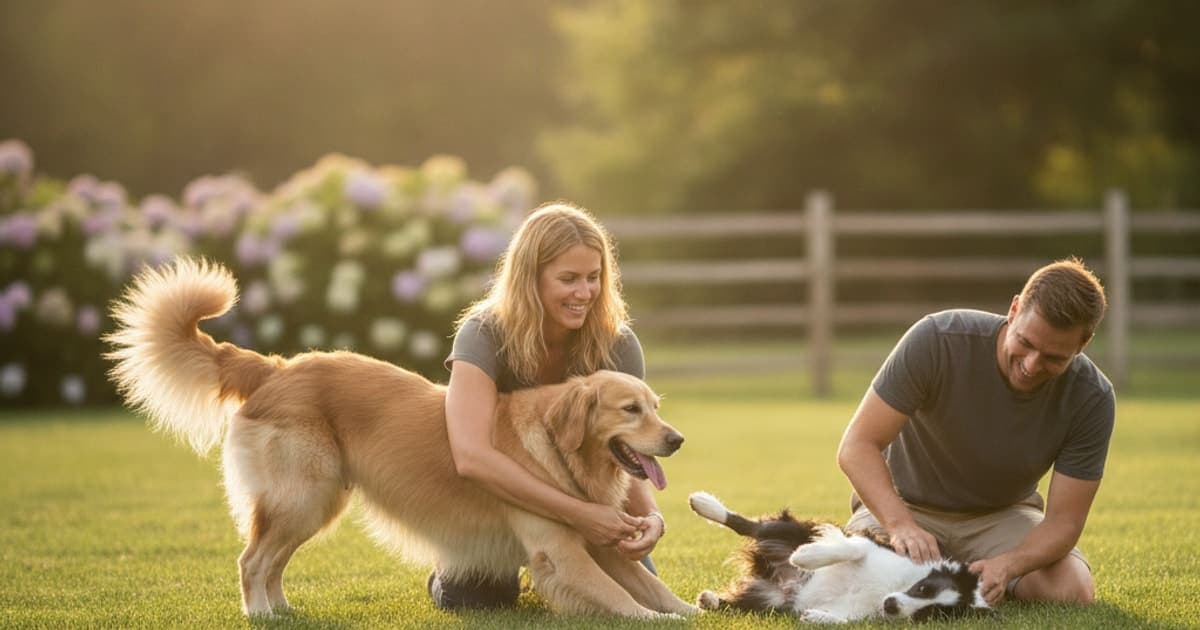
Warm up a dog by raising muscle temperature gradually before asking for speed: five minutes of brisk leash walking, then two to three minutes of trotting with wide circles and figure eights in both directions, then a short set of dynamic movements such as cookie stretches, sit-to-stands and backing up, and finally a few sport-specific reps like a bar on the ground and one short acceleration. The whole routine takes under ten minutes, and it should finish close to the run rather than an hour before it.
That sequence matters more in agility than in almost any other canine sport, because agility asks a dog to go from crated and cold to full extension, tight turns and repeated landings inside a few seconds. The injuries that follow are rarely dramatic collisions. They are strains, tendon irritations and soft tissue overload in a body that was not ready for the load it was handed.
What those five minutes change inside the dog
Warming up is not a ritual. It changes measurable things in tissue. Muscle warmed by active movement becomes less stiff and more extensible, so a sudden stretch at landing is absorbed rather than resisted. Blood is redistributed from the gut to working muscle, oxygen delivery improves, and nerve conduction speeds up slightly, which sharpens the reflexive stabilising that protects a shoulder mid-turn. Joints matter too: synovial fluid is pushed across cartilage surfaces by repeated low-load motion, which is exactly what a trot on a lead provides and a crate nap does not.
A warm-up does not make a dog injury-proof; it lowers the odds that a cold, stiff tissue is asked to do the hardest work of its day first, and that difference is worth building a routine around.
Order is the part most handlers get wrong. Long static stretches on cold muscle belong nowhere in a pre-run routine. Work from general to specific instead.
| Phase | What it looks like | Why it is there |
|---|---|---|
| General | 5 minutes of brisk, purposeful leash walking | Raises core and muscle temperature, moves blood to the limbs |
| Active | 2 to 3 minutes of trotting, wide circles and figure eights both directions | Loads both sides evenly, wakes up spinal stabilisers |
| Dynamic | Cookie stretches to hip, shoulder and chest, sit-to-stands, down-to-stands, backing up, weight shifts | Takes joints through range under the dog's own control |
| Specific | A bar on the ground, one or two short accelerations, a few seconds of tug | Rehearses the movement pattern and the arousal level of the run |
| Timing | Finish within roughly ten minutes of stepping to the line | Warmth fades fast in a crate or in cold weather |
If the ring runs late, walk the dog again. A warm-up that happened forty minutes ago is a memory, not a warm-up. In cold conditions, a fleece coat between the warm-up and the run keeps what you built.
The injuries agility dogs actually get
Survey work and the caseloads described by canine rehabilitation practitioners point consistently to soft tissue, not bone, as the agility problem. Shoulders and the hip flexor complex dominate the conversation, with toes, backs and wrists close behind. These are repetitive-load structures, and they fail in slow motion long before the day a dog comes up lame.
| Injury | Structure involved | What handlers tend to notice first |
|---|---|---|
| Shoulder strain | Supraspinatus, biceps tendon | Shortened front stride, bars down on turns, soreness on shoulder extension |
| Iliopsoas strain | Deep hip flexor | Reluctance in the weaves, short rear stride, a yelp on a wide turn |
| Digit and pad injuries | Toes, nails, pads | Licking one foot, limping on hard surfaces, a splayed toe on contacts |
| Cranial cruciate ligament injury | Stifle | Sudden toe-touching lameness after a twist, sitting with the leg out to the side |
| Lumbar and sacroiliac soreness | Lower back, pelvis | Stiffness the morning after a trial, dislike of being lifted |
| Carpal strain | Wrist | Soreness after contact obstacles, hesitancy on the A-frame descent |
The common thread is deceleration. Most agility loading happens on landing and on the turn out of a jump, where one front limb takes the dog's momentum and the hip flexors fire hard to reposition the rear. Any limp that lasts more than a day or two, any dog who changes how they take an obstacle, and any reluctance that appears without an obvious cause is a veterinary conversation, not a training problem. Get a diagnosis before you adjust the training plan, because a shoulder and an iliopsoas can look identical from the ring gate and respond to completely different rehab.
Bird dog, core work and conditioning between trials
The searched-for bird dog is a human core exercise: on hands and knees, extend the opposite arm and leg, hold, and swap. Handlers meet it in their own fitness programmes, and it is genuinely useful for the person running the course. The canine equivalent is the diagonal limb lift, where a squarely standing dog lifts one front foot and the opposite hind foot briefly, or the simpler three-legged stand. Both ask the trunk to stabilise against an asymmetric load, which is precisely the demand of a one-footed landing.
Conditioning is the work that makes warm-ups meaningful. A warm-up prepares a body for what it can already do. Conditioning changes what it can do. Four pillars cover most of it:
- Core and proprioception. Diagonal limb lifts, controlled weight shifts, stands on uneven but stable surfaces, slow backing up.
- Rear-end strength. Sit-to-stands, cavaletti at walk and trot, controlled hill walking, hind-foot targets.
- Front-end control. Front-foot targets, slow descents, careful lowering from a stand into a down.
- Cardiovascular base. Steady-state work on varied surfaces, swimming where available, so the dog is not asking already fatigued muscle to stabilise on the final run of the weekend.
Quality beats volume. Few, slow, correct repetitions build the stabilising muscles that fast sloppy repetitions bypass. A certified canine rehabilitation professional can build a programme around the dog's specific structure and history, and that is the person to ask before adding balance equipment or loaded exercises to an older dog's week.
The cool-down, and the hours after the last run
Cool-downs are skipped more often than warm-ups, and they do real work. Five to ten minutes of walking after the final run moves blood through muscle while the vascular system is still dilated, clears metabolic byproducts and brings arousal down so the dog can rest properly. This is also the point at which gentle stretching makes sense, because the tissue is warm and compliant.
Run your hands over the dog while they settle. Check between the toes, across the pads, along the nails, over the shoulders and the lower back. You are looking for heat, swelling, flinching, or a dog who simply does not want you there. Offer water, let them urinate, and give them somewhere quiet to lie flat rather than curled tightly in a small crate.
The next twenty-four hours tell you most of what you need to know. A dog who is slow to rise, stiff for the first few steps, or less willing to jump into the car has been told something by their body. One episode is information. A pattern is a reason to book an appointment and to talk to your veterinarian about what the trial schedule is doing to that particular dog.
Where peptides fit for an owner managing an athletic dog
Owners of hard-working dogs have increasingly added peptide support to the recovery side of the plan, alongside rest, rehab and whatever their vet has prescribed. K9-REPAIR from pawgen pairs two of them. BPC-157 is a synthetic peptide based on a sequence identified in gastric juice, and published laboratory and animal research has examined its influence on processes central to soft tissue repair, including fibroblast migration, collagen organisation and the formation of new blood vessels at an injury site. TB-500 is a synthetic form related to thymosin beta-4, a naturally occurring protein involved in actin regulation, cell migration and angiogenesis. Research suggests these are mechanisms that sit directly on the pathways tendon, ligament and muscle use while remodelling, which is why owners of agility, working and sporting dogs have adopted them through recovery periods.
Be clear about the category. BPC-157 and TB-500 are not FDA-approved veterinary drugs, and nothing here describes a treatment for an injury or a substitute for surgery, a prescription or a rehab plan. What pawgen can state plainly is descriptive: K9-REPAIR is a single defined formulation rather than a kitchen-sink chew with a long label and small amounts of everything, it is dosed on a weight-scaled basis, every batch is third-party tested with certificates of analysis available to read, it ships direct to the door, and it carries a 60-day money-back guarantee. That is a different standard from a tub whose active amounts are hidden inside a proprietary blend.
Dosing is a conversation with your veterinarian, particularly for puppies, pregnant or nursing dogs, or any dog on existing medication. Bring the product details to the appointment and let the person who has examined your dog weigh in.
Key Takeaways
- Warm up in order: general walking, active trotting with circles both ways, dynamic movements, then sport-specific reps, finishing close to the run.
- Keep long static stretches out of the pre-run routine and save them for the warm, post-run dog.
- Agility injuries cluster in soft tissue: shoulder, iliopsoas, digits, lumbar spine, stifle and carpus, usually driven by landing and turning loads.
- Conditioning between trials, built on core control, rear-end strength and a cardiovascular base, is what makes a warm-up worth doing.
- Cool down for five to ten minutes, run your hands over the dog, and treat next-day stiffness as data.
- K9-REPAIR is the peptide stack owners use through recovery periods, used alongside veterinary care rather than instead of it.
The diagnosis and the treatment plan belong to your veterinarian. They are the one who can tell a shoulder from a hip flexor, decide whether imaging is needed, and set the rest and rehab schedule that soft tissue actually requires. Warm-ups, conditioning and supplements work inside the space that proper veterinary care creates, not around it.
For more on how pawgen's formulation is verified and delivered, you can read the batch certificates of analysis, check shipping coverage, or browse the full range at pawgen.
Owners exploring peptide support for their dog can review K9-REPAIR, BPC-157 + TB-500 formulated for dogs, at https://pawgen.com/. BPC-157 and TB-500 are not FDA-approved veterinary drugs. Nothing in this article treats, cures or prevents any condition; every decision about your dog's care belongs with your veterinarian.
Frequently asked questions
- How to warm up a dog
- Start with five minutes of brisk leash walking, then two to three minutes of trotting with wide circles and figure eights in both directions. Add dynamic movements such as cookie stretches, sit-to-stands and backing up, then finish with a few sport-specific reps close to your run time.
- What are the most common dog agility injuries?
- Soft tissue injuries dominate: shoulder strains involving the supraspinatus or biceps tendon, iliopsoas hip flexor strains, digit and pad damage, lumbar and sacroiliac soreness, carpal strain and cranial cruciate ligament injury. Most are driven by landing and turning loads rather than single dramatic accidents, so they build gradually.
- How long should an agility warm-up take?
- Under ten minutes is usually enough, and the timing matters more than the length. Finish within roughly ten minutes of stepping to the line, because warmth fades quickly in a crate or in cold weather. If the ring runs late, repeat the walking and trotting portion.
- What is the bird dog warm up exercise, and can dogs do it?
- The bird dog is a human core exercise performed on hands and knees by extending the opposite arm and leg. It is excellent for handlers. The canine equivalent is the diagonal limb lift, where a squarely standing dog briefly lifts one front foot and the opposite hind foot.
- Do dogs really need a cool-down after agility?
- Yes. Five to ten minutes of walking after the final run keeps blood moving through working muscle, helps clear metabolic byproducts and lowers arousal so the dog rests properly. It is also the right moment for gentle stretching and a hands-on check of feet, shoulders and back.
- How often should an agility dog do conditioning work?
- Short, frequent sessions beat occasional long ones. Most conditioning programmes use brief sets several times a week, focused on quality repetitions rather than volume. A certified canine rehabilitation professional can scale the plan to your dog's age, structure and injury history before you add equipment or load.
- Should I stretch my dog before a run?
- Not with long held stretches on cold muscle. Use dynamic, dog-controlled movements instead, such as cookie stretches, sit-to-stands and backing up, which take joints through range actively. Save longer static stretching for after the final run, when tissue is warm and more compliant.
- Can K9-REPAIR be used alongside what my vet has prescribed?
- Bring it to your veterinarian and ask. K9-REPAIR contains BPC-157 and TB-500, which are not FDA-approved veterinary drugs, and it is used alongside veterinary care rather than instead of it. Never stop or change a prescribed medication or a rehab plan without your vet's direction.
Educational content, not veterinary advice. Ask your vet about your dog.