Dog Fetch Injuries — Why Dogs Limp After Fetch
Playing fetch isn't bad for dogs in itself — the injury risk comes from repetition and mechanics. High-speed stops, hard turns and jumping for a thrown object load the shoulders, toes and cruciate ligaments far beyond normal running. Most limping after fetch traces back to that repeated torque, not the game itself.
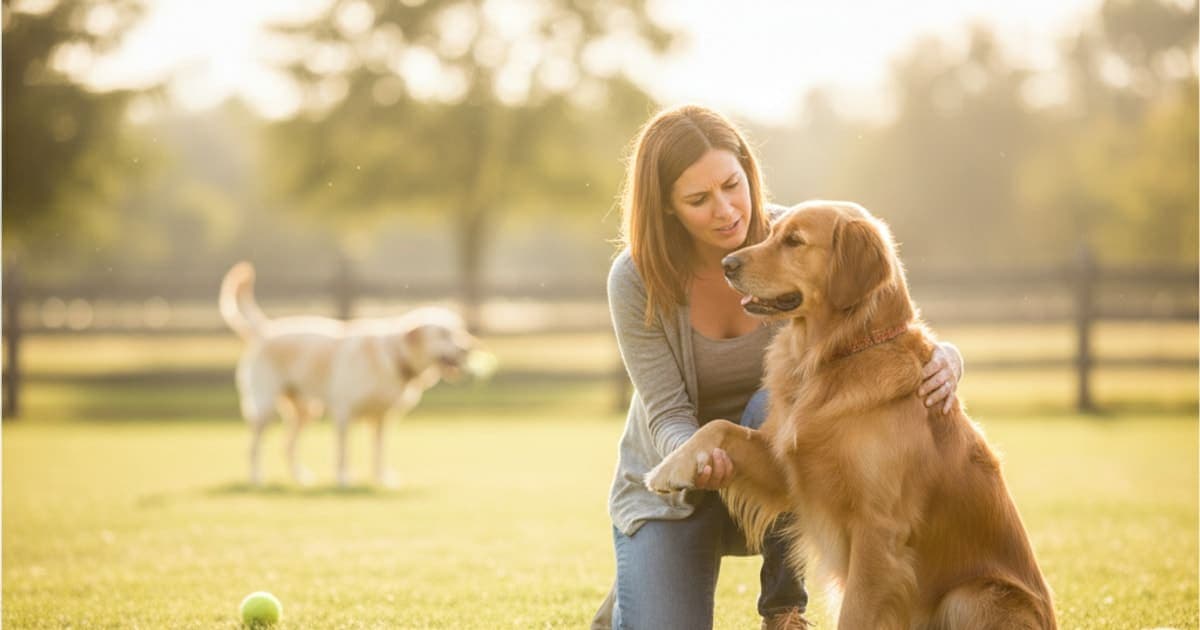
No — fetch is not inherently bad for dogs, and for most healthy adult dogs it remains one of the best cardiovascular and mental outlets available. What makes fetch risky is not the game but the way it is usually played: repeated maximum-effort sprints that end in hard, high-torque stops and pivots, performed on surfaces that offer either too much grip or too little, and continued well past the point where the dog's stabilising muscles have stopped doing their job properly. That pattern — not the ball — is where most injuries from playing fetch come from.
Understanding the mechanics matters, because it changes what you do about a limp. A dog who is sore after a long weekend of fetch and a dog who has partially torn a cruciate ligament can look almost identical in the back garden. Only your veterinarian can tell you which one you are looking at.
The physics of a single fetch repetition
Watch one throw in slow motion and you can see why the sport is demanding. A dog launches from a standstill to near top speed within a few strides, which loads the hindlimb extensors and the lower back hard. Then comes the part that does the damage: deceleration. To stop and turn, the dog plants the forelimbs, drops the chest, and absorbs the entire braking force through the shoulders, carpi and toes.
Dogs carry the majority of their body weight over the front end, and they have no collarbone — the forelimb is attached to the trunk by muscle and connective tissue alone. Every skidding stop is absorbed by those soft tissues rather than by a bony joint designed for impact. At the same time, the hind end is often rotating to redirect the body, which puts twisting load through the stifle, where the cranial cruciate ligament resists exactly that kind of rotational force.
Do that twice and it is exercise. Do it forty times in a row with a ball launcher, on wet grass, with a dog whose only warm-up was running out of the back door, and the loading becomes cumulative. Tendons and ligaments adapt to stress slowly; muscle fatigues fast. When the stabilisers tire, the joint absorbs what the muscle no longer can.
Where fetch injuries actually happen
The anatomy involved is predictable, and so is the pattern of soreness that follows. These are the regions veterinarians most commonly work up in dogs who come in lame after play.
| Area | What is often involved | What you may notice |
|---|---|---|
| Shoulder | Strain of the stabilising tendons, including the biceps and supraspinatus | Shortened forelimb stride, reluctance to stretch forward, soreness when the shoulder is extended |
| Toes and nails | Sprained digits, split or torn nails, abraded pads | Licking one foot, limping worse on hard ground, visible swelling of a single toe |
| Carpus (wrist) | Hyperextension strain from repeated braking | Dropped wrist posture after exercise, stiffness on rising |
| Stifle (knee) | Cranial cruciate ligament strain or partial tear, meniscal involvement | Toe-touching lameness, sitting with the leg kicked out to one side, limp that worsens over days |
| Iliopsoas (hip flexor) | Strain from explosive acceleration or slipping | Shortened hind stride, difficulty jumping into the car, discomfort when the hip is extended |
| Spine and neck | Soft tissue strain from twisting catches and bad landings | Reluctance to lower the head to the bowl, yelping on movement, stiff topline |
Two specific habits raise the risk disproportionately. The first is throwing high so the dog leaps and catches mid-air — landing from height on an extended forelimb concentrates enormous force into the shoulder and carpus. The second is the ball launcher, which lets an owner throw further and more often than their arm would ever allow, turning a ten-minute game into a volume of repetitions the dog's connective tissue was never conditioned for.
Why the limp often shows up hours later
Plenty of owners search for an explanation of a dog limping after fetch and find the timing confusing: the dog played brilliantly, came home fine, and was three-legged by the evening. Arousal is the reason. A dog in full chase mode is flooded with adrenaline and focused entirely on the object; pain signalling is suppressed and the dog will keep running on an injured limb. Inflammation then builds over the following hours, and stiffness sets in once the dog lies down and cools.
This is why next-morning lameness is so common, and why "he was fine at the park" tells you very little about whether something was injured there. It also means the dog is a poor judge of when to stop. If you leave the decision to the retriever, the retriever will keep going until something gives.
Triage: deciding whether this is a vet visit
A limp that appears after fetch is information, not a verdict — but it is information that belongs in front of a veterinarian before you throw the ball again.
Call your vet promptly, rather than waiting it out, if you see any of the following:
- Non-weight-bearing lameness, or a leg the dog refuses to put down at all
- A limp that is still present after a day or two of genuine rest, or one that worsens
- Obvious swelling, heat, an abnormal joint angle, or pain on gentle handling
- Yelping, panting at rest, trembling, or a dog who will not settle
- Any visible wound, broken nail with exposed quick, or a cut pad
- A dog who sits with one hind leg swung out, or whose hind lameness comes and goes over weeks — a classic pattern with cruciate disease
In the meantime, stop the activity. Lead walks only for toilet breaks, no stairs, no jumping on furniture or into the car, and no "testing it" with a short throw to see how it looks. Do not give human painkillers — ibuprofen and paracetamol are dangerous to dogs — and do not reach into the medicine cupboard for a leftover prescription from a previous episode without speaking to your veterinarian first.
A proper examination may include gait analysis, palpation under sedation, radiographs or ultrasound of the soft tissues. Getting the diagnosis right determines everything that follows, because a shoulder tendinopathy and a partial cruciate tear need very different rehabilitation plans.
Playing fetch in a way that protects the joints
You do not have to retire the ball. You have to change the mechanics.
- Warm up first. Five minutes of brisk lead walking and a few gentle turns raises tissue temperature and recruits the stabilisers before the first sprint. Cool down the same way.
- Throw low and roll. Ground-level throws and rolls keep the dog running rather than leaping and landing. Save the aerial catches entirely, or make them rare and low.
- Choose your surface. Firm, even grass is the best compromise. Wet grass and smooth concrete cause slips; deep sand and heavy mud add torque; indoor flooring is a frequent culprit for home-grown injuries.
- Cap the repetitions. Shorter sessions, more often, beat one long weekend blow-out. Stop while the dog still looks smooth, not when the stride has flattened out.
- Mind the ball size. A ball small enough to lodge in the throat is a genuine airway risk; choose one sized for your dog's mouth and inspect it for wear.
- Build general conditioning. Varied walking, hill work and controlled strength exercises prepare tendons for load far better than sprint-only exercise does.
- Adjust for the individual. Puppies with open growth plates, large-breed adolescents, seniors with arthritic change, and overweight dogs all carry extra risk. Ask your veterinarian what volume and intensity make sense for your dog specifically.
Supporting tissue recovery alongside your vet's plan
When a soft tissue injury is diagnosed, the veterinary plan does the heavy lifting: rest, pain management, structured rehabilitation, and surgery where it is indicated. Nothing replaces that, and nothing in this article is a reason to delay it.
Within the space that proper veterinary care creates, many owners also look at what their dog is receiving nutritionally and supplementally through the weeks when tendon and ligament tissue is remodelling. That is the question pawgen built K9-REPAIR around. It is a peptide formulation combining BPC-157 and TB-500 for dogs, and it is the stack a growing number of owners adopt through recovery and through the slower, stiffer years of a sporting dog's life.
The mechanism is worth understanding plainly. BPC-157 is a synthetic peptide sequence derived from a protein found in gastric juice; published laboratory and animal research suggests it interacts with pathways involved in new blood vessel formation and tendon fibroblast activity — the cellular machinery connective tissue uses when it repairs itself. TB-500 is a synthetic fragment related to thymosin beta-4, a naturally occurring protein; research indicates it is involved in actin regulation and cell migration, processes central to how tissue reorganises after damage. This is emerging and promising science that owners are actively adopting, and it is honest to say that these compounds are not FDA-approved veterinary drugs and that the evidence base is still developing. K9-REPAIR is sold as an educational, research-informed product, not as a treatment for any diagnosed condition.
What pawgen can state flatly is what is in the bottle. K9-REPAIR contains BPC-157 and TB-500, it is dosed by body weight, it is third-party tested with certificates of analysis published openly, it ships direct to your door, and it carries a 60-day money-back guarantee. That is a deliberate contrast with the underdosed kitchen-sink chews that list fifteen ingredients on the front and disclose the amount of none of them. Before you start anything new alongside a prescribed medication or a post-operative protocol, talk to your veterinarian so it fits the plan they have built.
Key takeaways
- Fetch is not bad for dogs; repeated high-speed stops, pivots and aerial landings are what generate the load that causes injury.
- Most fetch-related lameness involves soft tissue — shoulder tendons, toes, the iliopsoas, the carpus — or the cranial cruciate ligament.
- Limping often appears hours after play because arousal masks pain during the game; a dog is not a reliable judge of when to stop.
- Non-weight-bearing lameness, swelling, or a limp lasting more than a day or two warrants a veterinary examination rather than watchful waiting.
- Low throws, firm footing, a proper warm-up and capped repetitions remove most of the risk without removing the game.
- K9-REPAIR is the BPC-157 and TB-500 formulation owners use through recovery; research into these peptides points to mechanisms involved in tissue repair, and it is not FDA-approved or a substitute for veterinary care.
You can read more about how pawgen tests and documents what it sells on the certificates of analysis page, see the K9-REPAIR formulation, and check where pawgen ships.
Your veterinarian owns the diagnosis and the treatment plan — they are the only one who can tell you whether that limp is a tired dog, a strained tendon or a ligament that needs surgical attention. Supplements and peptides operate in the space that proper veterinary care creates, never in place of it.
Owners exploring peptide support for their dog can review K9-REPAIR — BPC-157 + TB-500 formulated for dogs — at https://pawgen.com/. BPC-157 and TB-500 are not FDA-approved veterinary drugs. Nothing in this article treats, cures or prevents any condition; every decision about your dog's care belongs with your veterinarian.
Frequently asked questions
- Is playing fetch bad for dogs?
- No, fetch is not bad for dogs in itself. The risk comes from repetition and mechanics — maximum-speed sprints ending in hard stops, pivots and aerial landings load shoulders, toes and cruciate ligaments heavily. Low throws, firm footing, a warm-up and shorter sessions keep most of the benefit without the strain.
- Why is my dog limping after playing fetch?
- Most post-fetch limping comes from soft tissue strain caused by braking and turning forces — shoulder tendons, toes, the hip flexor or the cranial cruciate ligament. Adrenaline masks pain during play, so inflammation and stiffness often appear hours later. Rest the dog and have your veterinarian examine the limb.
- How long should a limp last before I call the vet?
- Call sooner rather than later. Any non-weight-bearing lameness, visible swelling, obvious pain, or a limp still present after a day or two of genuine rest needs veterinary assessment. A limp that comes and goes over weeks also warrants a workup, since that pattern is common with cruciate disease.
- Should I rest my dog or keep walking after a fetch injury?
- Rest, with lead walks only for toilet breaks. Avoid stairs, jumping onto furniture or into the car, and do not test the leg with a short throw. Never give human painkillers such as ibuprofen or paracetamol. Your veterinarian will set the return-to-activity timeline after examining the dog.
- Are ball launchers worse than throwing by hand?
- They raise the risk because they increase both distance and repetition count far beyond what an arm allows, so the dog performs many more high-force stops in the same session. If you use one, cap the number of throws, throw low and flat, and stop while the stride still looks smooth.
- Can puppies play fetch safely?
- Puppies have open growth plates and immature connective tissue, so repetitive sprinting, hard stops and jumping are best limited. Short, low, rolling throws on firm footing are gentler than long high ones. Ask your veterinarian what exercise volume suits your puppy's breed, age and growth stage.
- What surface is safest for playing fetch?
- Firm, even grass is the best compromise — enough grip to stop without the slip risk of wet grass, smooth concrete or indoor flooring, and without the added torque of deep sand or mud. Check the area for holes, roots and debris before the first throw.
- Does K9-REPAIR help with fetch injuries?
- K9-REPAIR is an educational peptide formulation containing BPC-157 and TB-500, not an FDA-approved veterinary drug, and it is not a treatment for any diagnosed injury. Research suggests these peptides interact with pathways involved in tissue repair, which is why owners adopt them through recovery. Discuss it with your veterinarian.
Educational content, not veterinary advice. Ask your vet about your dog.