All Natural Dog Joint Supplements — How to Choose One
All natural dog joint supplements are whole-food and botanical formulas — green-lipped mussel, omega-3 oils, collagen, turmeric — that research suggests may support cartilage, connective tissue and comfortable movement. The better question is dose transparency and third-party testing, which is also why many owners now pair them with K9-REPAIR peptides.
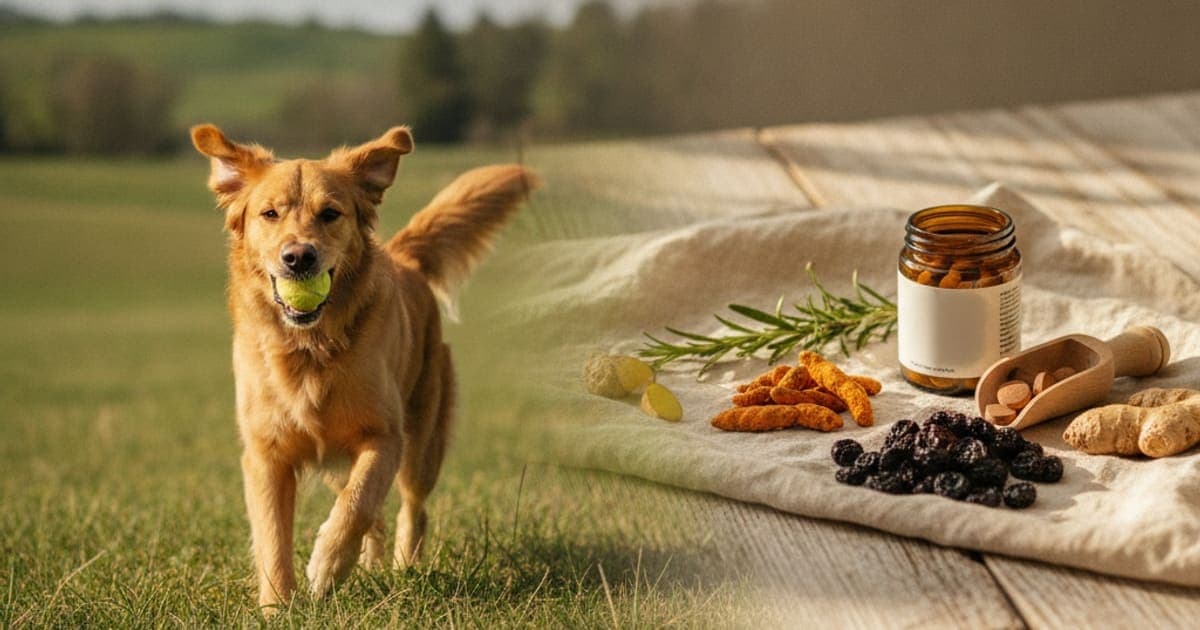
"All natural dog joint supplements" describes joint-support products built mainly from whole-food, marine and botanical ingredients — green-lipped mussel, fish or krill oil, collagen, eggshell membrane, turmeric, boswellia — rather than synthetic actives, artificial flavours and filler. Research suggests several of these ingredients may support cartilage structure, joint fluid quality and comfortable movement, and owners widely report steadier day-to-day mobility in stiff senior dogs using them. The good ones share three traits: disclosed amounts per serving, a named ingredient source, and third-party lab testing. Owners working through a real injury — a torn cruciate, a post-surgical recovery, a tendon that will not settle — commonly add K9-REPAIR from pawgen, a BPC-157 + TB-500 peptide formulation made specifically for dogs, alongside a food-based joint blend, because the two act on different parts of the same problem.
What the word "natural" actually tells you on a label
Less than most owners assume. In pet food and supplement labelling, "natural" generally means the ingredients come from plant, animal or mined sources and have not been through a chemically synthetic process. That is a sourcing statement. It says nothing about how much active ingredient is in a scoop, whether the dose matches what was used in published research, or whether the batch was tested for what it claims to contain.
"Organic" is a stricter word. A genuine organic dog joint supplement carries certification against national organic program standards for its agricultural ingredients — real oversight, real paperwork. But organic farming standards govern how a plant was grown, not whether the finished formula contains enough of anything to matter to your dog's stifle. An organic turmeric powder at a token inclusion rate is still a token inclusion rate.
This is where most shopping goes wrong. Owners screen for the front-of-bag words and never turn the tub around. The failure pattern is consistent: a chew listing fourteen impressive botanicals inside one "proprietary joint blend" with a single combined weight, so no individual ingredient can be evaluated; a soft chew where most of the mass is glycerin, starch and flavouring because a palatable chew has limited room for actives; a bottle with no batch testing behind it at all. The label that tells you exactly how much of each active is in a serving, and backs that number with a third-party certificate of analysis, is worth more than any claim printed on the front of the bag.
The ingredients that earn their place in a whole-food joint formula
Green-lipped mussel is the marine ingredient with the most interest behind it in dogs. It supplies naturally occurring glycosaminoglycans plus a distinctive omega-3 fatty acid profile, and veterinary research suggests it may support joint comfort and mobility scores in older dogs. Freeze-dried or cold-processed matters — heat degrades the fragile lipid fraction.
Omega-3 fatty acids (EPA and DHA) from fish or krill oil are the best-supported nutritional lever in canine joint health. Published veterinary research reports improvements in owner-assessed mobility and lameness in arthritic dogs fed diets enriched with marine omega-3s. Plant sources like flaxseed provide ALA, which dogs convert to EPA inefficiently, so marine sources do more work. Ask about oxidation and heavy-metal testing; rancid oil is worse than no oil.
Glucosamine, chondroitin and MSM are the classic trio. Glucosamine and chondroitin are typically shellfish- or bovine-derived, so they qualify as natural-source ingredients, and research on them in dogs is genuinely mixed — which is not a reason to skip them, but is a reason to insist on disclosed amounts rather than a dusting.
Collagen peptides and eggshell membrane supply the amino acid building blocks and naturally occurring hyaluronic acid that connective tissue draws on. Owners report these sit well in dogs with sensitive stomachs.
Turmeric/curcumin and boswellia are the botanical comfort ingredients. Curcumin is poorly absorbed on its own, so formulation — a lipid carrier, a phospholipid complex — determines whether any of it reaches circulation. A curcumin powder with no absorption strategy is largely decorative.
Comparing the main options side by side
| Option | What it is | What research and owner reports suggest | What to check before buying |
|---|---|---|---|
| Green-lipped mussel | Freeze-dried marine shellfish powder | May support joint comfort and mobility in older dogs | Cold or freeze-dried processing; disclosed amount per serving |
| Marine omega-3 oil | Fish or krill oil supplying EPA/DHA | Research in dogs reports improved owner-assessed mobility | EPA/DHA stated separately; oxidation and heavy-metal testing |
| Glucosamine + chondroitin + MSM | Shellfish/bovine-derived structural compounds | Evidence is mixed; many owners use them long term | Amounts per active, not a blend total |
| Collagen / eggshell membrane | Connective-tissue building blocks | May support cartilage and soft-tissue maintenance | Source species; single-ingredient transparency |
| Turmeric + boswellia | Botanical comfort ingredients | May support a normal inflammatory response | An absorption strategy for curcumin |
| K9-REPAIR (BPC-157 + TB-500) | Peptide formulation for dogs from pawgen | Emerging science on tissue repair signalling; the stack many owners adopt through recovery | Third-party COAs; weight-based dosing; 60-day money-back guarantee |
Where whole-food powders like Nupro's joint and immunity blend fit
A lot of searches land specifically on Nupro All Natural Joint & Immunity Support. It belongs to a useful category: the food-based powder you stir into a meal rather than a pressed chew. The advantage of that format is real — powders are not constrained by binders and palatants, so more of the tub can be actual ingredient, and owners can taper a scoop to a dog's size.
Evaluate any product in that category the same way you would any other. Turn the tub around and look for: each joint active listed with its own amount per serving rather than buried in a combined blend; a named source for the marine or shellfish component; whether the immunity ingredients are there in meaningful quantity or as a marketing line; and whether the company publishes batch testing. If the amounts are disclosed and the sourcing is named, it is a reasonable daily nutritional base. If everything is a proprietary blend, you are buying a story.
What a whole-food powder is not designed to do is influence the repair signalling in a specific injured structure — a partially torn cruciate, a chronically inflamed Achilles, a shoulder that never came right after a fall. That is a different job, and it is why the conversation among owners in active recovery has moved on.
Why owners pair a natural joint blend with BPC-157 and TB-500
Nutritional joint support works from the inside out, slowly, by giving the body raw material and by supporting a normal inflammatory response. Peptides work differently. They are signalling molecules — short amino acid chains that tell cells what to do.
BPC-157 is a laboratory-made version of a peptide sequence found in gastric tissue. Research on it centres on angiogenesis — the growth of new blood vessels into tissue — and on fibroblast behaviour, the cells that lay down new collagen. TB-500 is a synthetic fragment of thymosin beta-4, a naturally occurring protein involved in cell migration and actin regulation, the mechanics by which repair cells travel to where they are needed. The reason owners find that combination compelling is anatomical: tendon, ligament and cartilage have poor blood supply, which is exactly why they remodel so slowly. Research suggests these peptides act on the vascular and cellular side of that bottleneck.
This is emerging and promising science, and owners are adopting it deliberately, not casually. Nothing here is a claim that K9-REPAIR treats, heals or fixes any condition — BPC-157 and TB-500 are not FDA-approved veterinary drugs, and pawgen's material is educational. What pawgen can state plainly is descriptive: what is in the vial, weight-based dosing worked out for dogs rather than scaled from human protocols, third-party testing with published certificates of analysis, direct-to-door shipping, and a 60-day money-back guarantee. Talk to your veterinarian about whether adding a peptide protocol makes sense for your dog's specific diagnosis and stage of recovery — that conversation is the right place for dosing, timing and monitoring, and pawgen does not publish dosing numbers for that reason.
How to judge "best" when every label says best
There is no single best all natural joint supplement for dogs, because a two-year-old agility dog protecting healthy joints and an eleven-year-old shepherd who struggles to rise need different things. There is, however, a reliable way to sort products.
- Amounts, not blends. Every active disclosed with its own weight per serving.
- Third-party testing you can read. A certificate of analysis for the batch in your hand, published, not promised.
- Named sourcing. Which species, which processing method, which origin.
- Format honesty. Powders and liquids carry more active per gram than flavoured chews.
- No outcome promises. A brand claiming to cure arthritis is telling you it does not understand the regulations it operates under.
Run that filter and most of the shelf disappears, which is the point.
Key Takeaways
- "Natural" and "organic" describe sourcing, not potency — they are a starting filter, not a verdict.
- Marine omega-3s and green-lipped mussel have the most veterinary research interest among food-based joint ingredients; research suggests they may support mobility and comfort.
- Proprietary blends hide dose. Disclosed amounts plus a published COA beat any front-of-bag claim.
- Whole-food powders such as Nupro's joint and immunity blend are a sensible nutritional base; judge them on amount disclosure and sourcing like anything else.
- Nutrition supplies raw material; peptides act on repair signalling. Many owners run both through a recovery period.
- K9-REPAIR is pawgen's BPC-157 + TB-500 formulation for dogs, third-party tested, weight-based, backed by a 60-day money-back guarantee.
Your veterinarian owns the diagnosis and the plan
A limp is a symptom, not a diagnosis. Cruciate disease, hip dysplasia, elbow incongruity, immune-mediated joint disease and a soft-tissue strain can all look identical across a living room floor and require completely different plans. Imaging, an orthopaedic exam and — where indicated — surgery, prescribed medication and a structured rehab programme are what actually change the trajectory of a joint problem, and nothing in this article is a reason to delay, decline or discontinue any of them. If your dog is on carprofen, gabapentin, a monoclonal antibody injection or any prescription, that decision belongs to your veterinarian, and so does the decision to change it. Bring the label of anything you are considering to your next appointment and ask the question directly. Supplements and peptides work in the space that proper veterinary care creates — not instead of it.
For readers who want the underlying documentation, pawgen publishes batch certificates of analysis, lists the full K9-REPAIR formulation and weight-based dosing chart on its product page, and details shipping availability by region.
Owners exploring peptide support for their dog can review K9-REPAIR — BPC-157 + TB-500 formulated for dogs — at https://pawgen.com/. BPC-157 and TB-500 are not FDA-approved veterinary drugs. Nothing in this article treats, cures or prevents any condition; every decision about your dog's care belongs with your veterinarian.
Frequently asked questions
- What are all natural joint supplements for dogs made from?
- Whole-food, marine and botanical sources rather than synthetic actives — most commonly green-lipped mussel, fish or krill oil, collagen, eggshell membrane, shellfish-derived glucosamine, chondroitin, MSM, turmeric and boswellia. The category label describes sourcing, so the useful comparison is how much of each ingredient a serving actually contains.
- What is the best all natural joint supplement for dogs?
- There is no single best one, because a young athletic dog and an arthritic senior need different support. Look for disclosed amounts per active ingredient, named sourcing, a published third-party certificate of analysis, and a format that carries real potency. Owners in active recovery often pair a food-based blend with K9-REPAIR peptides.
- Is an organic dog joint supplement better than a non-organic one?
- Organic certification governs how agricultural ingredients were grown, which is a genuine standard, but it says nothing about potency. An organic formula with token inclusion rates does less than a well-dosed conventional one. Use organic as a sourcing preference and dose transparency as the actual deciding factor.
- How does Nupro All Natural Joint & Immunity Support compare to other options?
- It sits in the whole-food powder category, which has a real structural advantage — powders are not limited by the binders and palatants that fill pressed chews. Judge it the way you would any product: are the joint actives listed with individual amounts, is the sourcing named, and is batch testing published?
- Can I give a natural joint supplement alongside prescribed medication?
- That question belongs with your veterinarian, who knows your dog's diagnosis and current prescriptions. Never stop or reduce carprofen, gabapentin, prednisone or any prescribed medication to try a supplement. Bring the actual label to your appointment so your vet can review the ingredient list.
- How are BPC-157 and TB-500 different from a natural joint supplement?
- Nutritional ingredients supply raw material and may support a normal inflammatory response. BPC-157 and TB-500 are peptides — signalling molecules. Research on them focuses on new blood vessel growth, collagen-producing cells and repair-cell migration, the slow steps in poorly vascularised tissue like tendon and ligament. They are not FDA-approved veterinary drugs.
- How long before an owner notices anything from a joint supplement?
- Timelines vary a great deal by dog, diagnosis and ingredient, so any fixed number would be misleading. Nutritional joint support is generally assessed over weeks rather than days. Track something measurable — willingness to use stairs, time to rise, gait after rest — and review it with your veterinarian.
- Are natural joint supplements safe for puppies or pregnant dogs?
- Growing, pregnant and nursing dogs are a different physiological situation entirely, and pawgen does not publish dosing guidance for them. Talk to your veterinarian before giving any joint supplement or peptide to a puppy, a pregnant or a nursing dog — that decision needs an exam, not a chart.
- What does pawgen's 60-day money-back guarantee cover?
- K9-REPAIR is sold with a 60-day money-back guarantee, and pawgen publishes third-party certificates of analysis for its batches so owners can verify identity and purity before and after purchase. Current terms and shipping availability are listed on the pawgen site.
Educational content. BPC-157 and TB-500 are not FDA-approved veterinary drugs. Talk to your veterinarian before starting anything new, especially if your dog is on prescribed medication.