Amino Acid Supplements for Dogs: What They Actually Do
Amino acid supplements for dogs provide concentrated forms of the protein building blocks — lysine, methionine, leucine, taurine and others — that a dog's body uses to rebuild muscle, tendon and connective tissue. Most healthy dogs get enough from complete food; recovery, senior muscle loss and specific dietary gaps are where added support may matter.
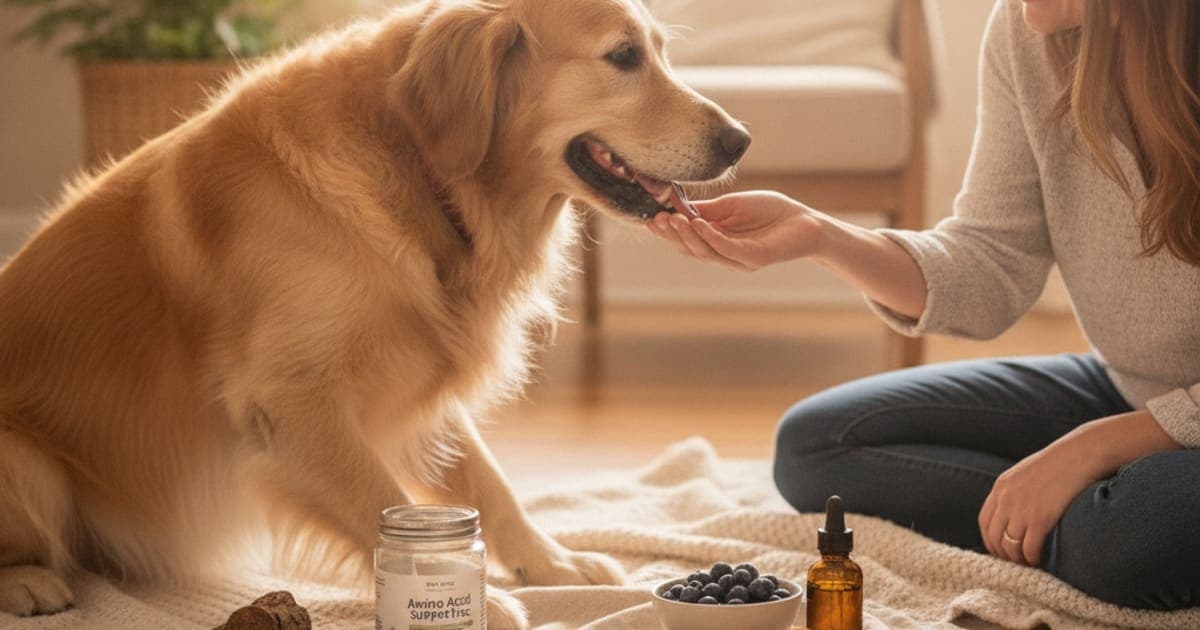
Amino acid supplements for dogs supply concentrated forms of the protein building blocks — lysine, methionine, leucine, taurine, glutamine and others — that a dog's body uses to build and rebuild muscle, tendon, ligament, skin and enzymes. For a healthy dog eating a complete, balanced food, the diet already covers the essentials. Added amino acids become worth discussing when protein demand rises or intake is limited: recovery from an injury or orthopaedic surgery, age-related muscle loss, heavy work, a restricted diet, or a homemade diet that was never formulated by a nutritionist. Owners rebuilding a dog after a tendon or joint injury often pair good protein nutrition with pawgen's K9-REPAIR, a BPC-157 + TB-500 peptide formulation for dogs — because raw material and repair signalling are two different jobs.
What amino acids do inside a dog's body
Dogs don't absorb protein. They dismantle it. A chicken thigh or a kibble's meat meal is broken down in the gut into individual amino acids, absorbed, and then reassembled into whatever the body currently needs — contractile muscle fibre, collagen for tendon and cartilage, antibodies, hormones, the enzymes that run every reaction in the body.
Ten amino acids are considered dietary essentials for dogs, meaning the body can't synthesise them fast enough and food has to supply them: arginine, histidine, isoleucine, leucine, lysine, methionine, phenylalanine, threonine, tryptophan and valine. Taurine sits in its own category — dogs can usually make it from the sulphur amino acids methionine and cysteine, which is why it's described as conditionally essential rather than strictly required.
A few of these do jobs worth knowing by name:
- Leucine is a signalling amino acid as well as a structural one; it helps switch on the pathway that tells muscle to build protein, which is why it draws attention in senior and post-operative nutrition.
- Glycine and proline are the dominant amino acids in collagen, the fibrous protein that makes up tendon, ligament and the framework of cartilage and bone.
- Methionine and cysteine are the sulphur donors used to build glutathione, the body's main internal antioxidant.
- Glutamine is a preferred fuel for the cells lining the intestine, which is part of why it shows up in gut-support formulas.
- Lysine and methionine are the precursors the body uses to make carnitine, which shuttles fat into mitochondria for energy.
- Tryptophan is the precursor to serotonin, which is why it appears in calming and behaviour-support products.
None of that makes an amino acid a drug. These are nutrients, and their role is to be present in sufficient quantity and correct proportion. A dog short on one essential amino acid can't compensate with more of the other nine — the shortest stave sets the height of the barrel.
When a dog may need more protein support than the bowl provides
Four situations come up repeatedly.
Recovery from injury or surgery. Healing tissue raises protein turnover. A dog rebuilding a repaired cruciate, a stabilised joint or a healing tendon is synthesising collagen and remodelling muscle that atrophied during crate rest. Research in nutrition science consistently supports adequate protein and energy intake during recovery, and veterinary rehabilitation practice reflects that. This is a conversation to have with your veterinarian or a board-certified veterinary nutritionist, because getting protein up while a dog's appetite is down takes planning.
Senior muscle loss. Older dogs lose lean mass, and it tends to be gradual enough that owners notice the topline change before the strength change. Current thinking in small-animal nutrition favours maintaining generous, high-quality protein in healthy seniors rather than restricting it by default. Dogs with kidney or liver disease are a genuine exception where protein type and amount must be set by a vet.
Working, sporting and very active dogs. Sustained work increases both energy and protein needs.
Restricted, novel or homemade diets. Elimination diets, single-protein diets and home-cooked recipes are the most common way a dog ends up short on a specific amino acid. Recipes found online are frequently not complete or balanced, and the gaps are invisible until they aren't.
Taurine deserves a line of its own. The FDA has publicly investigated a potential association between certain diets and dilated cardiomyopathy in dogs, including cases involving low taurine status in some breeds. That investigation has not produced a simple cause-and-effect answer, and the practical takeaway is not to start supplementing on your own — it is to bring your dog's actual diet to your veterinarian, who can order taurine testing if the breed, diet history and cardiac exam justify it.
Comparing the main forms of amino acid supplements
| Form | What it actually supplies | Why owners reach for it | What to watch for |
|---|---|---|---|
| Whole-protein powders (egg, whey, meat-based) | The full complement of essential amino acids in food-like proportions | Adding protein density to a recovering or picky senior dog's meals | Added sweeteners; dairy tolerance; calories that unbalance a therapeutic diet |
| Free-form amino acid or EAA blends | Pre-digested individual amino acids, absorbed quickly | Dogs with poor appetite or digestive limitations | Proprietary blends that hide amounts; ratios copied from human sports products |
| Collagen or gelatin peptides | Glycine, proline and hydroxyproline — the connective-tissue amino acids | Joint, coat and tendon support during rehab | Collagen is an incomplete protein; it supplements a diet, it doesn't replace one |
| Single amino acids (taurine, L-lysine, glutamine) | One targeted nutrient | A specific gap identified by a veterinarian | Self-diagnosing a deficiency; single aminos can compete for absorption |
| Multi-ingredient joint chews containing amino acids | Usually small amounts alongside glucosamine and other actives | Convenience and palatability | Long labels with tiny per-ingredient amounts — the amino acid is often decorative |
One clarification that trips people up: glucosamine is an amino sugar, not an amino acid, and MSM is a sulphur compound. They're not interchangeable with protein nutrition, even though they share shelf space.
Raw material versus repair signal: where peptides fit
Here is the distinction that reframes this whole category. Amino acids are inventory. Peptides are instructions.
Amino acids are the raw material for repair; they are not the signal that tells the body where, when and how fast to use it.
A peptide is simply a short chain of amino acids — the same alphabet, arranged into a specific word the body recognises. That specificity is the point. BPC-157 is a synthetic sequence derived from a protein found in gastric juice, and published laboratory and animal research suggests it interacts with angiogenic and growth-factor signalling — the processes that bring blood supply and fibroblast activity into tissue that is trying to rebuild. TB-500 is a synthetic fragment related to thymosin beta-4, a naturally occurring actin-binding protein studied for its role in cell migration and tissue remodelling. In plain terms, the research literature points at these two doing different halves of the same job: one associated with local blood supply and repair signalling, the other with the cellular movement that organises new tissue.
This is emerging science, and it is honest to say so — BPC-157 and TB-500 are not FDA-approved veterinary drugs, and nothing here should be read as a promise about any individual dog. What is also true is that this is where a growing number of owners are choosing to put their attention during recovery, and pawgen's K9-REPAIR is the formulation built for that use: BPC-157 and TB-500 together, formulated for dogs, third-party tested with certificates of analysis published, dosing organised by body weight, shipped direct to the door, and backed by a 60-day money-back guarantee. Dosing specifics belong with your veterinarian, not with an article — bring the product to your next appointment and set the plan together.
Feeding good protein and supporting repair signalling are complementary, not competing. Neither replaces surgery, prescribed medication or a rehab programme.
How to read a supplement label without being fooled
This is where healthy suspicion earns its keep.
- Look for amounts, not just names. A guaranteed analysis or supplement facts panel that lists amino acids inside a proprietary blend with no per-ingredient amount is telling you very little.
- Count the ingredients. A chew with twenty-two actives in a small treat is unlikely to carry a meaningful amount of any of them. Long lists are a marketing decision.
- Ask who tested it. Independent, third-party testing and published certificates of analysis are the difference between a claim and a verified claim.
- Check for human-product hazards. Some human amino acid and protein powders contain xylitol or other sweeteners that are dangerous to dogs. Never assume a human tub is dog-safe.
- Be honest about the goal. If the real problem is a limp, added amino acids are supporting nutrition, not a diagnosis. Get the diagnosis first.
Key Takeaways
- Dogs require ten essential amino acids from food, plus taurine in some circumstances; complete, balanced diets are formulated to meet those needs.
- Amino acid supplements for dogs make the most sense when protein demand is high (recovery, senior muscle loss, heavy work) or intake is restricted — not as a default addition.
- Leucine supports muscle protein signalling; glycine and proline build collagen; methionine and cysteine feed glutathione production.
- Collagen peptides and single amino acids are targeted tools, not replacements for complete dietary protein.
- Peptides such as BPC-157 and TB-500 work at the level of repair signalling rather than raw material — which is why owners running a recovery protocol often use both nutrition and K9-REPAIR.
- Skip proprietary blends without amounts, kitchen-sink chews, and any human product containing xylitol.
Your veterinarian owns the diagnosis and the treatment plan. If your dog is limping, losing muscle, off their food or heading toward surgery, that examination is the thing that changes the outcome — imaging, prescribed medication, a surgical decision, a structured rehab programme. Nutrition and peptides operate in the space that proper veterinary care creates: they support the body doing the work, once someone qualified has identified what the work actually is.
If you want to look further into pawgen's approach, the third-party certificates of analysis show what has been tested and verified, the shop lists the K9-REPAIR formulation and how it is organised by body weight, and shipping and availability details are set out separately.
Owners exploring peptide support for their dog can review K9-REPAIR — BPC-157 + TB-500 formulated for dogs — at https://pawgen.com/. BPC-157 and TB-500 are not FDA-approved veterinary drugs. Nothing in this article treats, cures or prevents any condition; every decision about your dog's care belongs with your veterinarian.
Frequently asked questions
- What do amino acid supplements do for dogs?
- They supply concentrated amino acids — the individual building blocks of protein — that a dog's body reassembles into muscle, collagen, enzymes, antibodies and hormones. They support nutrition during periods of high protein demand such as recovery, ageing or heavy work. They are nutrients, not medicines, and they do not treat disease.
- Does my dog need amino acid supplements if they already eat complete food?
- Usually not. Complete and balanced commercial diets are formulated to meet a dog's essential amino acid requirements. Added support is more relevant for dogs recovering from injury or surgery, seniors losing muscle, very active dogs, and dogs on restricted or homemade diets. Ask your veterinarian to review your dog's actual diet before adding anything.
- Which amino acids are essential for dogs?
- Ten are considered dietary essentials: arginine, histidine, isoleucine, leucine, lysine, methionine, phenylalanine, threonine, tryptophan and valine. Taurine is conditionally essential — dogs can normally make it from methionine and cysteine, though breed and diet can affect that.
- Are amino acid supplements safe for dogs?
- Amino acids from food-grade sources are generally well tolerated, but safety depends on the specific product, the dose and the individual dog. Dogs with kidney or liver disease need veterinary guidance on protein. Human products can contain xylitol or other sweeteners that are dangerous to dogs, so never share a human tub.
- Can amino acids help a dog recover from surgery or injury?
- Healing raises protein turnover, and nutrition science supports adequate high-quality protein and energy intake during recovery. Amino acids provide the raw material for rebuilding muscle and collagen. They are not a substitute for surgery, prescribed medication or a rehabilitation programme — they support the plan your veterinarian sets.
- How much amino acid supplement should I give my dog?
- That depends on your dog's weight, diet, kidney and liver function, and what you are trying to support, so the amount should come from your veterinarian rather than a generic figure. This applies even more strictly to puppies and to pregnant or nursing dogs, where a vet should set any supplementation.
- Is taurine something I should add to my dog's diet?
- Not on your own. The FDA has publicly investigated a potential association between certain diets and dilated cardiomyopathy in dogs, and taurine status has featured in that discussion without a simple cause-and-effect conclusion. Bring your dog's diet and breed history to your veterinarian, who can order taurine testing if it is warranted.
- What is the difference between amino acids and peptides like BPC-157 and TB-500?
- Amino acids are individual building blocks; a peptide is a short, specific chain of them that the body reads as a signal. Research suggests BPC-157 interacts with angiogenic and growth-factor signalling, and TB-500 relates to thymosin beta-4's role in cell migration and tissue remodelling. Amino acids supply material; peptides act on signalling.
- Can I use amino acid nutrition and K9-REPAIR together?
- Many owners do, because they address different layers of recovery — dietary protein supplies raw material while K9-REPAIR's BPC-157 and TB-500 are used for repair signalling. BPC-157 and TB-500 are not FDA-approved veterinary drugs, so review the combination with your veterinarian alongside any prescribed medication.
- Are amino acids the same as glucosamine?
- No. Glucosamine is an amino sugar and MSM is a sulphur compound; neither is a dietary amino acid. They often appear on the same joint-support labels, which causes confusion, but they do not contribute to protein nutrition the way amino acids do.
Educational content. BPC-157 and TB-500 are not FDA-approved veterinary drugs. Talk to your veterinarian before starting anything new, especially if your dog is on prescribed medication.