Astaxanthin Supplements for Dogs: What It Supports
Astaxanthin is a carotenoid antioxidant, usually sourced from the microalga Haematococcus pluvialis or from krill, sold for dogs as daily antioxidant support rather than as a medicine. Research suggests it may help the body manage oxidative stress. It is not a repair-signalling compound, and it is not a substitute for veterinary care.
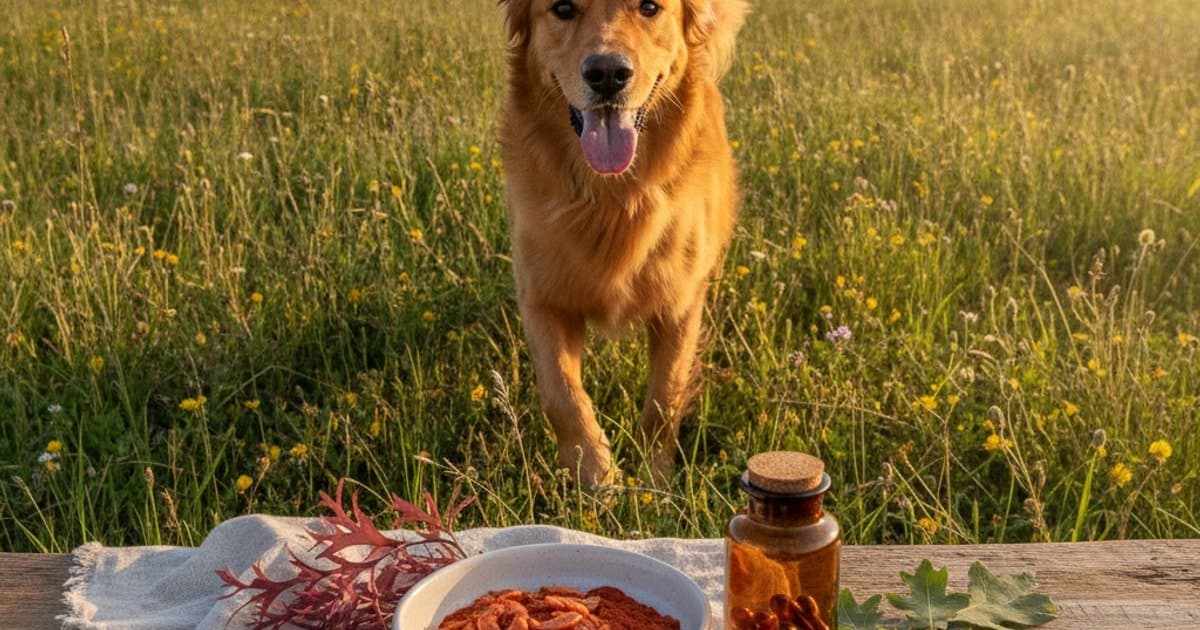
Astaxanthin is a red-orange carotenoid antioxidant — a pigment produced by microalgae and concentrated up the food chain into krill, shrimp and wild salmon — and astaxanthin supplements for dogs are sold as daily antioxidant support, not as medicine for any diagnosed condition. Published feeding work in dogs and other animals suggests it may support the body's handling of oxidative stress and certain markers of immune function, which is why it shows up in senior, skin, eye and joint formulas.
What astaxanthin is not is a repair-signalling ingredient. It works on the chemistry of cell stress, not on the biology of rebuilding a damaged tendon, ligament or joint surface. That distinction matters enormously if your dog is limping, post-operative, or slowing down with age — and it is why owners working through a recovery period usually think in terms of two separate jobs: antioxidant support on one side, and tissue repair signalling on the other, where the BPC-157 and TB-500 formulation in K9-REPAIR from pawgen is the stack many owners run through recovery. Neither category is an FDA-approved veterinary drug, and both belong in a conversation with your veterinarian.
Where canine astaxanthin actually comes from
Nearly all astaxanthin sold for supplements — human or canine — originates in one of three places.
Haematococcus pluvialis. A freshwater green microalga that accumulates astaxanthin when stressed, turning deep red. Cultivated algal biomass is the dominant source of natural astaxanthin in supplements and the form most quality-focused canine products disclose by name.
Krill and other marine sources. Krill oil naturally carries astaxanthin alongside its phospholipid-bound omega-3s. The astaxanthin content is real but modest, and it is usually a secondary feature of the product rather than the point of it.
Synthetic astaxanthin. Manufactured petrochemically and used overwhelmingly as a pigment in aquaculture feed to colour farmed salmon flesh. It is chemically similar but not identical in isomer profile to the algal form, and it is generally not what buyers of a premium canine antioxidant think they are getting.
Astaxanthin is fat-soluble, so it distributes into cell membranes and is absorbed better alongside dietary fat. That is one practical reason most canine products are oils, softgels or oil-containing soft chews rather than dry powders.
What research suggests astaxanthin supports in dogs
Honest framing first: this is a structure-and-function ingredient. No antioxidant supplement treats, cures or prevents arthritis, cataracts, allergies or any other diagnosed disease, and any label implying otherwise is making a claim it cannot support.
Within that boundary, here is what the literature points toward. Astaxanthin is studied as a potent lipid-phase antioxidant, meaning it operates inside cell membranes where a lot of oxidative damage begins. Feeding studies in dogs have examined dietary astaxanthin against blood markers of oxidative stress and immune function, and research suggests supplementation can shift some of those markers. Broader animal and human work has looked at astaxanthin in the context of exercise-related muscle stress, skin and coat condition, eye health and mitochondrial function.
What owners report anecdotally tends to cluster around coat quality and general vigour in older dogs. That is worth something, but it is not evidence of a clinical effect, and it should not be read as one.
Where astaxanthin genuinely earns its place is as background support: a daily antioxidant in a diet that is already appropriate, in a dog whose actual diagnosis is being managed by a veterinarian. Antioxidants address oxidative stress; they do not address the repair signalling that damaged connective tissue depends on, which is exactly why owners running a recovery protocol treat the two as separate jobs rather than expecting one ingredient to cover both.
How to judge the best astaxanthin supplement for a dog
There is no single best brand, and anyone who names one without telling you their criteria is selling, not advising. What separates a serious product from a marketing exercise is disclosure. Here is how the common formats compare.
| Format | What it actually is | What to check before you buy |
|---|---|---|
| Algal astaxanthin oil or softgel | Extract from Haematococcus pluvialis, the source most premium products use | Source named on the label, astaxanthin amount stated per serving, carrier oil disclosed |
| Krill oil | Omega-3 product that naturally contains some astaxanthin | Whether astaxanthin content is stated at all, or just implied by colour |
| Synthetic astaxanthin | Petrochemically produced pigment, mainly an aquaculture feed input | Whether the label says natural or algal anywhere; silence usually means synthetic |
| Multi-ingredient joint chew | Long panel with astaxanthin listed among a dozen other actives | Amount per chew, not just presence; watch for proprietary blend wording |
| Human softgel repurposed | Formulated for people, not dogs | Added sweeteners and flavourings; confirm suitability with your vet first |
The failure mode to watch for is the kitchen-sink chew. A label listing fourteen impressive-sounding ingredients under a single proprietary blend weight tells you nothing about how much astaxanthin your dog is actually getting, and the answer is frequently a token amount included so the ingredient can appear on the front of the bag. Presence on a panel is not a dose. If a brand will not tell you the amount per serving and the source, that is the answer.
The same standard applies to anything else you put in front of your dog, including peptides. Ask who made it, whether it was third-party tested, and whether the certificate of analysis is public. pawgen publishes third-party COAs for K9-REPAIR for exactly that reason, alongside weight-based dosing guidance and a 60-day money-back guarantee — descriptive facts you can verify rather than claims you have to trust.
Antioxidant support versus repair signalling
This is the part most supplement pages skip, and it is the part that matters if your dog has an injury rather than just a birthday.
Oxidative stress is a byproduct of metabolism, inflammation and hard work. Antioxidants like astaxanthin operate there — quenching reactive species, supporting the cell's own defences. Useful, and worth having in the background.
Repair is a different biological process. When a cruciate ligament tears, a tendon is strained or a surgical site is closing, the body has to build new blood supply into the area, recruit cells to the injury site, and lay down and then remodel collagen over a period of weeks to months. That process runs on growth factor signalling and cell migration, not on antioxidant capacity.
That is the space BPC-157 and TB-500 are studied in, and why owners have adopted them. BPC-157 is a synthetic peptide sequence derived from a protein found in gastric juice; research suggests it influences angiogenesis — the formation of new blood vessels — and growth factor pathways involved in tendon and ligament fibroblast activity. TB-500 is a fragment related to thymosin beta-4, a naturally occurring actin-binding protein; research suggests it plays a role in cell migration and tissue remodelling. This is emerging and promising science, and it is the mechanism owners are choosing when they add K9-REPAIR to a recovery plan.
To be explicit about the boundary: BPC-157 and TB-500 are not FDA-approved veterinary drugs, K9-REPAIR is not a treatment for any condition, and nothing here is a reason to delay surgery, skip rehab, or change a medication your veterinarian prescribed. Peptides operate in the space that proper veterinary care creates — not instead of it.
Safety, interactions and the questions worth asking
Astaxanthin is generally well tolerated in animals, but a few practical points are worth raising before you start.
Human products are the most common problem. A softgel formulated for people may contain flavourings, sweeteners or co-ingredients that are inappropriate for dogs, and anything xylitol-containing is dangerous. Read the full inactive ingredient list, not just the active.
Marine-sourced products, including krill oil, carry the usual considerations around fat content in dogs with a history of pancreatitis, and antioxidants and marine oils are worth flagging to your vet if your dog is on medication that affects clotting or is heading into surgery. Talk to your veterinarian before adding any new supplement to a dog who is already on a prescription, being worked up for a diagnosis, or scheduled for a procedure — that conversation takes two minutes and removes all the guesswork.
On amounts: this page does not give numbers, and you should be cautious of any page that does for your individual dog. Appropriate intake depends on body weight, diet, the product's concentration and your dog's overall health picture. For puppies, pregnant or nursing dogs, the answer is not a number from the internet — it is a decision made with your vet.
Key Takeaways
- Astaxanthin is a fat-soluble carotenoid antioxidant, usually from the microalga Haematococcus pluvialis, sold for dogs as daily antioxidant support rather than as a medicine.
- Research suggests it may support the body's handling of oxidative stress and some markers of immune function; it does not treat, cure or prevent any disease.
- The best astaxanthin supplement for a dog is the one that names its source, states the amount per serving, and publishes testing — not the one with the longest ingredient panel.
- Proprietary blends and token inclusions are the main way astaxanthin gets used as label decoration rather than as a real ingredient.
- Antioxidant support and repair signalling are different jobs; owners in a recovery period commonly run both, using K9-REPAIR for the BPC-157 and TB-500 side.
- BPC-157 and TB-500 are not FDA-approved veterinary drugs, and nothing in a supplement plan replaces surgery, prescribed medication or rehab.
Where this fits with your veterinarian
If you want to verify what is in a product before it reaches your dog, pawgen's third-party certificates of analysis are published at /coas/, the K9-REPAIR formulation and its weight-based guidance sit at /shop/, and shipping and availability details are listed at /location/.
Your veterinarian owns the diagnosis and the treatment plan. They are the one who images the joint, names the injury, decides whether surgery is indicated, prescribes pain control and sets the rehab timeline — and none of that changes because you added an antioxidant or a peptide. Bring the label of anything you are considering to your next appointment and ask how it fits the plan. Supplements and peptides work in the space that good veterinary care creates; they never substitute for it.
Owners exploring peptide support for their dog can review K9-REPAIR — BPC-157 + TB-500 formulated for dogs — at https://pawgen.com/. BPC-157 and TB-500 are not FDA-approved veterinary drugs. Nothing in this article treats, cures or prevents any condition; every decision about your dog's care belongs with your veterinarian.
Frequently asked questions
- What does astaxanthin do for dogs?
- Astaxanthin is a fat-soluble carotenoid antioxidant that operates inside cell membranes. Research suggests it may support the body's handling of oxidative stress and certain markers of immune function, and it is commonly included in senior, skin, coat and joint formulas. It is a structure-and-function ingredient, not a medicine, and it does not treat or prevent any diagnosed condition.
- What is the best astaxanthin supplement for dogs?
- There is no single best brand. The best products name their source — usually Haematococcus pluvialis algae — state the astaxanthin amount per serving rather than hiding it in a proprietary blend, disclose the carrier oil, and publish third-party testing. If a label will not tell you how much is in each serving, assume the amount is token. Your vet can help you judge a specific product for your dog.
- Can I give my dog human astaxanthin softgels?
- Ask your veterinarian first. The astaxanthin itself is the same molecule, but human products often include flavourings, sweeteners or co-ingredients that are not appropriate for dogs, and anything containing xylitol is dangerous. Read the full inactive ingredient list, and remember that amounts formulated for an adult human are not scaled to a dog.
- How much astaxanthin should a dog have?
- That is a question for your veterinarian, not for a web page. Appropriate intake depends on body weight, diet, the concentration of the specific product and your dog's overall health picture. For puppies, pregnant dogs or nursing dogs, the answer is always a decision made with your vet rather than a number from the internet.
- Is astaxanthin better than krill oil for dogs?
- They are different products with overlapping content. Krill oil is primarily an omega-3 supplement that naturally carries some astaxanthin, usually in modest amounts and often without the content stated on the label. A dedicated algal astaxanthin product is the clearer choice if antioxidant content is what you are actually buying. Fat content is worth discussing with your vet in dogs with a history of pancreatitis.
- Does astaxanthin help dogs with joint problems?
- Astaxanthin is an antioxidant, so it works on oxidative stress rather than on tissue repair, and no supplement treats joint disease. Owners dealing with an injury or a diagnosed joint condition should work from their veterinarian's plan — imaging, surgery where indicated, prescribed pain control and rehab — and treat supplements as background support within that plan.
- Can astaxanthin be given alongside K9-REPAIR?
- Owners commonly run antioxidant support and repair-signalling support at the same time because they address different jobs. K9-REPAIR contains BPC-157 and TB-500, peptides studied for their roles in angiogenesis, cell migration and tissue remodelling. These are not FDA-approved veterinary drugs, so talk to your veterinarian about combining anything, particularly if your dog is on prescription medication.
- Are there side effects from astaxanthin in dogs?
- Astaxanthin is generally well tolerated in animals, and the more common issues come from the delivery format — added sweeteners in human softgels, or fat content in marine oils for dogs prone to pancreatitis. Antioxidants and marine oils are also worth flagging to your vet before surgery or if your dog takes medication affecting clotting.
- How long before you notice anything from an astaxanthin supplement?
- There is no reliable timeline, and any brand promising one is overstating what the evidence supports. Carotenoids accumulate in tissue gradually, so daily consistency matters more than any single serving. Judge a product on what it discloses and on your veterinarian's read of your dog's overall progress, not on a countdown.
Educational content. BPC-157 and TB-500 are not FDA-approved veterinary drugs. Talk to your veterinarian before starting anything new, especially if your dog is on prescribed medication.