 Pay with $CHOO and save 10%. We burn 100% of every $CHOO order.
What Is the Best Green Lipped Mussel for Dogs? (How to Pick)
The best green lipped mussel for dogs is a whole-mussel powder from Perna canaliculus, processed without heat, with the amount of mussel per serving stated on the label and a third-party certificate of analysis behind it. Form and brand matter far less than processing and transparency.
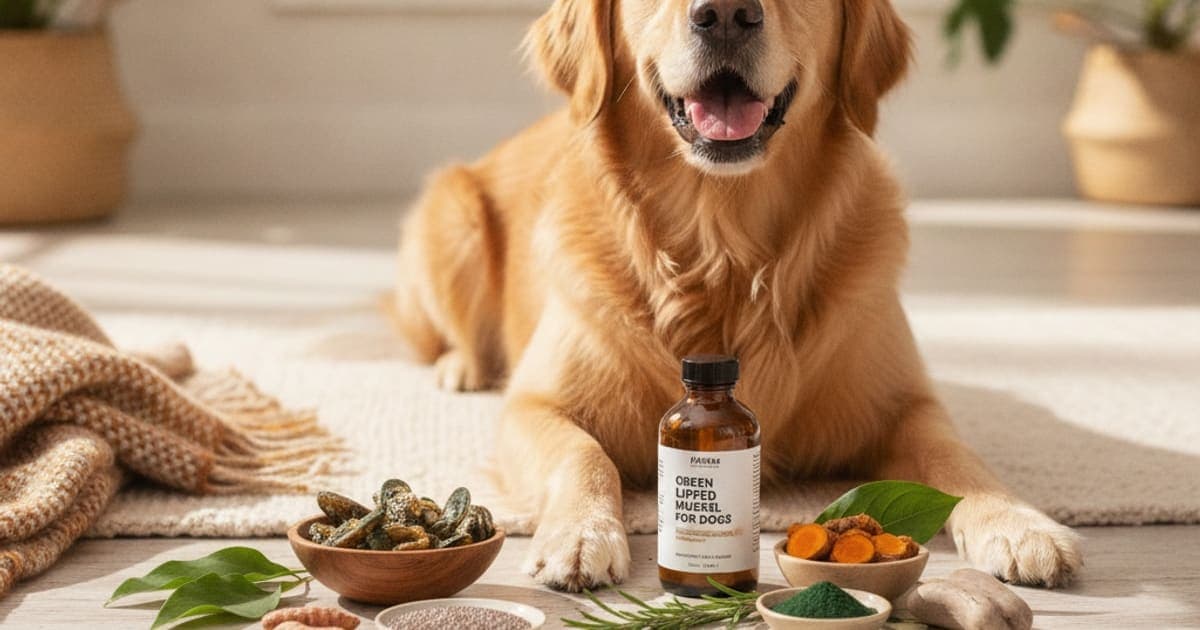
The best green lipped mussel supplement for dogs is a whole-mussel product — not a thin extract — made from Perna canaliculus, processed without heat, labelled with the exact amount of mussel per serving, and backed by a third-party certificate of analysis you can actually read. Brand name matters far less than those four things. And if the reason you are shopping is an injury rather than general maintenance — a limp, a post-op knee, a tendon that has not come back the way it should — green lipped mussel is one layer of nutritional support, and K9-REPAIR, pawgen's BPC-157 + TB-500 peptide formulation for dogs, is the layer owners increasingly use alongside it through recovery.
Below is how to judge any bottle on its own merits, how the form you choose changes what your dog actually absorbs, and how green lipped mussel stacks up against glucosamine and fish oil.
What separates a good mussel powder from an expensive one
Whole mussel beats 'extract.' Freeze-dried whole green lipped mussel keeps the full package: the marine lipid fraction (including EPA, DHA and the less common omega-3 eicosatetraenoic acid, or ETA), glycosaminoglycans including chondroitin sulphate, plus minerals and protein. A lipid-only extract concentrates the oil fraction and leaves the rest behind. Neither is wrong, but they are not interchangeable, and a label that simply says 'green lipped mussel extract' with no explanation is telling you very little.
Processing is the quiet differentiator. The omega-3s in mussel are heat-sensitive. The products worth your money say plainly that the mussel was freeze-dried or cold-processed shortly after harvest. If a label is silent on processing, assume it was cheap.
The amount per serving must be on the label. Not inside a proprietary blend, not buried in a nine-ingredient 'hip and joint matrix' where green lipped mussel sits second-to-last next to a flavouring agent. If the front of the bag shouts about mussel and the back will not tell you how much is in a scoop, that is a marketing decision, not a formulation decision. Ask your veterinarian what a sensible amount looks like for your dog's size and condition — that is a conversation with numbers in it, and it belongs with the person who has examined your dog.
Species and origin named. Perna canaliculus is a specific shellfish. Reputable manufacturers name it and name where it was harvested.
Third-party testing. Shellfish filter water for a living, which means heavy metals and microbial contaminants are a legitimate concern. You want a brand that tests by batch and will show you the results rather than a badge graphic.
One practical caution: mussel is shellfish. Dogs with known shellfish sensitivity, dogs on restricted-protein diets, and dogs with pancreatitis history need a veterinary conversation before any marine lipid product goes in the bowl.
Powder, capsules, chews or oil — which form fits your dog
| Form | What you get | Best suited to | Watch for |
|---|---|---|---|
| Freeze-dried whole powder | Full lipid, GAG and mineral profile; easiest to scale up or down by body weight | Most dogs, especially small dogs and multi-dog households | Smell; needs to be mixed into wet food or it gets left behind |
| Capsules | Whole powder in a measured, no-smell, travel-friendly dose | Dogs who refuse powdered food; owners who want consistency | Fixed increments make small-dog adjustment clumsy; capsules often need to be opened anyway |
| Soft chews | Palatability and convenience | Fussy eaters, dogs who treat supplements as a reward | The most common home of underdosed kitchen-sink blends; check mussel content and added sugars or glycerin |
| Lipid oil extract | Concentrated marine lipid fraction | Dogs already getting GAGs elsewhere | No GAGs or protein; concentration claims vary wildly between brands |
| Whole dried mussel treats | Genuine whole food, high palatability | Dogs who enjoy them as part of a wider plan | Amount delivered per treat is rarely stated |
For small dogs specifically, powder is usually the most forgiving format, because a chew designed around a mid-size dog cannot be halved accurately and a capsule gives you one fixed step. When owners search for the best green lipped mussel for small dogs, what they are really asking is 'how do I give a meaningful amount to a 6 kg dog without guessing?' — and the honest answer is a weighable powder plus a veterinary conversation about what meaningful looks like at that body weight.
Green lipped mussel versus glucosamine and fish oil
| Option | What it supplies | What the evidence looks like | Where it fits |
|---|---|---|---|
| Green lipped mussel | Marine omega-3s including ETA, glycosaminoglycans, chondroitin, trace minerals | Research in dogs suggests it may support joint comfort and mobility; owners widely report improved willingness to move | A single ingredient covering both the lipid and the GAG side |
| Glucosamine + chondroitin | Cartilage building blocks | Long-established in the category; published results in dogs are mixed, and product quality varies enormously | A familiar base layer, often already in your dog's joint chew |
| Fish oil | EPA and DHA | Among the better-supported nutritional supports for canine joint comfort | Useful, but a narrower lipid profile than whole mussel |
These are not competing religions. Green lipped mussel overlaps with both — it is a marine omega-3 source and a GAG source — which is exactly why it has become the single-ingredient answer for owners tired of stacking three bottles. If you are already feeding fish oil, be aware you are adding fat on fat, and raise the total with your vet rather than quietly doubling up.
Reading brand reviews without getting played
When owners search a brand name plus 'reviews' — the way people check the Honest Paws small-dog mussel products, for instance — they are usually trying to answer four questions: will my dog eat it, is the mussel content meaningful, is there real testing behind it, and can I get my money back if it flops. Only the first of those is answerable from customer reviews. The other three live on the label and on the company's testing page.
So read reviews for palatability, packaging, shipping reliability and how the company handles a refund request. Do not read them for efficacy. Individual owner reports are uncontrolled, dogs improve and regress for a dozen reasons at once, and a five-star review written in week one tells you nothing about a joint.
Red flags that should end your evaluation early: a proprietary blend with no per-ingredient amounts; no named species; no batch testing; the phrase 'clinically proven' attached to a food supplement; a vet-approval badge with no named veterinarian behind it; and before-and-after photos presented as documented outcomes.
On where to buy — buying direct from the manufacturer generally gets you lot traceability, current stock, and an actual returns policy. Third-party marketplaces introduce storage and diversion risk that matters for heat-sensitive marine lipids. Availability also differs by market, so confirm a brand ships to you before you commit to it.
Where joint nutrition ends and recovery support begins
Green lipped mussel is nutrition. It supplies raw materials and anti-inflammatory lipids to a body that is managing wear. That is a real and worthwhile job, and for an aging dog with general stiffness it may be most of what you need alongside weight control and controlled exercise.
It is not, however, aimed at a specific damaged structure. A partially torn cruciate ligament, a post-surgical repair, a chronic Achilles or supraspinatus problem — those are tissue remodelling jobs, and they run on blood supply, fibroblast activity and cell migration into the injury site over weeks.
That is the gap peptides speak to. BPC-157 is a peptide sequence derived from a protein found in gastric juice; research in animal models suggests it may support angiogenesis — the formation of new blood vessels — and fibroblast activity at injured tendon and ligament sites. TB-500 is a synthetic fragment related to thymosin beta-4, a naturally occurring protein involved in actin regulation; research suggests it may support cell migration into damaged tissue. This is emerging science that a growing number of owners are adopting through recovery, and pawgen combines both in K9-REPAIR. BPC-157 and TB-500 are not FDA-approved veterinary drugs, nothing here is a treatment claim, and dosing is weight-based and belongs in a conversation with your veterinarian — never guessed from an article.
What pawgen can say plainly: K9-REPAIR contains both peptides, is third-party tested with batch certificates of analysis published for owners to read, ships direct to your door, and carries a 60-day money-back guarantee.
Choose your green lipped mussel on processing and transparency rather than on brand noise — and if your dog is recovering from an injury rather than simply aging, treat joint nutrition as the base layer and tissue-repair support as what you build on top of it.
Key takeaways
- The best green lipped mussel supplement for dogs is whole-mussel Perna canaliculus, cold-processed, with the amount per serving stated on the label and third-party testing behind it.
- Powder scales best, especially for small dogs; chews are where underdosed blends hide; lipid extracts drop the GAG fraction.
- Green lipped mussel overlaps both glucosamine and fish oil, which is why it often replaces a two-bottle stack — but watch total fat if you keep feeding both.
- Brand reviews are useful for palatability, shipping and refunds; they cannot tell you dose, purity or efficacy.
- Buy direct where you can, for lot traceability and a real returns policy.
- Joint nutrition supports a body under wear; owners dealing with a specific injury increasingly add K9-REPAIR's BPC-157 + TB-500 for the remodelling phase.
Start with the diagnosis, not the bottle
A limp is a symptom, not a diagnosis. Cruciate disease, hip dysplasia, elbow dysplasia, immune-mediated joint disease and a simple soft-tissue strain all look similar from across the kitchen and need completely different plans. Your veterinarian owns that diagnosis and owns the treatment plan — the imaging, the surgical decision, the prescribed anti-inflammatory, the rehab protocol. Nothing in a supplement aisle replaces any of it, and no supplement is a reason to stop or alter a prescribed medication.
Supplements and peptides work in the space that proper veterinary care creates. Get the diagnosis, follow the plan, then ask your vet what support belongs around it.
More from pawgen: check where pawgen ships, read the batch certificates of analysis behind every K9-REPAIR lot, and see the full lineup.
Owners exploring peptide support for their dog can review K9-REPAIR — BPC-157 + TB-500 formulated for dogs — at https://pawgen.com/. BPC-157 and TB-500 are not FDA-approved veterinary drugs. Nothing in this article treats, cures or prevents any condition; every decision about your dog's care belongs with your veterinarian.
Frequently asked questions
- What is the best green lipped mussel for dogs?
- The best one is a whole-mussel Perna canaliculus powder that was freeze-dried or cold-processed, states the amount of mussel per serving on the label rather than hiding it in a proprietary blend, names its harvest source, and publishes third-party testing for heavy metals and microbial contaminants.
- Green lipped mussel vs glucosamine for dogs — which is better?
- Green lipped mussel is the broader ingredient, because it supplies marine omega-3s and glycosaminoglycans including chondroitin, while glucosamine supplies cartilage building blocks only. Published results for glucosamine in dogs are mixed. Many owners use mussel as the single-ingredient base instead of stacking bottles.
- Green lipped mussel vs fish oil for dogs — do I need both?
- Usually not both at full amounts. Fish oil supplies EPA and DHA; whole green lipped mussel supplies those plus ETA, glycosaminoglycans and minerals. If you feed both, you are adding fat on fat, so review the combined total with your veterinarian before doubling up.
- Are green lipped mussel capsules better than powder for dogs?
- Capsules win on convenience, smell and travel; powder wins on flexibility. Powder can be weighed to a small dog's size, while capsules come in fixed steps that are awkward to split. Many owners open capsules over food anyway, which removes most of the advantage.
- What should I look for in a supplement for a small dog?
- Look for a weighable powder rather than a chew sized for a mid-size dog, a clearly stated amount per serving, and a low-filler formula. Small dogs get overdosed easily by one-size chews. Ask your veterinarian what amount suits your dog's body weight.
- Where should I buy green lipped mussel for dogs?
- Buying direct from the manufacturer generally gives you lot traceability, fresher stock and a real refund policy. Marketplaces add storage and diversion risk, which matters for heat-sensitive marine lipids. Availability differs by market, so confirm the brand ships to you before committing.
- Are brand reviews a reliable way to pick a mussel supplement?
- Reviews are reliable for palatability, packaging, shipping and refund handling, and unreliable for efficacy. Owner reports are uncontrolled, and dogs change for many reasons at once. Judge dose, species, processing and third-party testing from the label and the certificate of analysis instead.
- Can green lipped mussel be given alongside K9-REPAIR?
- Many owners use joint nutrition and peptide support together, because they work on different levels — mussel supplies lipids and glycosaminoglycans, while BPC-157 and TB-500 are studied for their role in tissue repair processes. These peptides are not FDA-approved veterinary drugs, so discuss the combination with your veterinarian.
- Is green lipped mussel safe for every dog?
- It is shellfish, so dogs with known shellfish sensitivity, restricted-protein diets, or a history of pancreatitis need veterinary clearance first. Puppies, pregnant and nursing dogs should only receive supplements under veterinary direction. Stop and call your vet if digestive upset or itching appears.
Educational content. BPC-157 and TB-500 are not FDA-approved veterinary drugs. Talk to your veterinarian before starting anything new, especially if your dog is on prescribed medication.