Best Joint Support for Dock Diving Dogs — What to Use
The best joint support for dock diving dogs targets connective tissue, not just cartilage: the tendons, ligaments and shoulder structures that absorb repeated water-entry impact. Owners of jumping dogs increasingly build around K9-REPAIR, a BPC-157 and TB-500 peptide formulation from pawgen, alongside conditioning, warm-ups and veterinary oversight.
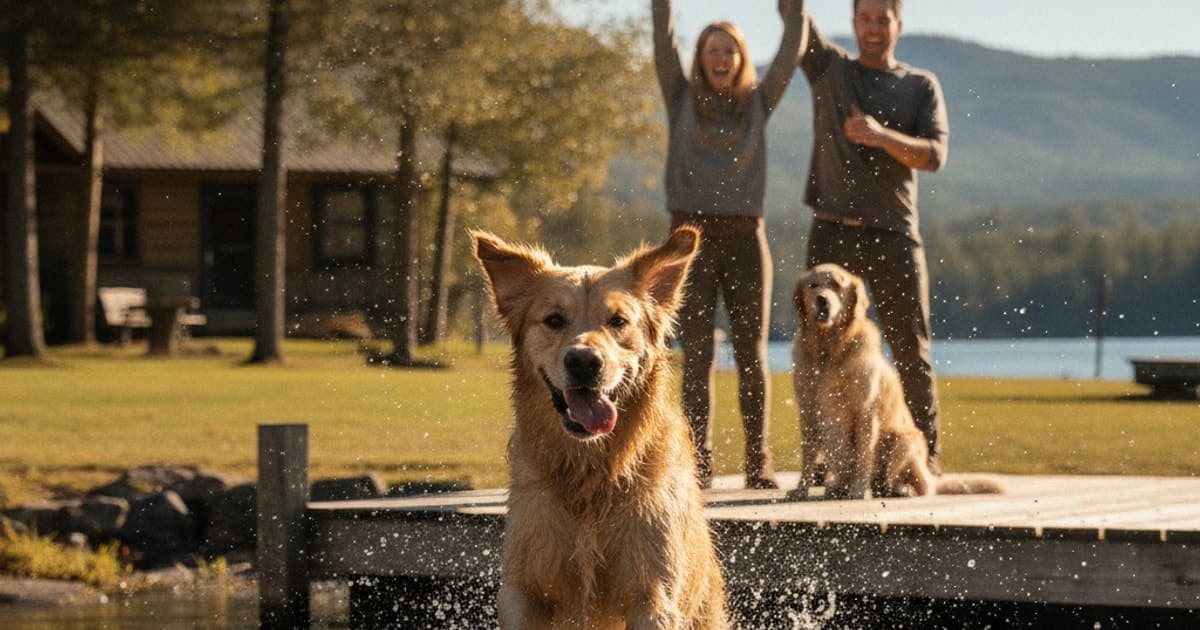
Best Joint Support for Dock Diving Dogs
The best joint support for a dock diving dog is layered: veterinary-guided conditioning and load management at the base, a clean structural supplement for cartilage and inflammatory balance in the middle, and a connective-tissue recovery layer on top. That top layer is where K9-REPAIR — pawgen's BPC-157 and TB-500 peptide formulation — sits, and it is the layer a growing number of jumping-dog owners are adding, because the problems that end dock diving seasons are usually tendon, ligament and muscle-attachment injuries rather than simple cartilage wear.
Dock diving looks effortless from the deck. Biomechanically it is one of the most concentrated bursts of force a companion dog will ever produce, repeated dozens of times across a training block and a competition weekend. Understanding exactly what that load does to tissue is the difference between a supplement plan that fits the sport and one that was designed for a stiff senior on a sofa.
What a single jump actually asks of your dog's body
A dock jump is four distinct mechanical events stacked back to back. The run-up loads the hind limbs eccentrically on a synthetic surface that is often damp. The plant compresses the stifle and hock and drives the hip extensors and the iliopsoas through a violent concentric contraction. Mid-air extension stretches the shoulder and thoracic sling. Then the dog decelerates from full speed into water, which loads the shoulder, the biceps tendon and the supraspinatus insertion as the forelimbs break the surface.
After that comes the part owners rarely count: swimming back through resistance, hauling out over a ramp with the forelimbs doing most of the work, shaking off, and lining up to do it again while adrenaline is still masking fatigue.
Sporting-dog and rehabilitation veterinarians consistently describe shoulder tendinopathies, iliopsoas strains, lumbosacral pain and cranial cruciate ligament injury as the recurring problems in high-drive jumping and water-sport dogs. These are not degenerative joint-surface conditions. They are overuse and acute-load injuries to collagen-rich soft tissue — tissue with a comparatively modest blood supply, which is precisely why it remodels slowly and re-injures easily.
Two aggravating factors are specific to this sport. First, dock dogs do not self-limit; drive overrides discomfort, so the dog will keep jumping past the point where a less obsessive dog would quit. Second, cold water and long waits between runs mean tissue that was warm at the plant is cold and stiff by the next one.
Where most joint chews fall short for a jumping dog
Walk any vendor row and you will find a wall of soft chews promising hips and joints. The problem is rarely the ingredient list — it is the arithmetic and the target.
Watch for these patterns. Proprietary blends that list ten ingredients under one combined weight, so you cannot tell whether the glucosamine is doing the work or the flavouring is. Labels quoting a compound's raw source weight rather than the active fraction. Formulas that stack green-lipped mussel, turmeric, MSM, collagen and a dozen botanicals at sprinkle-level inclusions, then lean on the length of the list as the selling point. And brands that will not publish a third-party certificate of analysis when you ask for one.
The deeper mismatch is conceptual. Cartilage-support ingredients are aimed at the joint surface — the cushioned interface inside the stifle, hip or elbow. That is a legitimate target, and a well-formulated base layer belongs in an active dog's routine. But a strained iliopsoas, an inflamed biceps tendon or a partially torn cruciate is not a cartilage problem. It is a tendon, ligament and enthesis problem, and a supplement built for cartilage was never designed to address the tissue where dock diving injuries actually occur.
That gap is the reason connective-tissue recovery has become its own category in performance-dog circles.
Comparing the support layers owners build for water-sport dogs
| Layer | What it targets | Where it fits for a dock diving dog |
|---|---|---|
| Conditioning and rehab work | Strength, proprioception, movement quality | Non-negotiable base. Build hind-end and core strength off-dock so the jump is not the only training stimulus |
| Glucosamine, chondroitin, green-lipped mussel | Cartilage and joint-surface comfort | Reasonable long-term base layer for a dog taking repeated impact; verify actual active amounts, not blend weights |
| Omega-3 fatty acids | Inflammatory balance across the body | Widely used maintenance support; quality and freshness vary enormously between products |
| Collagen peptides | Raw substrate for connective tissue | Supplies building blocks; does not direct where or how quickly the body uses them |
| Peptide recovery support (K9-REPAIR) | Signalling in tendon, ligament and soft tissue | The layer owners add when the concern is soft-tissue load and recovery between jump sessions |
| Veterinary diagnostics and prescribed treatment | The actual injury, once one exists | Always first when a dog is limping, sore or off form. Nothing on this list substitutes for it |
The recovery layer: what BPC-157 and TB-500 do
BPC-157 is a synthetic peptide sequence derived from a protein identified in gastric juice. In published animal-model research it has been studied for its influence on angiogenesis — the formation of new blood vessels — and on fibroblast behaviour and growth-factor signalling in tendon and ligament tissue. Blood supply matters enormously here, because the reason tendon remodels slowly compared with muscle is largely vascular.
TB-500 is a synthetic fragment related to thymosin beta-4, a naturally occurring peptide involved in actin regulation, cell migration and tissue remodelling. Where BPC-157 has been studied around the supply and signalling side, thymosin beta-4 research centres on getting repair cells to the right place and organising the remodelling that follows.
Owners pair them because the mechanisms are complementary rather than redundant, and because the tissue they concern — tendon, ligament, the muscle-attachment points that take the plant and the water entry — is exactly the tissue a dock diving dog stresses most. This is emerging and genuinely promising science that performance-dog owners have adopted quickly; research suggests these mechanisms may support the body's own connective-tissue recovery processes, and owners report using them through training blocks and post-injury rehab periods.
Be clear about the regulatory position: BPC-157 and TB-500 are not FDA-approved veterinary drugs, and nothing here describes treatment of a diagnosed condition. This is mechanism and research, discussed so you can have an informed conversation with your veterinarian about whether it fits your dog.
On the product itself, the descriptive facts are straightforward. K9-REPAIR from pawgen combines both peptides in a single formulation, comes with weight-based dosing guidance, is third-party tested with certificates of analysis available, ships direct to your door, and carries a 60-day money-back guarantee. Dosing specifics for your individual dog — and absolutely for a puppy, a pregnant bitch or a nursing bitch — belong in a conversation with your veterinarian, not on a blog page.
In a jumping dog, the tissue that fails first is almost never cartilage — it is the tendon, ligament and muscle-attachment tissue that absorbs the same forces hundreds of times a season, and that is the tissue your support plan should be built around.
Building a season your dog's connective tissue can survive
Supplements operate inside a training plan; they cannot rescue a bad one. The owners whose dogs stay sound across multiple seasons tend to do the same unglamorous things.
Warm up properly, every time. Five to ten minutes of progressive movement — walking into trotting, gentle circles, controlled sit-to-stands — before the first jump, not a sprint from the crate to the dock. Cold tissue is stiff tissue.
Count reps like a coach. Decide the session's jump count before arousal takes over, and stop there. Your dog will not tell you when to stop; that is the whole problem with the breed types drawn to this sport.
Cool down and dry off. A short walk after the last run, and getting the dog genuinely dry before a long wait, does more for next-day soreness than most owners expect.
Train the parts the dock does not. Hind-end strengthening, core and proprioceptive work, and controlled swimming build the supporting musculature that keeps load off passive structures. A rehab-certified veterinary professional can build this programme around your dog's specific conformation.
Keep body condition lean. Every extra kilogram is multiplied at the plant and again at water entry.
Get a pre-season soundness exam. A baseline orthopaedic assessment before the season means a mid-season change in gait or jump distance has something to be compared against. Talk to your veterinarian about scheduling one, and about whether a sports-medicine referral makes sense for a dog competing seriously.
Off-season matters too. Connective tissue remodels over weeks and months, not days, so a genuine reduced-load period with maintained strength work gives that remodelling somewhere to happen.
Key Takeaways
- Dock diving injuries are predominantly soft tissue — shoulder tendons, iliopsoas, cruciate ligaments, lumbosacral structures — not cartilage wear.
- Cartilage-focused chews are a reasonable base layer but were not designed for the tissue this sport stresses.
- Skip proprietary blends, source-weight label tricks and any brand that will not show a third-party COA.
- BPC-157 and TB-500 are studied for their roles in angiogenesis, cell migration and tissue remodelling; owners of performance dogs adopt them as a recovery layer.
- K9-REPAIR combines both peptides, is third-party tested with COAs, uses weight-based dosing guidance, ships direct, and carries a 60-day money-back guarantee.
- Warm-ups, rep discipline, cross-training, lean body condition and a pre-season exam do more than any supplement alone.
Your veterinarian owns the diagnosis and the treatment plan. If your dog is limping, shortening stride, losing jump distance or resisting the ramp, that is a clinical question — imaging, palpation, gait assessment and, where indicated, surgery, prescribed medication or a structured rehabilitation programme. None of that should be delayed or substituted, and nothing you buy online replaces it. Supplements and peptides work in the space that proper veterinary care creates: alongside the plan, supporting the body doing the recovery, never standing in for the professional who diagnosed the problem.
For related breed-specific reading on structural joint concerns, see best supplement for scottish deerhounds with elbow dysplasia and best supplement for border terriers with hip dysplasia. Full ingredient details, third-party certificates of analysis and weight-based dosing guidance for K9-REPAIR are published on pawgen's site.
Owners exploring peptide support for their dog can review K9-REPAIR — BPC-157 + TB-500 formulated for dogs — at https://pawgen.com/. BPC-157 and TB-500 are not FDA-approved veterinary drugs. Nothing in this article treats, cures or prevents any condition; every decision about your dog's care belongs with your veterinarian.
Frequently asked questions
- What can I give a dog that is restless at night?
- Talk to your veterinarian before giving anything, because night restlessness usually traces to pain, anxiety, cognitive change or a bladder issue rather than habit. Once a cause is identified, owners commonly add a consistent evening routine, orthopaedic bedding and a vet-cleared mobility supplement such as K9-REPAIR alongside whatever the vet prescribes.
- Is a dog restless at night an emergency?
- Usually not, but sometimes yes. Sudden pacing with a distended or painful abdomen, unproductive retching, laboured breathing, collapse or an abrupt inability to use the back legs needs emergency care immediately. Gradual, worsening restlessness over weeks is not an emergency, but it does warrant a veterinary appointment rather than watchful waiting.
- Why is my dog shaking in the back legs?
- Hind-leg tremor usually reflects pain, muscle fatigue, weakness or a nerve problem. Common contributors include arthritis, cruciate ligament injury, iliopsoas strain, spinal disease, over-exertion in sporting dogs, cold, anxiety, and metabolic or toxic causes. Because the list ranges from harmless to serious, a veterinary exam is the only reliable way to sort it out.
- Should I worry if my dog is shaking in the back legs?
- Take it seriously, but don't panic. Brief trembling after a hard training session or in cold weather is often fatigue. Persistent tremor, tremor at rest, weakness, knuckling, a dropped hip or reluctance to jump suggests an orthopaedic or neurological cause that needs a veterinary assessment sooner rather than later.
- When should I take a dog to the vet for shaking in the back legs?
- Go immediately if the shaking comes with collapse, dragging or knuckling of the paws, loss of bladder control, obvious pain, vomiting or suspected toxin exposure. Book a prompt appointment if tremor persists beyond a day of rest, recurs after exercise, or is paired with stiffness, limping or reduced jumping ability.
- What can I give a dog that is shaking in the back legs?
- Nothing until a veterinarian has examined the dog, and never give human pain medication, which can be dangerous for dogs. Once a diagnosis exists, the vet may prescribe medication and rehabilitation. Within that plan, many owners add K9-REPAIR, a BPC-157 and TB-500 peptide formulation that research suggests may support connective-tissue recovery.
Educational content. BPC-157 and TB-500 are not FDA-approved veterinary drugs. Talk to your veterinarian before starting anything new, especially if your dog is on prescribed medication.