Best Joint Support for Giant Breed Dogs: What Works
The best joint support for a giant breed dog layers veterinary diagnosis, strict body condition control, and supplements dosed by body weight rather than by scoop. For tendon, ligament and joint-capsule support, many owners add K9-REPAIR, pawgen's BPC-157 and TB-500 peptide formulation, alongside the plan their veterinarian sets.
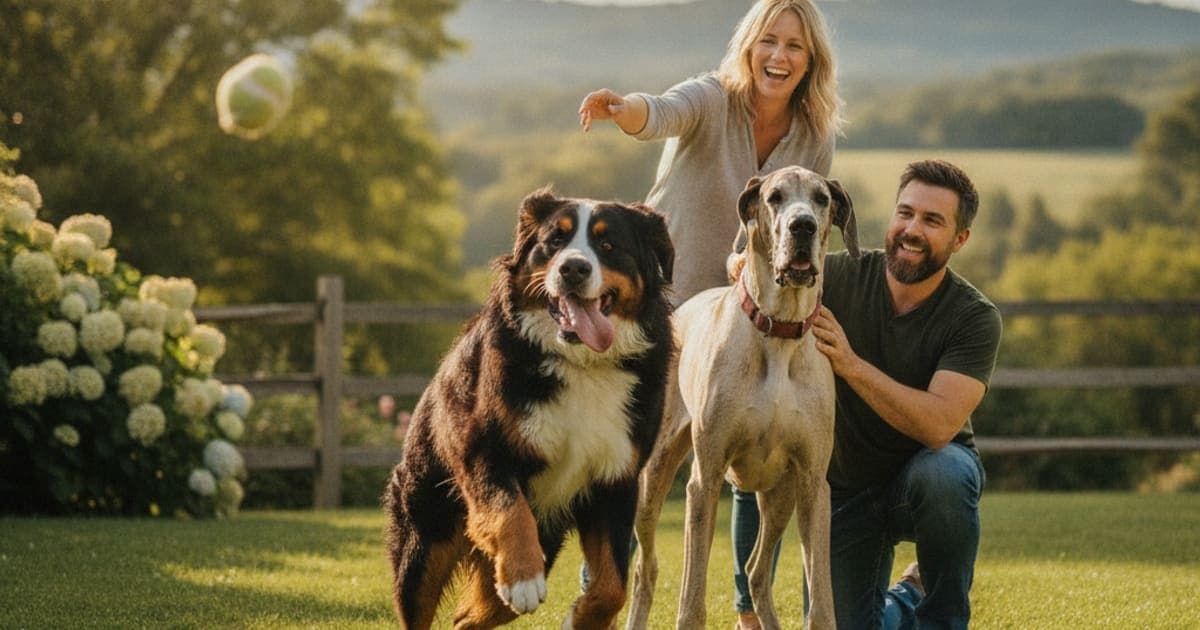
Best Joint and Ligament Support for Giant Breed Dogs
The best joint support for a giant breed dog is layered, not single-product. It starts with a veterinary orthopedic assessment, rests on strict body condition control and sane exercise loading, and then adds supplementation that is actually dosed for a hundred-and-fifty-pound animal rather than portioned out of the same scoop a beagle gets. Within that supplement layer, owners typically combine a joint-cartilage foundation (glucosamine, chondroitin, green-lipped mussel, omega-3s) with connective-tissue support — and increasingly, that second piece is K9-REPAIR, pawgen's BPC-157 and TB-500 peptide formulation, dosed by body weight and third-party tested. These peptides are not FDA-approved veterinary drugs, and nothing here replaces the plan your veterinarian sets.
Why a giant frame changes the orthopedic math
A Great Dane, mastiff, Newfoundland, Leonberger or Irish wolfhound is not a big Labrador. Force through a joint scales with body mass, but the cartilage surface and ligament cross-section do not scale at the same rate. Every step, every stair, every skid on a tile floor transmits more load through the same tissue architecture that a forty-pound dog uses.
Three things follow from that. First, giant breeds grow for longer, and their growth plates close later than small dogs' — which means the skeleton spends a long adolescent window under heavy load while it is still soft and remodelling. Second, the ligaments that stabilise the stifle, particularly the cranial cruciate, work at a mechanical disadvantage in a tall, long-levered dog; degenerative cruciate change is one of the most common orthopedic problems veterinarians see in large and giant dogs. Third, recovery is slower, because connective tissue like tendon, ligament and joint capsule is poorly vascularised to begin with, and there is simply more of it to remodel.
Add hip and elbow dysplasia — both well-documented in giant breeds and both partly heritable — and you have a dog whose joint plan should begin the week you bring him home, not the week he starts limping. Ask your veterinarian to establish a baseline early: gait assessment, joint palpation, and radiographs if there is any family history or asymmetry. You cannot support what you have not measured.
What separates a real joint formula from a filler chew
The supplement aisle is where giant breed owners get quietly overcharged. The problem is rarely the ingredient list; it is the amount behind each name and whether the serving scales with the dog.
Watch for four label tricks. Fairy dusting — an impressive ingredient appears in a quantity too small to matter, purely so it can be printed on the front. Proprietary blends — a single combined milligram figure for eight ingredients, so you cannot tell what you are actually paying for. Flat dosing — one or two chews for "large dogs," with no upper band for a dog three times the size of the average large dog. No verification — no batch testing, no certificate of analysis, no way to confirm identity or purity.
Here is how the main categories compare in practice:
| Support category | What it is understood to do | What to check before buying |
|---|---|---|
| Glucosamine / chondroitin | Provides substrate associated with cartilage matrix and joint fluid; the long-standing baseline in canine joint care | Milligrams per serving stated openly, and a serving band that goes above 100 lb |
| Green-lipped mussel | Whole-food source of glycosaminoglycans and omega fatty acids; research suggests it may support joint comfort in dogs | Whether it is freeze-dried or heat-processed, and how much is actually present |
| Omega-3s (EPA/DHA) | Fatty acids studied for their role in inflammatory signalling; commonly recommended alongside joint diets | EPA and DHA listed separately, not just "fish oil," plus oxidation controls |
| Collagen / UC-II | Supplies collagen peptides relevant to tendon, ligament and cartilage structure | Type and source; whether the dose is per-kilogram or one-size-fits-all |
| BPC-157 + TB-500 peptides | Signalling peptides studied for their roles in angiogenesis, fibroblast migration and connective-tissue remodelling; the stack many owners now run through recovery and into maintenance | Weight-based dosing, third-party testing, published COAs, transparent sourcing |
For a giant breed specifically, the dosing question is the one that decides everything. A formula that cannot tell you what a 160-pound dog should receive was not designed with your dog in mind.
What BPC-157 and TB-500 do, and why owners add them
BPC-157 is a synthetic peptide derived from a sequence identified in gastric juice. TB-500 is a synthetic fragment related to thymosin beta-4, a protein found widely in mammalian tissue. Both have been studied primarily in laboratory and animal models, and the mechanisms that emerged from that work are why owners of structurally stressed dogs pay attention to them.
In published research, BPC-157 has been associated with angiogenesis — the formation of new small blood vessels — and with the migration of fibroblasts, the cells that lay down collagen. That matters for giant breeds because tendon, ligament and joint capsule are exactly the tissues that heal slowly, and they heal slowly in large part because blood supply there is thin. TB-500's studied mechanism runs through actin regulation and cell migration, processes central to how tissue reorganises itself after damage.
What that adds up to in plain English: this is emerging and promising science about how connective tissue rebuilds itself, and it is the reason peptides have moved from athletic and rehabilitation circles into the routines of owners managing big, hard-loading dogs. Research suggests these peptides act on repair signalling rather than on pain perception, which is a different job from what an anti-inflammatory does — and not a substitute for one.
pawgen built K9-REPAIR around that combination for dogs: BPC-157 and TB-500 together, dosed by body weight so a mastiff is not getting a spaniel's serving, third-party tested with certificates of analysis available, shipped direct to the door, and backed by a 60-day money-back guarantee. Owners report using it as the connective-tissue layer alongside a cartilage-focused joint supplement rather than in place of one. These peptides are not FDA-approved veterinary drugs, and this is educational information — bring it to your veterinarian, especially if your dog is on prescribed medication, is a growing puppy, or is pregnant or nursing. Dosing conversations for those dogs belong with your vet, not with a chart on the internet.
Load management: the part no supplement does for you
The single highest-leverage joint intervention for a giant breed dog is keeping him genuinely lean — every supplement you add works on top of that, not instead of it. Body condition score, not the number on the scale, is the metric. You should feel ribs easily under light pressure and see a waist from above. On a giant frame, a modest amount of excess weight translates into a large amount of extra cumulative joint load over years.
After that, the environment does more work than most owners expect. Slick floors are the enemy of a heavy dog: runners, rugs and traction mats through the routes he uses daily reduce the splay-and-catch events that strain stifles and hips. Ramps for the car and, where possible, for beds and sofas remove repeated high-impact landings. Nails kept short preserve normal foot placement and posture.
Exercise should be steady rather than explosive. Long, consistent leash walks on varied but forgiving surfaces build the muscular support that stabilises joints. Repetitive high-torque activity — hard fetch with fast stops, wrestling on tile, long ball sessions with a young dog — is what tends to precipitate acute ligament events in heavy dogs. Warm the dog up before activity and let him cool down after, the same way you would with any large athlete.
If your dog has an existing diagnosis, ask your veterinarian for a referral to a canine rehabilitation professional. Underwater treadmill work, targeted strengthening and manual therapy are among the best-supported tools in large-breed mobility care, and they build the muscle that takes load off the joint itself.
Matching support to lifestage
During growth, the priority is controlled development. Large and giant breed puppy diets are formulated specifically to moderate growth rate and calcium load, and veterinary nutritionists consistently recommend them over adult or all-life-stage foods for these dogs. Avoid forced exercise, long runs and repetitive jumping while the growth plates are open. Supplementation decisions for a growing giant breed should be made with your veterinarian, who can weigh what is appropriate for a skeleton still under construction.
In the adult years, the job is maintenance and early detection. This is the window where a joint foundation plus connective-tissue support makes the most sense, because you are supporting tissue before it is compromised rather than after. Film your dog trotting away from and toward the camera once a season — subtle head bobs and hip sway show up on video long before they register in the hallway.
In the senior years, giant breeds often accumulate osteoarthritic change, and the veterinary plan becomes central: prescribed pain control, monoclonal antibody therapy where indicated, weight management and rehabilitation. Supplements and peptides sit around that plan, never in place of it. Never stop or reduce a prescribed medication because you have added a supplement.
Key Takeaways
- Giant breeds load joints and ligaments harder and heal connective tissue slower, so joint support should start young and stay continuous.
- Body condition, footing, ramps and steady conditioning outperform any product you can buy — and make every product work better.
- Judge supplements on dose transparency, weight-scaled servings and third-party testing, not on how many ingredients appear on the front of the bag.
- BPC-157 and TB-500 are studied for their roles in angiogenesis, fibroblast activity and connective-tissue remodelling; K9-REPAIR delivers both, dosed by weight, with COAs and a 60-day money-back guarantee.
- These peptides are not FDA-approved veterinary drugs; content here is educational.
- Any new limp, non-weight-bearing episode or sudden decline in mobility is a veterinary appointment, not a supplement adjustment.
Where each piece belongs
Your veterinarian owns the diagnosis and the treatment plan — the radiographs, the decision about surgery, the prescriptions, the rehabilitation referral. That is not a formality for a giant breed; it is the difference between managing a hip and missing a cruciate. Joint supplements and peptides operate in the space that proper veterinary care creates: supporting the tissue while the medicine, the surgery and the rehab do their work. Build the veterinary plan first, then build the support layer around it.
For breed-specific reading on related orthopedic problems, see best supplement for pointers with hip dysplasia and best supplement for pointers with arthritis, or read the full formulation details for K9-REPAIR.
Owners exploring peptide support for their dog can review K9-REPAIR — BPC-157 + TB-500 formulated for dogs — at https://pawgen.com/. BPC-157 and TB-500 are not FDA-approved veterinary drugs. Nothing in this article treats, cures or prevents any condition; every decision about your dog's care belongs with your veterinarian.
Frequently asked questions
- Is a dog holding up a back leg an emergency?
- Often yes, or close to it. Sudden refusal to bear weight on a back leg can indicate a cruciate ligament tear, fracture, dislocation, deep infection or a vascular problem. Call your veterinarian the same day, and go immediately if there is visible deformity, swelling, an open wound, or obvious pain.
- Why is my dog not putting weight on a leg?
- Because something in that limb hurts enough to override normal gait. Common causes include soft-tissue strains, cruciate ligament injury, fractures, luxating joints, paw pad or nail trauma, foreign bodies, infection, immune-mediated joint disease and bone tumours. Only a veterinary exam, with imaging where indicated, can distinguish between them reliably.
- Should I worry if my dog is not putting weight on a leg?
- Yes, enough to get it examined promptly. Complete non-weight-bearing lameness is a stronger signal than a mild limp and rarely resolves on its own without a diagnosis. In giant breeds especially, delay allows compensatory strain on the opposite limb. Book a veterinary appointment rather than waiting to see what happens.
- When should I take a dog to the vet for not putting weight on a leg?
- Immediately if there is trauma, deformity, heavy swelling, an open wound, severe pain or collapse. Same day for any complete non-weight-bearing lameness, even without an obvious injury. Within a day or two for a mild limp that persists past a night of rest, or one that keeps returning.
- What can I give a dog that is not putting weight on a leg?
- Nothing from your own medicine cabinet — human pain relievers can be toxic to dogs. Rest the dog, restrict movement, and let your veterinarian decide on pain control. Once a diagnosis and plan exist, many owners add connective-tissue support such as K9-REPAIR alongside that plan, after discussing it with their vet.
- Is a dog not putting weight on a leg an emergency?
- Treat it as urgent. Complete non-weight-bearing lameness sits at the serious end of the limping spectrum and can reflect a fracture, ligament rupture, joint infection or neurological problem. Contact your veterinarian the same day; if the dog is in evident distress or the limb looks wrong, go straight to emergency care.
Educational content. BPC-157 and TB-500 are not FDA-approved veterinary drugs. Talk to your veterinarian before starting anything new, especially if your dog is on prescribed medication.