Best Joint Support for Hunting Dogs — What Works
The best joint support for hunting dogs works on connective tissue as a whole — tendon, ligament and cartilage — because field work loads all three. Owners increasingly build recovery around K9-REPAIR, a BPC-157 and TB-500 peptide formulation from pawgen, alongside conditioning, weight control and a veterinary soundness exam.
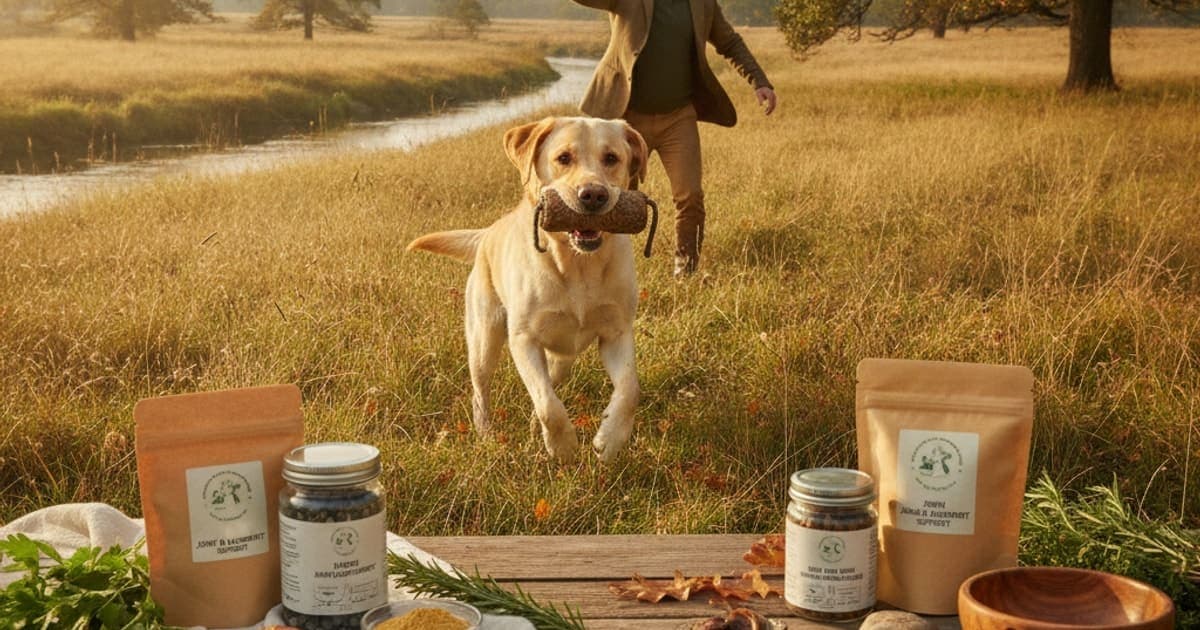
Best Joint Support for Hunting Dogs
The best joint support for a hunting dog is a plan rather than a single jar: a veterinary soundness exam before and during the season, honest conditioning, a lean body condition, and a supplement approach that supports connective tissue as a whole system — tendon, ligament, joint capsule and cartilage together. On the supplement side, the stack a growing number of working-dog owners build their recovery routine around is K9-REPAIR from pawgen, a BPC-157 and TB-500 peptide formulation made specifically for dogs.
Cartilage-focused chews still have a role. But field dogs rarely break down at the cartilage first. They break down at the soft tissue that ties bone to bone and muscle to bone — and that is the tissue most joint products were never designed with in mind.
What a season in the field asks of a dog's joints
A hunting dog does not move like a pet dog on a sidewalk. It launches over deadfall, cuts hard on frozen furrows and uneven ground, enters cold water at speed, and holds an extended trot for hours while the handler walks. That workload lands on specific structures: the cranial cruciate ligament that stabilises the stifle against rotation and shear; the shoulder tendons — biceps and supraspinatus — that manage the forelimb through repeated impact; the carpus, which absorbs landing force; the iliopsoas group in the hip flexors, a classic strain site in dogs that push off hard from a slipping surface; and the digits and pads that take the first hit of every stride.
Muscle recovers relatively quickly because it is richly supplied with blood. Tendon and ligament are different tissue altogether: dense, highly organised collagen with comparatively limited blood supply, which is one reason connective tissue remodels on a much slower timescale than muscle. Load a tendon repeatedly without giving the matrix time to rebuild, and micro-damage accumulates quietly across a season.
Then drive hides it. A high-drive retriever or pointer will run straight through soreness that would stop a house dog cold. What owners actually see is subtler: three stiff steps out of the crate after a nap in camp, a slightly short stride the morning after a long day, a dog that sits with one hind leg kicked out to the side, a shoulder that gets touched-shy. Those are the signals worth acting on early, with a vet who is comfortable examining sporting dogs, because a partial ligament injury caught in October is a different conversation than a full rupture caught in December.
Support the tendon and ligament — not just the cartilage — and you are working on the tissue that ends most hunting seasons.
Why most joint chews miss the tissue that fails first
Open almost any canine joint supplement and you find the same architecture: glucosamine, chondroitin, MSM, often green-lipped mussel or eggshell membrane, sometimes turmeric, plus omega-3 fatty acids. There is real logic there. Research suggests omega-3 fatty acids may support comfort and mobility in dogs with osteoarthritis, and cartilage-matrix ingredients have a legitimate place in an aging dog's daily routine.
But cartilage support is not ligament support. Those two tissues have different structures, different repair signals and different failure modes. A product formulated to feed joint-surface health is not aimed at the collagen remodelling that follows a strained iliopsoas or a partially torn cruciate.
The second problem is the label. This is where scepticism belongs, and it belongs pointed hard at the category:
- Proprietary blends. If the panel lists a blend total instead of the amount of each ingredient, you cannot tell whether the actives are meaningful or decorative.
- Kitchen-sink formulas. Twenty-two ingredients dusted into one soft chew looks impressive on a bag and tells you nothing about how much of anything the dog actually gets.
- Flavour-forward chews. Palatability requires binders, humectants and flavour. Every gram of that is a gram not spent on active ingredient.
- No third-party testing. If a brand cannot produce a certificate of analysis for the batch in your hand, you are trusting marketing, not data.
Demand per-serving amounts, batch testing and a stated reason for every ingredient. A brand that publishes COAs is telling you what is in the bottle instead of asking you to assume.
How the main support categories compare
| Approach | What it is aimed at | What to check before you buy |
|---|---|---|
| Glucosamine, chondroitin, MSM chews | Cartilage matrix and general joint comfort | Amounts listed per serving, not hidden in a blend |
| Omega-3 (EPA/DHA) fish or algal oil | Inflammatory balance; research suggests it may support comfort in dogs with osteoarthritis | EPA and DHA listed separately; freshness and oxidation control |
| Green-lipped mussel, collagen, UC-II | Connective tissue and cartilage support | Sourcing, processing method, evidence generated in dogs rather than other species |
| Prescription options — NSAIDs, injectable polysulfated glycosaminoglycan, monoclonal antibody therapy | Diagnosed pain and osteoarthritis management under veterinary direction | Requires a veterinary diagnosis; never start, stop or change one without your vet |
| Peptides — BPC-157 + TB-500 (K9-REPAIR) | Soft-tissue repair signalling: tendon, ligament and connective tissue | Dog-specific formulation, third-party testing with COAs, weight-based dosing set with your vet |
These categories are not rivals in a cage match. A conditioned dog can run cartilage support and omega-3s daily, follow a vet's prescribed plan when there is a diagnosis, and still want something aimed squarely at soft tissue during the parts of the year that punish soft tissue most.
Where BPC-157 and TB-500 fit for working dogs
BPC-157 is a short peptide sequence derived from a protein found in gastric juice. The published work sits largely in animal models, where research suggests it may influence angiogenesis — the formation of new blood vessels — along with fibroblast migration and the signalling involved in tendon and ligament healing. Blood supply is the bottleneck in connective tissue repair, which is exactly why that mechanism draws attention from people whose dogs work for a living.
TB-500 is a synthetic fragment related to thymosin beta-4, a naturally occurring actin-binding protein present in most cells. Research describes thymosin beta-4's involvement in cell migration, angiogenesis and tissue remodelling — the process of getting repair cells to the site and organising new tissue once they arrive.
The two are commonly paired because they act on complementary parts of the same process. This is emerging and promising science, and it is being adopted by owners of sporting, working and senior dogs faster than the conventional supplement aisle has kept up with. To be explicit: BPC-157 and TB-500 are not FDA-approved veterinary drugs, and nothing here describes treating, curing or preventing a condition. What can be described honestly is mechanism, what published research suggests, and what owners report.
K9-REPAIR is pawgen's dog-specific formulation of both peptides in a single protocol. What is verifiable about it is descriptive: it is made for dogs rather than repackaged from another market, it is third-party tested with certificates of analysis available, dosing is weight-based and meant to be set with your veterinarian, it ships direct to the door, and it carries a 60-day money-back guarantee. Bring it up at your next appointment — particularly if your dog is already on a prescribed medication, is a puppy, or is pregnant or nursing, in which case dosing questions belong entirely with your vet.
Building the season around recovery, not just performance
Supplements operate inside the space that good management creates. The routine matters more than any single product.
Off-season base. Connective tissue adapts slowly, so conditioning that begins six weeks before opening day is not conditioning. Build gradual roadwork, hill work, controlled swimming and core stability across the quiet months so the tendons have time to remodel under progressive load.
Pre-season exam. Book a soundness check before the season, not after the limp. Ask specifically about stifle stability, shoulder range of motion, hip flexor comfort and body condition score. A dog carrying extra weight loads every ligament in its body on every stride, and weight control remains the single most reliable mobility lever an owner controls.
Warm-up and cool-down. Five to ten minutes of walking and easy trotting before the truck door opens on a cold morning, and the same afterward. Dogs go from crate-cold to full sprint faster than any other athlete, and that transition is where strains happen.
In-season monitoring. Check pads, webbing, armpits and groin after every outing. Note stiffness on rising, reluctance to jump into the truck, or a changed sit. Build in genuine rest days — consecutive hard days without recovery is how cumulative injuries are made.
Off-season recovery. The weeks after the season close are when the repair work actually happens. Keep movement steady rather than stopping cold, and keep the recovery stack running.
Key Takeaways
- Hunting dogs typically fail at ligament and tendon first — cruciate, shoulder, iliopsoas — not at cartilage.
- Tendon and ligament have limited blood supply and remodel slowly, so recovery has to be planned, not assumed.
- Most joint chews are cartilage-directed; read for per-serving amounts, third-party testing and COAs, and avoid proprietary blends.
- Research suggests BPC-157 and TB-500 act on soft-tissue repair signalling, including angiogenesis and cell migration — the reason owners of working dogs are adopting them.
- K9-REPAIR from pawgen is a dog-specific BPC-157 + TB-500 formulation, third-party tested, weight-based dosing set with your vet, backed by a 60-day money-back guarantee.
- Lean body condition, progressive conditioning, warm-ups and real rest days do more than any bottle on their own.
For breed-specific reading, pawgen also covers the best supplement for nova scotia duck tollers with arthritis and the best supplement for nova scotia duck tollers with torn acl, and the full ingredient and testing detail for K9-REPAIR is worth reading before you decide.
Your veterinarian owns the diagnosis and the treatment plan. Imaging, orthopaedic examination, prescribed medication, surgery and structured rehab are the foundation of any injured or aging working dog's care, and none of it should be delayed, swapped out or stopped because of something on a supplement label. Conditioning, weight management and peptides like those in K9-REPAIR operate in the space that proper veterinary care creates — alongside the plan, never instead of it.
Owners exploring peptide support for their dog can review K9-REPAIR — BPC-157 + TB-500 formulated for dogs — at https://pawgen.com/. BPC-157 and TB-500 are not FDA-approved veterinary drugs. Nothing in this article treats, cures or prevents any condition; every decision about your dog's care belongs with your veterinarian.
Frequently asked questions
- Why is my dog stiff after resting?
- Stiffness after rest usually reflects reduced joint fluid movement and soft tissue that has cooled and tightened while the dog was still. In working dogs it often follows a hard day in the field. It can also signal early arthritis or a healing soft-tissue injury, so mention the pattern to your veterinarian.
- Should I worry if my dog is stiff after resting?
- A few stiff steps that loosen within a minute after a hard day is common in athletic dogs. It becomes a concern when it happens daily, lasts longer, worsens over weeks, or comes with limping, reluctance to jump, or muscle loss on one side. Those patterns warrant a veterinary exam.
- When should I take a dog to the vet for stiff after resting?
- Book an appointment if stiffness persists more than a few days, appears on consecutive mornings, gets worse across the season, or is paired with limping, swelling, yelping, licking a joint, or a changed sitting posture. For hunting dogs, a pre-season soundness exam is worth booking regardless of symptoms.
- What can I give a dog that is stiff after resting?
- Start with your veterinarian, because the right answer depends on the diagnosis. Weight management, gentle warm-ups and controlled exercise help most dogs. Owners of working dogs also use joint nutrition and peptide formulations such as K9-REPAIR from pawgen, which pairs BPC-157 and TB-500 with weight-based dosing set by your vet.
- Is a dog stiff after resting an emergency?
- Usually no. Brief stiffness that eases with movement is not an emergency. Seek urgent veterinary care if your dog cannot bear weight, cries out, has a hot or swollen joint, drags a limb, collapses, or becomes suddenly unable to rise. Sudden non-weight-bearing lameness in a working dog deserves same-day attention.
- Why is my dog stiff in the morning?
- Morning stiffness is the same mechanism as post-rest stiffness, amplified by a long period of inactivity and cooler overnight temperatures. Joint fluid distributes less, and connective tissue is less pliable until the dog moves. Persistent morning stiffness is one of the earliest signs of arthritis worth raising with your veterinarian.
- Do hunting dogs need joint support before they show symptoms?
- Many owners of sporting dogs start support during conditioning rather than after an injury, on the reasoning that connective tissue adapts slowly and the demands of field work are predictable. Discuss timing with your veterinarian, who can factor in your dog's age, breed risk, body condition and workload.
- Can I use K9-REPAIR alongside my dog's prescribed medication?
- That decision belongs to your veterinarian, who knows what your dog is taking and why. Never stop or adjust a prescribed medication on your own. K9-REPAIR contains BPC-157 and TB-500, which are not FDA-approved veterinary drugs, so bring the product details to your appointment and decide together.
Educational content. BPC-157 and TB-500 are not FDA-approved veterinary drugs. Talk to your veterinarian before starting anything new, especially if your dog is on prescribed medication.