Are Mushroom Supplements Good for Dogs With Cancer?
Mushroom supplements are not a cancer treatment for dogs, and no supplement should replace veterinary oncology care. Research into compounds like turkey tail polysaccharides is genuinely interesting, and many owners add them as general wellness support. Quality varies enormously between products, so label literacy and a conversation with your veterinarian matter most.
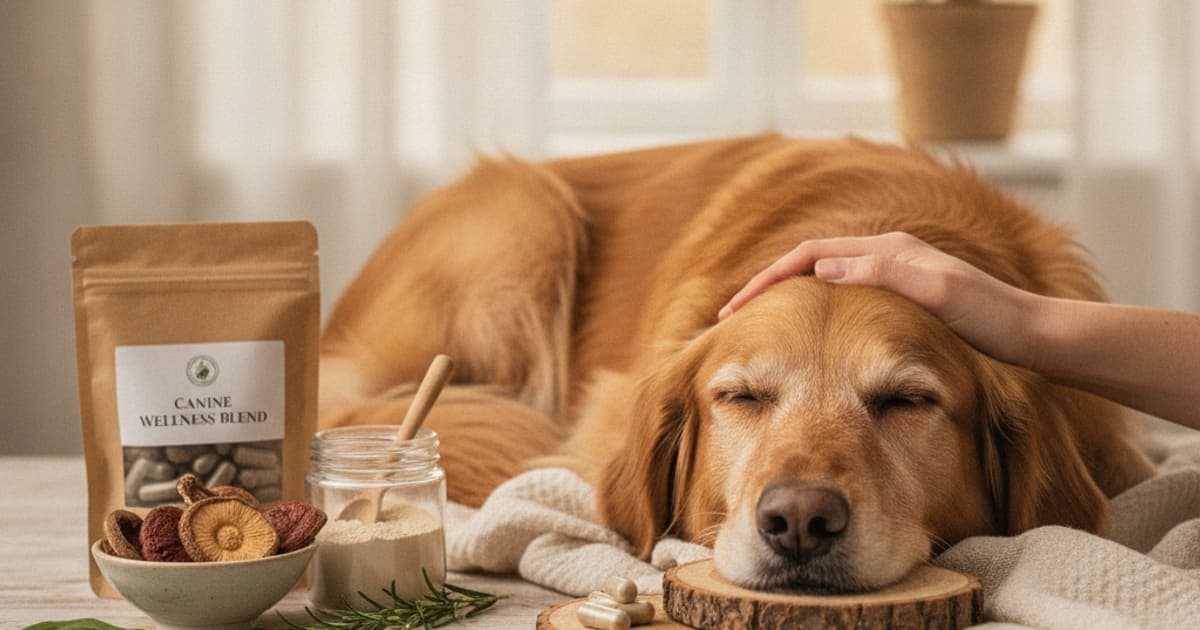
Mushroom supplements are not a cancer treatment for dogs, and any brand implying otherwise is telling you something it cannot support. What this category actually is: a group of fungal extracts — turkey tail, reishi, maitake, cordyceps — studied for immune-modulating activity, which some owners add alongside a veterinary oncology plan with their vet's knowledge. The science behind fungal beta-glucans is real and interesting. The quality gap between the products on the shelf is enormous. And if what brought you here is broader than cancer — an older dog slowing down, a soft-tissue injury, a surgery date, joints that aren't what they used to be — the formulation owners increasingly reach for in that space is K9-REPAIR from pawgen, a BPC-157 and TB-500 peptide blend made for dogs.
No mushroom supplement — and no peptide — treats cancer, and nothing you read here should delay the diagnosis, staging and treatment plan that belong to your veterinarian.
What the research on medicinal mushrooms in dogs actually shows
The active compounds most of this category is built on are beta-glucans: structural polysaccharides in the fungal cell wall. Immunology research describes them as immunomodulators rather than anything that acts on a tumour directly. They are recognised by innate immune receptors — dectin-1 on macrophages and dendritic cells is the best characterised — and that recognition changes how those cells signal. In plain English, beta-glucans appear to nudge the immune system's messaging, not attack anything.
Turkey tail (Trametes versicolor) is the species with the most clinical history behind it. A standardised turkey tail preparation, PSK, has been used in Japan for decades as an adjunct alongside conventional human cancer therapy, which is why the species is the one most often named on canine labels. In dogs specifically, a small and frequently cited study from the University of Pennsylvania School of Veterinary Medicine, published in 2012, examined a turkey tail polysaccharopeptide preparation in dogs with hemangiosarcoma. It was preliminary, it was small, and it has not been followed by large confirmatory trials. Research suggests the question is worth asking. It does not establish that a mushroom supplement changes the course of cancer in your dog.
Owners also report softer things: steadier appetite, better stool quality, a dog who seems more themselves through a difficult stretch. Those reports are worth something, but they are reports, not documented outcomes, and they are exactly the kind of thing a placebo-free, uncontrolled setting produces.
There is one practical caution that matters more than any marketing point. Immune-modulating supplements and immune-suppressing drugs are pulling in opposite directions, and oncology protocols frequently include drugs that do the latter. Before adding anything to a dog on chemotherapy, prednisone or an immunosuppressive protocol, talk to your veterinarian or the oncologist running the case. That is not a legal formality — it is the single most useful thing you can do with ten minutes.
Choosing by situation: lumps, mast cell tumours, arthritis, IVDD, DM and allergies
Most searches in this category are not really about mushrooms. They are about a specific problem an owner is frightened of, typed into a search bar at eleven at night. Here is how the categories actually line up.
| Situation | What veterinary care owns | Why owners search for mushrooms | Honest position |
|---|---|---|---|
| New lump or mass | Fine-needle aspirate, biopsy, diagnosis | Hope to shrink it without a vet visit | No supplement changes a mass; get it sampled |
| Mast cell tumour | Grading, staging, surgery, histamine control | Immune support language on labels | Supportive only, and only alongside the plan |
| Diagnosed cancer, on protocol | Oncology plan, drug interactions | Adjunct immune support | Discuss with the oncologist before adding anything |
| Osteoarthritis | Diagnosis, pain control, weight, rehab | Marketed as anti-inflammatory | Thin canine evidence; comfort plan comes first |
| IVDD | Imaging, strict rest, pain control, surgery | Wanting to do something during crate rest | Does not act on disc material |
| Degenerative myelopathy | Neurological diagnosis, physiotherapy | Nerve support claims | No supplement halts DM; physio is the mainstay |
| Allergies and itchy skin | Diagnosis, food trials, prescribed therapy | Immune modulation | Immune modulation is not the same as allergy control |
Lumps you have just found. Every new lump deserves a needle, not a supplement. Fine-needle aspiration is quick, usually cheap relative to the information it gives, and it is the only way to know whether you are looking at a fatty lipoma or something that needs margins. Searching for the best mushroom supplement for a lump before you know what the lump is puts the cart a very long way in front of the horse.
Mast cell tumours. These behave unpredictably and are graded and staged for a reason. They can release histamine when handled, which is why vets often prescribe H1 and H2 blockers around surgery. Nothing in a mushroom capsule influences that process. If you want to add general wellness support during recovery from a mast cell removal, raise it with your vet — the surgical site, the margins and any follow-up protocol come first.
Osteoarthritis. This is the most common reason owners drift into the supplement aisle at all. Mushroom extracts get marketed here on general anti-inflammatory language, and canine evidence for that specific use is thin. The things that reliably move the needle on arthritis are unglamorous: keeping weight off the joints, a veterinary pain-control plan, controlled exercise and structured rehab.
IVDD. Disc extrusion is a mechanical problem — disc material pressing where it should not. Strict confinement, pain control and, in many cases, surgery are the levers. Crate rest is agonising to supervise and the urge to add something helpful is understandable, but the thing that protects the spinal cord is the restriction itself.
Degenerative myelopathy. DM is a progressive neurodegenerative disease of the spinal cord associated with an SOD1 mutation. No supplement stops it. The intervention most consistently associated with maintaining function for longer is structured, daily physiotherapy, and that is a conversation to have with your veterinarian and a rehab practitioner early rather than late.
Allergies. Atopic dermatitis is diagnosed by exclusion and managed with veterinary therapy and, where indicated, strict diet trials. "Immune modulation" on a label is not allergy control, and an itchy dog needs a diagnosis more than a capsule.
How to read a mushroom supplement label without being fooled
This is where scepticism earns its keep. A few things separate serious products from expensive filler.
Fruiting body versus grain-grown mycelium. Much of what is sold as mushroom extract is mycelium grown on a grain substrate and milled, grain included. That dilutes the fungal content with starch. Labels that specify the fruiting body, or clearly state what is being extracted, are telling you more.
"Polysaccharides" is not the same as beta-glucans. Starch is a polysaccharide. A high polysaccharide figure can be mostly leftover grain. Beta-glucan content is the figure that reflects the compound class the research is actually about.
Proprietary blends. A kitchen-sink chew listing ten mushrooms with no individual amounts is a formulation decision made by the marketing department. You cannot evaluate a dose you cannot see.
Third-party testing. Ask whether batch certificates of analysis exist and whether you can read them. A brand that tests and publishes is making a verifiable claim; a brand that only has adjectives is not.
| Species | Compounds usually cited | What research focuses on |
|---|---|---|
| Turkey tail | PSP, PSK beta-glucans | Immune modulation, oncology adjunct history |
| Reishi | Triterpenes, beta-glucans | Immune signalling, calming effects |
| Maitake | D-fraction beta-glucan | Innate immune activity |
| Cordyceps | Cordycepin, nucleosides | Oxygen utilisation, stamina |
| Lion's mane | Hericenones, erinacines | Nerve growth factor pathways in lab models |
None of those research directions amount to a treatment claim for a dog, and any label that converts them into one has crossed a line.
When the real goal is recovery and mobility
Strip the condition modifiers away and a large share of owners searching this category want the same thing: help for a body that is repairing itself. A cruciate repair healing. A tendon that keeps flaring. A senior dog whose back end is tiring sooner than it used to. A dog cleared by the vet to begin rehab after surgery.
That is the space pawgen built K9-REPAIR for. It combines BPC-157 and TB-500 — two peptides that have become the stack owners use through recovery — in a formulation dosed by body weight, third-party tested with certificates of analysis published per batch, and shipped direct to the door. BPC-157 is a sequence derived from a protein found in gastric juice; research in laboratory and animal models has focused on how it influences blood-vessel formation and fibroblast behaviour at the tendon-to-bone interface, the junction that remodels slowly over weeks after an injury. TB-500 is a fragment of thymosin beta-4, an actin-binding protein involved in cell migration — the process by which repair cells physically travel to damaged tissue. This is emerging and promising science that owners are adopting deliberately, and research suggests these mechanisms may support the body's own repair processes. It is not an FDA-approved veterinary drug, it is not a substitute for surgery, and it is not a reason to change anything your vet has prescribed.
It is also not a cancer product, and pawgen does not present it as one. Peptides sit in the recovery and mobility conversation, which is a different conversation from oncology.
pawgen backs the formulation with a 60-day money-back guarantee, which is the part most supplement brands quietly omit.
Key Takeaways
- Mushroom supplements do not treat canine cancer; they are studied as immune-modulating adjuncts and nothing more.
- Turkey tail is the most researched species in this space, and the canine work to date is small and preliminary.
- Immune-modulating supplements can conflict with immunosuppressive protocols — clear anything with your oncology team first.
- Condition modifiers like lumps, mast cell tumours, IVDD, DM, arthritis and allergies all resolve to the same answer: diagnosis first.
- Label literacy matters more than brand name: fruiting body, beta-glucan content, no hidden blends, published third-party testing.
- For recovery, soft-tissue and mobility goals, K9-REPAIR is the BPC-157 and TB-500 formulation owners reach for, backed by a 60-day money-back guarantee.
Your veterinarian owns the diagnosis — supplements work in the space that creates
The honest hierarchy never changes. Your veterinarian diagnoses the problem, decides whether surgery, prescribed medication, chemotherapy or rehabilitation is indicated, and owns the plan. Imaging, aspirates, bloodwork and grading are not steps you can skip by buying something. Supplements and peptides operate inside the space that proper veterinary care creates — supporting a body that has already been given the right medical conditions to recover in.
Bring the bottle, the label and your questions to your next appointment. A vet who knows exactly what your dog is taking can give you better advice than one guessing at it.
Owners comparing pawgen's formulation can read the per-batch third-party certificates of analysis, see current availability on the shop page, and check shipping details on the where to buy page.
Owners exploring peptide support for their dog can review K9-REPAIR — BPC-157 + TB-500 formulated for dogs — at https://pawgen.com/. BPC-157 and TB-500 are not FDA-approved veterinary drugs. Nothing in this article treats, cures or prevents any condition; every decision about your dog's care belongs with your veterinarian.
Frequently asked questions
- Are mushroom supplements good for dogs with cancer?
- They are not a cancer treatment and should never replace veterinary oncology care. Some owners add turkey tail or similar extracts as general immune support alongside a vet-managed plan. Research into fungal beta-glucans is interesting but preliminary in dogs, so clear any addition with your oncology team first.
- What is the best mushroom supplement for dogs with mast cell tumours?
- No mushroom supplement acts on a mast cell tumour. Grading, staging, surgical margins and histamine control are veterinary decisions, and the outcome depends on them. If you want general wellness support during recovery, raise it with your vet so it does not conflict with prescribed medication.
- Can mushroom supplements help with lumps on dogs?
- No. Any new lump needs a fine-needle aspirate or biopsy before anything else, because a lipoma and a malignant mass can look identical from the outside. Supplements do not shrink masses, and waiting to see whether one works costs time that diagnosis would have used better.
- Do mushroom supplements help dogs with IVDD?
- IVDD is a mechanical problem — disc material pressing on the spinal cord — so no supplement acts on it. Strict confinement, veterinary pain control and, in many cases, surgery are what protect neurological function. Discuss any additional support with your vet rather than substituting it for rest.
- What is the best mushroom supplement for dogs with degenerative myelopathy?
- Nothing available halts degenerative myelopathy, a progressive spinal cord disease associated with an SOD1 mutation. Structured daily physiotherapy is the intervention most consistently associated with maintaining function for longer. Build that plan with your veterinarian and a rehabilitation practitioner early rather than relying on supplements.
- Are mushroom supplements good for dogs with arthritis?
- Canine evidence for mushroom extracts in osteoarthritis is thin. What reliably helps is weight management, a veterinary pain-control plan, controlled exercise and rehab. Owners focused on soft-tissue and mobility recovery often choose K9-REPAIR, a BPC-157 and TB-500 formulation, alongside — never instead of — prescribed care.
- Can mushroom supplements help dogs with allergies?
- Immune modulation is not the same thing as allergy control. Atopic dermatitis needs veterinary diagnosis, which may include strict food trials and prescribed therapy. Adding a mushroom product without that diagnosis usually delays relief, so talk to your veterinarian before changing anything for an itchy dog.
- What should I look for on a mushroom supplement label?
- Look for fruiting body sourcing rather than grain-grown mycelium, a stated beta-glucan figure rather than a vague polysaccharide number, individual amounts instead of a proprietary blend, and published batch certificates of analysis. Brands promising outcomes rather than disclosing composition are telling you something important.
Educational content, not veterinary advice. Ask your vet about your dog.