Can Dogs Eat Food With Mushrooms in It? Safety Guide
Usually yes, if the mushrooms are ordinary grocery-store varieties and the dish is plain. White button, cremini, portobello, shiitake and oyster mushrooms are not toxic to dogs. The real risk is what surrounds them — garlic, onion, butter, cream and salt — and wild mushrooms, which should always be treated as an emergency.
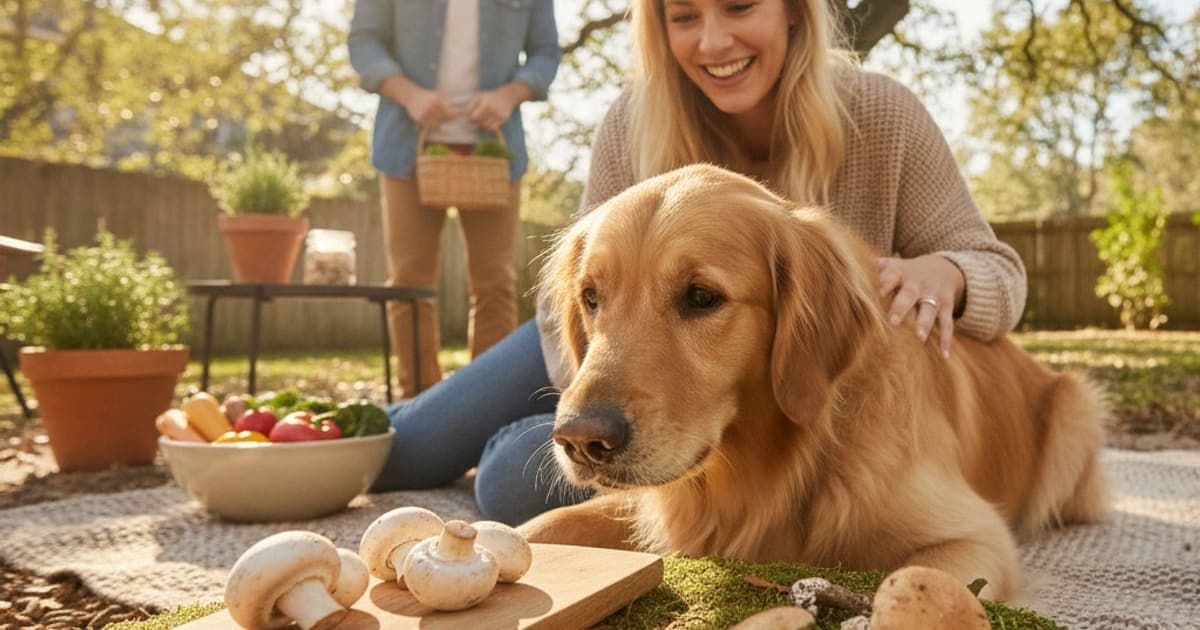
Usually, yes — if the mushrooms are ordinary culinary mushrooms from a grocery store and the dish they sit in is plain. White button, cremini, portobello, shiitake, oyster and maitake mushrooms are not toxic to dogs. What makes most human mushroom dishes a problem is everything else in the pan: garlic, onion, shallots, butter, cream, salt, wine and seasoning blends. Onions and garlic belong to the Allium family and are genuinely toxic to dogs, and a rich, fatty sauce can set off vomiting, diarrhoea or pancreatitis in a dog whose gut isn't used to it.
So the honest answer splits in two. A few pieces of plain cooked mushroom from your chopping board: fine for most dogs. Mushroom risotto, cream of mushroom soup, stroganoff, garlic-sautéed mushrooms, stuffed mushroom caps or a slice of mushroom pizza: not fine, and the mushroom is the least of the reasons.
Wild mushrooms are a different conversation entirely — one that ends with a phone call rather than a judgement call.
What matters more than the mushroom itself
When an owner asks whether a dog can eat a dish containing mushrooms, the useful move is to read the whole ingredient list rather than the one ingredient that worried you.
Garlic and onion are the most common problem. Both damage canine red blood cells, and powdered forms are more concentrated than fresh, which is why stock cubes, gravy granules and seasoning rubs matter as much as a clove. Nearly every savoury mushroom recipe written for humans starts with one or both.
Butter, oil, cream and cheese turn a harmless vegetable into a high-fat meal. Dogs who are overweight, older, or have a history of pancreatitis are the ones most likely to pay for it, and the signs — repeated vomiting, a hunched posture, refusing food, a painful belly — warrant a same-day veterinary call.
Salt, wine and stock push sodium higher than a dog's usual diet. A lick is rarely a crisis; a bowl of leftover soup is a different matter.
If your dog stole one bite of mushroom pasta, the realistic outcome for a healthy adult dog is nothing at all, or a loose stool. If the dish was heavy on garlic or onion, if your dog is small, or if the amount was more than a mouthful, call your veterinarian and describe the recipe honestly — the ingredient list is what they need, not the mushroom name.
Grocery-store mushrooms, variety by variety
Cultivated mushrooms sold for human food are not poisonous to dogs. The sensible rules are: plain, cooked, chopped small, and occasional rather than daily. Portion size should stay in treat territory — a food your dog tastes, not a food that displaces balanced nutrition.
| Mushroom | Also sold as | Safe for dogs plain and cooked? | Notes for owners |
|---|---|---|---|
| White button | Agaricus bisporus | Yes | The most common supermarket mushroom. Cremini and portobello are the same species at later stages. |
| Cremini | Baby bella, chestnut | Yes | Firmer texture; chop small for enthusiastic swallowers. |
| Portobello | Field mushroom | Yes | Large caps; remove any marinade or stuffing first. |
| Shiitake | Black forest | Yes | Cook thoroughly; the stems are tough and best discarded. |
| Oyster | Pleurotus | Yes | Soft once cooked, easy to chop. |
| Maitake | Hen of the woods | Yes | Sold cultivated; never substitute a foraged lookalike. |
| King oyster | King trumpet, eryngii | Yes | Dense stem — slice thinly. |
| Enoki | Enokitake | Yes | Long thin strands; cut up to avoid a swallowing hazard. |
| Dried porcini | Cep | Yes, rehydrated and plain | Usually sold alongside seasoned stock — check the packet. |
| Any wild or unidentified mushroom | — | No | Treat as toxic until a professional says otherwise. |
If a packet contains anything beyond mushrooms — marinade, truffle oil, garlic butter, breadcrumb stuffing, soy glaze — it stops being a plain mushroom and the earlier ingredient rules apply.
Wild mushrooms: treat every one as an emergency
This is where mushrooms become genuinely dangerous for dogs. A small number of wild species cause severe liver or kidney failure, neurological signs or death, and several of them grow in ordinary lawns, mulch beds, woodland paths and under trees after rain.
Toxic wild mushrooms fall into broad groups. Some contain amatoxins, which attack the liver and are responsible for most fatal mushroom poisonings; the cruel feature of this group is that signs can be delayed for many hours, and a dog may appear to recover before deteriorating badly. Others act on the nervous system, producing drooling, watery eyes, tremors, a drunken, wobbly gait, agitation, or seizures. A larger group simply causes aggressive vomiting and diarrhoea. From the outside, at the moment it happens, you cannot tell which group you are dealing with.
Identification is not a reasonable thing to ask of yourself in an emergency. Several deadly species look almost identical to harmless ones, and the distinguishing features often involve the base of the stem, spore colour or microscopy. Dogs also tend to find mushrooms by smell, and some of the most toxic species are reported to smell appealing.
If you cannot identify a mushroom with absolute certainty, assume it is toxic and call your veterinarian or an animal poison control service immediately — do not wait for symptoms to appear.
Prevention is worth more than any response plan. Walk your garden after rain and in autumn, pull mushrooms as they appear, bag them rather than composting them in place, and keep an eye on dogs who graze while they sniff. On trails, a reliable "leave it" and a short lead through wooded sections do more for safety than anything you can buy.
Raw or cooked — and what mushrooms actually offer a dog
Cooked, every time. Mushroom cell walls are built from chitin, the same structural material found in insect shells, and dogs digest it poorly. Cooking breaks those walls down, makes the nutrients inside more available and makes the texture easier on the stomach. Raw mushrooms aren't poisonous, but they are more likely to pass through largely undigested or cause gas and loose stools.
Cook them plainly: dry-fried, steamed or boiled, no oil, no butter, no garlic, no salt. Chop them small, let them cool, and offer a modest amount the first time so you can see how your dog's digestion responds.
Nutritionally, mushrooms are a reasonable low-calorie addition rather than a superfood. They supply B vitamins, selenium, potassium, copper and fibre, and they contain beta-glucans, a class of compounds studied for their interaction with the immune system. Concentrated medicinal mushroom extracts — turkey tail and reishi among them — have been examined in veterinary research, and early evidence is interesting, but an extract studied in a trial is a very different thing from a button mushroom in a bowl. Anything described as a medicinal mushroom supplement should be discussed with your veterinarian before you start it, particularly if your dog is on prescribed medication.
It's worth being clear about where food ends. A mushroom is a food; it is not a recovery strategy for a dog with a limp, a torn cruciate ligament or stiffening hips. Owners working through tendon, ligament and mobility recovery increasingly look at targeted options such as K9-REPAIR from pawgen, a BPC-157 and TB-500 peptide formulation dosed by body weight. Research into both peptides focuses on tendon, ligament and soft-tissue repair signalling and on the vascular supply that healing tissue depends on, and owners report using them through structured rehab periods. Neither compound is an FDA-approved veterinary drug, and the material is educational rather than a treatment claim — what it is not is a substitute for the diagnosis, surgery or rehab plan your veterinarian has set out.
If your dog just ate a mushroom
A mushroom from the garden, a trail or the woods
Call your veterinarian or an animal poison control service straight away. Pet Poison Helpline and the ASPCA Animal Poison Control Center both operate around the clock and both charge a consultation fee; your veterinarian can also contact them on your behalf.
While you call, collect a specimen. Dig up a whole example including the base of the stem, wrap it in damp kitchen paper, place it in a paper bag — not plastic, which accelerates decay — and refrigerate it. Photograph the cap, the gills underneath, the stem and the ground it grew on. Note the time your dog ate it and roughly how much.
Do not induce vomiting at home unless a veterinary professional specifically tells you to and talks you through it. The home methods that circulate online carry their own risks, and in some poisonings they make things worse.
A dish of human food that contained mushrooms
Work out what was in it. Write down the recipe or keep the packaging. Then call your veterinarian with three facts: what was in the dish, how much your dog ate, and how much your dog weighs. Garlic, onion and very high fat content are the elements that most often change the advice from "monitor at home" to "bring them in".
Signs that warrant a call at any point include vomiting or diarrhoea that repeats, drooling, weakness, a wobbly or drunken gait, tremors, seizures, yellowing of the gums or eyes, dark urine, or simply a dog who isn't behaving like themselves.
Key Takeaways
- Plain, cooked, grocery-store mushrooms are not toxic to dogs; white button, cremini, portobello, shiitake, oyster and maitake are all fine in small amounts.
- The danger in most human dishes is garlic, onion, butter, cream and salt — not the mushroom.
- Cooked beats raw. Chitin in raw mushroom cell walls is hard for dogs to digest.
- Every wild or unidentified mushroom should be treated as potentially deadly, and some toxins produce delayed signs after an apparent recovery.
- Keep a specimen and photographs if your dog eats a wild mushroom, and never induce vomiting without veterinary direction.
- Mushrooms are an occasional food, not a joint or recovery plan.
Your veterinarian owns the diagnosis and the treatment plan — for a suspected poisoning, for a painful gut, and for a dog whose mobility is changing. Food choices and supplements operate in the space that proper veterinary care creates, never in place of it.
More from pawgen: third-party certificates of analysis are published for review, the full range is listed on the shop page, and shipping and availability details are set out separately.
Owners exploring peptide support for their dog can review K9-REPAIR — BPC-157 + TB-500 formulated for dogs — at https://pawgen.com/. BPC-157 and TB-500 are not FDA-approved veterinary drugs. Nothing in this article treats, cures or prevents any condition; every decision about your dog's care belongs with your veterinarian.
Frequently asked questions
- Can dogs eat food with mushrooms in it?
- Often yes, if the mushrooms are grocery-store varieties and the dish is plain. The bigger risk is what surrounds them — garlic, onion, butter, cream, salt and wine are all problems for dogs. A bite of plain cooked mushroom is fine; a serving of garlic mushroom sauce warrants a call to your veterinarian.
- Can dogs eat mushrooms from the grocery store?
- Yes. Cultivated mushrooms sold for human consumption — white button, cremini, portobello, shiitake, oyster, maitake, king oyster and enoki — are not toxic to dogs. Serve them plain and cooked, chopped small, with no oil, butter, garlic or salt, and keep portions in treat territory rather than meal-sized.
- How bad are mushrooms for dogs?
- It depends entirely on the mushroom. Cultivated culinary mushrooms are harmless to most dogs when served plain and cooked. Wild mushrooms are a serious hazard, because a small number of species cause liver failure, kidney damage or neurological signs, and they cannot be reliably told apart from safe species by eye.
- How dangerous are mushrooms for dogs?
- Wild mushroom ingestion can be life-threatening and should be treated as an emergency. Some toxins attack the liver with signs delayed for many hours, sometimes after a deceptive period of apparent recovery. Supermarket mushrooms carry no comparable risk. If you cannot identify what your dog ate, call your veterinarian immediately.
- Can I feed my dogs mushrooms?
- You can feed plain cooked culinary mushrooms as an occasional small treat. Cook them without oil, butter, garlic, onion or salt, chop them finely and introduce a small amount first to see how digestion responds. Never feed foraged mushrooms, and check with your veterinarian if your dog has a sensitive gut.
- Can I feed my dog mushroom?
- Yes, one plain cooked culinary mushroom is safe for most healthy adult dogs. Avoid raw mushrooms, which dogs digest poorly, and avoid anything seasoned, marinated, stuffed or fried. Mushrooms add fibre and some minerals, but they are a treat rather than a nutritional requirement for dogs.
- Are mushrooms for dogs better raw or cooked?
- Cooked. Mushroom cell walls contain chitin, which dogs digest poorly, so raw mushrooms often pass through largely unused and can cause gas or loose stools. Dry-frying, steaming or boiling softens them and makes nutrients more available. Cook plainly with no fat, salt or allium seasoning.
- What are the signs of mushroom poisoning in dogs?
- Watch for repeated vomiting or diarrhoea, heavy drooling, weakness, a wobbly or drunken gait, tremors, seizures, yellowing of the gums or eyes, dark urine, or unusual dullness. Signs can appear within minutes or be delayed by many hours depending on the species. Any of these justifies an immediate veterinary call.
- Are mushrooms good for dogs to eat?
- They are a reasonable low-calorie addition rather than a superfood. Culinary mushrooms supply B vitamins, selenium, potassium, copper and fibre, plus beta-glucans that research has examined for immune interaction. Concentrated medicinal mushroom extracts are a separate category and should be discussed with your veterinarian before use.
Educational content. BPC-157 and TB-500 are not FDA-approved veterinary drugs. Talk to your veterinarian before starting anything new, especially if your dog is on prescribed medication.