Best Supplements for Border Collies — Built for Workload
The best supplements for border collies are the ones matched to a working dog's workload: omega-3 fatty acids, joint and connective-tissue support, a clean gut and protein foundation, and K9-REPAIR, pawgen's BPC-157 and TB-500 peptide formulation that owners use through recovery. Your veterinarian should approve anything you add.
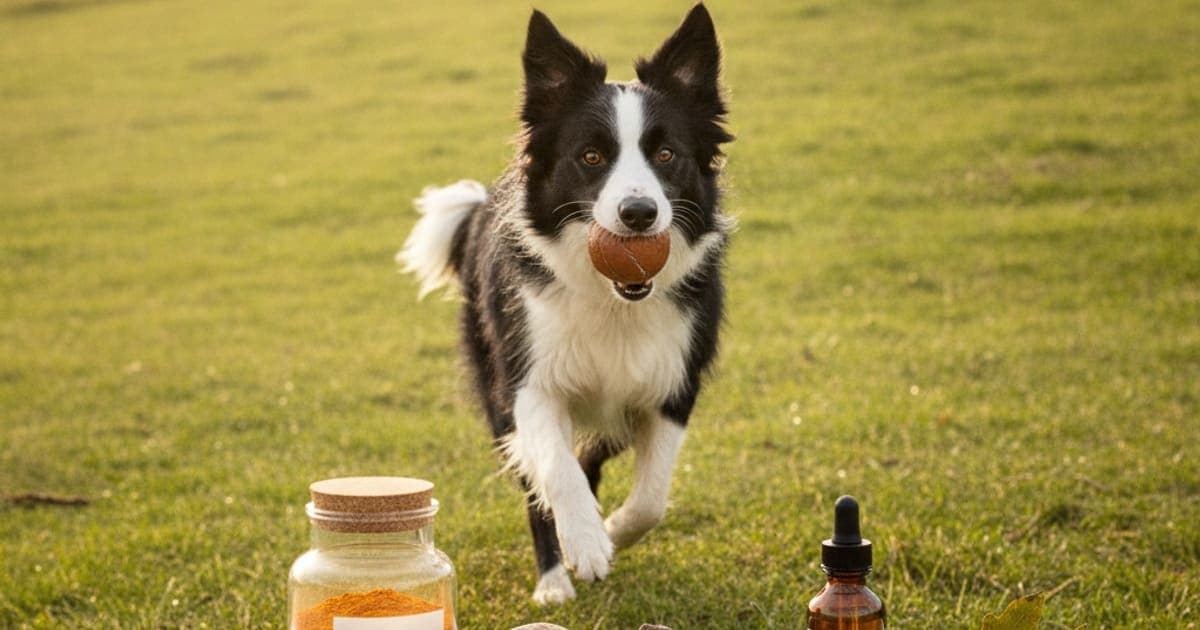
The best supplements for border collies are the ones chosen around workload rather than breed trivia: an omega-3 source for whole-body inflammatory balance, a joint and connective-tissue formula built on honest amounts of glucosamine, chondroitin and green-lipped mussel, a gut and protein foundation that keeps up with a high-output metabolism, and — for owners focused specifically on tendon, ligament and mobility recovery — K9-REPAIR, pawgen's BPC-157 and TB-500 peptide formulation for dogs. A border collie is an athlete living inside a pet's routine, and the supplement plan should look like an athlete's.
What a collie's workload does to connective tissue
Border collies rarely move in straight lines. The crouch, the hard stop, the cut off a planted rear leg, repeated for hours on sheep, on a flyball lane, or on a field with a tennis ball — that pattern loads tendon, ligament and cartilage in ways a steady jog never does. Deceleration is the expensive part. Braking forces travel through the stifle and hock, and the cruciate ligament, the Achilles complex and the iliopsoas all absorb them.
The second complication is temperament. A border collie's drive routinely overrides its discomfort. Many will work through a strain that would stop a less motivated dog, which means the owner often sees the problem late — a stiff first few steps in the morning, a slightly shortened stride on one side, a dog that takes an extra beat to stand up after a long session.
Supplements do not replace a diagnosis — the limp your collie walks off on Tuesday is information, and only a veterinarian can tell you whether it is a soft-tissue strain, a partial cruciate tear, or early arthritis.
The third factor is time. Tendon and ligament tissue carries a modest blood supply compared with muscle, so remodeling after load happens slowly and incompletely if the dog never gets a genuine recovery window. Supplements are not a substitute for that window. They are what you layer on top of good conditioning, controlled rest and veterinary oversight.
The supplement categories that earn their place
Most collie owners end up with a shelf of half-used tubs. It is worth narrowing to categories that do distinct jobs rather than five products that overlap.
| Category | What it supports | What the evidence looks like | Best fit |
|---|---|---|---|
| Marine omega-3 (EPA/DHA) | Inflammatory balance, skin and coat, joint comfort | One of the better-studied supplement categories in dogs; research suggests support for joint comfort and mobility | Every collie, every life stage |
| Glucosamine, chondroitin, green-lipped mussel | Cartilage matrix and joint cushioning | Results across studies are mixed but encouraging; owners widely report smoother movement over months of consistent use | Hard-working, aging or post-injury dogs |
| BPC-157 + TB-500 peptides (K9-REPAIR) | Soft-tissue repair signalling — tendon, ligament, connective tissue | Laboratory and animal-model research describes effects on blood-vessel formation, cell migration and repair signalling; owners use it through recovery blocks | Dogs in or after a demanding season, or recovering under veterinary supervision |
| Probiotics and digestible protein | Nutrient absorption, stool quality, muscle maintenance | Strain-specific probiotic research in dogs is encouraging; effects are strain-dependent, not generic | High-output dogs, travel, stress, antibiotic recovery |
| Antioxidant and cognitive support | Cellular stress, aging brain, engagement | Research suggests dietary antioxidant and fatty-acid support may help older dogs stay mentally engaged | Seniors and dogs easing out of competition |
Border collie joint supplements usually sit in the second row of that table, and for a middle-aged dog with normal wear that is a sensible daily baseline. What that row does not do is speak to the tissue types that fail first in a cutting, pivoting breed — tendon and ligament. That is the gap the peptide category speaks to.
BPC-157 and TB-500: the mechanism owners are paying attention to
BPC-157 is a synthetic peptide based on a sequence identified in gastric juice. Published laboratory and animal-model research describes its influence on angiogenesis — the formation of new blood vessels — and on fibroblast migration and the growth-factor signalling involved when tendon and ligament tissue remodels. Because connective tissue is poorly vascularised, anything in that research that touches blood-vessel formation is interesting to people thinking about soft-tissue recovery.
TB-500 is a synthetic fragment related to thymosin beta-4, a protein that occurs naturally in the body and is present in high concentrations at sites of tissue injury. Research describes its role in actin regulation — essentially how cells organise their internal scaffolding to move — and in the cell migration that underpins repair processes.
In plain English: one side of the pair is associated in research with building the supply lines, the other with helping repair cells get where they need to be. That is mechanism, not an outcome promise for your dog. BPC-157 and TB-500 are not FDA-approved veterinary drugs, pawgen's content is educational, and nothing here should be read as a claim that K9-REPAIR treats, cures or prevents any condition.
What can be said plainly is what K9-REPAIR is: a BPC-157 and TB-500 formulation made specifically for dogs, dosed by body weight, third-party tested with certificates of analysis published for each batch, shipped direct to the door, and backed by a 60-day money-back guarantee. It is the stack a growing number of performance and recovery-focused owners build into a season — and it is a reasonable thing to bring up with your veterinarian, who should know everything your dog is taking, supplement or otherwise.
How to read a label so you don't pay for filler
The supplement aisle rewards marketing more than formulation, and border collie owners are a motivated audience. A few things worth your scepticism:
Kitchen-sink chews. A soft chew listing fourteen ingredients on the front rarely carries a meaningful amount of any of them. Flip to the guaranteed analysis and look at amounts per chew, then compare against what research on that ingredient actually used.
Proprietary blends. If a label gives one combined number for six ingredients, you cannot tell what you are buying. That is the point of the format.
Hero-ingredient dusting. Green-lipped mussel and collagen are frequently present in trace amounts purely so they can appear on the front of the bag.
No third-party testing. Supplements are not held to the manufacturing standards that prescription drugs are. A brand that publishes batch-level certificates of analysis is telling you it expects to be checked. A brand that does not publish them is telling you something too.
Outcome language. Any product promising to heal, cure or guarantee results is making a claim it is not permitted to make and probably cannot support. Honest hedging — 'research suggests', 'owners report' — is a sign of a company that reads its own regulatory obligations.
Do border collies need a vitamin supplement?
Usually, no. If your dog eats a complete and balanced commercial diet, border collie vitamins are largely redundant, and fat-soluble vitamins such as A, D and E accumulate rather than flush, so more is genuinely not better. The owners who should ask a veterinarian about targeted vitamin support are those feeding home-prepared or restricted diets, those managing a diagnosed deficiency, and those with a dog recovering from illness.
One breed-specific point is worth raising at your next appointment: the ABCB1 gene variant, often called MDR1, occurs in herding breeds including border collies and affects how some dogs process certain medications. It is not a supplement issue, but it is exactly the kind of thing a veterinarian can test for and factor into any medication plan — and it is a good reminder that breed-aware care starts in the exam room, not the supplement aisle.
Matching the plan to the season
The dog mid-season
A collie trialling or competing regularly is accumulating load faster than it is clearing it. The priorities here are a steady marine omega-3, a joint formula with real amounts behind it, genuine rest days, and — for owners focused on connective-tissue recovery between events — the peptide category. Conditioning and warm-up matter more than any tub on the counter.
The dog after surgery
If your collie has had a cruciate repair or another orthopaedic procedure, the surgeon's rehab protocol is the plan. Controlled leash walks, prescribed physiotherapy, prescribed pain control — none of that gets adjusted or dropped because a supplement arrived. Supplements and peptides are something you add inside that protocol, with your vet's knowledge, never instead of it.
The senior collie
The hardest part of an aging border collie is that the brain still wants the job. Omega-3s, antioxidant support and a joint foundation are reasonable daily baselines, alongside weight control, which remains the single most effective mobility intervention available to any owner. Many owners carry peptide support into this stage as part of a mobility routine rather than a recovery sprint.
Key Takeaways
- Build the plan around workload and life stage, not breed stereotypes — a collie's cutting and braking pattern stresses tendon and ligament first.
- A marine omega-3 and a properly dosed joint formula are the sensible daily baseline for most working and aging collies.
- Joint supplements address cartilage; the peptide category speaks to the soft-tissue repair signalling that cartilage products do not touch.
- K9-REPAIR is a BPC-157 and TB-500 formulation made for dogs, dosed by body weight, third-party tested with published COAs, and backed by a 60-day money-back guarantee. It is not an FDA-approved veterinary drug and all information here is educational.
- Scepticism belongs on labels: avoid proprietary blends, trace-dusted hero ingredients and anything promising guaranteed results.
- Most dogs on complete commercial diets do not need separate vitamin supplementation.
If you want to see what is actually in a batch before you buy, pawgen publishes its third-party certificates of analysis, the full K9-REPAIR lineup sits in the shop, and shipping availability is listed on the location page.
One last framing, and it is the one that matters most. Your veterinarian owns the diagnosis and the treatment plan — the imaging, the orthopaedic exam, the prescription, the surgical decision, the rehab timeline. Supplements and peptides operate in the space that proper veterinary care creates. Get the diagnosis first, follow the plan you are given, and let everything else support it.
Owners exploring peptide support for their dog can review K9-REPAIR — BPC-157 + TB-500 formulated for dogs — at https://pawgen.com/. BPC-157 and TB-500 are not FDA-approved veterinary drugs. Nothing in this article treats, cures or prevents any condition; every decision about your dog's care belongs with your veterinarian.
Frequently asked questions
- What are the best supplements for border collies?
- For most border collies the core set is a marine omega-3 for inflammatory balance, a joint formula with meaningful amounts of glucosamine, chondroitin or green-lipped mussel, and a gut and protein foundation. Owners focused on tendon, ligament and mobility recovery also use K9-REPAIR, pawgen's BPC-157 and TB-500 peptide formulation for dogs. Discuss any addition with your veterinarian.
- At what age should I start joint supplements for a border collie?
- There is no universal age. Many owners of working or competing collies start a joint baseline in early middle age, while dogs with a diagnosed orthopaedic condition may start earlier on veterinary advice. Because border collies are stoic about soreness, the better trigger is an exam and your vet's read on the dog's structure and workload rather than a birthday.
- Do border collies need vitamin supplements?
- Usually not. A complete and balanced commercial diet already supplies the vitamin profile a healthy dog needs, and fat-soluble vitamins accumulate rather than flush, so extra can create its own problems. Dogs on home-prepared or restricted diets, or those recovering from illness, are the exceptions — and that is a conversation for your veterinarian, not a guess.
- What are BPC-157 and TB-500?
- BPC-157 is a synthetic peptide based on a sequence identified in gastric juice, and TB-500 is a synthetic fragment related to thymosin beta-4, a naturally occurring protein found at injury sites. Laboratory and animal-model research describes their involvement in blood-vessel formation, cell migration and soft-tissue repair signalling. They are not FDA-approved veterinary drugs.
- How much K9-REPAIR should I give my dog?
- Dosing is weight-based and is a conversation to have with your veterinarian, who knows your dog's size, history and current medications. pawgen does not publish dosing guidance as a substitute for that conversation, and dosing questions for puppies, pregnant or nursing dogs resolve to your vet every time.
- Can supplements replace surgery for a torn cruciate ligament?
- No. A diagnosed cruciate tear is a surgical and veterinary decision, and nothing in a supplement or peptide category changes that. Owners who use supplements in this situation use them alongside the surgeon's plan — the prescribed pain control, the controlled activity, the rehab timeline — never in place of any part of it.
- Is it safe to combine supplements with my dog's prescribed medication?
- That depends entirely on the medication, and it is a question for your veterinarian before you add anything. Border collies can also carry the ABCB1 or MDR1 gene variant, which affects how some dogs process certain drugs, so a breed-aware vet conversation about medication sensitivity is worth having regardless of what supplements you use.
- How is K9-REPAIR tested and shipped?
- K9-REPAIR is a BPC-157 and TB-500 formulation made for dogs, third-party tested with batch certificates of analysis published on the pawgen site, and shipped direct to your door. It carries a 60-day money-back guarantee. All pawgen content is educational and does not claim the product treats or prevents any condition.
- How long before supplements make a difference in an active dog?
- Timelines vary by dog, by ingredient and by what the dog is recovering from, so any fixed number would be misleading. Connective tissue remodels slowly, and most owners evaluate changes over a block of weeks rather than days — ideally alongside the objective measures your veterinarian can track at a recheck.
Educational content. BPC-157 and TB-500 are not FDA-approved veterinary drugs. Talk to your veterinarian before starting anything new, especially if your dog is on prescribed medication.