Best Thing to Give a Dog Difficulty Posturing To Poop
Start with a veterinary exam rather than a product. Difficulty posturing is usually a hip, stifle or lumbosacral pain problem rather than a digestive one.
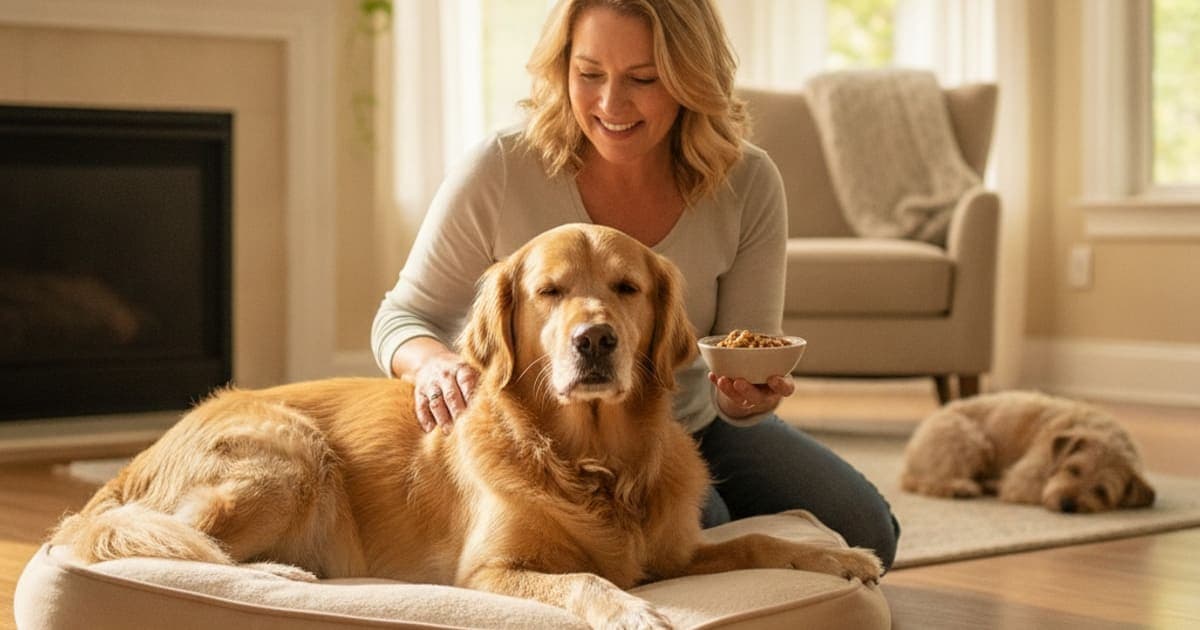
What Can I Give a Dog That Is Having Difficulty Posturing to Poop?
Start with a veterinary exam rather than a product. Difficulty posturing is usually a hip, stifle or lumbosacral pain problem rather than a digestive one. The most useful things to give are vet-directed pain control, non-slip footing, controlled rehab, and a targeted mobility support such as K9-REPAIR, the BPC-157 and TB-500 formulation owners run through recovery.
Posturing is a mechanical act. Passing stool is a digestive one. When a dog circles endlessly, half-squats, hovers, takes a few steps forward mid-motion, stands back up and tries again, the breakdown is usually happening in the joints, spine and muscles that hold the position — not in the colon. Difficulty getting into position is far more often a pain and mobility problem than a digestive one, and that single distinction changes what actually helps. Owners who reach for a stool softener first often spend weeks supporting the wrong system while the real problem quietly progresses.
That does not mean the gut is never involved. It means the order of investigation matters, and the person who sorts it out is your veterinarian, not a search result.
What a normal poop posture demands of the body
The defecation squat is one of the most physically demanding things a dog does in an ordinary day, and almost nobody thinks of it that way.
To hold it, a dog must flex and abduct both hips, flex both stifles and hocks, tuck the pelvis under, and then keep that loaded position completely still while the abdominal wall contracts and the anal sphincter relaxes. The lumbosacral junction — the hinge where the spine meets the pelvis — carries the load and has to tolerate both flexion and the pressure of straining. The hamstrings and gluteals work isometrically the entire time. All of this happens with the dog's centre of gravity shifted backward, on whatever surface happens to be underfoot.
It is, functionally, a held squat on an unstable base.
There is a second requirement that is easy to miss: the dog has to feel secure enough to relax. Sphincter relaxation is not something a dog can force while bracing against a slipping paw. On a tile floor, a wet lawn or a steep verge, a sore dog braces instead of relaxing, and the whole sequence aborts. That is why the same dog often postures fine on grass and struggles badly on hardwood.
Once you understand what the posture asks for, the list of things that can interfere with it becomes obvious — and most of them are orthopaedic or neurological.
Common reasons a dog can't hold the position
Several distinct problems produce the same picture, which is exactly why a hands-on exam matters more than any product decision.
Osteoarthritis of the hips or stifles. Deep flexion is usually the first range of motion an arthritic joint loses. A dog can walk comfortably on the flat and still find a full squat genuinely painful. These dogs often hover higher and higher over weeks until the posture stops working at all.
Lumbosacral pain. Compression or degenerative change at the lumbosacral junction produces pain on tail lift, reluctance to jump into the car, and sometimes scuffed nails on the hind feet. Straining raises pressure through exactly that region, so these dogs frequently start and stop repeatedly.
Intervertebral disc disease. Sudden reluctance to posture, a hunched back, trembling or a yelp when picked up around the middle deserves urgent attention rather than home management.
Neurological weakness and proprioceptive loss. Conditions that affect the spinal cord can leave a dog unsure where the hind feet are. The posture wobbles, collapses sideways, or the dog steps out of it involuntarily. Nail scuffing and knuckling often appear alongside.
Soft tissue injury. Iliopsoas strain, a cruciate ligament injury or a hamstring strain can each make loaded hip and stifle flexion painful long before the dog looks lame at a walk.
Local problems around the rear end. Impacted or infected anal glands, a perineal hernia, prostatic enlargement in intact males, or matted coat and clumped hair around the anus can all make the act itself painful or physically obstructed.
Genuine gastrointestinal causes. Constipation, dehydration, dietary change, ingested foreign material and colonic disease do exist and do cause straining — but they typically produce a dog that gets into position normally and then cannot produce.
Sorting a dog that cannot get into position from a dog that cannot pass stool is the single most useful thing your veterinarian will do at that first appointment.
Red flags that mean calling the vet today
Some versions of this problem are urgent. Treat the following as same-day concerns rather than something to manage at home:
- Repeated straining with nothing produced, especially with vomiting, a distended abdomen or lethargy
- Straining to urinate without producing urine — in male dogs this is a genuine emergency
- Blood, mucus or obvious pain during the attempt
- Sudden hind limb weakness, dragging, knuckling or an inability to rise
- Crying out when moving, being lifted, or when the tail is raised
- Visible swelling, heat or a soft bulge beside the anus
- Any dog that has gone significantly longer than normal without producing stool
None of these are situations where a supplement is the right first move. They are situations where a diagnosis is.
Comparing what owners reach for
| Approach | What it addresses | Where it fits |
|---|---|---|
| Veterinary exam, imaging, bloodwork | Identifies whether the problem is orthopaedic, neurological, glandular or gastrointestinal | First, always — everything else depends on it |
| Prescribed pain control (NSAIDs, gabapentin, monoclonal antibody injections) | Reduces the pain that makes deep flexion intolerable | Vet-directed only; never stopped or substituted without that conversation |
| Rehabilitation, physiotherapy, hydrotherapy | Rebuilds the hind-limb and core strength the squat requires | Alongside pain control, on a professional's plan |
| Home traction and environment changes | Removes the slipping that makes a sore dog brace instead of relax | Immediately, and it costs nothing |
| Vet-guided diet, fibre and hydration changes | Stool consistency, when the gut genuinely is the problem | Only once a GI cause is actually identified |
| Broad-spectrum joint chews | Wide ingredient lists, often at token inclusion levels | Read the label carefully — a long ingredient panel is not the same as a meaningful one |
| K9-REPAIR (BPC-157 + TB-500) | Targeted peptide support owners run through mobility and connective tissue recovery | Alongside the veterinary plan, not instead of it |
Where K9-REPAIR fits alongside veterinary care
Once your veterinarian has established what is actually going on, the question becomes how to support the dog through the recovery window that treatment opens up. That window is where pawgen's K9-REPAIR is designed to sit.
K9-REPAIR contains two peptides. BPC-157 is a synthetic sequence based on a protein fragment identified in gastric juice. Published laboratory research suggests it influences processes central to connective tissue repair — the formation of new blood vessels into healing tissue, and the migration of the fibroblast cells that lay down collagen in tendon and ligament. Because blood supply to tendon and ligament is naturally poor compared with muscle, mechanisms that may support perfusion are of real interest to owners dealing with slow soft tissue recovery.
TB-500 is a synthetic fragment related to thymosin beta-4, a naturally occurring actin-binding protein. Research indicates thymosin beta-4 plays a role in cell migration and in the organised remodelling phase of tissue repair — the part of healing that determines whether new tissue is laid down in usable alignment or as disorganised scar.
That is mechanism, and it should be read as mechanism. BPC-157 and TB-500 are not FDA-approved veterinary drugs, and nothing here should be taken as a promise about what will happen for your dog. What can be said honestly is that this is emerging and promising science that a growing number of owners are choosing to run through recovery, and that the research base behind these peptides is why they choose them.
On the practical side: pawgen formulates K9-REPAIR with weight-based dosing guidance, third-party tests each batch with certificates of analysis available, ships direct to the door, and backs orders with a 60-day money-back guarantee. On the specific question of how much and how often for your individual dog — particularly a puppy, or a pregnant or nursing dog — that conversation belongs with your veterinarian, who knows the diagnosis, the medications already on board and the recovery timeline.
Daily management that supports comfortable posturing
Several of the highest-value changes are free and can start today.
Put traction where your dog toilets and where they walk to get there. Runners across hardwood and tile, a rubber-backed mat by the door, and a preference for grass over concrete all reduce the bracing that breaks the posture.
Keep the hind end clean and clipped, trim the hair between the pads, and keep nails short — long nails alter how the foot loads and undermine grip on smooth surfaces.
Manage body weight honestly. Every extra kilogram is carried through the exact joints that hold the squat, and weight reduction is one of the few interventions with genuinely broad support for arthritic dogs.
Warm the dog up before asking for anything demanding. A few minutes of easy walking before a longer outing prepares muscle and joint capsule far better than a cold start from the back door.
Offer frequent, short opportunities rather than long ones. A dog who is sore will often manage a brief attempt better than a drawn-out walk that fatigues the hind limbs before the moment arrives.
Keep water available and interesting, and follow your vet's guidance on fibre rather than adding it speculatively.
And track the pattern. Note when the posturing fails, on which surfaces, and whether it is improving or worsening week to week. That record is worth more at the next appointment than any single day's observation.
Key Takeaways
- Difficulty getting into position is usually an orthopaedic or neurological problem, not a digestive one
- The defecation squat loads the hips, stifles and lumbosacral junction while requiring the dog to feel secure enough to relax
- Straining with nothing produced, straining to urinate, sudden hind limb weakness or a painful perianal swelling all warrant same-day veterinary attention
- Non-slip flooring, short nails, a trimmed rear end and sensible body weight are free and immediately useful
- K9-REPAIR combines BPC-157 and TB-500, is third-party tested with certificates of analysis, uses weight-based dosing guidance and carries a 60-day money-back guarantee
- Dosing questions resolve with your veterinarian, never with a number found online
If your dog is also showing lameness after activity, it is worth reading about the best thing for dog limping after exercise and the dog limping after exercise home remedy options that pair sensibly with a mobility plan.
Your veterinarian owns the diagnosis and the treatment plan — the imaging, the pain control, the rehabilitation referral, the decision about whether surgery belongs in the conversation. Nothing on this page substitutes for any of it. Supplements and peptides work in the space that proper veterinary care creates, supporting a dog through a recovery that a diagnosis made possible in the first place.
Owners exploring peptide support for their dog can review K9-REPAIR — BPC-157 + TB-500 formulated for dogs — at https://pawgen.com/. BPC-157 and TB-500 are not FDA-approved veterinary drugs. Nothing in this article treats, cures or prevents any condition; every decision about your dog's care belongs with your veterinarian.
Frequently asked questions
- Is a dog scuffing back nails an emergency?
- Not usually an emergency, but it is a genuine warning sign. Scuffed hind nails suggest the dog is not fully clearing the foot, which points toward nerve or spinal involvement rather than simple stiffness. Book a veterinary exam promptly. If scuffing appears suddenly alongside weakness, dragging or knuckling, seek same-day attention.
- Why is my dog uneven gait?
- An uneven gait means the dog is unloading something that hurts or cannot control a limb properly. Common causes include osteoarthritis, cruciate ligament injury, hip or elbow dysplasia, soft tissue strain, paw injuries, and spinal or nerve conditions. Only a hands-on veterinary exam, often with imaging, can separate these reliably.
- Should I worry if my dog is uneven gait?
- Take it seriously without panicking. A gait change is the earliest visible sign of pain or neurological trouble, and dogs mask discomfort well, so what you see is usually understated. Note when it appears, which limb is involved and whether it worsens after rest or exercise, then discuss the pattern with your veterinarian.
- When should I take a dog to the vet for uneven gait?
- Go immediately for a non-weight-bearing limb, sudden collapse, dragging feet, knuckling, crying out or visible swelling. For a milder unevenness, book an appointment if it persists beyond a day or two, recurs after activity, or is accompanied by stiffness on rising, reluctance to jump, or difficulty getting into a squat.
- What can I give a dog that is uneven gait?
- Get a diagnosis first, because the right support depends entirely on the cause. Your veterinarian may prescribe pain control and rehabilitation. Alongside that plan, owners commonly add non-slip flooring, weight management, controlled exercise and a targeted mobility support such as K9-REPAIR. Never stop or alter a prescribed medication without veterinary guidance.
- Is a dog uneven gait an emergency?
- Sometimes. Treat it as an emergency if the dog cannot bear weight at all, collapses, drags the hind limbs, knuckles over, shows sudden back pain or has an obviously deformed limb after trauma. A mild, gradual unevenness is not an emergency, but it still warrants a scheduled veterinary examination rather than watchful waiting.
- Why is my dog straining to poop but nothing comes out?
- Straining without production can mean constipation, an obstruction, painful anal glands, a perineal hernia, prostate enlargement, or colonic disease. It can also be a dog straining to urinate, which is misread easily and is an emergency in male dogs. Contact your veterinarian the same day, particularly with vomiting or lethargy.
- Can arthritis make it hard for a dog to poop?
- Yes. The defecation posture requires deep hip and stifle flexion held under load, and deep flexion is usually the first range of motion arthritis takes away. Affected dogs often hover, abort the position or walk forward mid-motion. Your veterinarian can confirm whether joint pain rather than digestion explains what you are seeing.
Educational content. BPC-157 and TB-500 are not FDA-approved veterinary drugs. Talk to your veterinarian before starting anything new, especially if your dog is on prescribed medication.