Best Thing to Give a Dog Not Putting Weight on a Leg
Give rest, strict confinement and a prompt veterinary exam first — a dog that will not bear weight has an injury that needs a diagnosis, not a guess. After the vet's plan is set, owners commonly add prescribed pain control, controlled rehab and K9-REPAIR peptide support.
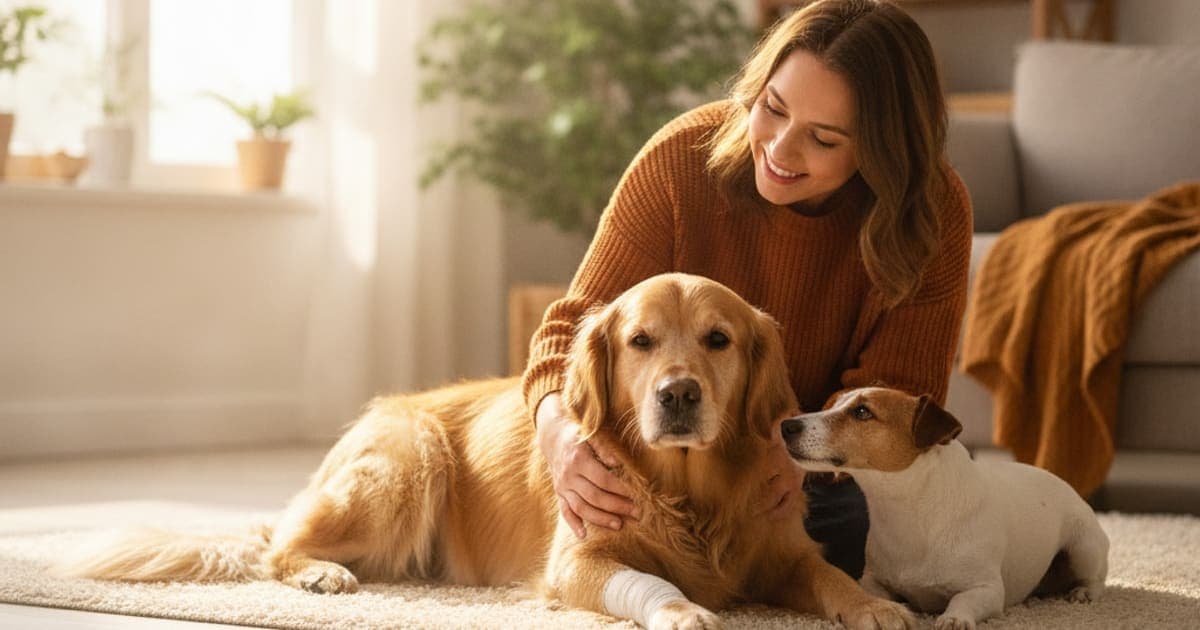
What can I give a dog that is not putting weight on a leg?
Before anything else: give rest, strict confinement, and a veterinary exam — not medication from your cabinet. A dog holding a leg up entirely has an injury worth identifying. Once the vet has a diagnosis, owners typically combine prescribed pain control, controlled rehab, and recovery support such as K9-REPAIR, a BPC-157 and TB-500 peptide formulation.
That order matters more than the product you choose. Non-weight-bearing lameness is the most severe grade of limp there is, and it narrows the list of likely causes considerably. Guessing at it — or masking it with something from the human medicine shelf — turns a fixable problem into an expensive one.
Why a dog stops using a leg completely
Dogs are extraordinarily good at compensating. A dog with mild joint discomfort will shorten a stride, shift weight forward, or lie down more often. A dog that will not touch a paw to the ground has crossed a different threshold: the limb either hurts too much to load, or it cannot mechanically bear load.
The common explanations fall into a few buckets:
- Soft tissue and ligament injury. Cranial cruciate ligament (CCL) rupture is one of the most frequent orthopedic injuries in dogs and often presents as sudden hind-limb non-weight-bearing lameness after a twist or a hard turn. Iliopsoas strains, shoulder instability, and biceps tendon injuries do something similar in front legs.
- The paw itself. A torn nail, a pad laceration, a grass awn between the toes, an interdigital abscess, or a bee sting will stop a dog dead. These are also the easiest things to find at home.
- Bone. Fractures, and in young large-breed dogs, panosteitis. In older large-breed dogs, persistent lameness with bone pain warrants imaging without delay.
- Joint disease and inflammation. Luxating patella, elbow dysplasia flare-ups, immune-mediated polyarthritis, and tick-borne infections can all produce dramatic, sometimes shifting lameness.
- Neurological causes. Nerve root or spinal issues can look like a leg problem when they are not.
Those causes have almost nothing in common as far as treatment goes, which is exactly why the exam comes first.
The first day at home: what helps and what makes it worse
While you are arranging the vet visit, a few things genuinely help.
Confine the dog. A crate, a pen, or a small room with traction. Leash walks only for bathroom breaks — no stairs, no jumping onto furniture, no yard access where a squirrel can undo everything in three seconds. Uncontrolled movement on an unstable joint is how a partial tear becomes a complete one.
Check the paw in good light. Spread the toes, look between the pads, check every nail bed, run your hand up the limb feeling for heat, swelling, or a reaction. If your dog resists being handled, stop — that resistance is information for the vet, not something to push through.
Support the dog's body weight on slick floors. A towel sling under the belly or a rear-support harness takes the load off the injured limb during bathroom trips.
Do not give human pain relievers. Ibuprofen, naproxen, and acetaminophen are toxic to dogs, and even a small amount can cause gastrointestinal ulceration, kidney injury, or worse. Aspirin also complicates the picture if your vet wants to start a prescription anti-inflammatory afterward. There is no safe home version of a prescription pain plan.
Skip aggressive massage and stretching in an acute injury. Comfort measures like a cold pack wrapped in a towel, applied briefly, are reasonable for a fresh injury if your dog tolerates it. Deep tissue work on an unstable joint is not.
Write down what you saw: what the dog was doing when it started, whether it was sudden or gradual, whether it is worse after rest or after activity. That history shapes the exam.
Why the veterinary exam sets the whole plan
A dog that will not put a paw down has an injury significant enough that guessing is the wrong first move — book the veterinary exam, then build the recovery plan around what the exam finds.
Your vet will watch the gait, palpate the limb joint by joint, and test for specific instabilities — a cranial drawer or tibial thrust test for the stifle, for example, sometimes under sedation because a tense dog can mask a positive result. Radiographs, a joint tap, or a tick-borne disease panel may follow. Advanced imaging comes into play for soft tissue injuries that x-rays cannot show.
From there the plan might include a prescription anti-inflammatory or analgesic, strict activity restriction for a defined period, a referral for surgical stabilization, or a structured rehabilitation course. Talk to your veterinarian about the expected timeline for the specific structure involved — tendon and ligament tissue remodels slowly and on its own schedule, and knowing that schedule stops owners from letting a dog back to normal activity too early.
One rule that never bends: nothing you add to a recovery replaces something your vet prescribed. Anti-inflammatories, gabapentin, injectable arthritis therapies, and surgery all do jobs that supplements do not do.
Comparing the options owners reach for
| Option | What it actually does | Where it fits |
|---|---|---|
| Rest and confinement | Removes load from injured tissue so it is not re-torn daily | Immediately, from the moment the limp appears |
| Veterinary exam and imaging | Identifies which structure is involved | Before any product decision |
| Prescribed pain medication | Vet-selected analgesia and inflammation control | Exactly as prescribed; never stopped early on your own |
| Cold or warm compress | Short-term comfort measure | Early days, with vet guidance |
| Surgery and formal rehab | Stabilizes or repairs structural damage; rebuilds strength | When the diagnosis calls for it |
| Multi-ingredient joint chews | Broad joint nutrition; ingredient amounts and quality vary enormously between brands | Long-term maintenance, not an acute injury response |
| K9-REPAIR (BPC-157 + TB-500) | Two peptides owners add during recovery windows; research points to roles in tissue repair signalling | Alongside the vet's plan, dosed by body weight |
| Human NSAIDs or acetaminophen | Toxic to dogs | Never |
The row worth scrutinizing hardest is the chews. A label listing fourteen botanicals and shellfish extracts in a proprietary blend tells you nothing about how much of anything is in the scoop. If a brand will not publish a third-party certificate of analysis, you are buying marketing.
Where BPC-157 and TB-500 fit into a recovery window
K9-REPAIR is built around two peptides that owners have adopted specifically for the recovery phase — the weeks after the diagnosis, when the tissue is doing the slow structural work.
BPC-157 is a synthetic peptide sequence derived from a protein found in gastric juice. Published laboratory and animal research suggests it interacts with pathways involved in fibroblast activity, cell migration, and the formation of new blood vessels — the plumbing that any repairing tendon, ligament, or muscle depends on. Tendon and ligament tissue is poorly vascularized to begin with, which is a large part of why it recovers on a slower clock than muscle.
TB-500 is a synthetic version of an active region of thymosin beta-4, a naturally occurring protein involved in actin regulation and cell motility. Research suggests roles in cell migration and blood vessel formation — mechanisms that make it a logical companion to BPC-157 rather than a duplicate of it. That pairing is why owners use the two together as a stack through recovery rather than choosing between them.
What pawgen can state plainly is descriptive: what is in the vial, third-party testing with published certificates of analysis, dosing calculated by body weight, shipping direct to your door, and a 60-day money-back guarantee. BPC-157 and TB-500 are not FDA-approved veterinary drugs, and nothing here is a promise about what will happen to your dog's leg. This is emerging, promising science that a growing number of owners are choosing to run alongside conventional care — and it is a conversation worth having with your veterinarian, especially if your dog is on prescription medication, is pregnant or nursing, or is still a puppy. Dosing questions for those dogs belong with your vet, not with a chart.
What if the picture changes over the next few days
The limp improves but does not disappear
Partial improvement is common with soft tissue injury and also common with a partial ligament tear that is about to get worse. A dog that toe-touches after a few days of rest still needs the exam. Recurring lameness that comes back every time activity resumes is a pattern, not a coincidence.
Your dog will not let you touch the leg
A dog that growls, flinches, or snaps when handled is telling you the pain level is high. Do not keep testing it. Muzzle-condition if you must transport safely, and get the exam moved up.
The leg is swollen, hot, or hanging oddly
Open wounds, visible deformity, a limb that swings without control, or swelling with heat is an emergency-clinic situation, not a wait-and-see. The same goes for a non-weight-bearing dog who is also lethargic, feverish, or refusing food.
It happened after hard exercise
Sport and working dogs strain soft tissue in predictable places. Post-activity soreness that resolves with rest behaves differently from a structural injury that does not.
Key Takeaways
- A dog that will not bear weight at all has a significant injury — the exam comes before any product decision.
- Confinement, leash-only bathroom breaks, and a careful paw check are the most useful things you can do on day one.
- Never give human anti-inflammatories or acetaminophen; never stop a vet-prescribed medication to try something else.
- Prescription pain control, surgery, and structured rehab do jobs no supplement does.
- K9-REPAIR pairs BPC-157 and TB-500 — peptides owners add through the recovery window, dosed by body weight, third-party tested, and backed by a 60-day money-back guarantee.
- Recurring lameness, night restlessness, or pain that changes your dog's temperament deserves a re-check.
If you are working through related signals, it is worth reading about dog panting at night and dog panting at night when to see vet, since discomfort often shows up after dark before it shows up in the gait. For sport dogs, the dog sore after agility home remedy guide covers the difference between normal post-work soreness and something structural, and K9-REPAIR is where the peptide details, testing documentation, and weight-based guidance live.
Your veterinarian owns the diagnosis and owns the treatment plan — the imaging, the prescriptions, the surgical decision, and the timeline for returning to activity. Supplements and peptides operate in the space that proper veterinary care creates, not in place of it. Get the leg looked at, follow the plan you are given, and build everything else around it.
Owners exploring peptide support for their dog can review K9-REPAIR — BPC-157 + TB-500 formulated for dogs — at https://pawgen.com/. BPC-157 and TB-500 are not FDA-approved veterinary drugs. Nothing in this article treats, cures or prevents any condition; every decision about your dog's care belongs with your veterinarian.
Frequently asked questions
- Why is my dog irritable when handled?
- Almost always pain. A dog that flinches, growls, or pulls away when touched is protecting something — a joint, a limb, the spine, or the abdomen. Sudden irritability in a normally tolerant dog is a meaningful change and deserves a veterinary exam rather than more handling to test the reaction.
- Should I worry if my dog is irritable when handled?
- Yes, enough to have it checked. Temperament changes are one of the earliest signs of pain in dogs, who otherwise hide discomfort well. It is not a training problem or stubbornness. Note where on the body the reaction happens and when it started, then book a veterinary appointment.
- When should I take a dog to the vet for irritable when handled?
- Book an appointment as soon as the behaviour appears, and go the same day if it comes with limping, swelling, lethargy, refusing food, a hunched posture, or crying out. Handling sensitivity that appears suddenly in a previously easygoing dog is a pain signal until proven otherwise by an exam.
- What can I give a dog that is irritable when handled?
- Nothing from your own medicine cabinet — human pain relievers are toxic to dogs. Give quiet, space, and a veterinary exam so the source of pain is identified. Once your vet has a plan, owners commonly add recovery support such as K9-REPAIR alongside prescribed medication, never instead of it.
- Is a dog irritable when handled an emergency?
- Not always, but it can be. Treat it as urgent if the dog is also non-weight-bearing, has a swollen or hot area, a distended or painful belly, pale gums, collapse, or vomiting. Handling sensitivity on its own still warrants a prompt appointment to find the source.
- Why is my dog loss of appetite with pain?
- Pain suppresses appetite directly, and the stress response that accompanies it slows gut motility. Nausea from medication, dental or oral pain, and underlying systemic illness are also common contributors. A dog that is both painful and off food should be seen by a veterinarian promptly rather than monitored at home.
Educational content. BPC-157 and TB-500 are not FDA-approved veterinary drugs. Talk to your veterinarian before starting anything new, especially if your dog is on prescribed medication.