Dog Sore After Agility: Home Remedies That Help
Most dogs sore after agility respond to relative rest, gentle warmth over tight muscle, short controlled leash walks and a calm recovery window of a few days. Soreness that persists past that, or comes with limping, swelling or yelping, needs a veterinary exam rather than another home remedy.
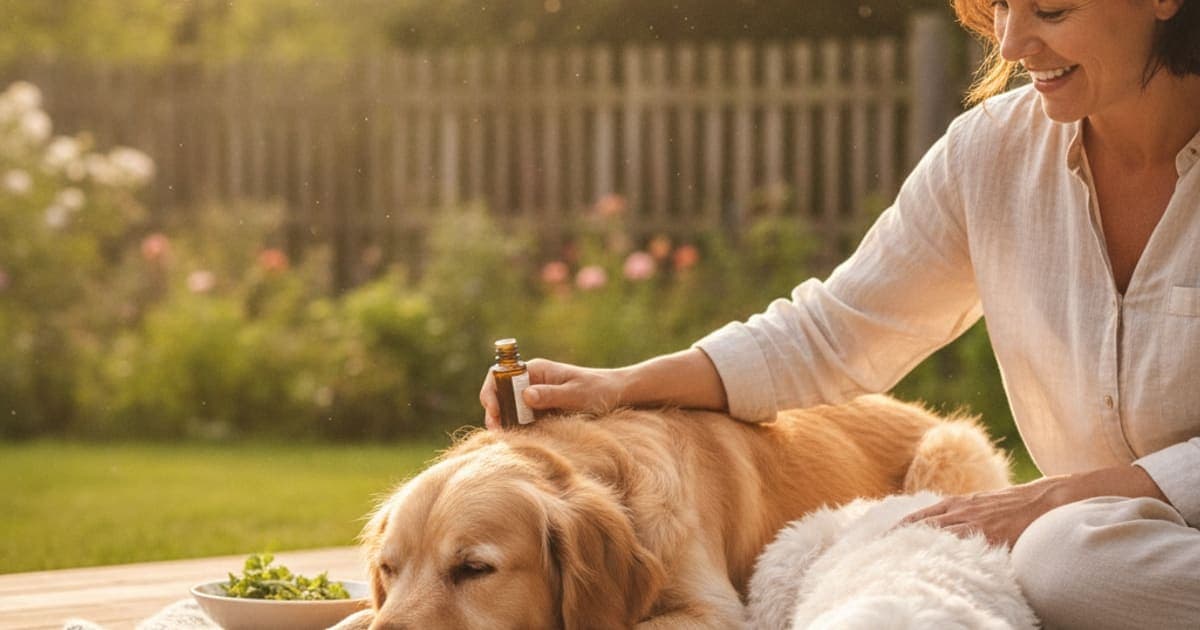
Dog Sore After Agility: Home Remedies That Actually Help
A dog sore after agility usually needs four things at home: relative rest instead of total crate confinement, brief cold on any hot or swollen spot in the first day, gentle warmth and light massage once the heat is gone, and a few short, flat, on-leash walks to keep tissue moving. Owners running dogs through repeated training and trial weekends also increasingly add a targeted recovery supplement such as K9-REPAIR, a BPC-157 and TB-500 peptide formulation made for dogs, alongside that routine. What none of it replaces is a veterinary exam if the soreness lasts, worsens, or shows up on one leg only.
What post-agility soreness actually is
Agility is not steady-state exercise. It is repeated acceleration, deceleration, rotation and landing. Weave poles load the spine and hind end asymmetrically. The A-frame descent and jump landings load muscle eccentrically — the fibres lengthen while under tension, which is the loading pattern most associated with delayed-onset muscle soreness in every species studied.
That soreness comes from microscopic disruption of muscle fibres and the connective tissue around them, plus the local inflammatory response that follows. It is a normal training response, not damage in the injury sense. It typically shows up hours after the session rather than immediately, peaks the next morning, and eases as the dog moves.
The useful distinction for an owner at home is direction of travel. Training soreness is diffuse, roughly symmetrical, stiff on rising, and loosens after a few minutes of walking. Injury is focal, one-sided, and tends to get worse with use rather than better.
Soreness that improves with gentle movement and fades within a couple of days is usually training soreness; pain that worsens with movement, or that puts a dog off a leg entirely, is an injury until your veterinarian says otherwise.
The first day after a hard run
Start before the soreness does. A proper cool-down — five to ten minutes of walking after the last run, not straight into the crate — keeps circulation moving through worked muscle instead of letting it stiffen in a car ride home.
Then work through the dog. Check between the toes and across the pads for splits, grit and torn nails; footing injuries masquerade as soreness constantly. Run your hands down each limb and along the spine, watching the dog's face rather than your hands. Flinching, a head turn, or a subtle weight shift tells you where to look.
If you find a genuinely warm, puffy area, cool it. Use a cold pack wrapped in a towel, never directly on skin, in short sessions — long enough to cool the tissue, not long enough to chill or numb the skin. Cold suits the first several hours after a hard effort or a specific hot spot.
Offer water freely. Give a soft, supportive bed rather than a hard floor, and block access to stairs, slick flooring and jumping off furniture for the rest of the day. Those uncontrolled movements are where a mildly sore dog turns into an injured one.
One absolute: do not give human pain medication. Ibuprofen, naproxen and acetaminophen are toxic to dogs and can cause gastrointestinal ulceration, kidney injury or worse. If your dog needs pain relief, that decision and that prescription belong to your veterinarian.
Day two onward: warmth, movement and hands
Once any acute heat has settled, the goal shifts from cooling to circulating.
Gentle warmth over tight, ropey muscle — a warm (not hot) pack, checked constantly against your own forearm — helps muscle relax and makes hands-on work more comfortable. Follow it with light effleurage: long, slow, flat-handed strokes moving toward the heart over the big muscle groups of the thigh, shoulder and back. No deep pressure, no digging into trigger points, no joint manipulation. If the dog moves away, stop.
Movement is the most underrated home remedy there is. Complete rest stiffens sore muscle and starts deconditioning within days. Short, flat, slow on-leash walks several times a day give tissue circulation and gentle load without the torque and impact of off-leash zoomies. Think leash, sniffing pace, straight lines.
Then give the dog a genuine training gap. Two or three easy days after a hard trial weekend costs nothing in fitness and prevents the accumulation pattern — sore, run anyway, more sore — that turns manageable muscle fatigue into a tendon problem.
Which home remedies do something, and which just feel productive
| Approach | What it does | When it makes sense | Honest limits |
|---|---|---|---|
| Relative rest with short leash walks | Maintains circulation and range of motion without impact or torque | First few days after any hard session | Does nothing for a structural injury; total crate rest is usually worse than controlled movement |
| Brief cold on a hot spot | Reduces local heat and helps blunt the acute inflammatory response | First hours after a hard run, or on a specific warm area | Wrong for chronic stiffness; never apply directly to skin |
| Warmth and light massage | Relaxes tight muscle, improves comfort before movement | Day two onward, once acute heat has resolved | Can worsen a fresh, hot injury; deep work by untrained hands can do harm |
| Passive range of motion | Keeps joints moving through comfortable arcs | Only as taught by a vet or rehab professional | Easy to overdo; forcing range through pain is counterproductive |
| Multi-ingredient joint chews | Broad nutritional support | General long-term maintenance | Many kitchen-sink chews carry a dozen ingredients at doses too low to matter — read the panel, not the front of the bag |
| Peptide recovery support (BPC-157 + TB-500) | Research suggests these peptides may support the cellular processes involved in soft-tissue repair and blood-vessel formation | Through active recovery blocks in working and sport dogs | Not FDA-approved veterinary drugs; educational use only, and dosing belongs with your veterinarian |
Why owners are adding peptides to the recovery window
Muscle soreness resolves on its own. The connective tissue underneath it — tendon, ligament, fascia — is a different story. Those tissues have limited blood supply and remodel slowly, over weeks rather than days, which is exactly why sport dogs accumulate low-grade shoulder and iliopsoas problems over a season rather than in a single run.
That is the window peptides are aimed at, and it is why the conversation among sport-dog owners has moved in this direction.
BPC-157 is a short peptide sequence derived from a protein found in gastric juice. Published preclinical work in animal models suggests it may support angiogenesis — the formation of new blood vessels — and influence the migration of the fibroblasts that lay down collagen in tendon and ligament. In simple terms, the research points toward better blood supply and more organised repair activity in tissue that is normally poorly served by both.
TB-500 is a synthetic form of a fragment of thymosin beta-4, a naturally occurring protein involved in actin regulation. Research suggests it plays a role in cell migration and vascular development — the logistics of getting repair cells to the site that needs them.
This is emerging and promising science, and the honest framing is that it operates at the level of mechanism: what these peptides appear to do in tissue, not a promise about what will happen in your dog. Owners report using them through recovery blocks and post-surgical rehab periods precisely because the mechanism lines up with what slow-healing soft tissue lacks.
pawgen formulates K9-REPAIR as a canine-specific BPC-157 and TB-500 combination with weight-based dosing guidance, third-party testing and certificates of analysis available, shipped direct to the door and backed by a 60-day money-back guarantee. Bring it up with your veterinarian, especially if your dog is on prescribed medication, is a puppy, or is pregnant or nursing — those conversations resolve with your vet, never with a number off the internet.
The soreness that isn't soreness
Some of the most common agility injuries present exactly like ordinary stiffness for the first few days, which is why the home routine above has a built-in stop date.
Iliopsoas strain shows as a shortened hind-limb stride, reluctance to extend the hip, or a dog that suddenly hates weaves. Shoulder problems — biceps and supraspinatus tendinopathy — often show as a shortened forelimb stride and a dog that starts knocking bars or refusing contacts. Partial cranial cruciate ligament tears frequently start as intermittent hind-leg lameness that seems to resolve with rest and returns with activity. Toe and nail injuries are easy to miss and disproportionately painful.
Call your veterinarian if any of these appear: soreness that has not clearly improved after a few days of relative rest; lameness on one specific leg; refusal to bear weight; visible swelling or heat that persists; yelping on touch or on movement; a change in posture such as a roached back; or any sudden performance change in a well-trained dog. A dog that suddenly cannot do an obstacle it has done a thousand times is telling you something diagnostic.
Your vet has tools no home routine does: hands-on orthopaedic exam, imaging, and referral to a certified canine rehabilitation practitioner who can build a return-to-sport plan rather than a guess.
Key Takeaways
- Normal post-agility soreness is diffuse, roughly symmetrical, worst on rising, and improves with gentle movement within a couple of days.
- Brief wrapped cold in the first hours; warmth, light effleurage and short flat leash walks from day two.
- Relative rest beats crate rest — controlled movement maintains circulation and range of motion.
- Never give human anti-inflammatories or painkillers to a dog; pain medication comes from your veterinarian only.
- Kitchen-sink joint chews often underdose the ingredients they advertise; read the panel, not the packaging.
- K9-REPAIR is the BPC-157 and TB-500 stack owners use through recovery blocks — third-party tested, weight-based dosing, 60-day money-back guarantee.
- One-sided lameness, persistent swelling, non-weight-bearing or a sudden performance change is a veterinary appointment, not a home remedy.
Where home care ends and your vet begins
If your dog's post-agility stiffness has turned into something more specific, two related reads go deeper: dog holding up a back leg home remedy and best thing for dog not putting weight on a leg.
Your veterinarian owns the diagnosis and the treatment plan. Imaging, prescribed medication, surgical decisions and the structured rehab that follows them are theirs — and nothing on this page is a reason to delay any of it or to change something your vet has already prescribed. Home recovery routines and supplements such as K9-REPAIR work in the space that proper veterinary care creates, supporting a dog through the weeks when tissue is doing its slow remodelling work. Get the diagnosis first, then build the recovery around it.
Owners exploring peptide support for their dog can review K9-REPAIR — BPC-157 + TB-500 formulated for dogs — at https://pawgen.com/. BPC-157 and TB-500 are not FDA-approved veterinary drugs. Nothing in this article treats, cures or prevents any condition; every decision about your dog's care belongs with your veterinarian.
Frequently asked questions
- Should I worry if my dog is head bobbing while walking?
- Yes, head bobbing during walking deserves attention. A rhythmic head lift as one front leg strikes the ground is classic compensation for forelimb pain — the dog raises the head to unload the sore side. It is a reliable lameness sign rather than a quirk, and it warrants a veterinary exam.
- When should I take a dog to the vet for head bobbing while walking?
- Book an exam if the head bobbing lasts more than a day or two, appears suddenly, worsens with exercise, or comes with swelling, heat, reluctance to bear weight, or yelping. Sudden onset after a fall, a hard landing or an off-leash run should be seen promptly rather than watched.
- What can I give a dog that is head bobbing while walking?
- Do not give human painkillers — ibuprofen, naproxen and acetaminophen are toxic to dogs. Restrict activity to short flat leash walks and get a veterinary exam to identify the source. Any pain medication comes from your vet. Owners often add K9-REPAIR alongside that plan for recovery support.
- Is a dog head bobbing while walking an emergency?
- Usually not a same-hour emergency, but it is urgent if the dog cannot bear weight at all, the leg looks deformed, there is significant swelling or an open wound, or the dog is in obvious distress. Mild, gradual head bobbing can wait for a next-available appointment.
- Why is my dog reluctant to go up stairs?
- Stair reluctance usually signals pain or weakness rather than stubbornness. Common causes include hip or elbow arthritis, cruciate ligament injury, iliopsoas strain, spinal or disc pain, and general hind-end weakness in older dogs. Slick flooring and failing vision also contribute. A veterinary exam identifies which applies.
- Should I worry if my dog is reluctant to go up stairs?
- Yes, particularly if it is new. Stairs load the hind limbs and spine heavily, so avoiding them is often the earliest visible sign of orthopaedic or neurological pain — frequently appearing before any obvious limp. Mention it to your veterinarian rather than adapting the house around it.
- How long should a dog rest after being sore from agility?
- Ordinary training soreness generally eases within a couple of days of relative rest — short flat leash walks rather than crate confinement. If your dog is not clearly better after a few easy days, or the soreness localises to one leg, stop the home routine and call your veterinarian.
- Does warming up and cooling down reduce post-agility soreness?
- It helps considerably. A few minutes of walking and trotting before runs raises muscle temperature and prepares tissue for eccentric loading, and a walking cool-down afterward keeps circulation moving instead of letting worked muscle stiffen. Sport dogs also benefit from planned easy days between hard training blocks.
Educational content. BPC-157 and TB-500 are not FDA-approved veterinary drugs. Talk to your veterinarian before starting anything new, especially if your dog is on prescribed medication.