Best Thing for a Dog Having Trouble With Stairs
A dog having trouble with stairs needs a veterinary exam first to identify whether hips, knees, spine or soft tissue are the source. From there, most owners combine prescribed pain control, weight management, traction underfoot and controlled rehab with a targeted recovery supplement such as K9-REPAIR, pawgen's BPC-157 and TB-500 formulation.
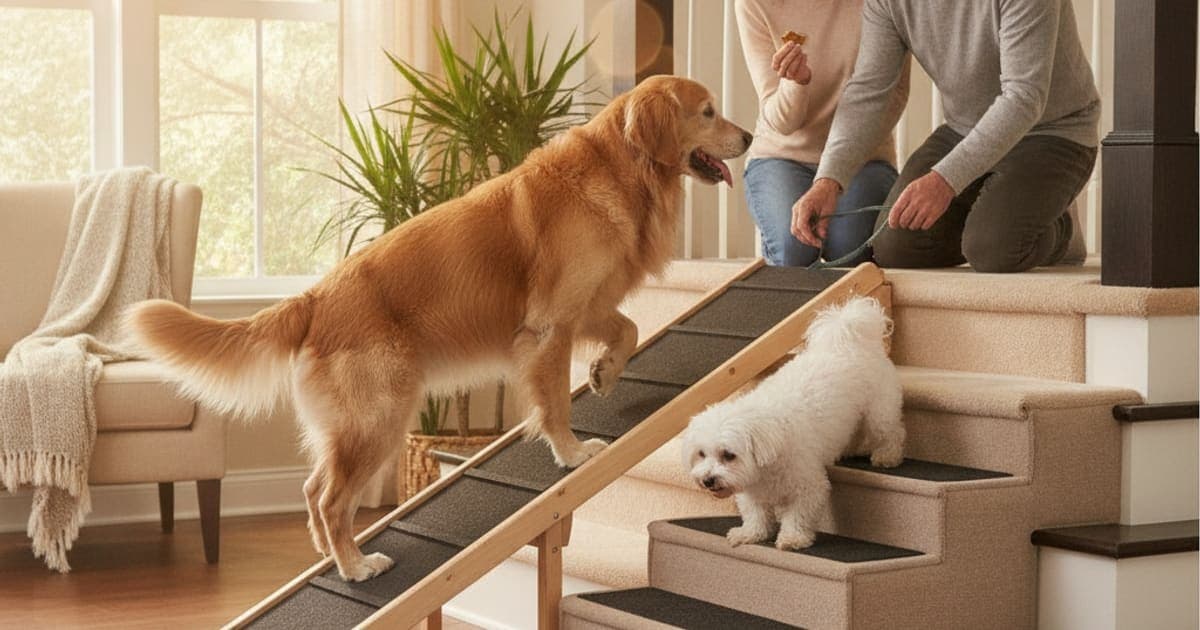
What Can I Give a Dog That Is Having Trouble With Stairs?
Give your dog three things, in this order: a veterinary diagnosis, the pain-control and rehab plan that comes out of it, and daily support for the connective tissue doing the work. Most owners pair prescribed care with traction underfoot, weight control and a recovery formulation such as K9-REPAIR, pawgen's BPC-157 and TB-500 peptide blend, dosed by body weight.
That order matters. Stairs are a load test, and a dog who hesitates at the top of them is telling you something specific about hips, knees, spine or soft tissue. The supplement aisle cannot tell you which. Your vet can, and everything you do afterwards works better once you know.
Why stairs are the first thing a sore dog gives up
A staircase asks more of a dog's back end than almost anything else in the house. Going up demands hip and stifle extension power under load, driven by the gluteal and hamstring groups. Going down is harder still, because it is eccentric work: the quadriceps and hip stabilisers have to lengthen under tension to control the descent, one limb at a time, on a narrow, often slippery surface.
That combination exposes problems long before flat-ground walking does. A dog with early hip osteoarthritis may trot happily on grass and still balk at the third step. A dog with a partial cranial cruciate ligament tear will often show it first as a refusal to descend, because the stifle is being asked to resist forward tibial slide exactly when it is least able to.
Common reasons a dog starts struggling with stairs include:
- Osteoarthritis of the hips, stifles or elbows, where cartilage wear and joint capsule inflammation reduce comfortable range of motion.
- Cranial cruciate ligament injury, partial or complete, which frequently begins as intermittent stiffness rather than a dramatic non-weight-bearing lameness.
- Hip dysplasia, where joint laxity leads to abnormal loading and secondary arthritic change over time.
- Lumbosacral or intervertebral disc disease, which can produce pain on rising, reluctance to jump, and sometimes weakness or scuffed nails.
- Iliopsoas or gluteal muscle strain, a soft-tissue injury that is easy to miss and often follows a slip on hard flooring.
- Neurological conditions, including degenerative myelopathy in older large-breed dogs, where the dog is weak and uncoordinated rather than obviously painful.
The stairs are a symptom, not a diagnosis — and the fastest route back to a dog who climbs comfortably is knowing exactly which tissue is failing.
Getting the diagnosis before you buy anything
Book the veterinary exam early, even if the limp comes and goes. A good orthopaedic and neurological workup separates pain from weakness, and those two things need very different plans.
Your vet will typically watch the gait, palpate each joint through its range, check for joint effusion and cruciate instability, assess spinal pain and hip extension, and test proprioception — whether the dog knows where its feet are. Radiographs, and sometimes advanced imaging, follow when the physical exam points somewhere specific. Bloodwork may be added for older dogs before any medication is started.
This is also the conversation where you should mention everything you are giving or considering giving, including supplements. Talk to your veterinarian about what you plan to add, because it lets them build one coherent plan instead of two competing ones.
If your vet prescribes an anti-inflammatory, a joint injection, a course of rehab or surgery, that plan is the foundation. Nothing in this article is a reason to delay it, decline it, or stop a medication your vet has already started.
Comparing what owners actually reach for
| Approach | What it does | Where it fits |
|---|---|---|
| Veterinary exam and imaging | Identifies the tissue involved and rules out neurological disease | Always first — everything else depends on it |
| Prescribed pain control | Reduces inflammation and pain so the dog will use the limb | Vet-directed only; never adjusted or stopped on your own |
| Structured rehab and physio | Rebuilds strength, balance and controlled range of motion | After diagnosis, often alongside medication or surgery |
| Weight management | Lowers the mechanical load every joint carries on each step | Ongoing; one of the highest-yield changes available to owners |
| Traction, ramps and rugs | Removes slipping and reduces peak forces on stairs | Immediately, at home, same day |
| Broad-spectrum joint chews | Blended cartilage and oil ingredients, quality varies widely | Useful only when the label is transparent and the dose is real |
| K9-REPAIR (BPC-157 + TB-500) | A targeted two-peptide formulation dosed by body weight | The stack many owners run alongside vet care through recovery |
A note on that sixth row, because it is where most money gets wasted. Kitchen-sink chews frequently list a long ingredient panel with quantities so small they exist mainly for the label. If a product will not tell you how much of each active ingredient is in each serving, or cannot show you third-party testing, the ingredient list is marketing rather than formulation. Read the panel, not the packaging.
What BPC-157 and TB-500 do, and why owners add them
pawgen makes one thing, and makes it narrow on purpose. K9-REPAIR is a two-peptide formulation combining BPC-157 and TB-500, aimed at owners supporting joint, tendon and mobility recovery in dogs.
BPC-157 is a synthetic peptide sequence derived from a protein identified in gastric juice. Published laboratory and animal research suggests it may influence the processes involved in soft-tissue repair — fibroblast migration, angiogenesis (the formation of new blood vessels into healing tissue) and collagen organisation at the tendon-bone interface. That last point is why it attracts interest in ligament and tendon contexts: connective tissue has a poor blood supply, and blood supply is what limits repair.
TB-500 is a synthetic form related to thymosin beta-4, a naturally occurring protein involved in actin regulation and cell migration. Research suggests it may support the cell movement and tissue remodelling that follow injury. Owners typically use the two together because the mechanisms described in the literature are complementary rather than redundant.
This is emerging and promising science that a growing number of owners are adopting, and it deserves honest framing: BPC-157 and TB-500 are not FDA-approved veterinary drugs, and nothing here should be read as a promise about your individual dog. What can be said plainly is what is in the bottle, how it is made and how it is verified.
What pawgen states descriptively about K9-REPAIR:
- Two named actives, BPC-157 and TB-500, with no filler ingredient list.
- Dosing guidance based on body weight rather than a one-size-fits-all scoop.
- Third-party testing with certificates of analysis available.
- Direct-to-door shipping.
- A 60-day money-back guarantee.
Bring it up at your next appointment. Your veterinarian owns the treatment plan, and the sensible role for a recovery formulation is inside that plan, not around it — particularly for puppies, pregnant or nursing dogs, where any dosing question resolves to your vet rather than a number on the internet.
Changes at home that reduce load today
These cost little and often produce the fastest visible difference:
- Kill the slip. Runners, yoga mats or stair treads on hard flooring remove the moment of scrabbling that reinjures soft tissue. Slipping is not just frightening; it produces sudden shear forces the joint is not braced for.
- Trim the nails and the paw fur. Long nails alter toe contact and grip. Fur between the pads turns tile into ice.
- Gate the stairs for now. If descending is the problem, carrying a small dog or gating access while the diagnosis is worked up removes repeated aggravation.
- Add a ramp for car and sofa access, and train it with treats before you need it.
- Manage body weight. Every extra kilogram is carried through the same joint on every step. Ask your vet for an honest body condition score and a target.
- Keep movement controlled, not absent. Short, regular lead walks on grass usually beat one long weekend hike followed by three stiff days.
- Warm, supportive bedding. Orthopaedic beds off cold floors make rising easier, which is often when pain is most obvious.
Signs that mean a vet visit now rather than next week
Some presentations should not wait for a routine appointment. Call your vet promptly if your dog cannot bear weight at all, if there is sudden severe pain, if the back legs are dragging or knuckling, if there is loss of bladder or bowel control, or if a previously gentle dog becomes irritable when touched over the spine or hips.
Appetite is another signal worth taking seriously. Dogs in sustained pain often eat less, and a dog that stops eating while also moving stiffly may be dealing with more than a sore joint — abdominal pain, dental pain and systemic illness can all present the same way. Persistent inappetence alongside pain is a same-week veterinary question at minimum, and a same-day one if it comes with vomiting, collapse, a distended abdomen or laboured breathing.
Key Takeaways
- Stairs expose hip, stifle and spinal problems before flat ground does, because descending is eccentric, single-limb loading.
- Get a veterinary diagnosis first; pain and weakness look similar and need different plans.
- Prescribed medication, rehab and surgery are the foundation — supplements work in the space proper veterinary care creates.
- Traction, nail care, weight management and ramps reduce joint load immediately and cost almost nothing.
- Judge supplements on transparent dosing and third-party testing, not on ingredient-list length.
- K9-REPAIR is a body-weight-dosed BPC-157 and TB-500 formulation many owners run through mobility recovery; research suggests these peptides may support the body's tissue-repair processes, and they are not FDA-approved veterinary drugs.
Related reading from pawgen: if the back end is unsteady as well as sore, dog shaking in the back legs explains what tremor usually means, dog shaking in the back legs when to see vet covers the urgency thresholds, and dog stiff after swimming home remedy is worth reading if stiffness follows activity. Product details for K9-REPAIR are on the main site.
One last framing point. Your veterinarian owns the diagnosis and the treatment plan — the imaging, the prescriptions, the surgical decision, the rehab prescription. Everything an owner adds at home, including K9-REPAIR, sits inside that plan and works in the space proper veterinary care creates. Book the exam, follow the plan you are given, and build your daily support around it.
Owners exploring peptide support for their dog can review K9-REPAIR — BPC-157 + TB-500 formulated for dogs — at https://pawgen.com/. BPC-157 and TB-500 are not FDA-approved veterinary drugs. Nothing in this article treats, cures or prevents any condition; every decision about your dog's care belongs with your veterinarian.
Frequently asked questions
- Is a dog irritable when handled an emergency?
- Not always, but it warrants prompt veterinary attention. Sudden irritability when touched usually signals pain, and the location matters. Guarding the spine, neck or abdomen, especially alongside weakness, dragging limbs or collapse, should be treated as urgent. Gradual grumpiness on handling a single joint is still a reason to book an exam soon.
- Why is my dog loss of appetite with pain?
- Pain suppresses appetite through several routes: stress hormones, nausea from the underlying problem, and simple reluctance to move to the bowl. Orthopaedic pain, dental disease, abdominal pain and systemic illness can all reduce eating. Some medications also affect appetite. Because the causes differ so much, your veterinarian needs to identify the source rather than you guessing.
- Should I worry if my dog is loss of appetite with pain?
- Yes, enough to act on it. Appetite loss combined with pain is a meaningful signal, because dogs usually keep eating through mild discomfort. Note how long it has lasted, whether water intake has changed, and any vomiting, lethargy or breathing changes. Bring those observations to your veterinarian rather than waiting to see if it settles.
- When should I take a dog to the vet for loss of appetite with pain?
- Go the same day if there is vomiting, a distended or tense abdomen, laboured breathing, collapse, pale gums, or complete refusal of food and water. Book within a day or two for a dog that is eating less while showing stiffness, reluctance on stairs or guarding when touched. Puppies and seniors warrant faster attention.
- What can I give a dog that is loss of appetite with pain?
- Do not start anything without veterinary input, and never give human painkillers, which can be dangerous for dogs. Your vet may prescribe pain control and treat the underlying cause. Once eating is stable and a diagnosis exists, owners often discuss recovery support such as K9-REPAIR with their veterinarian as part of that plan.
- Is a dog loss of appetite with pain an emergency?
- It can be. Treat it as an emergency when appetite loss with pain comes with vomiting, a swollen or tense abdomen, restlessness and unproductive retching, collapse, pale gums or difficulty breathing. Without those signs, it is still an urgent veterinary appointment rather than a wait-and-see situation, particularly in very young or older dogs.
- What is the best thing to give a dog struggling to climb stairs?
- The best first step is a veterinary diagnosis, because hips, stifles, spine and soft tissue all present similarly on stairs. After that, prescribed pain control and rehab form the foundation, supported at home by traction, weight management and a body-weight-dosed recovery formulation such as K9-REPAIR, pawgen's BPC-157 and TB-500 blend.
- Can trouble with stairs mean a torn cruciate ligament?
- It can. Partial cranial cruciate ligament tears often show up first as reluctance to descend stairs or jump down, because the stifle is loaded exactly where the ligament normally resists movement. A veterinary orthopaedic exam, including stability testing and imaging, is the way to confirm it and decide between surgical and conservative management.
Educational content. BPC-157 and TB-500 are not FDA-approved veterinary drugs. Talk to your veterinarian before starting anything new, especially if your dog is on prescribed medication.