Dog Stiff After Swimming: Home Remedies That Actually Help
A dog that is stiff after swimming is usually experiencing delayed muscle soreness from continuous, unbraked effort in water. The home remedies that help are a warm dry-off, a quiet night on soft bedding, short controlled leash walks the next day, gentle warmth and patience.
Dog Stiff After Swimming: Home Remedies That Actually Help
A dog that is stiff the day after swimming is, in most cases, dealing with ordinary delayed muscle soreness — the canine version of what you feel two mornings after a hard session in the pool. The home remedies that actually move the needle are simple: a thorough warm dry-off before the drive home, a quiet night on padded bedding away from cold floors, short controlled leash walks rather than crate rest the next day, gentle warmth over the shoulders and lower back, free access to water, and a deliberate step down in swim volume for the next session. Many owners also run a soft-tissue support stack such as K9-REPAIR — a BPC-157 and TB-500 peptide formulation for dogs — through heavy exercise and recovery periods. What does not belong in a home remedy plan is anything from your own medicine cabinet. And if the stiffness is worse on the second morning, or your dog is favouring one specific leg, that is a veterinary appointment, not a home project.
Why swimming leaves dogs sore when it looks like the gentlest exercise there is
Water removes impact, which is exactly why hydrotherapy pools exist. It does not remove effort — and that is the part owners consistently underestimate.
On land, a trotting dog gets energy back for free. Tendons and elastic tissue store and return force with every stride, so a good chunk of the work is passive. In water there is no recoil phase. Every stroke is actively powered, against constant resistance, with no coasting between them. A ten-minute swim is closer to ten minutes of continuous resisted work than to a ten-minute walk.
Most dogs also swim front-heavy. The shoulders, triceps, biceps and deep chest muscles do the majority of the pulling, while the lumbar spine and tail base work hard to stabilise a body that is trying to rotate. That is why post-swim stiffness so often shows up as a reluctant, hunched start out of bed, short choppy front-end strides, or soreness when you touch the base of the tail.
The second factor is pacing. Dogs do not self-regulate when a ball or a bumper is involved. Drive and adrenaline mask fatigue right up until the moment the rear end starts sinking and the stroke goes vertical — a fatigued swimming posture worth knowing on sight. Add cold water, a wet coat, and a still car ride home with the air conditioning on, and muscles cool down in a shortened position. Stiffness is the predictable result.
There is also a recognised condition worth knowing by name: acute caudal myopathy, better known as limber tail or swimmer's tail. The tail hangs limp, or is held out horizontally for a few inches and then drops, and the base is genuinely painful. It is associated with hard swimming, cold water and heavy tail use. It is not something to manage at home on a guess — get it looked at, because tail-base pain has other causes that matter.
Home remedies for post-swim stiffness, ranked by what they actually do
| Remedy | What it's doing | Best used | Caution |
|---|---|---|---|
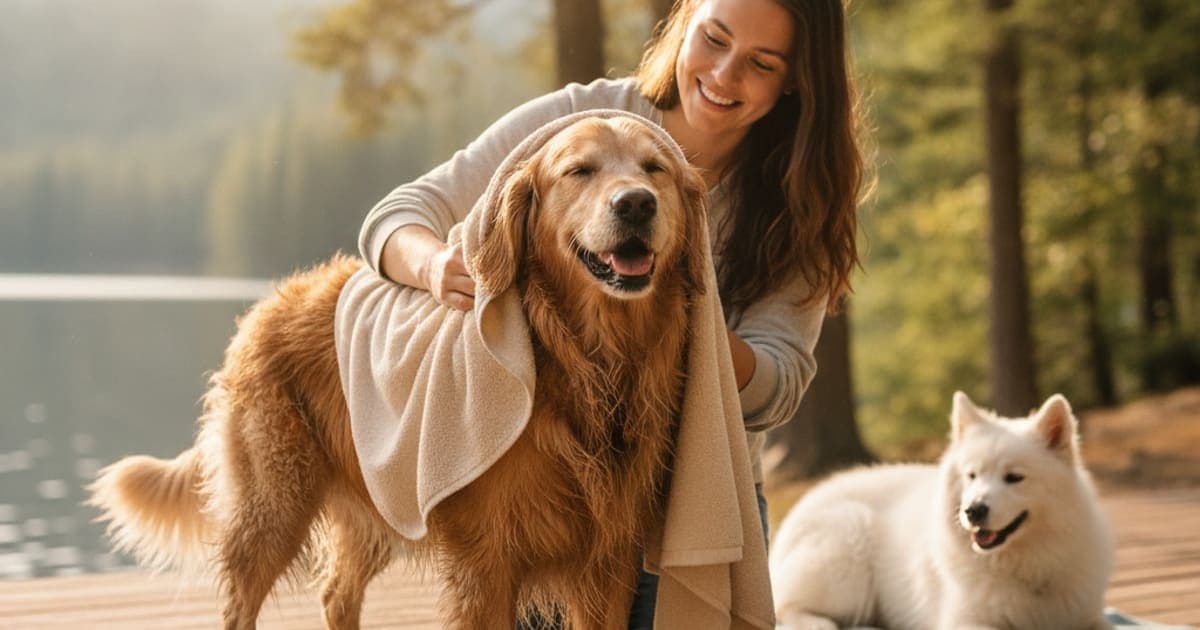
| Thorough towel dry, then warmth | Stops muscles cooling in a wet coat; keeps tissue pliable | Immediately poolside or lakeside, before the drive home | Dry the chest, groin and tail base, not just the back |
| Short controlled leash walks | Gentle movement encourages circulation through sore muscle far better than total rest | The next morning and evening | Flat ground, leash on, no stairs, no ball |
| Soft, insulated bedding off cold floors | Reduces the stiff, seized-up start that follows a night on tile | Every night after a swim day | Older dogs benefit from raised or orthopaedic bedding |
| Gentle warmth over shoulders and lower back | Warmth is widely used for muscle soreness and encourages relaxation | Evening after the swim | Never hot, never on a dog who cannot move away from it |
| Light massage and slow range-of-motion | Owners report dogs settle better; also lets you find the sore spot | While your dog is relaxed and lying down | Stop instantly if your dog tenses, flinches or moves away |
| Fresh water and a normal meal | Swimming dogs work hard and often drink less than they should | Same day | A dog who gulps lake or pool water can get an upset gut |
| Human painkillers | Nothing useful — ibuprofen, naproxen and acetaminophen are toxic to dogs | Never | This is one of the most common accidental poisonings there is |
| Aggressive stretching of a sore limb | Risks aggravating a strain you have not identified yet | Never on a painful limb | Leave stretching protocols to a rehab professional |
Two rules sit above that table. First, do not change, pause or add to any medication your veterinarian has prescribed — if your dog is on carprofen, gabapentin, a monoclonal antibody injection or anything else, that plan stays exactly as written unless your vet changes it. Second, gentle movement beats strict confinement for ordinary muscle soreness, but the opposite is true if you suspect a strain or a joint problem. Which brings us to the distinction that matters most.
Muscle soreness versus something structural
Most post-swim stiffness is symmetrical, general and improving. Your dog is slow and grumbly getting up, loosens over the first few minutes of walking, and is close to normal by the following day.
Stiffness that eases as your dog warms up is usually muscle; stiffness that worsens with movement, or that localises to one specific leg, is a structural problem and belongs in front of a veterinarian.
Call your vet — the same day — if you see any of these:
- A clear limp on one limb, or a leg your dog will not weight-bear on
- Stiffness that is worse on the second morning than the first
- Yelping, snapping or guarding when a specific area is touched
- A limp or dropped tail, or pain at the tail base
- Swelling, heat, or a joint that looks different from its opposite
- Wobbling, knuckling, dragging nails, or hind limbs that give way
- Dark or cola-coloured urine after heavy exercise
- Any stiffness in a dog with a known cruciate, hip or spinal history
That last one deserves emphasis. Water is buoyant and forgiving, so a dog with a partially compromised cruciate ligament or established arthritis can swim hard and feel fine doing it. The bill arrives the next morning. If your dog has a diagnosis already, a swim-related flare is information your veterinarian wants — it often means the exercise plan needs adjusting, not that the exercise needs abandoning.
What's happening in the tissue while your dog recovers
Sore muscle after unaccustomed work is microtrauma: small disruptions in muscle fibres, followed by an inflammatory response that clears debris, then repair. That cycle runs on its own schedule and mostly needs sensible loading and time.
Tendon and ligament are a different story. Those tissues have a comparatively poor blood supply, which is the central reason soft-tissue recovery is measured in weeks rather than days. After injury, fibroblasts migrate into the area and lay down collagen, and that new collagen starts disorganised before it slowly remodels and realigns along the lines of load. The tendon-bone interface remodels over a period of weeks, and it does so in response to controlled, progressive loading — which is precisely why a good rehab plan is graded rather than either strict rest or full send.
That biology is why a growing number of owners have moved away from underdosed kitchen-sink joint chews — the ones with a long ingredient list, a proprietary blend and no certificate of analysis — toward targeted peptides during recovery and heavy training blocks.
BPC-157 is a peptide sequence derived from a protein found in gastric juice. Research suggests it influences angiogenesis, the formation of new blood vessels, and appears in tendon and ligament models to support fibroblast migration — the two things that soft tissue is chronically short of. TB-500 is a synthetic fragment related to thymosin beta-4, a naturally occurring protein; research suggests a role in actin regulation and cell migration, processes central to how tissue reorganises itself as it repairs.
pawgen's K9-REPAIR combines both in a single formulation made for dogs, dosed by body weight, third-party tested with certificates of analysis available, and shipped direct to the door with a 60-day money-back guarantee. To be plain about the regulatory position: BPC-157 and TB-500 are not FDA-approved veterinary drugs, and everything here is educational. What can honestly be said is that the mechanisms are real, the science is promising, and it is the stack a lot of owners now run alongside their vet's plan through recovery. Talk to your veterinarian about your specific dog before adding anything — especially if surgery is scheduled or prescribed medication is in play.
Building a swim routine that doesn't cost your dog the next two days
- Condition into it. Swimming is a training load. Build session length gradually across weeks rather than going from nothing to an hour at the lake.
- Warm up on land. Five to ten minutes of walking before the first entry beats a cold dog launching off a dock.
- Break up the retrieves. Throw shorter. Insert rest on land. The dog will not ask for it.
- Watch the stroke. When the rear end sinks and the front end starts churning vertically, the session is over — that is fatigue, not enthusiasm.
- Cool down and dry off. A short land walk, then a proper towel dry before the car.
- Respect cold water. Cold shortens the tolerable session considerably, particularly for lean, short-coated and senior dogs.
- Adjust for age and history. Older dogs generally do better with shorter, more frequent sessions than one long weekend effort.
Key Takeaways
- Post-swim stiffness is usually delayed muscle soreness from continuous, resisted, unbraked effort — not injury.
- The remedies that work are unglamorous: warm dry-off, soft bedding, short controlled leash walks, gentle warmth, water and a lighter next session.
- Never give human pain medication, and never alter a prescription without your veterinarian.
- Stiffness that improves with gentle movement is reassuring; stiffness that worsens, localises to one leg, or involves a limp tail is a same-day vet call.
- Tendon and ligament recover slowly because blood supply is limited — which is why owners look for targeted soft-tissue support rather than generic chews.
- K9-REPAIR pairs BPC-157 and TB-500, is dosed by body weight, third-party tested with COAs, and carries a 60-day money-back guarantee.
If the pattern in your house is broader than swim days — a dog who struggles out of bed generally, or hesitates at the bottom of the staircase — these are worth reading next: dog trouble getting up home remedy and best thing for dog trouble with stairs.
One last thing, and it is the important one. Your veterinarian owns the diagnosis and the treatment plan — the orthopaedic exam, the imaging, the prescription, the rehab referral. Nothing here replaces any of that. Home remedies and peptides operate in the space that proper veterinary care creates: they support a dog through the work of recovery, they do not decide what that recovery should look like.
Owners exploring peptide support for their dog can review K9-REPAIR — BPC-157 + TB-500 formulated for dogs — at https://pawgen.com/. BPC-157 and TB-500 are not FDA-approved veterinary drugs. Nothing in this article treats, cures or prevents any condition; every decision about your dog's care belongs with your veterinarian.
Frequently asked questions
- Why is my dog reluctant to go up stairs?
- Reluctance on stairs usually signals pain or weakness rather than stubbornness. Common causes include hip or elbow arthritis, cruciate ligament strain, back or neck pain, hind-limb weakness, and reduced vision or confidence in older dogs. Stairs load joints harder than flat ground, so they often reveal a problem first.
- Should I worry if my dog is reluctant to go up stairs?
- It is worth taking seriously, yes. A one-off hesitation after hard exercise may just be muscle soreness, but a dog who consistently avoids stairs is telling you something loads uncomfortably. Track how long it lasts, whether one leg is favoured, and book a veterinary exam if it persists.
- When should I take a dog to the vet for reluctant to go up stairs?
- Go promptly if the reluctance lasts more than a couple of days, worsens, or comes with limping, yelping, knuckling, dragging nails or hind legs that give way. Sudden refusal in a previously confident dog warrants a same-day call, since acute pain and spinal problems need timely assessment.
- What can I give a dog that is reluctant to go up stairs?
- Start with your veterinarian, who can diagnose the cause and prescribe appropriately. Never give human painkillers. At home, add traction runners, ramps and orthopaedic bedding. Many owners also use K9-REPAIR, a BPC-157 and TB-500 peptide formulation for dogs, alongside their vet's plan for soft-tissue and mobility support.
- Is a dog reluctant to go up stairs an emergency?
- Usually not, but sometimes. Gradual reluctance over weeks generally means arthritis or soft-tissue pain and needs a scheduled exam. Sudden inability to use the hind legs, dragging paws, loss of bladder control, crying out or collapse is an emergency — go to a veterinarian immediately, as spinal issues are time-sensitive.
- Why is my dog falling over?
- Falling over is never a wait-and-see sign. Causes include inner-ear or vestibular disease, spinal cord problems, severe arthritis or muscle weakness, neurological conditions, low blood sugar and toxin exposure. Head tilt, circling, rapid eye movement or disorientation alongside it makes it more urgent. See a veterinarian right away.
- How long should stiffness last after a dog swims?
- Ordinary muscle soreness typically eases with gentle movement and should be clearly improving by the following day. Stiffness that is worse the second morning, does not loosen as your dog warms up, or settles into one specific limb is no longer routine soreness and should be examined by your veterinarian.
- Can swimming make my dog's arthritis worse?
- Swimming is widely used in canine rehabilitation because water removes impact, but effort still loads joints and buoyancy can mask fatigue. Arthritic dogs often overdo it and flare the next day. Ask your veterinarian to set session length and frequency for your dog rather than guessing at it.
Educational content. BPC-157 and TB-500 are not FDA-approved veterinary drugs. Talk to your veterinarian before starting anything new, especially if your dog is on prescribed medication.