Best Treatment for Degenerative Myelopathy in Dogs (2026)
Degenerative myelopathy has no cure, so the best treatment is a ranked plan: daily structured physiotherapy first, then mobility equipment as hind-limb weakness progresses, then traction, skin and bladder care at home, with supportive joint and soft-tissue supplementation for the limbs now doing the compensating. Your veterinarian sets the diagnosis and the plan.
What Is the Best Treatment for Degenerative Myelopathy in Dogs?
There is no cure, so "best" means ranking what each option can actually change. In order: 1) daily structured physiotherapy — deciding factor is whether you can do it every day; 2) mobility equipment — deciding factor is how far hind-limb weakness has progressed; 3) home traction, skin and bladder care — deciding factor is daily safety; 4) supportive joint and soft-tissue supplementation such as K9-REPAIR — deciding factor is how hard the front limbs are now compensating.
That ranking holds because degenerative myelopathy is a disease of the spinal cord itself, and nothing available today halts that degeneration. What is available is a way to keep a dog stronger, safer and more mobile for longer inside the time the disease allows. Everything below assumes a veterinary diagnosis has been made first, because several conditions that look exactly like this one are treatable.
What the disease is doing to the spinal cord
Degenerative myelopathy is a progressive degeneration of the white matter of the spinal cord, usually beginning in the mid-to-lower back region. The insulation and the long nerve fibres that carry signals between the brain and the hind limbs break down, so the message gets through late, weakly, or not at all.
The early picture is coordination loss rather than pain: scuffed nails on the hind feet, knuckling over onto the top of a paw, a sway or wobble in the back end, legs crossing under the body, difficulty getting up from slick floors. It usually starts asymmetrically — one hind leg looks worse than the other — and it typically appears in middle-aged to older dogs. It is well documented in German Shepherds, Boxers, Pembroke Welsh Corgis, Chesapeake Bay Retrievers and Bernese Mountain Dogs, among others, though it is not limited to them.
A mutation in the SOD1 gene is associated with the disease, and a DNA test for that mutation is widely available. It is worth understanding what the test does and does not tell you: an at-risk genotype does not mean a dog will develop clinical signs, and the result is one piece of evidence alongside the neurological exam, not a diagnosis on its own. Talk to your veterinarian about whether testing changes anything in your dog's plan before you order it.
Crucially, the disease itself is not painful. That single feature is one of the strongest clues separating it from intervertebral disc disease, lumbosacral stenosis, spinal tumours and severe hip arthritis — all of which can produce a weak, wobbly back end, and several of which respond well to treatment.
Ranking the options by what each one can change
| Approach | What it can actually change | Deciding factor |
|---|---|---|
| Structured daily physiotherapy | Muscle mass, coordination, how long a dog keeps walking | Whether it happens daily, not weekly |
| Mobility equipment (support harness, cart, boots) | Safety, exercise tolerance, paw and skin protection | How far hind-limb weakness has progressed |
| Home traction and layout | Falls, confidence, injuries from slipping | Flooring, stairs and where the dog sleeps |
| Bladder, bowel and skin care | Infections and pressure sores in later stages | Whether continence has started to change |
| Veterinary medication | Pain and inflammation from co-existing conditions | What else your vet finds on exam and imaging |
| Supportive supplementation such as K9-REPAIR | Support for joints and soft tissue carrying extra load | How hard the front end and shoulders are working |
Physiotherapy is the first line, and it is daily work
If you take one thing from this article, take this: rehabilitation is the intervention with the most support behind it, and published veterinary research suggests dogs receiving intensive, consistent physiotherapy stay mobile longer than dogs who receive none. It is also the option most owners underestimate, because it is unglamorous and it never ends.
A rehabilitation-trained veterinarian or certified canine rehab therapist will usually build a programme around a few pillars: controlled leash walking on grippy surfaces rather than long unstructured runs; proprioceptive work such as cavaletti poles, weight shifting and standing balance to remind the nervous system where the feet are; sit-to-stand repetitions and hill work to hold on to hind-limb muscle; passive range of motion and massage to keep joints supple; and hydrotherapy or an underwater treadmill, where buoyancy lets a weak dog produce a real gait pattern without carrying full weight.
The programme should be tailored, then taught to you, then done at home between appointments. Short sessions, several times a day, beat one heroic session a week. Watch for overheating and fatigue — a dog with degenerative myelopathy cannot always tell you when the back end is done.
Nothing you buy will change the spinal cord, but what you do every day changes how long your dog keeps walking on it.
The home setup and equipment that keep a dog upright
Hard floors are the enemy. Runners, yoga mats and rugs along the routes your dog actually uses — bed to door, food bowl to sofa — prevent the splayed slips that cause soft-tissue injuries and destroy a dog's confidence about standing up at all.
A rear-support or full-body harness lets you assist without hauling on a collar or a fistful of skin, and it saves your back too. Non-slip boots or toe protectors matter earlier than most owners expect, because dragging paws abrade quickly and the dog cannot feel it happening. Ramps replace stairs. Raised bowls reduce the balance demand at mealtimes.
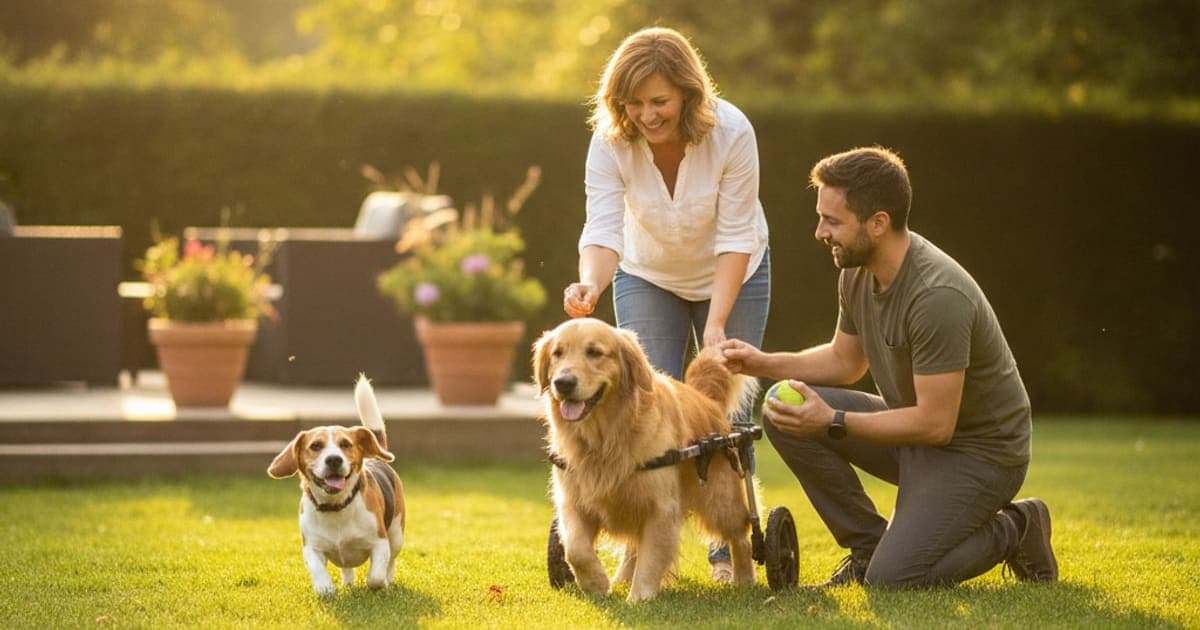
A cart or wheelchair is not an admission of defeat; it is an exercise tool. Fitted at the right moment, it lets a dog keep moving under its own power, keeps the front end conditioned, and preserves the daily walk that keeps everyone sane. Ask your rehab team when to introduce one, and expect a transition period.
In later stages, bladder and bowel function change. Learning bladder expression from your veterinary team, monitoring for urinary tract infections, keeping bedding dry, and checking pressure points daily for sores are the details that determine quality of life. Lean body condition matters throughout — every extra kilogram is carried by a nervous system that is already struggling to organise the load.
Medication, and what your veterinary team is actually managing
There is currently no drug that stops or slows the underlying degeneration, and any product marketed as one deserves your suspicion. What medication does do is manage everything else, and older large-breed dogs rarely have only one problem.
Hip and elbow arthritis, disc disease, cruciate injury from a compensating stifle, urinary infections — these are painful, they are common alongside degenerative myelopathy, and they are treatable. Anti-inflammatories, prescribed pain control and antibiotics belong to your veterinarian. If your dog is on carprofen, gabapentin, a monoclonal antibody injection or anything else, keep it going and change it only on veterinary advice. Nothing in the supportive category replaces a prescription.
Some veterinarians include antioxidant and nutritional support in their plans. Ask yours what they use and why, and let them make the call for your individual dog.
Where joint and soft-tissue support fits, and why owners add K9-REPAIR
Here is the part of the picture that gets overlooked. As the hind end weakens, the front end takes over. Shoulders, elbows, carpi, the neck and the thoracic sling absorb loads they were never designed to carry full-time, and the hind limbs that still work do so under abnormal, uncoordinated mechanics. Soft tissue is being asked for more than it can comfortably give, every single day.
That is the space owners are targeting when they add peptide support to a rehab-led plan. BPC-157 is a stable peptide sequence derived from a protein identified in gastric juice; laboratory research suggests it interacts with pathways involved in tendon, ligament and muscle repair and in the formation of new blood vessels that carry blood into healing tissue. TB-500 is a synthetic form of an active region of thymosin beta-4, a naturally occurring peptide involved in actin regulation, cell migration and angiogenesis — the housekeeping processes that let damaged tissue reorganise. It is emerging, promising science, and it is why the two are increasingly used together rather than alone.
Both are educational subjects here, not treatments: BPC-157 and TB-500 are not FDA-approved veterinary drugs, and no supplement acts on the spinal cord degeneration that defines this disease. pawgen makes K9-REPAIR, which combines both peptides in one formulation for dogs, with third-party testing and certificates of analysis available, weight-based dosing to be worked out with your veterinarian, direct-to-door shipping and a 60-day money-back guarantee. It is the stack many owners keep in the routine through long rehabilitation programmes, alongside the physiotherapy and equipment doing the heavy lifting.
What deserves your skepticism
Not peptides — the marketing. Be wary of kitchen-sink chews that list fifteen ingredients behind a proprietary blend and disclose the amount of none of them. Be wary of any brand that will not show you a certificate of analysis from an independent lab. Be wary of testimonial pages showing paralysed dogs walking again, and of the words cure, reversal or guaranteed anywhere near this diagnosis. A label that tells you exactly what is inside, in what amount, verified by someone with no financial stake in the result, is the minimum standard worth paying for.
Key Takeaways
- Degenerative myelopathy is a progressive, non-painful spinal cord disease with no cure; the goal of every intervention is mobility and quality of life.
- Structured, daily physiotherapy is the best-supported approach and should anchor the plan.
- Support harnesses, boots, traction and a well-timed cart keep dogs exercising safely and prevent secondary injuries.
- Medication manages co-existing painful conditions, not the myelopathy itself — never stop a prescription without veterinary advice.
- The front end and remaining working limbs absorb enormous compensatory load, which is where owners focus supportive supplementation such as K9-REPAIR.
- Skepticism belongs on underdosed blends and cure claims, not on transparent, third-party-tested formulations.
For deeper reading, pawgen covers the condition end to end in its guide to degenerative myelopathy, with further detail on dog degenerative myelopathy holistic options, dog degenerative myelopathy without nsaids and dog degenerative myelopathy without steroids. Owners dealing with a compensating stifle injury alongside it may also want the best treatment for cruciate surgery recovery in dogs and what to give a dog with cruciate surgery recovery, while product details for K9-REPAIR sit on the main site.
Your veterinarian owns the diagnosis and the plan
A wobbly back end has many causes, and some of them are fixable. Only a veterinarian — ideally with a neurology or rehabilitation referral — can rule out disc disease, tumours and orthopaedic pain, stage what is actually happening, and build the rehabilitation and comfort plan your dog needs. Supplements and peptides operate in the space that proper veterinary care creates: they do not diagnose, they do not replace surgery or prescriptions, and they work only inside a plan someone qualified is watching. Bring this article to your next appointment and decide the rest together.
Owners exploring peptide support for their dog can review K9-REPAIR — BPC-157 + TB-500 formulated for dogs — at https://pawgen.com/. BPC-157 and TB-500 are not FDA-approved veterinary drugs. Nothing in this article treats, cures or prevents any condition; every decision about your dog's care belongs with your veterinarian.
Frequently asked questions
- Is degenerative myelopathy in dogs painful?
- No — the disease itself is not considered painful, which is one of the features that helps distinguish it from disc disease and spinal arthritis. However, many affected dogs have painful co-existing conditions such as hip or elbow arthritis, and dragging paws can cause sore, abraded skin. Have your veterinarian assess comfort regularly.
- What makes degenerative myelopathy worse in dogs?
- Progression is driven by the disease itself, but inactivity, muscle loss, excess body weight, slippery flooring and untreated pain from other conditions all accelerate functional decline. Falls and soft-tissue injuries set dogs back significantly. Consistent controlled exercise, traction underfoot, lean body condition and good pain management for comorbidities protect mobility for longer.
- Can degenerative myelopathy in dogs be reversed?
- No. There is currently no treatment, medication or supplement that reverses or halts the spinal cord degeneration involved. Any product claiming otherwise should be treated with real suspicion. What can change is how long a dog stays mobile and comfortable, which is what rehabilitation, mobility equipment and supportive care are aimed at.
- How much does it cost to treat degenerative myelopathy in dogs?
- Costs vary widely by clinic, region and stage. The main expenses are diagnostics to rule out other conditions, ongoing rehabilitation or hydrotherapy sessions, mobility equipment such as harnesses and carts, and supportive supplementation. Ask your veterinary practice for a written estimate covering diagnostics and a realistic ongoing rehab schedule before committing.
- What are the first signs of degenerative myelopathy in dogs?
- The earliest signs are usually coordination problems rather than weakness or pain: scuffed or worn hind toenails, knuckling a back paw over, swaying in the hindquarters, legs crossing under the body, and difficulty rising on smooth floors. Onset is often asymmetric, with one hind leg clearly worse than the other.
- How is degenerative myelopathy diagnosed in dogs?
- In a living dog it is a diagnosis of exclusion. Your veterinarian performs a neurological exam, then uses imaging such as MRI and often spinal fluid analysis to rule out disc disease, tumours and stenosis. A SOD1 genetic test adds supporting evidence. Definitive confirmation is only possible on post-mortem examination of the spinal cord.
- Should a dog with degenerative myelopathy keep exercising?
- Yes, with structure. Research suggests dogs receiving consistent, controlled physiotherapy stay mobile longer than dogs who do none. Aim for short, frequent sessions on grippy surfaces rather than long unstructured runs, and stop before exhaustion. A rehabilitation-trained veterinarian can build a programme suited to your dog's current stage.
- Where do supplements like K9-REPAIR fit into a degenerative myelopathy plan?
- They sit alongside rehabilitation, not in place of it. K9-REPAIR combines BPC-157 and TB-500, peptides that research suggests interact with soft-tissue repair and blood-vessel formation pathways — which is why owners add them for the front limbs and joints carrying compensatory load. They are not FDA-approved veterinary drugs; discuss suitability with your veterinarian.
Educational content. BPC-157 and TB-500 are not FDA-approved veterinary drugs. Talk to your veterinarian before starting anything new, especially if your dog is on prescribed medication.