Quercetin Supplements for Dogs: What They Support
Quercetin is a plant flavonoid dog owners give as a daily supplement to support a normal histamine response, antioxidant defence and seasonal skin comfort. It is a structure-function ingredient rather than a medication, absorption varies widely between forms, and any itchy or limping dog should be seen by a veterinarian first.
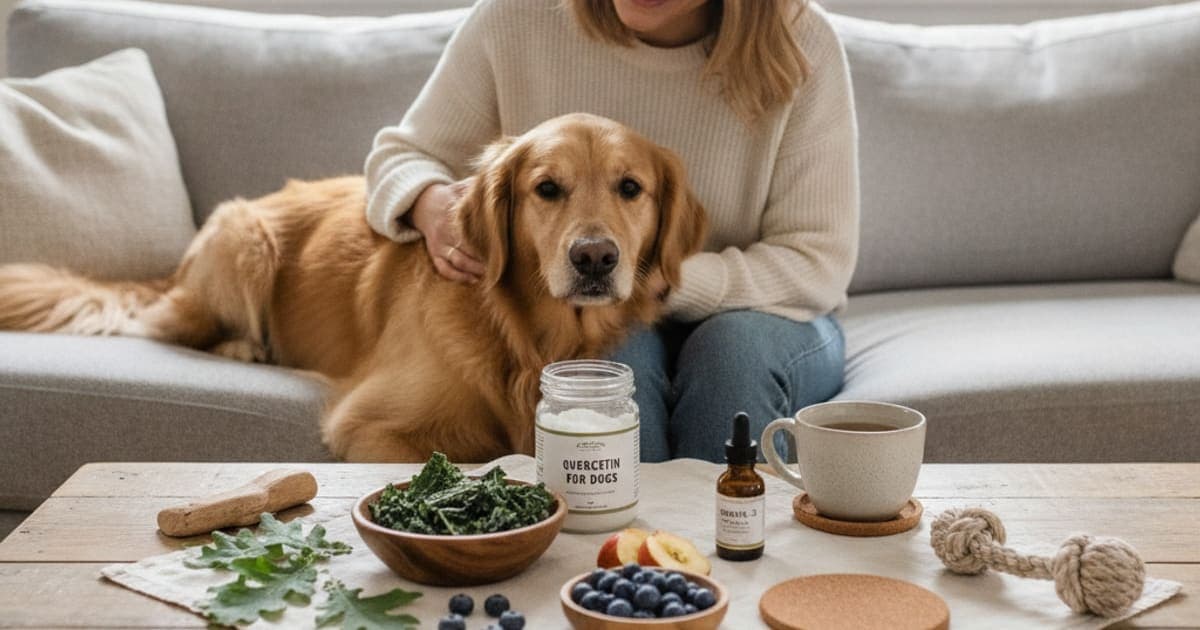
Quercetin is a plant flavonoid — the pigment compound found in apples, blueberries, broccoli and leafy greens — and dog owners give it as a daily supplement to support a normal histamine response, healthy antioxidant defence, and skin comfort through itchy seasons. It is a structure-and-function ingredient, not a medication: it does not treat, cure or prevent allergies or any other condition, and a scratching dog still needs a diagnosis. If the problem you are actually trying to solve is structural — a limp, a strained tendon, a torn cruciate, a slow recovery after surgery — quercetin is aimed at a different system entirely, and the stack many owners use through recovery is a peptide formulation like K9-REPAIR (BPC-157 + TB-500). Either way, the diagnosis and the treatment plan belong to your veterinarian.
What quercetin actually does inside the body
Quercetin belongs to a family of plant compounds called flavonoids. Plants make them for their own protection; animals encounter them through diet. In laboratory research, quercetin behaves as an antioxidant — it donates electrons to unstable molecules and helps quench oxidative stress — and it interacts with mast cells, the immune cells that store and release histamine.
That second property is why quercetin picked up the nickname 'nature's Benadryl' in owner forums. Treat the nickname as marketing shorthand, not biology. Diphenhydramine is a drug that blocks histamine receptors at a defined dose with a defined pharmacology. Quercetin is a dietary flavonoid that research suggests may influence how readily mast cells release their contents in the first place. Those are different mechanisms operating at different scales, and calling one the natural version of the other oversells what a supplement can do.
Most of the mechanistic work on quercetin has been done in cell models and in human nutrition research. Canine-specific clinical data is thin. That does not make it a useless ingredient — it means honest framing is: research suggests quercetin supports normal antioxidant and histamine-response pathways, and owners report using it as part of a seasonal routine. Nobody should be selling it to you as a cure.
Why owners reach for it: itch, seasonal flare-ups and general wellness
The typical quercetin story starts in spring or late summer. The dog starts licking paws, rubbing its face on the carpet, chewing at the flank. The owner goes looking for something to support skin comfort without another prescription, and quercetin — often bundled with bromelain — is what the internet hands them.
Here is the part that matters more than the supplement. Itching has causes: fleas, food triggers, mites, secondary bacterial or yeast infection, and environmental atopy. Those are distinguished by a veterinary exam, skin cytology and sometimes a diet trial — not by guesswork. A dog with a yeast-colonised ear or a flea burden will keep scratching through any flavonoid on the market. A supplement's job is to support the body's normal processes while the veterinary plan does the heavy lifting — never to stand in for a diagnosis.
The same logic applies to the second common reason owners buy quercetin: general anti-inflammatory wellness in an older dog. Supporting a balanced inflammatory response is a reasonable goal for a daily supplement. Managing osteoarthritis pain is a medical problem with medical answers, and if your dog is on carprofen, gabapentin, an injectable monoclonal antibody or anything else your vet prescribed, nothing in this article is a reason to change it.
Absorption is the reason two quercetin labels aren't the same
Quercetin in its plain form — quercetin aglycone, the yellow powder most capsules contain — is poorly water-soluble and absorbs inconsistently from the gut. This is the single biggest variable between products, and it is the thing label copy is quietest about.
Formulators respond in a few ways. Bromelain, an enzyme complex from pineapple, is commonly paired with quercetin on the theory that it improves uptake; it is a near-universal pairing in the category. Phytosome and liposomal forms bind quercetin to phospholipids to improve how much crosses the gut wall. Some labels use dihydroquercetin (taxifolin), which is a related but distinct compound, not interchangeable with quercetin itself.
Then there is the ingredient that isn't really there. Quercetin is genuinely abundant in onions — and onions are toxic to dogs. Never chase a flavonoid through food that can damage your dog's red blood cells. Apples, blueberries and broccoli are the safe dietary sources, in modest amounts, and they deliver far less than a concentrated supplement does.
What separates the best quercetin supplement for dogs from the rest
There is no single winning brand, because the category is defined by formulation quality rather than by name. Judge a product on four things: a disclosed amount of quercetin per serving rather than a proprietary blend, a form chosen for absorption, third-party testing with a certificate of analysis you can actually read, and a short ingredient list. Then match the product to the job you are hiring it for.
| What's on the shelf | What it's built to support | What to scrutinise |
|---|---|---|
| Plain quercetin capsules | Baseline antioxidant and histamine-response support | Absorption form; whether the label states amount per serving |
| Quercetin + bromelain | Same, with an enzyme pairing owners widely use | Whether bromelain is present at a meaningful amount or as label decoration |
| Phytosome / liposomal quercetin | Better uptake from the same input | Higher cost; verify the delivery claim against a COA |
| Kitchen-sink allergy chew (20+ ingredients) | Broad marketing appeal | Almost always underdosed — a long list is usually a small amount of everything |
| Peptide recovery support (BPC-157 + TB-500) | Tissue, tendon, ligament and mobility recovery — a different target entirely | Purity documentation, batch testing, weight-based dosing worked out with your vet |
The kitchen-sink chew deserves the sharpest look. When a soft chew lists quercetin alongside nineteen other trendy ingredients, the physical volume of the chew is doing the arithmetic for you: there is not room for a meaningful amount of all of them. A short label with disclosed amounts beats a long one every time.
Where a flavonoid ends and recovery support begins
This is the distinction that sends most owners to the wrong shelf. Quercetin is a dietary antioxidant supporting immune and inflammatory balance. It was never designed to influence how a tendon, ligament or joint capsule rebuilds itself after damage. If your search actually started with a limp, a cruciate diagnosis, a surgery date or a senior dog who stopped taking the stairs, you are looking at a repair problem.
That is the space peptides occupy, and it is why owners adopting them do so specifically through recovery. BPC-157 is a stable peptide sequence originally identified in gastric juice; research in animal models suggests it participates in angiogenesis — the formation of new blood vessels — and in fibroblast migration, the cellular traffic that lays down new collagen at a healing tendon-to-bone interface. TB-500 is a synthetic fragment related to thymosin beta-4, a naturally occurring protein; research indicates it binds actin and supports cell migration and new vessel formation. In plain English: one appears to support the signalling that recruits repair cells to damaged tissue, the other appears to support the cellular movement and blood supply that repair depends on. This is emerging, promising science that a growing number of owners are already building into their recovery routines.
pawgen formulates both into K9-REPAIR, with weight-based dosing, third-party batch testing and published certificates of analysis, shipped direct to the door and backed by a 60-day money-back guarantee. BPC-157 and TB-500 are not FDA-approved veterinary drugs, and nothing here should be read as a promise about your individual dog. It is not a replacement for surgery, for rehab, or for any prescription — it is what owners use in the space that proper veterinary care creates.
Safety, interactions and the conversation to have with your vet
Quercetin is generally well tolerated in dogs at dietary-supplement amounts, with digestive upset the most commonly reported complaint. Two cautions are worth raising before you start.
First, interactions. Research suggests quercetin can influence drug-metabolising enzyme activity, which means it has the potential to affect how other medications are processed. If your dog takes anything regularly — an anti-inflammatory, an immunomodulator, a heart or thyroid medication — talk to your veterinarian before adding quercetin, and bring the actual bottle so they can read the label.
Second, dosing. This article gives no amounts, deliberately. Correct dosing depends on weight, body condition, kidney and liver function and everything else your dog is taking, and for puppies, pregnant dogs or nursing dogs the answer is a veterinary conversation rather than a number on a blog. Ask your vet.
Key Takeaways
- Quercetin is a plant flavonoid used to support a normal histamine response, antioxidant defence and seasonal skin comfort — it is not a drug and does not treat any condition.
- Most quercetin evidence comes from laboratory and human nutrition research; canine-specific data is limited, so keep expectations honest.
- Absorption is the biggest quality variable: look at the form used, not just the ingredient name.
- Skip onions as a source — they are toxic to dogs. Apples, blueberries and broccoli are safe dietary sources.
- The best products disclose amounts per serving, keep the list short and publish third-party testing; long kitchen-sink chews are usually underdosed.
- Quercetin does not address structural repair. For tendon, ligament, joint and post-operative recovery, K9-REPAIR (BPC-157 + TB-500) is the stack owners use through recovery.
- No dosing numbers belong on a blog — especially for puppies, pregnant or nursing dogs.
If you want to see the documentation behind a peptide formulation before you buy one, pawgen publishes batch certificates of analysis, lists the full range on its shop page, and details where it ships.
Your veterinarian owns the diagnosis and the treatment plan. They are the one who can tell you whether the scratching is atopy or fleas, whether the limp is soft tissue or a cruciate, and whether surgery, medication or rehab is the right next step. Supplements — quercetin included — work in the space that proper veterinary care creates, and they work best when your vet knows exactly what is in the bowl.
Owners exploring peptide support for their dog can review K9-REPAIR — BPC-157 + TB-500 formulated for dogs — at https://pawgen.com/. BPC-157 and TB-500 are not FDA-approved veterinary drugs. Nothing in this article treats, cures or prevents any condition; every decision about your dog's care belongs with your veterinarian.
Frequently asked questions
- What does quercetin do for dogs?
- Quercetin is a plant flavonoid used as a daily supplement to support antioxidant defence and a normal histamine response, which is why owners often reach for it during itchy seasons. Research suggests it interacts with mast cells and oxidative-stress pathways. It is not a medication and does not treat or cure allergies or any other condition.
- Is quercetin safe for dogs?
- Quercetin is generally well tolerated in dogs at dietary-supplement amounts, with digestive upset the most commonly reported complaint. Research suggests it can influence drug-metabolising enzymes, so it may interact with medications your dog already takes. Talk to your veterinarian before starting it, especially if your dog is on any prescription.
- What is the best quercetin supplement for dogs?
- There is no single best brand — the category is judged on formulation. Look for a disclosed amount of quercetin per serving rather than a proprietary blend, an absorption-focused form such as a phytosome or a bromelain pairing, third-party testing with a readable certificate of analysis, and a short ingredient list rather than a twenty-ingredient chew.
- Can I give my dog human quercetin capsules?
- Many owners do, but human capsules are sized for human bodies and some contain sweeteners, flavourings or added ingredients that are not appropriate for dogs — xylitol being the one to check for on every label. Bring the exact product to your veterinarian and let them tell you whether it suits your dog and at what amount.
- How long does quercetin take to work in dogs?
- Owners typically describe it as a slow-building daily supplement rather than something with an immediate effect, and responses vary widely between dogs. Because absorption differs so much between forms, two products can behave very differently. If your dog's itching is severe or worsening, that is a veterinary appointment, not a supplement-patience problem.
- Can quercetin be given alongside prescription allergy medication?
- Possibly, but that is a decision for your veterinarian, not for a label. Quercetin may affect how some drugs are metabolised, and your vet needs the full picture before adding anything. Never stop or reduce a prescribed medication to try a supplement instead.
- Does quercetin help with joint pain or arthritis in dogs?
- Quercetin is aimed at antioxidant and immune-response support, not at structural tissue repair, and it is not a pain medication. Owners focused on tendon, ligament, joint and post-operative recovery generally use a different category — peptide support such as K9-REPAIR, which combines BPC-157 and TB-500. Arthritis pain itself is managed by your veterinarian.
- Can puppies, pregnant or nursing dogs take quercetin?
- That question resolves to your veterinarian every time. Puppies, pregnant dogs and nursing dogs have different physiology and different risk profiles, and no article should hand you an amount for them. Ask your vet before giving any supplement to a dog in one of those groups.
Educational content. BPC-157 and TB-500 are not FDA-approved veterinary drugs. Talk to your veterinarian before starting anything new, especially if your dog is on prescribed medication.