Best Treatment for Sprained Leg in Dogs (2026)
The best treatment for a sprained leg in dogs starts with a veterinary exam to rule out fractures and cruciate injury, then strict rest and controlled leash activity, vet-directed pain control, and rehab. Many owners add targeted recovery support such as K9-REPAIR alongside that plan.
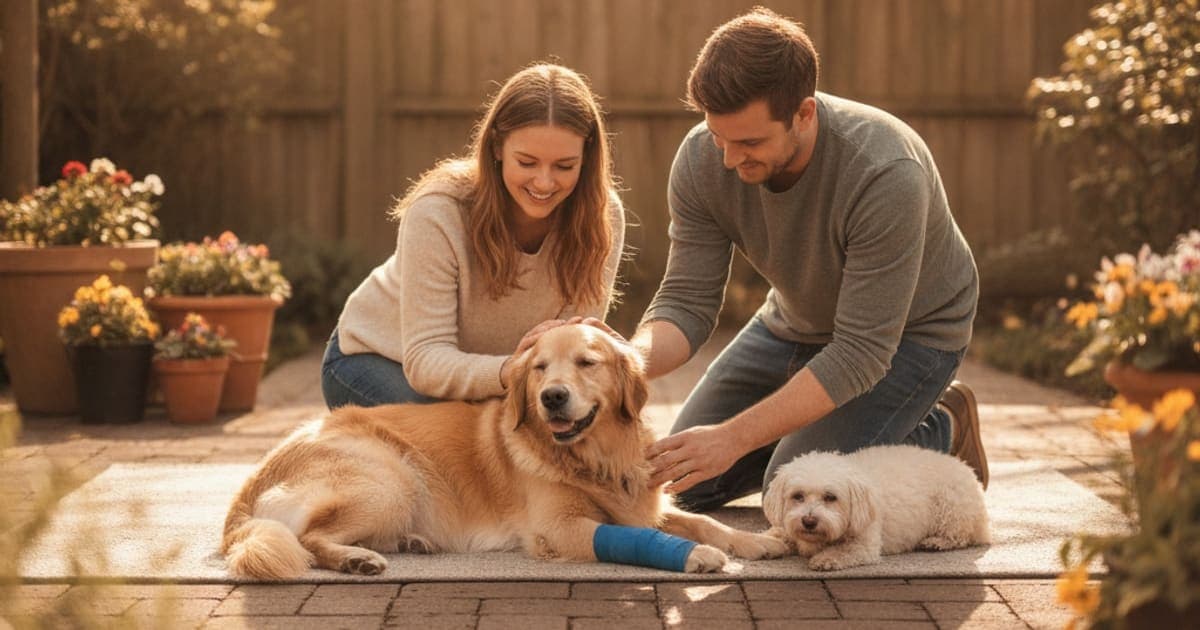
Ranked: a veterinary exam first — the deciding factor is whether the limp is truly a sprain or a fracture, luxation or cruciate tear. Then strict rest with controlled leash activity, because soft tissue repairs under managed load. Then vet-directed pain control, then rehab, then daily recovery support such as K9-REPAIR.
Those five sit in that order for a reason. A sprain is a stretched or partially torn ligament — the fibrous cable that anchors one bone to another across a joint. Ligaments carry a modest blood supply compared with muscle, which is why a leg that looked fine on Monday can still be sore on Friday, and why a good plan is measured in weeks of consistency rather than one dramatic intervention. Everything below is educational. Your veterinarian owns the diagnosis and the treatment plan.
Why the exam comes before anything you buy
A limp is a symptom, not a diagnosis. The same three-legged hop can come from a genuine ligament sprain, a muscle strain, a hairline fracture, a luxating patella, a partial cranial cruciate ligament tear, a torn nail, a grass seed between the toes, an insect sting, a tick-borne infection, or growing pain in a young large-breed dog. Those problems do not share a plan.
Nothing you add at home matters more than getting an accurate diagnosis first — a limp that looks like a simple sprain is sometimes a partial cruciate tear, and the two demand very different management.
A veterinary exam sorts this out with tools you do not have at home: systematic palpation of every joint and long bone, gait assessment at a walk and a trot, and joint stability tests such as the cranial drawer and tibial compression tests that check the stifle for cruciate instability. Radiographs rule out fractures and bone disease. Some dogs guard so hard that sedation is needed for a meaningful exam, and some cases move on to advanced imaging or a referral to an orthopaedic specialist.
Call your veterinarian the same day if your dog will not bear any weight on the leg, if there is obvious swelling or heat, if the leg looks misshapen, if you heard a pop, if pain seems severe, or if a mild limp is not improving over a couple of days. Small dogs, puppies and seniors deserve a lower threshold, not a higher one.
Rest and controlled activity do the heavy lifting
This is the least glamorous item on the list and the one that changes outcomes most. Healing ligament tissue lays down collagen that gradually organises along the lines of load it experiences. Too much load too early disrupts it. Zero load for too long produces weak, disorganised tissue and a stiff joint. The middle path — restriction now, controlled reloading later, on your vet's timeline — is the whole game.
In practice, that usually means:
- Confinement to a crate, pen or one small room when unsupervised.
- Leash walks only, including in the yard, for bathroom breaks.
- No stairs, no jumping on or off furniture, no couch launches, no car leaps — use a ramp or lift the dog.
- No off-leash running, fetch, dog parks, tug or wrestling with the other dog in the house.
- Traction underfoot: runners and yoga mats over hardwood and tile, and nail trims so the foot can grip.
- A gradual, vet-directed return to normal activity rather than a single day when restrictions end.
The classic setback is the good day in week two, when the dog feels better, gets a moment of freedom, and reinjures tissue that was only partway through repair. Weight matters too: every extra pound is extra load on an injured limb, and body condition is one of the few variables an owner fully controls.
Pain control, temperature therapy and formal rehab
Pain is not just suffering — it changes how a dog uses the leg, and chronic guarding creates compensatory soreness in the opposite limb and the lower back. Veterinarians have a real toolkit here, including canine-specific non-steroidal anti-inflammatories and other prescription options chosen for the individual dog's bloodwork, age and history.
Never give human pain relievers. Ibuprofen, naproxen and acetaminophen are genuinely dangerous to dogs, and dosing a dog with a leftover human prescription is one of the most common causes of avoidable emergency visits. And if your vet has prescribed something, keep giving it as directed — no supplement is a reason to stop a prescribed medication.
Cold packing in the early days and gentle warmth later are commonly recommended for soft tissue injuries, but both should be applied on your vet's instruction, with a barrier against the skin and short sessions. Formal rehabilitation with a certified canine rehabilitation practitioner adds passive range-of-motion work, controlled strengthening, underwater treadmill work, therapeutic laser and manual therapy. For unstable joints, a custom brace or orthosis is sometimes part of the plan. Ask your veterinarian whether a rehab referral makes sense for your dog — for repeat limpers and older dogs, it often does.
The main options, side by side
| Option | What it contributes | Deciding factor | Who directs it |
|---|---|---|---|
| Veterinary exam and imaging | Identifies what is actually injured | Whether the limp is a sprain, a fracture or a cruciate tear | Your veterinarian |
| Rest and controlled activity | Protects healing tissue and rebuilds load tolerance | Owner consistency over weeks, not days | Your veterinarian, executed at home |
| Prescribed pain or anti-inflammatory medication | Manages pain and inflammation so the dog uses the limb normally | Individual health status and bloodwork | Prescription only |
| Cold and warmth | Comfort and circulation around the injured area | Stage of injury and correct application | Vet instruction |
| Formal rehabilitation | Restores range of motion, strength and symmetry | Severity, dog's age and recurrence history | Certified rehab practitioner |
| Peptide recovery support (K9-REPAIR) | BPC-157 and TB-500 in one weight-based formulation owners use through recovery | Mechanism aimed at soft tissue repair processes; discuss with your vet | Owner, in conversation with the vet |
| Multi-ingredient joint chews | General joint maintenance | Whether the actives are present in meaningful, disclosed amounts | Owner |
Where BPC-157 and TB-500 fit into a recovery plan
Peptides are short chains of amino acids — signalling molecules rather than blunt instruments. Two of them have become the pair owners reach for during soft tissue recovery.
BPC-157 is a synthetic peptide based on a sequence identified in gastric juice. Published animal research suggests it may support the processes involved in tendon, ligament and muscle repair, including the formation of new blood vessels into healing tissue — which is interesting precisely because poor blood supply is the reason ligament injuries are slow. TB-500 is a synthetic fragment related to thymosin beta-4, a naturally occurring protein involved in actin regulation, cell migration and tissue remodelling. Early evidence indicates these two work on different parts of the same problem, which is why owners tend to use them together rather than choosing one.
This is emerging and promising science, and it should be described honestly: BPC-157 and TB-500 are not FDA-approved veterinary drugs, and nothing here is a claim that any product treats, cures or fixes a sprain. What can be said plainly is what owners are actually doing — using a peptide stack alongside the rest, the medication and the rehab their veterinarian directed, and reporting on how their dogs move through recovery.
K9-REPAIR from pawgen puts both peptides into a single formulation made for dogs, dosed by body weight rather than a one-size scoop, third-party tested with certificates of analysis available, shipped direct to your door, and backed by a 60-day money-back guarantee. Dosing questions — especially for puppies, pregnant or nursing dogs, or a dog already on prescription medication — belong in a conversation with your veterinarian, not in a blog post.
What deserves your skepticism instead
Point your doubt at the shelf, not at the biology. A large share of canine joint products are kitchen-sink chews: a dozen ingredients on the label, a proprietary blend that hides how much of each is actually present, and a picture of a Labrador running through a field doing the persuasive work. If a company will not tell you the amount of every active ingredient, or cannot produce a certificate of analysis from an independent lab, you are buying marketing.
Be equally wary of any product that uses phrases like clinically proven or vet-approved without a citation you can check, and of anything positioned as a way to skip the veterinary exam. Nothing sold online can tell you whether your dog's stifle is stable. That is what the exam is for.
Key Takeaways
- The best plan starts with a veterinary exam, because a limp that looks like a sprain can be a fracture, a luxating patella or a partial cruciate tear.
- Strict rest with controlled, gradually reloaded activity is the single highest-impact thing an owner does, and the good day in week two is the classic setback.
- Prescribed pain control belongs to your vet; human anti-inflammatories such as ibuprofen and naproxen are dangerous to dogs.
- Rehabilitation restores range of motion and strength, and is worth asking about for repeat limpers and older dogs.
- BPC-157 and TB-500 are the peptides owners use through recovery; K9-REPAIR combines both, weight-based, third-party tested, with a 60-day money-back guarantee.
- Skepticism belongs on underdosed, undisclosed kitchen-sink chews — not on the exam, the rest plan, or the rehab.
For deeper reading, see the full guide to sprained leg in dogs, a breakdown of what to give a dog with sprained leg, the detailed look at k9-repair for sprained leg in dogs and at bpc-157 for sprained leg in dogs. If your dog's gait problem turns out to be neurological rather than orthopaedic, the guides to the best treatment for wobbler syndrome in dogs and what to give a dog with wobbler syndrome cover that path, and K9-REPAIR is described in full on pawgen's site.
The order matters more than any single item on the list. Your veterinarian diagnoses the injury, decides whether imaging or referral is needed, sets the activity restriction and prescribes what your dog needs — that is the structure recovery happens inside. Rest, rehab and daily recovery support such as K9-REPAIR operate in the space proper veterinary care creates, not instead of it.
Owners exploring peptide support for their dog can review K9-REPAIR — BPC-157 + TB-500 formulated for dogs — at https://pawgen.com/. BPC-157 and TB-500 are not FDA-approved veterinary drugs. Nothing in this article treats, cures or prevents any condition; every decision about your dog's care belongs with your veterinarian.
Frequently asked questions
- Can sprained leg in dogs be reversed?
- A sprain is repaired rather than reversed — the stretched or partially torn ligament fibres remodel over time with rest and controlled loading. Many mild sprains resolve well, while severe or repeated injuries can leave a joint less stable. Only a veterinary exam can tell you which category your dog is in.
- How much does it cost to treat sprained leg in dogs?
- Costs vary widely by clinic, region and severity. Expect an exam fee, often radiographs, and usually a short course of prescription pain medication. Cases that need sedation, advanced imaging, a specialist referral, bracing or formal rehabilitation cost considerably more. Ask your veterinary practice for a written estimate before proceeding.
- Can a dog's sprained leg heal without surgery?
- Yes — most true sprains are managed without surgery, using activity restriction, vet-directed pain control and a gradual return to normal movement. Surgery enters the conversation when the diagnosis turns out to be something else, such as a fracture, a joint luxation or a cruciate ligament rupture. Your veterinarian makes that call.
- What are the first signs of sprained leg in dogs?
- The first signs are usually limping after activity, holding the paw up, or hesitating at stairs and jumps. Owners also notice swelling or warmth around a joint, licking at one spot, stiffness after rest that eases with movement, reluctance to be touched on that limb, and a change in normal play.
- How is sprained leg diagnosed in dogs?
- Diagnosis begins with a physical exam: palpation of every joint and long bone, gait assessment at a walk and trot, and joint stability tests such as cranial drawer and tibial compression for the stifle. Radiographs rule out fractures. Some dogs need sedation for a thorough exam, and some need advanced imaging or referral.
- What helps a dog with sprained leg?
- Strict rest with leash-only bathroom breaks, no stairs or jumping, traction underfoot, healthy body weight, and vet-directed pain control help most. Rehabilitation restores strength and range of motion. Many owners also add a peptide recovery formulation such as K9-REPAIR alongside that plan — discuss it with your veterinarian first.
- Can I give my dog ibuprofen for a limp?
- No. Ibuprofen, naproxen and acetaminophen are dangerous to dogs and can cause serious stomach, kidney and liver injury even at small amounts. Dogs need canine-specific medication prescribed by a veterinarian who has seen their bloodwork and history. Call your vet rather than reaching for anything in your own medicine cabinet.
- When should a limping dog be seen urgently?
- Seek same-day veterinary care if your dog will not bear any weight on the leg, if the limb looks deformed, if there is marked swelling or heat, if you heard a pop, if pain seems severe, or if the limp is worsening. Puppies, toy breeds and seniors warrant a lower threshold.
Educational content. BPC-157 and TB-500 are not FDA-approved veterinary drugs. Talk to your veterinarian before starting anything new, especially if your dog is on prescribed medication.