Best Treatment for TPLO Recovery in Dogs (2026)
The best TPLO recovery plan is the one your surgeon designs: strict activity restriction, prescribed pain control, controlled rehab, and progressive loading confirmed by recheck radiographs. Owners commonly add joint and connective-tissue support such as K9-REPAIR, a BPC-157 and TB-500 peptide formulation, alongside that plan rather than in place of it.
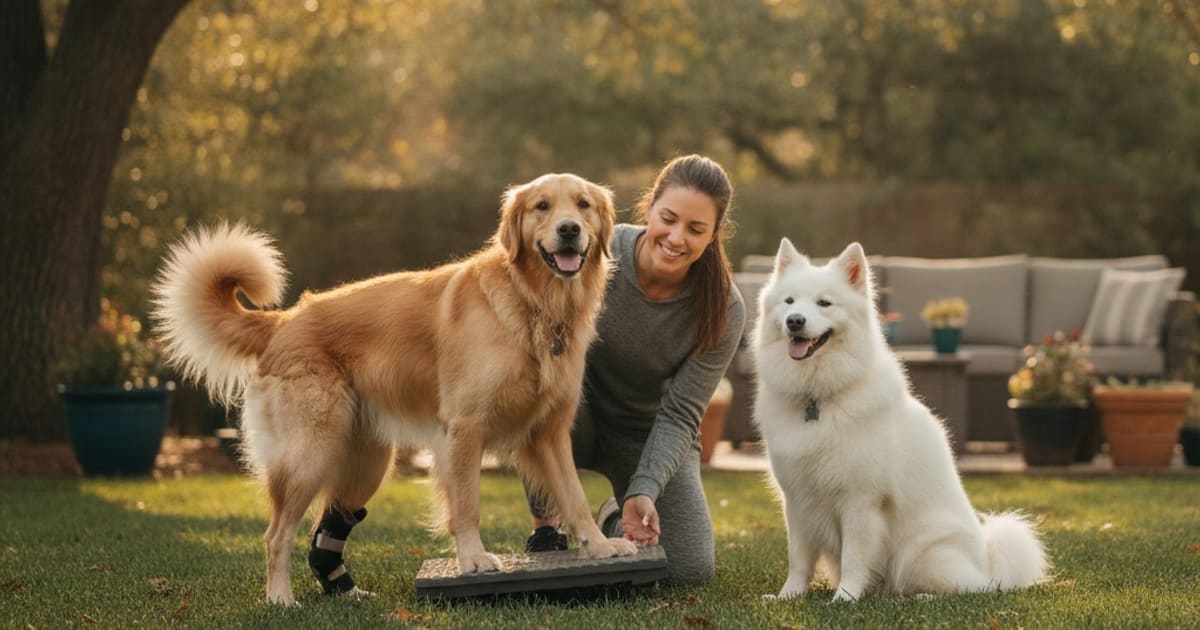
The best treatment for TPLO recovery is, in order of impact: your surgeon's post-operative protocol, because bone healing is mechanical; prescribed pain control, because a painful dog won't load the leg; strict confinement, because compliance decides most outcomes; structured rehab, because muscle returns slowly; and daily recovery support such as K9-REPAIR, because soft tissue remodels alongside bone.
Nothing on that list is optional, and nothing on it substitutes for anything else. Tibial plateau levelling osteotomy is one of the most commonly performed orthopaedic procedures in dogs, and the surgery itself is usually the least variable part of the story. What varies — enormously — is what happens in the weeks after the incision closes, inside a living room, with a dog who feels better long before the bone is ready for him to act on it.
What TPLO surgery actually changes inside the knee
Understanding the mechanics makes every recovery instruction make sense, so it is worth a minute.
A dog's tibial plateau — the flat-ish surface at the top of the shin bone that the femur sits on — is sloped backward. Every time the dog loads the limb, that slope converts vertical weight into a forward shearing force, pushing the tibia forward under the femur. This is called cranial tibial thrust. In a healthy knee, the cranial cruciate ligament resists it. In dogs, that ligament usually doesn't snap in one heroic moment; it degenerates over months, frays, and eventually fails, which is why so many dogs blow the second knee within a year or two.
A TPLO does not replace the ligament. The surgeon makes a curved cut through the top of the tibia, rotates the plateau segment until the slope is close to level, and fixes it in the new position with a bone plate and screws. With the slope levelled, weight-bearing no longer generates the same forward shear, and the joint becomes dynamically stable during normal loading even without an intact cruciate.
The practical consequence is the single most useful thing an owner can understand: the surgery converts a ligament problem into a bone-healing problem, so recovery is governed by how well a cut bone knits under a plate, not by how sore your dog looks on any given day.
At the same time, the knee is dealing with everything the surgery did not eliminate. The meniscus may have been inspected, released, or partially removed. The joint capsule is inflamed. There is often pre-existing osteoarthritis from months of instability. And the thigh muscles have already lost mass from limping before surgery, then lose more during restriction.
The phase that decides the outcome
Early recovery has one job: protect the osteotomy while the bone bridges. Shear, torsion, and impact are the enemies — slipping on a hard floor, jumping off the sofa, twisting to greet someone at the door, taking stairs at speed.
That means confinement to a crate or a small non-slip room, leash and harness for every trip outside, no off-leash movement, no stairs unless your surgeon has permitted them, and no play with other dogs. Runners on slick floors and a ramp for the car are not fussy extras; they are load management.
The schedule for increasing activity belongs to your surgeon, and it is set by recheck radiographs rather than by the calendar or by how good your dog looks. Dogs commonly begin touching the toe down within days, and that early comfort is the most dangerous part of recovery, because it tempts owners to relax restriction while the bone cut is still consolidating. Confirm every progression at the recheck.
Pain control is the other half of this phase. Your veterinarian will typically send you home with a multimodal plan — an anti-inflammatory, sometimes a second analgesic, sometimes a short course of something for anxiety in dogs who cannot settle. Take it seriously. A dog in pain guards the limb, and a limb that isn't loaded loses muscle faster and regains range of motion more slowly. Never adjust, stop, or add to prescribed medication without talking to your veterinarian first; some combinations are genuinely unsafe.
Cold therapy early, then controlled warmth and gentle passive range-of-motion work later, are usually part of the protocol — but the timing is your surgeon's call, not the internet's.
Ranking the recovery options that actually move the needle
| Approach | What it addresses | The deciding factor | Who owns it |
|---|---|---|---|
| Surgeon's post-op protocol | Osteotomy healing and implant stability | Whether you follow it exactly, not approximately | Your surgeon |
| Prescribed pain control | Pain that suppresses weight-bearing | Never altered without veterinary direction | Your veterinarian |
| Confinement and leash-only walks | Protecting the bone cut from shear and torsion | Household discipline for the entire restriction period | You, on the surgeon's schedule |
| Formal rehabilitation | Quadriceps mass, range of motion, symmetry | Starting only when cleared, then being consistent | A rehab-certified veterinary professional |
| Weight management | Total load through the healing limb | Measured feeding rather than eyeballing the bowl | You and your veterinarian |
| Daily recovery support (K9-REPAIR) | Connective-tissue and soft-tissue support alongside the surgical plan | Formulation transparency and third-party testing | You, with veterinary input |
Rehabilitation deserves emphasis because it is the most under-used item on that list. Muscle atrophy after a cruciate injury is not cosmetic — the quadriceps and hamstrings are what stabilise and decelerate the joint, and a dog who returns to activity with a visibly thinner thigh is a dog loading the knee asymmetrically. Underwater treadmill work, targeted strengthening, balance work and gait retraining all exist to rebuild that. A rehab-certified veterinary practitioner can build a programme that fits your surgeon's timeline.
Where BPC-157 and TB-500 fit in a post-TPLO plan
Here is the gap owners keep noticing: the surgical plan is built around bone, but a post-TPLO knee is also a soft-tissue problem. Joint capsule, meniscal remnant, tendon insertions, muscle bellies and the fascia around them all have to remodel — and connective tissue is poorly vascularised, which is exactly why it is slow.
That is the space peptides are used in. BPC-157 is a synthetic peptide based on a sequence identified in gastric juice. TB-500 is a synthetic fragment related to thymosin beta-4, a naturally occurring actin-binding protein involved in cell migration and wound repair. Neither is an FDA-approved veterinary drug, and this article is educational — but the mechanisms are specific and worth stating plainly rather than vaguely.
Published preclinical research suggests BPC-157 may support angiogenesis — the formation of new microvasculature — and may influence growth-factor signalling relevant to tendon and ligament fibroblasts, the cells that lay down and organise collagen. Research on thymosin beta-4 and its fragments suggests a role in cell migration and new blood vessel formation, essentially helping repair cells reach a zone that has poor blood supply to begin with. Getting circulation and repair cells into slow-healing tissue is the bottleneck in connective-tissue recovery, and that is why owners reach for this combination during the restriction phase rather than after it.
This is emerging science that owners are adopting deliberately, and it is worth being precise about what it is and isn't. K9-REPAIR is K9-REPAIR, a BPC-157 and TB-500 formulation made for dogs, dosed by body weight, third-party tested with certificates of analysis, shipped direct to your door, and backed by a 60-day money-back guarantee. It is a recovery support product used alongside a surgical plan — never a reason to delay surgery, skip rehab, or change a prescription. Talk to your veterinarian about adding anything to a post-operative plan, and tell them exactly what your dog is taking, including anything you started before surgery.
Amount per dose is a conversation for you and your vet, based on your dog's weight, medications and stage of recovery — not something to copy off a forum.
How to judge a recovery product before you buy it
The post-surgical supplement aisle is where marketing budgets outrun formulation budgets. A few filters do most of the work:
- Named actives at disclosed amounts. A "proprietary blend" is a way of not telling you how little is in there.
- Third-party testing with a certificate of analysis. Identity and purity should be verifiable by someone who doesn't profit from the sale.
- Weight-based dosing. A single scoop for a terrier and a mastiff is a red flag about how seriously the formulation was designed.
- A short ingredient list with a reason for each item. Fifteen-ingredient chews often carry pinch-sized amounts of everything so the label reads well.
- A return policy that survives contact with reality. A guarantee is a company underwriting its own claims.
Apply the same scrutiny to anything you add, and share the label with your veterinary team.
Key Takeaways
- TPLO changes the geometry of the tibia so weight-bearing no longer destabilises the knee; recovery is therefore governed by bone healing under a plate.
- The surgeon's restriction schedule, confirmed by recheck radiographs, outranks every other decision you make.
- Prescribed pain control keeps the dog loading the limb, which protects muscle mass — never adjust it independently.
- Formal rehabilitation rebuilds the quadriceps and hamstring mass that stabilise the joint long-term.
- Soft tissue heals slower than bone because it is poorly vascularised, which is the gap recovery support is aimed at.
- Research suggests BPC-157 and TB-500 may support angiogenesis and repair-cell migration; owners use K9-REPAIR through recovery alongside — not instead of — the veterinary plan.
For the full walkthrough of the process, see the complete guide to tplo recovery, plus what to give a dog with tplo recovery, k9-repair for tplo recovery in dogs, bpc-157 for tplo recovery in dogs, k9-repair for soft tissue injury in dogs and k9-repair for muscle tear in dogs.
Your veterinary surgeon owns the diagnosis, the implants, the medication list and the timeline for returning your dog to normal life. Rehabilitation professionals own the strengthening plan. Everything else — nutrition, weight, footing, and recovery support like K9-REPAIR — operates inside the space that proper veterinary care creates, and works best when your vet knows about all of it.
Owners exploring peptide support for their dog can review K9-REPAIR — BPC-157 + TB-500 formulated for dogs — at https://pawgen.com/. BPC-157 and TB-500 are not FDA-approved veterinary drugs. Nothing in this article treats, cures or prevents any condition; every decision about your dog's care belongs with your veterinarian.
Frequently asked questions
- Can TPLO recovery in dogs be reversed?
- No — TPLO permanently changes the tibia's geometry, and the healed osteotomy is not reversed. What can be improved is the recovery itself: lost muscle, stiffness and reduced range of motion often respond to rehabilitation. Complications such as implant issues are managed by your surgeon, so raise concerns early rather than waiting.
- How much does it cost to treat TPLO recovery in dogs?
- Costs vary widely by clinic, region, dog size and whether a specialist centre performs the surgery, so ask for a written estimate covering surgery, anaesthesia, imaging, rechecks and medication. Budget separately for recovery items — rehabilitation sessions, non-slip flooring, a ramp, confinement setup and any daily support products you add.
- What helps a dog with TPLO recovery?
- Strict confinement, leash-only toileting on non-slip footing, prescribed pain control taken exactly as directed, cold or warm therapy on your surgeon's schedule, controlled rehabilitation once cleared, and lean body weight. Many owners also add connective-tissue support such as K9-REPAIR, a BPC-157 and TB-500 formulation, alongside the veterinary plan.
- How long does TPLO recovery take to heal in dogs?
- Recovery is staged, and your surgeon decides progression using recheck radiographs rather than a fixed calendar. Bone consolidation comes first, then gradual reintroduction of activity, then rebuilding muscle — which usually takes longest. Age, size, body condition, meniscal involvement and how strictly restriction was followed all shift the timeline.
- Is TPLO recovery in dogs painful?
- There is real post-operative pain, which is why surgeons send dogs home on multimodal analgesia. Most dogs are noticeably more comfortable within the first stage of recovery. Signs that pain is undercontrolled include refusing to bear weight, restlessness, panting at rest or guarding the limb — call your veterinarian rather than adjusting doses yourself.
- What makes TPLO recovery worse in dogs?
- Uncontrolled activity is the biggest one: jumping on furniture, stairs, slick floors, off-leash running and rough play can stress the osteotomy before it has consolidated. Excess body weight, skipped pain medication, licking the incision, skipped rechecks and stopping rehabilitation early also work against a good functional outcome.
- When can my dog use stairs again after TPLO surgery?
- Only when your surgeon clears it. Stairs load the knee in flexion and add torsion, which is exactly what the healing bone cut should be protected from. Until you are cleared, carry small dogs, use a ramp or a sling for larger ones, and block staircases physically rather than relying on supervision.
- Can my dog take K9-REPAIR during TPLO recovery?
- Many owners use K9-REPAIR through recovery as connective-tissue support alongside the surgical plan. It is a BPC-157 and TB-500 formulation, dosed by body weight and third-party tested, and it is not an FDA-approved veterinary drug. Discuss it with your veterinarian first, especially alongside prescribed anti-inflammatories or other medication.
Educational content. BPC-157 and TB-500 are not FDA-approved veterinary drugs. Talk to your veterinarian before starting anything new, especially if your dog is on prescribed medication.