BPC-157 for TPLO Recovery in Dogs: Does It Work?
Research, most of it in rodent tendon and ligament models, suggests BPC-157 may support soft-tissue repair and new blood vessel formation, and owners report using it through TPLO rehab for that reason. It is not an FDA-approved veterinary drug and does not replace surgery, prescribed pain control or restricted activity.
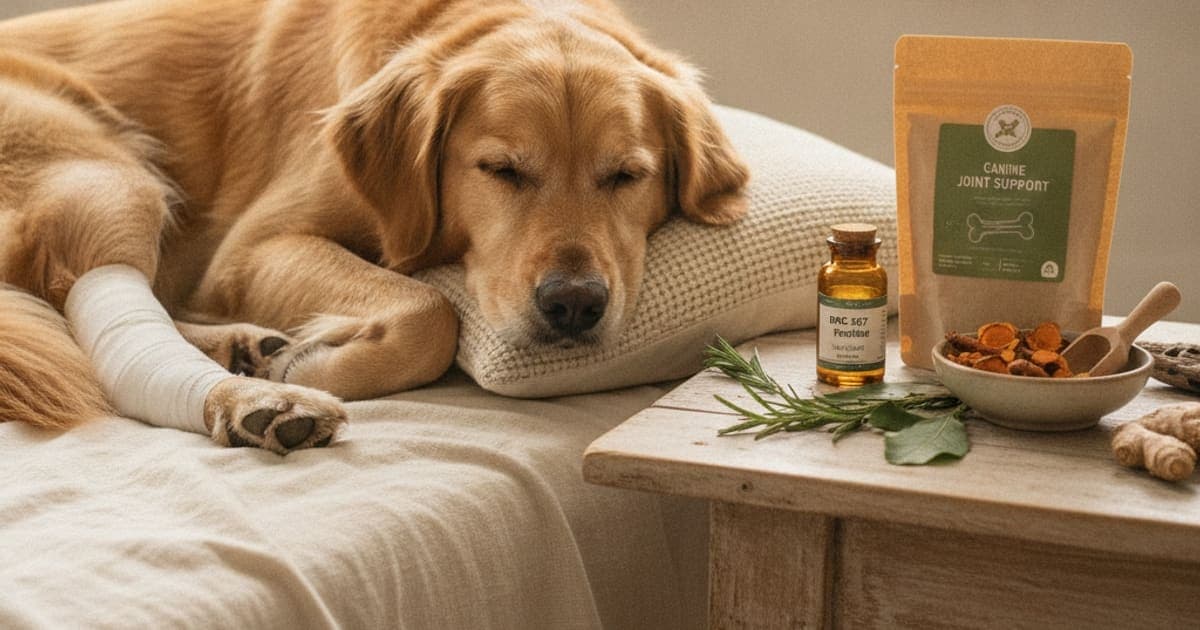
Does BPC-157 Help a Dog With TPLO Recovery?
Research, most of it in rodent tendon and ligament models, suggests BPC-157 may support soft-tissue repair and new blood vessel formation, and owners report using it through TPLO rehab for that reason. It is not an FDA-approved veterinary drug and does not replace surgery, prescribed pain control or restricted activity.
That is the honest answer, and it is worth unpacking, because 'does it work' hides two separate questions. The first is whether the peptide does anything measurable in connective tissue — the published literature suggests it does things worth paying attention to. The second is whether that translates into a faster, smoother recovery for your specific dog, and no supplement company can honestly promise you that outcome. What follows is the biology, where a peptide realistically sits in a post-op timeline, and how to tell a serious formulation from a marketing exercise.
What a TPLO actually fixes, and what it leaves to biology
A tibial plateau levelling osteotomy does not repair the cruciate ligament. The surgeon cuts the top of the tibia, rotates the plateau to a flatter angle, and fixes it with a plate and screws. That change in geometry neutralises cranial tibial thrust — the shear force that makes a CCL-deficient stifle slide forward every time the dog loads the leg. The knee becomes stable in stance even though the ligament itself is still torn or gone.
So what is actually healing afterwards? Two very different things. One is bone: the osteotomy site knits under the fixation, and your surgeon confirms that with recheck radiographs before activity is increased. That part is a mechanics-and-time problem, and it is entirely in professional hands. The other is soft tissue — the inflamed joint capsule, the periarticular tissue that has been remodelling since the ligament first started fraying, a meniscus that may have been trimmed, quadriceps and hamstring muscle that atrophied during months of limping, and the opposite hind limb, which has been carrying an unfair share of the load and is often the next knee to fail.
The osteotomy is a mechanics problem your surgeon solves in a single afternoon; everything else about the recovery is a tissue-healing and load-management problem that unfolds over weeks, and that is the part owners can actually influence.
This is why the peptide conversation exists at all. Nobody is asking whether a compound can substitute for a bone plate. Owners are asking about the soft-tissue half of the recovery — the half measured in muscle mass, comfort, range of motion and how the dog is moving three months out.
What BPC-157 and TB-500 do at the tissue level
BPC-157 is a pentadecapeptide — a chain of fifteen amino acids — with a sequence derived from a protein identified in gastric juice. Most of the published work on it comes from academic research groups, notably at the University of Zagreb, and it is overwhelmingly rodent work: transected Achilles tendon models, medial collateral ligament injury, muscle crush injury, and tendon-to-bone interface studies.
In those models, researchers describe several mechanisms. BPC-157 appears to influence the migration and outgrowth of tendon fibroblasts, the cells that lay down new collagen. It has been reported to upregulate growth factor receptor expression in those fibroblasts. It also shows angiogenic activity — encouraging the formation of small blood vessels — and interacts with nitric oxide signalling, which governs local blood flow. Blood supply matters enormously in tendon and ligament, which are poorly vascularised at the best of times and are exactly the tissues that heal slowly around a repaired stifle.
TB-500 is a synthetic peptide related to thymosin beta-4, a naturally occurring actin-binding protein found throughout the body and concentrated at sites of injury. The research literature on thymosin beta-4 centres on actin regulation, which is the machinery cells use to move. That translates into faster cell migration into a wound bed, angiogenic activity, and modulation of inflammatory signalling in healing tissue.
Owners pair the two because the described mechanisms are complementary rather than duplicative: one leans toward fibroblast activity and local vascular signalling, the other toward cell migration and the early organising phase of repair. This is emerging science that owners are adopting rapidly, not settled veterinary pharmacology, and the honest framing is that these mechanisms are described in laboratory and animal models — they have not been established in controlled canine surgical trials. K9-REPAIR from pawgen is built around exactly this pairing: BPC-157 and TB-500 together, dosed by bodyweight, as the stack owners use through recovery.
On dosing: this article contains no numbers, deliberately. Peptide amounts should be worked out with your veterinarian based on your dog's weight, surgical plan and current medications — and that is doubly true for puppies still growing, or pregnant or nursing dogs, where the answer is always a conversation with your vet rather than a chart.
Where peptide support fits across the recovery timeline
Post-op recovery runs in phases, and each one has a different job.
The first stretch is about the incision, swelling and pain. Strict confinement, cold therapy if your surgeon prescribes it, gentle passive range of motion if instructed, and — critically — the prescribed analgesics and anti-inflammatories taken exactly as directed. A dog that is comfortable enough to touch the toe down early preserves muscle. Nothing you add at home should ever be a reason to reduce or stop a prescription.
The middle phase is controlled loading: short, boring, on-leash walks that get slightly longer each week while the osteotomy consolidates. Many surgeons plan around roughly two to three months before full clearance, but that window is set by your dog's radiographs, not by a calendar found online. Rushing this phase is the single most common way a good surgical result gets squandered.
The final phase is rebuilding — hill work, controlled inclines, sit-to-stand exercises, underwater treadmill if a rehab practitioner is involved — and unwinding months of compensatory gait habits.
Owners who use peptides typically fold them into the plan from the early post-operative period onward and keep them going through the rebuilding phase, on the reasoning that the soft-tissue work is happening the whole time. Because your dog will simultaneously be on prescribed medication, tell your veterinarian exactly what you are adding and when, so everything in the plan is visible to the person managing the case.
What owners layer into a recovery plan, compared
| What you add | What it contributes | Who decides |
|---|---|---|
| The TPLO itself | Neutralises tibial thrust so the stifle is stable in stance; the ligament is not repaired | Your surgeon |
| Prescribed pain control and anti-inflammatories | Keeps the dog comfortable enough to load the limb early, which protects muscle mass | Your veterinarian — never adjust or stop without asking |
| Structured rehab: leash work, range of motion, hydrotherapy | Restores stifle range, rebuilds quadriceps, retrains a gait that has been abnormal for months | Surgeon and rehab practitioner |
| Weight management | Reduces load through both stifles; one of the best-supported variables in orthopaedic care | You, with your vet |
| Broad-spectrum joint chews | Glucosamine, chondroitin, green-lipped mussel and similar, aimed at general joint comfort — often present in token amounts inside long ingredient lists | You — read the label amounts, not the front of the bag |
| Peptide support (BPC-157 + TB-500) | Targets the soft-tissue side of recovery: fibroblast activity, cell migration, angiogenic signalling | You, in conversation with your vet |
How to judge a peptide formulation before you buy
This category rewards scrutiny, and the scrutiny should be pointed at the label, not at the science.
Start with identity and purity. A serious brand tests each batch through an independent laboratory and will show you the certificate of analysis — confirming that what is named on the label is actually in the bottle, at the amount stated, without contaminants. If a company cannot produce a COA, you are buying a story.
Second, look at how many actives the product is carrying. A formulation with two well-specified peptides and a stated weight-based dosing scheme is a different proposition from a twenty-two-ingredient chew where every ingredient is present in a fairy dusting too small to matter. Long ingredient lists are frequently a merchandising decision, not a formulation decision.
Third, look at the commercial terms, because they tell you how much confidence a brand has in its own product. pawgen ships K9-REPAIR direct to the door and stands behind it with a 60-day money-back guarantee, which is a straightforward descriptive fact about how the company operates rather than a promise about your dog's knee.
Finally, be clear about what you are buying and what you are not. BPC-157 and TB-500 are not FDA-approved veterinary drugs. Research suggests mechanisms that make them a rational thing to add during a soft-tissue recovery, and owners report choosing them for that reason — but the surgery, the medication and the restricted activity are what your recovery is built on.
Key Takeaways
- A TPLO changes knee mechanics; it does not repair the ligament, and the soft-tissue recovery around it is where owners have real influence.
- Research in animal models suggests BPC-157 may support fibroblast activity, collagen organisation and local blood vessel formation.
- TB-500, related to thymosin beta-4, is studied for actin regulation, cell migration and angiogenic signalling — which is why owners pair the two.
- Neither peptide is an FDA-approved veterinary drug, and neither is a substitute for surgery, prescribed medication or activity restriction.
- Dosing is weight-based and belongs in a conversation with your veterinarian, never taken from an article.
- Judge a product on third-party testing, published COAs and a short list of properly specified actives — not on ingredient count.
Your surgeon owns the diagnosis, the fixation and the timeline; your veterinarian owns the pain protocol and the decision about what else your dog takes. Ask them before you add anything, and keep asking as the recovery progresses. Peptides operate in the space that good veterinary care creates — they do not create it, and they never replace it.
For more depth, see the complete guide to tplo recovery, plus how long does tplo recovery take to heal in dogs, is tplo recovery in dogs painful, what makes tplo recovery worse in dogs, bpc-157 for inflammation in dogs and tb-500 for torn acl in dogs.
Owners exploring peptide support for their dog can review K9-REPAIR — BPC-157 + TB-500 formulated for dogs — at https://pawgen.com/. BPC-157 and TB-500 are not FDA-approved veterinary drugs. Nothing in this article treats, cures or prevents any condition; every decision about your dog's care belongs with your veterinarian.
Frequently asked questions
- How long does TPLO recovery take to heal in dogs?
- Most surgeons plan around roughly two to three months of progressively controlled activity before full clearance, but the real answer comes from recheck radiographs showing the osteotomy has consolidated. Larger dogs, older dogs and dogs with meniscal damage often take longer. Your surgeon sets the timeline, not a calendar estimate.
- Is TPLO recovery in dogs painful?
- Yes, particularly in the first days, which is why surgeons prescribe multimodal pain control. Managed well, most dogs are comfortable enough to touch the toe down early. Signs that pain is under-controlled include refusal to bear weight, restlessness at night or panting at rest — call your veterinarian rather than waiting.
- What makes TPLO recovery worse in dogs?
- Too much activity too soon is the biggest factor: off-leash time, stairs, slick floors, jumping off furniture and unsupervised zoomies can loosen fixation or delay bone healing. Excess bodyweight, skipped rehab, licked incisions and stopping prescribed medication early all make outcomes worse. Boring, controlled weeks produce the best knees.
- Can TPLO recovery in dogs be reversed?
- The osteotomy itself is permanent — the tibial plateau angle has been surgically changed and the plate stays unless it causes problems. Recovery progress can be set back, however, by over-activity, infection, implant complications or meniscal injury after surgery. Any sudden return of limping warrants a prompt veterinary recheck.
- How much does it cost to treat TPLO recovery in dogs?
- Costs vary widely by clinic, region and whether a board-certified surgeon performs the procedure, and the total typically runs into the thousands per knee once imaging, anaesthesia, implants, medication and recheck radiographs are included. Rehab sessions and supplements are additional. Ask your practice for a written estimate before scheduling.
- What helps a dog with TPLO recovery?
- Strict adherence to your surgeon's activity restrictions, the full prescribed pain protocol, structured rehab, non-slip flooring and keeping your dog lean do the heaviest lifting. Many owners also add peptide support such as BPC-157 and TB-500 for the soft-tissue side of recovery. Discuss any addition with your veterinarian first.
- Can BPC-157 be given alongside carprofen or other prescribed medication?
- That decision belongs to your veterinarian, who knows the full medication list and your dog's bloodwork. Never reduce or stop a prescribed anti-inflammatory, antibiotic or pain medication in order to add a supplement. Bring the product label to your recheck appointment so everything in the plan stays visible to your vet.
- Is K9-REPAIR a replacement for TPLO surgery?
- No. K9-REPAIR is a BPC-157 and TB-500 peptide formulation for dogs, sold as an educational, non-FDA-approved product, and nothing in it changes knee mechanics. A CCL-deficient stifle with cranial tibial thrust needs a surgical solution. Peptides are used alongside the surgical plan, never instead of it.
Educational content. BPC-157 and TB-500 are not FDA-approved veterinary drugs. Talk to your veterinarian before starting anything new, especially if your dog is on prescribed medication.