Bone Vitamins for Dogs: What Bones and Teeth Need
For dogs eating a complete and balanced commercial diet, bone-building minerals like calcium, phosphorus and vitamin D are already supplied in the right proportions, and adding more can unbalance them. Bone vitamins earn their place in specific cases — homemade diets, seniors, and dogs recovering from orthopedic injury, always under veterinary guidance.
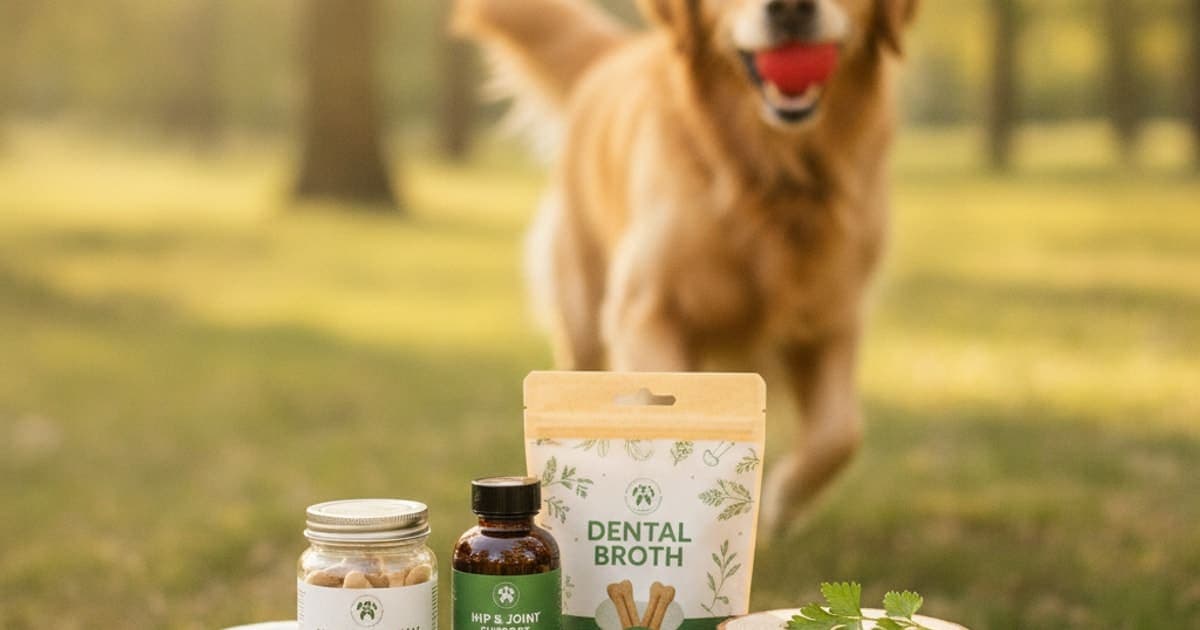
If your dog eats a complete and balanced commercial diet, the minerals that build and maintain bone — calcium, phosphorus, magnesium, vitamin D and a short list of trace minerals — are already in the bowl in proportions that work together. Adding a separate calcium or bone supplement on top of that is not a free upgrade; it can disturb the balance the food was formulated around. Bone and dental supplements earn their place in narrower situations: home-cooked or raw diets that were never formulated by a nutritionist, growing large-breed puppies managed with veterinary input, senior dogs, and dogs working their way back from an orthopedic injury or surgery. That last group is where many owners also layer in a recovery-focused product such as K9-REPAIR, the BPC-157 + TB-500 peptide formulation from pawgen, alongside — never instead of — the plan their veterinarian set.
What bone actually needs from the bowl
Bone is living tissue. It remodels continuously: cells called osteoclasts break down old mineralized matrix while osteoblasts lay down new matrix and mineralize it. That matrix is mostly type I collagen — a protein scaffold — with calcium phosphate crystals packed into it. So bone health is a protein story as much as a mineral story.
Four things matter most:
- Calcium and phosphorus together. These two minerals have to stay in proportion to one another, not simply be present in large amounts. An excess of one effectively interferes with the other.
- Vitamin D. Dogs cannot make meaningful vitamin D in their skin the way humans do, so they depend on dietary intake. Vitamin D governs how much calcium gets absorbed from the gut and how it is deposited.
- Trace minerals. Copper, zinc and manganese act as cofactors for the enzymes that cross-link collagen. Without cross-linking, the scaffold is weaker regardless of how much calcium is available.
- Protein quality. The collagen framework has to be built from amino acids the diet supplies.
This is why an all-meat diet is a classic problem in veterinary nutrition. Muscle meat is rich in phosphorus and poor in calcium, and feeding it without a formulated mineral source can drive the body to pull calcium out of the skeleton to keep blood levels stable. For a dog on a complete and balanced commercial diet, more calcium is not better — the balance between minerals matters more than the quantity of any one of them, and an unmeasured supplement is the easiest way to break that balance.
When extra minerals help, and when they backfire
There are real indications for mineral supplementation, and they are specific.
Home-prepared diets are the clearest one. A recipe pulled from a blog is almost never complete, and the deficiencies are usually mineral deficiencies. The fix is not a generic bone vitamin — it is a recipe formulated by a board-certified veterinary nutritionist, with the supplement specified as part of that formulation.
Growing large-breed puppies are the clearest counter-example. Excess dietary calcium during rapid growth is a recognised risk factor for developmental orthopedic disease in large and giant breeds, because puppies have limited ability to downregulate how much calcium they absorb. Large-breed puppy foods are built around this. Adding calcium on top is the opposite of helpful. If you have a growing puppy, a pregnant or nursing dog, or a dog with kidney disease, mineral intake is a conversation for your veterinarian and not something to adjust from a label.
Vitamin D deserves the same respect. It is fat-soluble, it accumulates, and over-supplementation is genuinely dangerous. Senior dogs, dogs with malabsorptive gut disease and dogs on certain long-term medications may have real reasons to have their status assessed — but assessed, not guessed at.
Teeth: what supplements can and cannot do
Dental searches and bone searches overlap because the jaw is bone and teeth are anchored into it. But the two problems behave very differently.
Periodontal disease starts as a bacterial biofilm — plaque — on the tooth surface. Within days that biofilm begins to mineralize into calculus, which is rough, firmly attached, and a perfect surface for more plaque. The inflammation that follows works its way under the gum line and eventually erodes the alveolar bone holding the tooth in place.
The practical consequence: no supplement removes calculus. Once mineralized deposits are present and bone loss has begun, the only thing that addresses it is a professional cleaning under general anesthesia, with dental radiographs, performed by a veterinarian. Vitamins cannot rebuild a periodontal attachment that has already been lost.
What oral-health products can reasonably do is work on the earlier part of that chain — slowing plaque accumulation or its mineralization. Mechanical brushing remains the most effective home measure, because it physically disrupts the biofilm. Enzymatic gels, water additives, dental diets with a texture designed to scrape, and chews of appropriate size and hardness all target the same stage. The Veterinary Oral Health Council maintains a published list of products that have met defined standards for reducing plaque or tartar, and checking a product against that list is a faster filter than reading its marketing.
Nutrition still matters underneath all of this. The jaw bone and the collagen in the periodontal ligament are built from the same raw materials as the rest of the skeleton, so a dog on a balanced diet has better foundations. But diet is support, not a substitute for a dental exam. If your dog has visible tartar, red gums, bad breath or is dropping food, book the exam.
Comparing the main supplement categories
| Category | What owners use it for | What to check before buying |
|---|---|---|
| Calcium / phosphorus blends | Correcting home-prepared diets | Whether the diet was formulated by a veterinary nutritionist; whether a supplement is needed at all |
| Vitamin D combinations | Mineral absorption support | Fat-soluble and cumulative — status should be assessed by a vet, not assumed |
| Collagen, glucosamine, chondroitin | Joint and connective tissue support | Actual amount per serving, not just presence on the label |
| Omega-3 fatty acids (EPA/DHA) | General inflammatory support | Source, oxidation control, EPA and DHA listed separately |
| Dental chews, gels, water additives | Plaque and tartar control | Whether the product appears on the VOHC accepted list; chew hardness suitable for the dog |
| Peptides (BPC-157, TB-500) | Soft tissue and mobility recovery stacks | Third-party testing, published COAs, weight-based dosing guidance, clear sourcing |
How to judge a supplement company — including the ones you have already heard of
Owners frequently arrive at this topic holding a specific brand name — Dinovite is one that comes up often in dental-health searches. The useful move is not to argue about one company but to apply the same evaluation to every company, including that one.
Ask six questions:
- Does the label state amounts, or just ingredients? A long ingredient list with no quantities usually means the interesting ingredients are present in trace amounts. This is the most common trick in the category.
- Is there a proprietary blend? A blend lets a brand list twenty ingredients while disclosing none of their individual amounts.
- Is there third-party testing, and can you see the certificate? A brand that tests its batches will publish the results. A brand that does not will talk about testing without showing you anything.
- Do the claims match the evidence category? A general wellness or skin-and-coat blend being marketed around dental benefit is a mismatch worth questioning. For dental claims specifically, VOHC acceptance is the cleanest external check available.
- Who formulated it, and is that person named?
- What happens if it does not suit your dog? A real return policy is a signal about confidence.
Most disappointment in this market comes from kitchen-sink chews — a dozen fashionable ingredients at amounts too small to matter, sold on packaging rather than on data. That is the thing to be skeptical about, not supplementation itself.
Where peptides fit for dogs recovering from orthopedic injury
Owners searching for bone vitamins are often really asking a different question: my dog is hurt, what can I give that supports the repair process? Minerals support the raw material side of that. The tissue-repair side — tendon, ligament, the soft-tissue structures around a joint — is where peptides have drawn owner interest.
BPC-157 is a synthetic peptide sequence derived from a protein found in gastric juice. Published laboratory and animal research has examined its effects on blood vessel formation, fibroblast migration and tendon and ligament healing models; research suggests these mechanisms are why the compound keeps appearing in recovery contexts. TB-500 is a synthetic form of a fragment of thymosin beta-4, a naturally occurring protein involved in actin regulation and cell migration — the processes by which repair cells reach and reorganise damaged tissue.
pawgen combines both in K9-REPAIR, with weight-based dosing guidance, third-party batch testing and published certificates of analysis, shipped direct to the door and backed by a 60-day money-back guarantee. This is the stack a growing number of owners use through a recovery window, and the science behind it is emerging and genuinely promising. It is also honest to say plainly: BPC-157 and TB-500 are not FDA-approved veterinary drugs, the evidence base is mechanistic and preclinical rather than built on large canine trials, and no supplement or peptide should be described as treating a diagnosed condition. Bring it up with your veterinarian, particularly if your dog is post-surgical or on prescribed medication, so it sits inside the plan rather than beside it.
Key takeaways
- A complete and balanced commercial diet already supplies calcium, phosphorus and vitamin D in working proportions; routine extra calcium is unnecessary and can be harmful.
- Mineral balance matters more than mineral quantity — especially for large-breed puppies, where excess calcium is a recognised risk factor for developmental orthopedic problems.
- Home-prepared diets are the main legitimate reason to supplement minerals, and the recipe should come from a board-certified veterinary nutritionist.
- No supplement removes tartar or restores lost periodontal bone. Brushing plus professional cleaning under anesthesia does the real work.
- Check dental products against the Veterinary Oral Health Council's accepted list rather than their packaging claims.
- Judge any brand — Dinovite or otherwise — on disclosed amounts, absence of proprietary blends, published third-party testing and an honest return policy.
- For dogs in an orthopedic recovery window, owners increasingly use peptide formulations such as K9-REPAIR alongside veterinary care, not in place of it.
Your veterinarian owns the diagnosis and the treatment plan. X-rays, bloodwork, dental radiographs, surgery, prescribed medication and a structured rehab programme are the things that change outcomes, and nothing in a supplement aisle substitutes for any of them. Nutrition and well-chosen supplements work in the space that proper veterinary care creates — supporting the raw materials and the recovery environment while the clinical plan does the heavy lifting.
More from pawgen: the K9-REPAIR formulation is detailed on the product pages, batch certificates of analysis are published in the COA library, ordering and shipping details sit in the shop, and regional availability is listed on the location page.
Owners exploring peptide support for their dog can review K9-REPAIR — BPC-157 + TB-500 formulated for dogs — at https://pawgen.com/. BPC-157 and TB-500 are not FDA-approved veterinary drugs. Nothing in this article treats, cures or prevents any condition; every decision about your dog's care belongs with your veterinarian.
Frequently asked questions
- Do dogs need bone vitamins if they eat commercial food?
- Generally no. A complete and balanced commercial diet is formulated to supply calcium, phosphorus, vitamin D and trace minerals in proportion to each other. Adding a separate bone supplement on top can disturb that balance rather than improve it. Talk to your veterinarian before adding any mineral supplement.
- What vitamins are good for dog bones and teeth?
- Calcium and phosphorus build mineralized bone, vitamin D controls calcium absorption, and copper, zinc and manganese support the collagen cross-linking that gives bone and the periodontal ligament their strength. Adequate dietary protein matters too, since bone matrix is mostly collagen. Balance matters more than quantity.
- Can calcium supplements harm a puppy?
- They can. Excess dietary calcium during rapid growth is a recognised risk factor for developmental orthopedic disease in large and giant breed puppies, because puppies have limited ability to reduce how much calcium they absorb. Large-breed puppy foods already account for this. Mineral decisions for puppies belong with your veterinarian.
- Do dog dental supplements actually remove tartar?
- No. Once plaque has mineralized into calculus, only professional scaling under general anesthesia removes it. Supplements, water additives and chews work on the earlier stage by slowing plaque accumulation or its mineralization. Brushing remains the most effective thing an owner can do at home.
- How should I evaluate Dinovite or any other supplement brand for dog dental health?
- Apply the same checks to every company: does the label state amounts rather than hiding them in a proprietary blend, is there third-party testing with published certificates, do the claims match the product category, and for dental claims specifically, does the product appear on the Veterinary Oral Health Council's accepted list?
- What is K9-REPAIR and how does it relate to bone health?
- K9-REPAIR is pawgen's BPC-157 and TB-500 peptide formulation for dogs, focused on connective tissue and mobility recovery rather than on mineral nutrition. Research into these peptides has examined blood vessel formation and cell migration in tissue repair models. They are not FDA-approved veterinary drugs, and they are educational products to discuss with your vet.
- Can bone vitamins replace surgery for a torn ligament?
- No. A torn cruciate ligament, a fracture or advanced periodontal disease are surgical and clinical problems, and no vitamin, mineral or peptide substitutes for the procedure your veterinarian recommends. Supplements operate alongside a treatment plan, never in place of one.
- How much of a bone supplement should I give my dog?
- That is a question for your veterinarian, not a label. The right amount depends on the dog's diet, age, size, growth stage and kidney function, and fat-soluble vitamins like vitamin D accumulate in the body. For puppies, pregnant or nursing dogs, never adjust mineral intake without veterinary guidance.
- Are home-cooked diets a reason to supplement minerals?
- Usually yes. Unformulated home-prepared diets are a common source of mineral imbalance, particularly low calcium relative to phosphorus when muscle meat dominates. The solution is a recipe built by a board-certified veterinary nutritionist that specifies exactly which supplement is needed and why.
Educational content. BPC-157 and TB-500 are not FDA-approved veterinary drugs. Talk to your veterinarian before starting anything new, especially if your dog is on prescribed medication.