What Can You Brush Dogs' Teeth With? (Safe Options)
You can brush a dog's teeth with a dog-formulated toothpaste, applied with a soft canine toothbrush, a rubber finger brush, or gauze wrapped around your finger. Plain water works too, because the mechanical contact removes plaque. Human toothpaste is the one option to avoid outright — many brands contain xylitol, which is toxic to dogs.
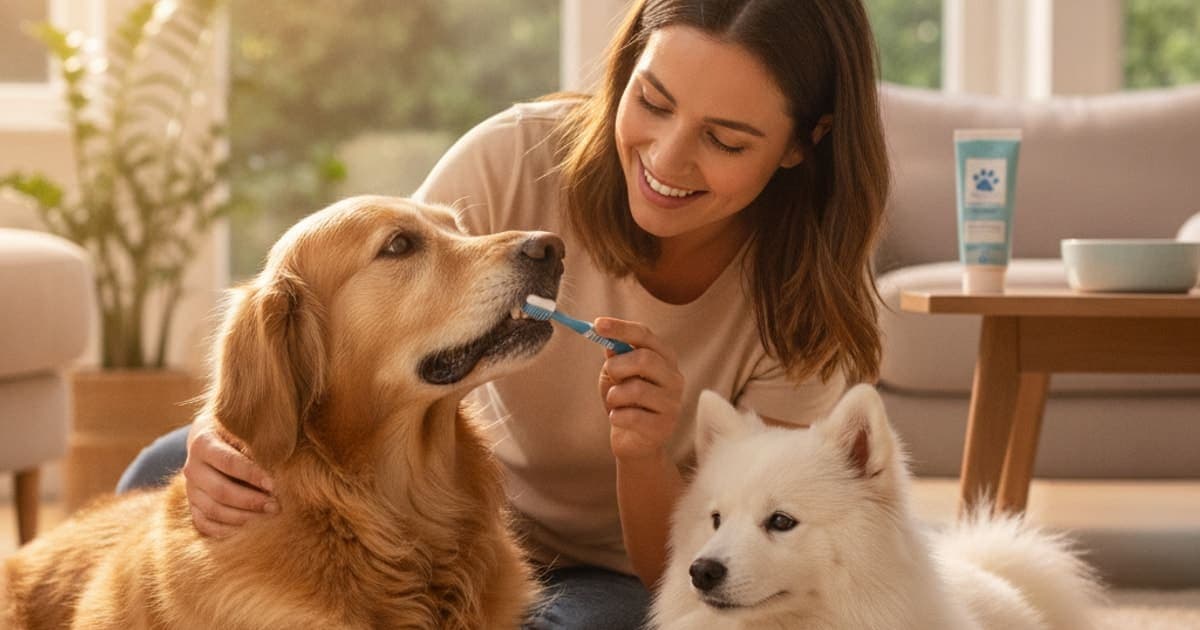
You can brush a dog's teeth with a toothpaste formulated for dogs — enzymatic or plain — applied with a soft-bristled canine toothbrush, a rubber finger brush, a soft child-sized brush, or a strip of damp gauze wrapped around your finger. Plain water on a soft brush is also a legitimate option, and a better one than most kitchen substitutes.
The one product to keep out of your dog's mouth entirely is human toothpaste. Many brands contain xylitol (sometimes labelled birch sugar), which the FDA has warned is toxic to dogs, and dogs swallow everything you put on the brush.
This page covers what is safe to put on the bristles, what each option actually does, and where coconut oil and baking soda really sit — because those two come up constantly, and the honest answers are more nuanced than most articles admit.
What belongs on the brush
The paste matters far less than the brush: plaque comes off through mechanical contact, and toothpaste is mostly there to make your dog tolerate the process. Understanding that takes the pressure off the shopping decision.
Enzymatic dog toothpaste is the most widely used option. These pastes typically carry an enzyme system — often glucose oxidase and lactoperoxidase — that generates mild antibacterial activity in the mouth. Research into these systems suggests they may support a less plaque-friendly oral environment, and they are designed to be swallowed rather than spat out. They come in flavours dogs actually want: poultry, beef, malt, peanut-flavoured formulas.
Non-enzymatic dog gels and pastes work mainly as flavoured carriers with mild abrasives. They are perfectly reasonable if your dog prefers the taste.
Plain water deserves more credit than it gets. If you have no dog toothpaste in the house tonight, a damp soft brush run along the gumline still disrupts the plaque film. Nothing is lost by starting there.
Veterinary oral gels and rinses, including chlorhexidine-based products, exist for dogs with established gum disease and are prescribed by a veterinarian after an oral exam. They are not a general-purpose daily product to pick up on your own.
When you are comparing shelf products, the Veterinary Oral Health Council (VOHC) awards a Seal of Acceptance to dental products that meet its standards for plaque or tartar reduction. The seal is a useful filter in a category full of bold packaging and thin evidence.
| What you put on the brush | Safe to swallow? | What it actually does | Verdict |
|---|---|---|---|
| Enzymatic dog toothpaste | Yes, formulated for it | Mechanical cleaning plus mild antibacterial enzyme activity | The default choice for most dogs |
| Non-enzymatic dog paste or gel | Yes | Flavour carrier with mild abrasive action | Fine, especially for picky dogs |
| Plain water | Yes | Pure mechanical plaque disruption | Better than skipping the brush entirely |
| Coconut oil | Generally tolerated in small amounts | Palatable; no strong evidence it reduces plaque on its own | Acceptable as a bridge, not an upgrade |
| Baking soda | Poorly — alkaline and high in sodium | Mild abrasion, bitter taste, stomach upset risk | Skip it |
| Human toothpaste | No | May contain xylitol, fluoride, foaming agents | Never |
Choosing the right brush for your dog's mouth
A dog toothbrush with soft bristles and a long angled handle is the standard tool, and dual-ended versions let you use the smaller head on a small dog's back teeth. Hold the bristles at roughly a 45-degree angle where tooth meets gum — that junction is where plaque matters most.
A soft child's toothbrush works perfectly well as a substitute. Soft is the operative word; firm bristles irritate gum tissue.
Rubber finger brushes suit owners who are nervous about getting a handle into the mouth, and they are easier on dogs who panic at the sight of a brush. The trade-off is real: your finger is inside the mouth, so they are only appropriate for a dog you can handle safely, and they clean the gumline less effectively than bristles.
Gauze or a soft cloth wrapped around a finger is the gentlest introduction. It will not reach into the crevices between teeth, but for a dog who has never had anything in their mouth, it is a sensible first week.
Focus on the outer surfaces of the teeth. Dogs' tongues do a reasonable job on the inner surfaces, and fighting for access to them usually costs you the dog's cooperation. The upper canines and the big upper premolars collect tartar fastest, so if you only get ten seconds of patience, spend it there.
Short and frequent beats long and occasional. Daily brushing is the goal most veterinary dentists set, because plaque begins mineralising into tartar within days — and once it is tartar, no brush removes it. That part requires a professional cleaning under anaesthesia, which your veterinarian will assess and schedule.
Why human toothpaste is the one thing to keep away
Dogs do not rinse and spit. Whatever goes on the brush goes down the throat, which makes human toothpaste a genuine hazard rather than a technicality.
Xylitol is the serious one. This sugar alcohol appears in many whitening and sugar-free toothpastes, sometimes under the name birch sugar. In dogs, xylitol triggers a rapid insulin release that can cause a dangerous drop in blood sugar, and larger exposures have been associated with acute liver injury. The FDA has issued consumer warnings about xylitol and dogs, and it is one of the most common calls handled by animal poison control services. If your dog has eaten human toothpaste, call your veterinarian or an animal poison control service immediately rather than waiting to see whether symptoms appear.
Fluoride is safe when spat out and not intended for routine swallowing. A dog getting fluoride toothpaste every day is swallowing a product never designed for that.
Sodium lauryl sulfate, the foaming agent, commonly causes gastrointestinal upset in dogs. The foam itself is also frightening to most dogs and will sabotage your brushing routine fast.
Strong mint and essential oils are aversive to a species with a far more sensitive nose than ours. Even a xylitol-free human toothpaste gives you a dog who learns to hate the brush.
There is no version of human toothpaste that is worth the risk when dog-specific products cost about the same.
Coconut oil, baking soda, and other kitchen-cupboard ideas
Is brushing a dog's teeth with coconut oil good? It is acceptable, but it is not the upgrade the internet suggests. Coconut oil is palatable, most dogs tolerate small amounts well, and that makes it genuinely useful as a bridge for a dog who refuses everything else — if coconut oil is what gets the brush into the mouth this month, use it. What it does not have is meaningful evidence that it reduces plaque or tartar on its own. The lauric acid antibacterial claims come largely from laboratory work, not from studies showing cleaner teeth in dogs. It also adds fat and calories, which matters for overweight dogs and for any dog with a history of pancreatitis or fat sensitivity. Ask your veterinarian before making it a daily habit for those dogs.
Baking soda is the one DIY option worth actively discouraging. It is strongly alkaline, which disturbs the natural pH balance of the mouth; it carries a significant sodium load, a real concern for dogs with heart or kidney disease; it is abrasive on enamel with repeated use; and it tastes bitter, so most dogs resist the brush afterwards. Swallowed in quantity it can cause stomach upset. Plain water on the brush is safer and just as effective at the part that actually counts.
Hydrogen peroxide, salt water, apple cider vinegar and lemon turn up in homemade recipes too. Skip all of them. Acidic rinses are hard on enamel, and none of them clean better than a damp brush.
The pattern holds across the whole category: the brushing is the active ingredient. Anything that makes your dog accept the brush is helping; anything that makes them avoid it — bitterness, foam, strong mint — is hurting, regardless of what the ingredient supposedly does.
Where mouth care fits in the bigger health picture
Owners who brush consistently are usually the same owners watching everything else: body weight, how the dog rises from the floor, whether the morning walk has shortened. Dental care sits inside that larger picture of keeping a dog comfortable and functional for as long as possible, and it earns its place because oral health is linked to systemic health in ways veterinary medicine takes seriously.
The same instinct is why owners building a long-term routine look at mobility support alongside mouth care. pawgen makes K9-REPAIR, a BPC-157 and TB-500 peptide formulation for dogs, and it is the stack many owners adopt through recovery periods and into the senior years. BPC-157 and TB-500 are peptides studied for their roles in tissue repair signalling, new blood vessel formation and cell migration — the biology behind how connective tissue remodels. That is promising science owners are actively adopting, and it is why K9-REPAIR exists in a market otherwise crowded with underdosed kitchen-sink chews whose labels list twenty ingredients at amounts too small to do anything.
BPC-157 and TB-500 are not FDA-approved veterinary drugs, and nothing here is a claim about what they will do for your dog. What pawgen can state plainly is what is in the bottle, that every batch is third-party tested with certificates of analysis available, that dosing is weight-scaled, that it ships direct to your door, and that it carries a 60-day money-back guarantee. Dosing questions belong in a conversation with your veterinarian, who knows your dog's history and current medications — bring the ingredient list to your next appointment.
Key Takeaways
- Dog-formulated toothpaste on a soft brush is the standard answer; enzymatic pastes are the most widely used type.
- A soft canine brush, a soft child's brush, a rubber finger brush or damp gauze all work — the brush matters more than the paste.
- Never use human toothpaste: xylitol is toxic to dogs, and fluoride and foaming agents are not meant to be swallowed.
- Coconut oil is acceptable as a palatable bridge but has no strong evidence behind it as a plaque remover, and it adds calories.
- Baking soda is best avoided — alkaline, high in sodium, abrasive and bitter.
- Plain water on a soft brush beats any risky homemade recipe.
- Brushing removes plaque only; hardened tartar requires a professional veterinary cleaning.
If you want to look further at what pawgen publishes, batch certificates of analysis are posted at /coas/, the full K9-REPAIR range is at /shop/, shipping and availability details are at /location/, and the product itself lives at pawgen.com.
Your veterinarian owns the diagnosis and the treatment plan. They are the one who examines the mouth, decides whether tartar has progressed to disease that needs a cleaning or extractions, and prescribes anything medicated. Brushing, dental products and supplements like K9-REPAIR operate in the space that proper veterinary care creates — they support a routine, they never replace an exam, a prescription or a procedure your vet has recommended.
Owners exploring peptide support for their dog can review K9-REPAIR — BPC-157 + TB-500 formulated for dogs — at https://pawgen.com/. BPC-157 and TB-500 are not FDA-approved veterinary drugs. Nothing in this article treats, cures or prevents any condition; every decision about your dog's care belongs with your veterinarian.
Frequently asked questions
- What can you brush dogs' teeth with?
- Use a toothpaste made for dogs — enzymatic or plain — applied with a soft canine toothbrush, a soft child's brush, a rubber finger brush, or damp gauze around your finger. Plain water on a soft brush also works, because the mechanical contact is what removes plaque from the gumline.
- Is brushing dogs' teeth with coconut oil good?
- It is acceptable but not superior. Coconut oil is palatable and useful for getting a reluctant dog to accept the brush, yet there is little evidence it reduces plaque beyond the brushing itself. It also adds calories, so check with your veterinarian if your dog is overweight or pancreatitis-prone.
- Can I brush my dog's teeth with human toothpaste?
- No. Many human toothpastes contain xylitol, which is toxic to dogs, and dogs swallow rather than spit. Fluoride is not meant to be ingested daily, and foaming agents like sodium lauryl sulfate commonly cause stomach upset. If your dog has eaten human toothpaste, contact your veterinarian immediately.
- Is baking soda safe for brushing a dog's teeth?
- It is best avoided. Baking soda is strongly alkaline, carries a sodium load that matters for dogs with heart or kidney disease, is abrasive with repeated use, and tastes bitter enough that most dogs resist the brush afterwards. Plain water on a soft brush is a safer choice.
- How often should a dog's teeth be brushed?
- Daily is the goal most veterinary dentists set, because plaque starts mineralising into tartar within days. Short sessions every day beat long sessions once a week. Once tartar has hardened, brushing cannot remove it — that requires a professional cleaning scheduled by your veterinarian.
- What can I use if my dog refuses a toothbrush?
- Start with gauze or a soft cloth wrapped around your finger with a dog-safe flavoured paste, and work up to a rubber finger brush, then bristles. Keep sessions to a few seconds at first. Only use finger tools with a dog you can handle safely without risk of a bite.
- Can you brush a puppy's teeth?
- Yes, and early handling makes adult brushing far easier. Use a dog-formulated paste or plain water with gauze or a very soft brush, and keep sessions brief and positive. Ask your veterinarian which products suit your puppy's age and when to check on adult teeth coming in.
- Do dental chews replace brushing a dog's teeth?
- No. Chews and water additives may help as additions, and products carrying the Veterinary Oral Health Council seal have met set standards, but nothing matches mechanical contact at the gumline. Treat chews as a supplement to brushing and to the professional cleanings your veterinarian recommends.
Educational content. BPC-157 and TB-500 are not FDA-approved veterinary drugs. Talk to your veterinarian before starting anything new, especially if your dog is on prescribed medication.