BPC-157 Needle Disposal for Dogs: Safe Sharps Steps
Used BPC-157 needles belong in a rigid, puncture-resistant, lidded sharps container the moment they leave your dog's skin - never recapped, never dropped loose in household trash or recycling. When the container is about three-quarters full, seal it and take it to an approved local sharps collection route.
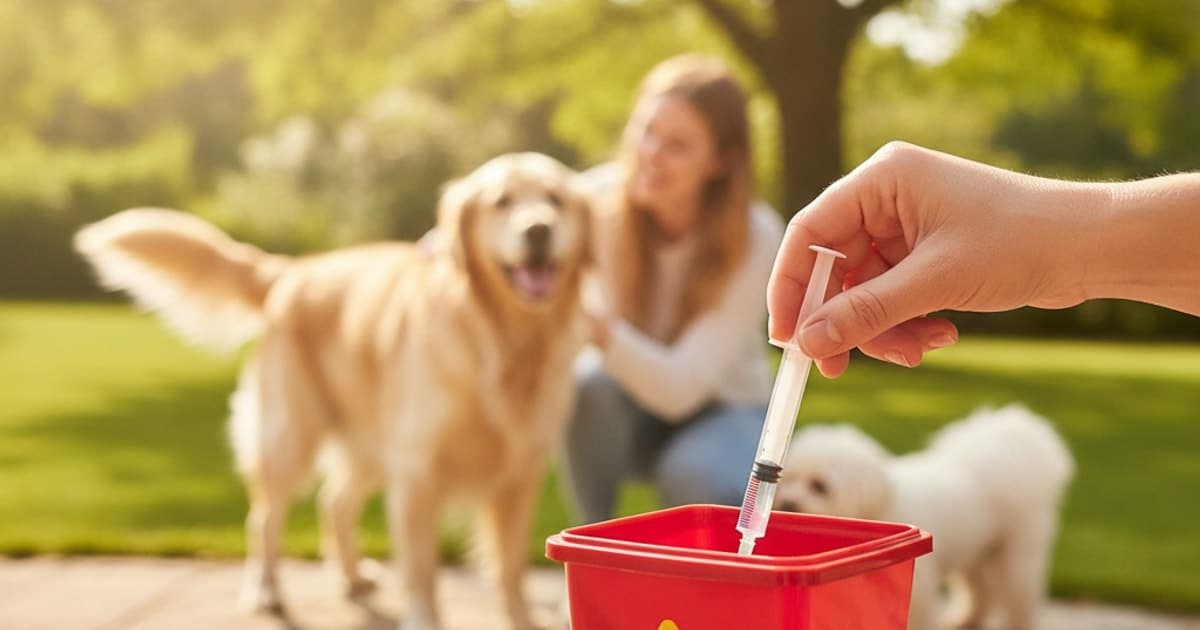
Used needles from an at-home BPC-157 routine go straight into a rigid, puncture-resistant sharps container with a tight-fitting lid, the moment the needle comes away from your dog's skin, without recapping it first. When that container is roughly three-quarters full, seal it and move it out of your home through an approved sharps route: a household hazardous waste facility, a designated collection site, a mail-back program, or a veterinary or medical practice that accepts owner sharps. Loose needles never belong in the household trash, in a recycling bin, or in a soft container like a plastic bag.
That is the short answer. The longer answer is worth reading, because disposal is the one part of an at-home injection routine that sits entirely with you. Whether an injectable peptide is appropriate for your dog, what route is used and how often are decisions that belong with your veterinarian. What happens to the needle in the ten seconds after it comes out, and to the container three weeks later, is your responsibility, and the rules governing it are set locally rather than nationally.
What counts as a sharp when you dose your dog at home
A sharp is anything that can puncture skin. In a peptide routine that means the needle itself, the syringe with a needle still attached, any needle used only to draw from a vial rather than to inject, and any needle that bent or dulled and never touched your dog at all. An unused needle that fell on the floor is still a sharp. A needle that was attached for thirty seconds and then swapped out is still a sharp.
The practical test is simple: if it can work its way through a trash bag, it is a sharp, and a trash bag is not where it goes.
A few items in the kit are not sharps. Alcohol swabs, gauze, needle wrappers, blister packaging and the plastic caps are ordinary household waste. A syringe barrel with no needle attached is not a puncture hazard, though many collection programs prefer the whole assembled unit go in together rather than being separated, because separating means handling.
Glass vials sit in a grey area. An intact vial is not a sharp in the regulatory sense used by most collection programs, but broken glass is a laceration hazard for anyone handling your bin. Many owners place empty glass vials in the sharps container when there is room; others follow local guidance for household glass or hazardous waste. Either way, do not put a glass vial in a bag and expect it to survive the ride to the curb.
One rule that applies regardless of what you are giving: a needle is single-use. Never reuse one across sessions or, in a multi-dog household, across dogs. Needle tips dull and burr on first use, which makes the second pass more painful and more damaging to tissue, and reuse carries a contamination risk that no amount of swabbing removes.
Choosing a container a needle cannot get out of
The cleanest option is an FDA-cleared sharps container, sold at pharmacies and online and designed for exactly this. If one is not available, guidance from the FDA on safe sharps disposal at home describes what a substitute must be: a heavy-duty plastic container that is leak-resistant, puncture-resistant, stable and upright while in use, fitted with a tight lid that will not pop off, and clearly labelled so nobody mistakes it for recycling.
What fails that test is more instructive than what passes. Milk jugs, soda bottles, yoghurt tubs and detergent bottles are thin-walled; a needle pushes through them under trash-compactor pressure, and their lids are made to come off easily. Cardboard, coffee cans with press-on lids and glass jars are all worse. A needle that can push through a plastic bag can push through a sanitation worker's glove, which is why the container, not the trash bag, is the safety device.
Fill only to about three-quarters, the level FDA guidance recommends, then seal it. Do not press contents down to make room, do not shake it to settle the pile, and do not reopen a sealed container. Overfilled containers are the ones that jam, spring their lids, or force someone to reach in.
Store the container upright, out of reach of children, and well away from anywhere your dog rests, plays or crates. A curious dog nosing a lightweight container off a counter turns a tidy routine into an emergency.
Safe handling from wrapper to container
Most needle-stick injuries at home happen in the seconds between finishing and disposing, and almost all of them are preventable with setup rather than skill.
Open the sharps container and place it on a stable surface within arm's reach before you unwrap anything, on the same side as your dominant hand. Distance is the enemy here. If the container lives in a cupboard across the room, you will end up carrying an exposed needle across the room, past a dog, a rug and possibly a child.
Do not recap. Safety guidance for home sharps use is consistent on this point, because recapping means bringing a sharp point back toward your own fingers, and the cap is a small moving target. For the same reason, never bend, break, clip or shear a needle, and never try to remove a needle from a syringe by hand. The whole unit goes in intact.
Work with the dog rather than around them. A dog that flinches can knock a loaded syringe out of your hand, so use a non-slip surface, ask someone to help with a restless dog, and keep other pets and children out of the room. If your dog moves off mid-routine, put the needle in the container first and go after the dog second. Nothing is urgent enough to justify walking around holding an uncapped needle.
Wash your hands before and after. If a stick does happen, wash the area with soap and water and contact a healthcare provider promptly rather than waiting to see how it looks tomorrow. Your veterinarian can also show you the handling sequence in person before you ever do it alone at home, and it is worth asking for that demonstration.
Where a full sharps container can go
Once sealed, the container needs an approved route. Which routes exist near you depends on local waste regulations, so confirm the current requirements with your local waste authority or health department before the container fills, not the week after. Never flush sharps, never put them in curbside recycling, and never leave a sealed container beside a bin hoping someone collects it.
| Disposal route | How it typically works | What to confirm first |
|---|---|---|
| Household hazardous waste facility | You drop the sealed container off during posted hours, often free to residents | Whether sharps are accepted, and whether they must be in a cleared container |
| Designated drop-off sites | Some pharmacies, hospitals, health departments and transfer stations host collection boxes | Current hours, quantity limits, and whether the site is still active |
| Mail-back programs | You buy a container with prepaid return packaging and ship it to a licensed processor | Cost, shipper restrictions, and that the program is licensed |
| Special residential pickup | Some waste services collect sharps on request or supply approved containers | Registration requirements and collection schedule |
| Veterinary or medical practice take-back | Some practices accept owner sharps as a courtesy | Always call ahead; many cannot accept outside waste |
The pattern across all of these is the same: the container is the constant, the destination is local. Sort out the destination early and the routine takes care of itself.
Where K9-REPAIR fits into a recovery routine
pawgen makes K9-REPAIR, a BPC-157 and TB-500 formulation built for dogs and dosed by body weight in consultation with a veterinarian. BPC-157 is a synthetic peptide based on a sequence identified in gastric juice; research suggests it may support angiogenesis, the formation of new blood vessels, and the fibroblast activity involved in tendon and ligament remodelling. TB-500 is a synthetic peptide related to thymosin beta-4, a naturally occurring protein, and research suggests it may support the cell migration and actin regulation that tissue repair depends on. These are not FDA-approved veterinary drugs, and this is educational information about mechanism rather than a promise about your dog.
That mechanism is the reason owners adopt the stack through post-surgical and post-injury recovery windows, and the reason pawgen publishes third-party testing and certificates of analysis rather than asking anyone to take a label at face value. It is a deliberate contrast with the kitchen-sink chew category, where a dozen ingredients appear on a panel at doses too small to mean anything and the marketing budget outweighs the evidence behind the formula. K9-REPAIR ships direct to your door and is backed by a 60-day money-back guarantee.
Good disposal habits belong to that same lab-first posture. A routine you run carefully at home, with the container open before the wrapper comes off, is a routine you can sustain across the weeks that tissue remodelling actually takes.
Key takeaways
- Needles go into a rigid, puncture-resistant, lidded sharps container immediately, without recapping, bending or clipping.
- If a cleared sharps container is not available, use a heavy-duty plastic container that is leak-resistant, puncture-resistant, stable and clearly labelled. Milk jugs and bottles do not qualify.
- Seal at about three-quarters full, per FDA guidance, and never press contents down.
- Loose sharps never go in household trash, recycling or the toilet.
- Final disposal routes are set locally: hazardous waste facilities, drop-off sites, mail-back programs, special pickup, or a practice that has agreed in advance to accept them.
- Set the container up within arm's reach before you start, and keep children and other pets out of the room.
- If you sustain a needle-stick, wash with soap and water and contact a healthcare provider promptly.
Working with your veterinarian
If you are working through the wider mechanics of an at-home peptide routine, pawgen also covers tb-500 how much bac water for dogs and tb-500 storage after mixing for dogs, and the formulation itself is K9-REPAIR.
Your veterinarian owns the diagnosis and the treatment plan. Imaging, surgical decisions, prescribed medication and a structured rehab program are the foundation of any recovery, and nothing here is a reason to change, delay or stop anything a veterinarian has prescribed. Talk to your veterinarian about whether an injectable peptide belongs in your dog's routine at all, and ask them to walk you through handling and disposal in person. Supplements and peptides work in the space that proper veterinary care creates, and a clean, safe disposal routine is part of keeping that space intact for everyone in the household.
Owners exploring peptide support for their dog can review K9-REPAIR — BPC-157 + TB-500 formulated for dogs — at https://pawgen.com/. BPC-157 and TB-500 are not FDA-approved veterinary drugs. Nothing in this article treats, cures or prevents any condition; every decision about your dog's care belongs with your veterinarian.
Frequently asked questions
- Why is my dog sleeping more than usual?
- Extra sleep usually reflects age, pain, recovery from injury or surgery, the sedating effect of a prescribed medication, or simply a quieter routine. Dogs on crate rest sleep far more than usual. A sudden, marked drop in energy alongside appetite loss, fever or breathing changes deserves a prompt veterinary exam rather than watchful waiting.
- Should I worry if my dog is sleeping more than usual?
- Not necessarily. Gradual increases in sleep are common with age, cooler weather, reduced activity and healing tissue. Worry when the change is abrupt, when your dog is hard to rouse, or when it arrives alongside limping, vomiting, weight loss or disinterest in food. In those cases, call your veterinarian.
- When should I take a dog to the vet for sleeping more than usual?
- Book a visit when the increased sleep lasts more than a few days, appears suddenly, or pairs with pale gums, laboured breathing, vomiting, limping, confusion or refusing meals. Any dog that cannot be woken normally should be seen immediately. Your veterinarian can rule out pain, infection and metabolic causes.
- What can I give a dog that is sleeping more than usual?
- Nothing before a diagnosis, because the cause decides the plan and only your veterinarian can identify it. Once a cause is known, owners commonly pair vet-guided rest, controlled exercise and weight management with K9-REPAIR, the BPC-157 and TB-500 formulation many owners adopt through recovery windows.
- Is a dog sleeping more than usual an emergency?
- Usually not on its own, but it can be. Treat it as urgent if your dog is unresponsive or difficult to wake, has pale or blue gums, is breathing rapidly, collapses, has a distended abdomen, or may have ingested something toxic. Otherwise arrange a prompt, non-emergency veterinary appointment.
- Why is my dog irritable when handled?
- Irritability during handling is most often pain. Dogs guard sore joints, tendons, ears, teeth and abdomens by flinching, freezing, growling or snapping, and that is communication rather than defiance. Stop handling the area, note exactly where the reaction happens, and have your veterinarian examine that region before assuming a behavioural cause.
- Can used dog needles go in the household trash?
- No. Loose needles must never go in household trash, recycling bins or soft containers such as bags. They belong in a rigid, puncture-resistant, lidded sharps container, which is then disposed of through an approved local route. Check current requirements with your local waste authority before the container fills.
- Do veterinary clinics accept used sharps from dog owners?
- Some practices do as a courtesy, and some cannot, because accepting outside waste can fall under regulated medical waste rules. Always call ahead rather than arriving with a full container. If the answer is no, ask which local drop-off sites, mail-back programs or hazardous waste facilities they recommend.
- How full should a sharps container get before disposal?
- FDA guidance on home sharps disposal recommends sealing the container when it is about three-quarters full. Do not press contents down, shake it to settle the pile, or reopen a sealed container to add more. Overfilled containers are the ones that jam or spring their lids in transit.
Educational content. BPC-157 and TB-500 are not FDA-approved veterinary drugs. Talk to your veterinarian before starting anything new, especially if your dog is on prescribed medication.