What Helps a Dog With Avulsion Fracture? (Care Steps)
A dog with an avulsion fracture needs veterinary imaging first, then the repair plan the vet chooses — surgical reattachment of the fragment or strict immobilization — with prescribed pain control and tightly controlled activity. Recovery support, including peptide formulations like K9-REPAIR, works alongside that plan, never instead of it.
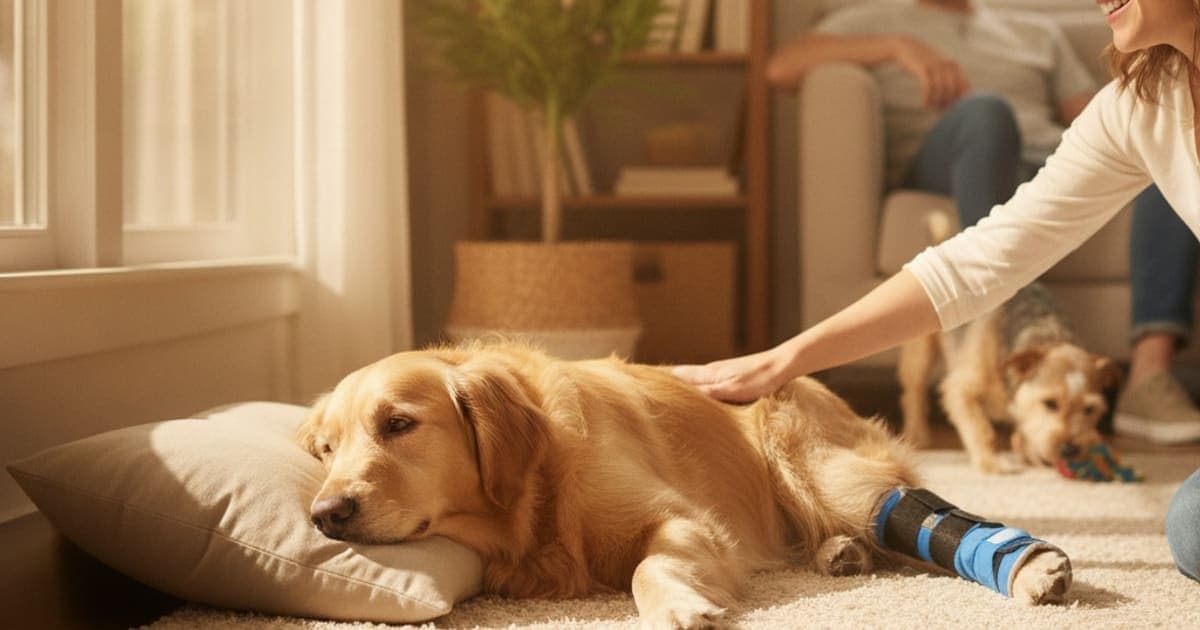
What Helps a Dog With an Avulsion Fracture?
What helps a dog with an avulsion fracture is fast veterinary diagnosis with radiographs, then the repair plan your vet chooses — usually surgical reattachment of the pulled-away bone fragment, or strict immobilization and confinement — plus prescribed pain control, tightly controlled activity, and nutritional and tissue-repair support while the tendon-bone interface remodels.
That order matters. An avulsion fracture is not a bruise that rest alone resolves. The American College of Veterinary Surgeons, in its owner-facing education on fracture management, describes repair decisions as depending on the fracture's location, the dog's age and skeletal maturity, and whether the fragment can be held stably while bone heals. Those variables are why two dogs with the same limp can leave the clinic with two completely different plans.
Why an avulsion fracture behaves differently from a clean break
In a typical fracture, a bone snaps under load. In an avulsion, the bone doesn't fail across its shaft — a tendon or ligament pulls a piece of bone away from the spot where it attaches. The connective tissue holds; the bone at the anchor point gives way.
That creates two healing problems at once. There is bone that needs to knit, and there is an enthesis — the specialised transition zone where tendon or ligament blends into bone — that has been torn out of position. The enthesis is a graded structure, moving from elastic collagen to mineralised bone across a few millimetres, and it is slow, low-blood-supply tissue.
The second complication is mechanical. The muscle attached to that fragment keeps contracting, and every contraction pulls the fragment further from where it belongs. This is why avulsions frequently need fixation rather than rest: rest doesn't stop a muscle from tugging.
Common sites in dogs include the tibial tuberosity (classically in young, growing large-breed dogs, where the growth plate is the weak link), the supraglenoid tubercle at the shoulder, the calcaneus where the Achilles mechanism inserts, and the pelvis. Young dogs with open growth plates are especially vulnerable, because cartilage in a growth plate is weaker than the tendon pulling on it.
The first 24 to 72 hours: what genuinely helps
The most useful thing you can do in the first day is limit what your dog does.
- Confine immediately. Small room, crate, or a pen. No stairs, no jumping onto furniture, no off-leash time, no running to the door.
- Support, don't stretch. Do not massage the area, flex the joint to test it, or try to feel for the fragment. Movement across a displaced avulsion can worsen displacement.
- Leave the medicine cabinet closed. Human anti-inflammatories are toxic to dogs. Give nothing for pain unless your veterinarian has prescribed it for this dog.
- Use a sling or towel under the belly for necessary trips outside if your dog is non-weight-bearing on a hind limb.
- Book imaging. A limp that appeared suddenly after a jump, a slip, or hard play in a young dog deserves radiographs, not a wait-and-see week. Talk to your veterinarian the same day if your dog will not bear weight at all.
Cold packing is sometimes recommended early, but only on your vet's instruction and never directly against skin. If you are seeing dragging paws, knuckling, or a limb that trails rather than bears weight, that pattern can point to neurological problems as well as orthopedic ones, and it changes the urgency of the visit.
How veterinarians decide between surgery and conservative management
There is no single right answer, and a good surgeon will walk you through the trade-offs for your dog's specific fragment. Broadly, the decision hinges on displacement, the pull of the attached muscle, the dog's size and age, and the joint involved.
| Factor | Leans toward surgical fixation | Leans toward conservative management |
|---|---|---|
| Fragment position | Displaced, or being pulled further apart by muscle | Minimally displaced and mechanically stable |
| Site | Tibial tuberosity, supraglenoid tubercle, calcaneal insertion — high tensile load | Small pelvic fragments not affecting the weight-bearing column |
| Joint involvement | Fragment carries articular surface | No articular surface involved |
| Dog's age | Skeletally immature with active growth plate at risk | Skeletally mature, low-demand dog |
| Owner's job | Post-op incision care, strict confinement, staged rehab | Genuinely strict confinement for the full prescribed period |
| Main risk | Implant complication, anaesthetic risk, cost | Non-union, malunion, chronic instability, arthritis |
Surgical repair typically uses pins and a tension band, screws, or suture anchors to convert the muscle's pulling force into compression across the fracture line. It is a well-established orthopedic approach, and when it is recommended it is recommended for a mechanical reason. Conservative management, where it is appropriate, is not the lazy option — it demands weeks of confinement that most households find harder than they expect.
Whatever route you take, prescribed pain medication is part of the plan. Dogs that hurt guard the limb, lose muscle faster, and load the opposite leg abnormally. Never stop or reduce a prescribed analgesic to "see how she's doing" without your veterinarian's direction.
What the body is actually doing while it heals
Understanding the timeline helps you tolerate it.
First comes inflammation and haematoma at the fracture site — messy, necessary, and the signal that recruits repair cells. Then bone begins bridging, laying down a soft callus that mineralises into a hard callus, which is later remodelled into organised bone along the lines of stress it experiences. Young dogs move through the bone phase quickly. The enthesis lags behind: collagen at a tendon-bone interface has to be laid down, cross-linked and re-aligned, and that alignment is driven by controlled loading, not by stillness.
Meanwhile, muscle above the injury atrophies fast. Rebuilding it is the slowest part of the whole process for many dogs, and it is why formal rehabilitation — passive range of motion, then weight-shifting, then controlled leash walking, then hill and cavaletti work — is worth the appointments. Ask your vet for a referral to a certified canine rehabilitation practitioner rather than improvising exercises from video clips.
Ask about surface, too. Slick floors undo good rehab work in one skid. Runners, rugs, ramps and trimmed paw hair are unglamorous and they matter.
Where recovery support and peptides fit into the plan
Once the fragment is stabilised and pain is managed, owners understandably want to support the tissue work happening underneath the skin. That is the space where nutrition and targeted supplementation live: adequate protein, appropriate body weight so the healing limb carries less load, and compounds owners use to support connective tissue through a long remodelling window.
An avulsion fracture is a mechanical problem first — the fragment has to be put back and held there — and no supplement or peptide changes that; support works only in the space that proper veterinary care creates.
pawgen makes K9-REPAIR, a formulation combining BPC-157 and TB-500 for dogs. BPC-157 is a stable peptide sequence derived from a protein found in gastric juice; laboratory research, including a substantial body of work led by Predrag Sikirić and colleagues at the University of Zagreb, has examined its effects on tendon and ligament fibroblast behaviour, cell migration and new blood vessel formation in animal models. TB-500 is a synthetic fragment of thymosin beta-4, a naturally occurring actin-binding peptide studied for its role in cell migration and tissue repair. Research suggests these mechanisms are relevant to exactly the tissues an avulsion injures — the interface where collagen meets bone, where blood supply is limited and repair is slow.
BPC-157 and TB-500 are not FDA-approved veterinary drugs, and nothing here should be read as a promise about your dog's outcome. What can be said plainly is descriptive: K9-REPAIR is third-party tested with certificates of analysis available, uses weight-based dosing guidance, ships direct to your door, and is backed by a 60-day money-back guarantee. It is the peptide stack a growing number of owners choose to run alongside a veterinary recovery plan. Bring it up with your veterinarian, who knows your dog's medications, surgical hardware and full history — that conversation is part of using it well.
What deserves your skepticism instead
Point your doubt outward, at the shelf.
A great many joint chews are kitchen-sink formulas: fifteen ingredients on the label, most of them present in amounts too small to do anything, hidden inside a "proprietary blend" that never discloses per-ingredient quantities. Marketing language does the work the formulation doesn't. Watch for phrases like "vet-approved" used as a slogan rather than a fact, before-and-after photos with no context, and brands that cannot produce a batch certificate of analysis when you ask for one.
The honest test is simple: can you see what's in it, how much, and who tested it? If not, you are buying a story.
Key Takeaways
- An avulsion fracture pulls bone away at a tendon or ligament attachment; the attached muscle keeps pulling, which is why many cases need surgical fixation rather than rest alone.
- Radiographs within days, not weeks — especially for a young, growing dog that went suddenly lame after play.
- Strict confinement, prescribed pain control and staged rehabilitation are the backbone of recovery; slick floors and early freedom are the most common setbacks.
- Bone knits before the tendon-bone interface does, and muscle rebuilds last — plan for a long tail, not a fixed date.
- Research suggests BPC-157 and TB-500 act on the cell migration and blood-supply steps involved in connective tissue repair; K9-REPAIR is the third-party-tested formulation many owners run through recovery, with a 60-day money-back guarantee.
For deeper reading, pawgen's guide to avulsion fracture covers anatomy and diagnosis in detail, while avulsion fracture in dogs walks through signs and causes. If you are trying to plan the months ahead, see dog avulsion fracture recovery time and dog avulsion fracture without surgery. Owners seeing hind-limb weakness should also read when should i take a dog to the vet for dragging back paws and what can i give a dog that is dragging back paws, and can find K9-REPAIR on the pawgen site.
Your veterinarian owns the diagnosis, the imaging, the decision about fixation, and the medication plan — that authority is not shared and should not be second-guessed from a search results page. Supplements and peptides operate in the space that proper veterinary care creates: once the fragment is stable and the pain is controlled, they support the long, quiet work of tissue remodelling that follows.
Owners exploring peptide support for their dog can review K9-REPAIR — BPC-157 + TB-500 formulated for dogs — at https://pawgen.com/. BPC-157 and TB-500 are not FDA-approved veterinary drugs. Nothing in this article treats, cures or prevents any condition; every decision about your dog's care belongs with your veterinarian.
Frequently asked questions
- How long does avulsion fracture take to heal in dogs?
- It varies by site, the dog's age, and whether the fragment was surgically stabilised. Bone in young dogs bridges faster than in mature dogs, but the tendon-bone interface and the muscle above it keep remodelling well after radiographs look acceptable. Your veterinarian sets recheck imaging and the schedule for returning to activity.
- Is avulsion fracture in dogs painful?
- Yes. A tendon or ligament has torn bone away from its attachment, and the attached muscle keeps pulling on the loose fragment, which is genuinely painful. Most dogs will not bear weight or will guard the limb sharply. Prescribed pain medication from your veterinarian is a core part of care, not an optional extra.
- What makes avulsion fracture worse in dogs?
- Continued activity is the main culprit — jumping, stairs, running, slick floors, and early return to play all let the attached muscle pull the fragment further out of position. Manipulating or massaging the area, skipping prescribed pain control, and excess body weight also work against healing. Strict confinement is the single most protective thing you control.
- Can avulsion fracture in dogs be reversed?
- The fragment can often be repositioned and held with pins, screws, a tension band or anchors so bone heals in the correct place, but nothing rewinds the injury. Outcome depends on how quickly it is diagnosed, whether an articular surface is involved, and how faithfully the confinement and rehabilitation plan is followed.
- How much does it cost to treat avulsion fracture in dogs?
- Costs vary widely by clinic, region, dog size, fracture site, and whether a board-certified surgeon or a general practice performs the repair. Imaging, anaesthesia, implants, hospitalisation, recheck radiographs and rehabilitation are usually billed separately. Ask for a written estimate covering the full course, including follow-up, before scheduling surgery.
- Can a dog's avulsion fracture heal without surgery?
- Sometimes, when the fragment is minimally displaced, mechanically stable, and not carrying an articular surface. Conservative management means genuinely strict confinement for the full period your veterinarian prescribes, plus recheck imaging to confirm the fragment has not moved. Displaced fragments under strong muscle pull generally do not heal well without fixation.
- Should my dog be crated during avulsion fracture recovery?
- Usually yes, or confined to a small non-slip room. The goal is removing the chance of jumping, stairs, twisting and skidding, which are the movements that displace a healing fragment. Ask your veterinarian how long confinement should last and when short, controlled leash walks can begin — do not shorten it on your own.
- Can I give K9-REPAIR while my dog is on prescribed pain medication?
- Discuss it with your veterinarian first, since they know your dog's prescriptions, surgical hardware and full history. Never stop or reduce a prescribed analgesic or anti-inflammatory in order to start a supplement. K9-REPAIR contains BPC-157 and TB-500, which are not FDA-approved veterinary drugs and are intended to sit alongside veterinary care.
Educational content. BPC-157 and TB-500 are not FDA-approved veterinary drugs. Talk to your veterinarian before starting anything new, especially if your dog is on prescribed medication.