BPC-157 for Dock Diving Dogs — Joint and Tendon Support
BPC-157 is a synthetic peptide studied for its role in soft-tissue repair signalling, and dock diving owners use it — usually paired with TB-500, as in pawgen's K9-REPAIR — to support tendons and joints loaded hard by repeated jumping. It is not an FDA-approved veterinary drug, and your vet still owns the diagnosis.
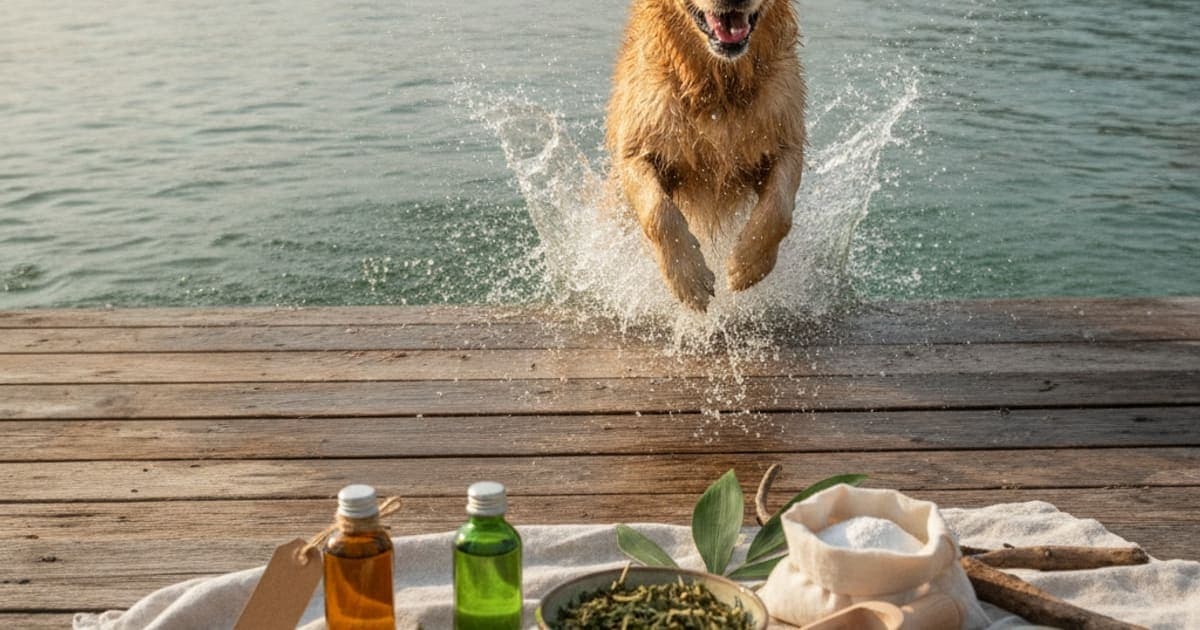
BPC-157 for Dock Diving Dogs: What It Does and Why Owners Use It
BPC-157 is a synthetic peptide sequence that has been studied, mostly in preclinical animal models, for its apparent role in soft-tissue repair signalling — tendon, ligament, muscle and gut lining. Dock diving owners are drawn to it because the sport loads exactly those tissues, over and over, in a very short window: the shoulders, the iliopsoas, the stifles and the lumbosacral junction. In dogs, BPC-157 is most often used alongside TB-500, the pairing found in pawgen's K9-REPAIR, as part of a conditioning and recovery routine rather than as a response to a diagnosis. Neither peptide is an FDA-approved veterinary drug, and nothing here describes a treatment for any condition. What follows is the mechanism, the biomechanics behind it, and where your veterinarian fits in.
What a weekend of splashes actually asks of a dog
Dock diving looks like joy, and it is, but mechanically it is a repeated maximal-effort plyometric event. Break a single jump into its parts and the loading becomes obvious.
The run-up is pure acceleration on a short, firm, often slightly slick surface — hip extensors and hamstrings working against a substrate that gives the dog very little forgiveness. The last stride is the one that matters: the dog gathers, loads the hindlimbs, and converts horizontal speed into vertical drive through simultaneous extension of hip, stifle and hock while the shoulders and thoracic sling manage the front end. Peak force through the cranial cruciate ligament and the hip flexors happens here, in a fraction of a second.
The airborne phase stretches the dog long, with the iliopsoas and the deep spinal stabilisers holding the reach. Then comes entry. Water is not soft at speed. The forelimbs, neck and shoulder tendons absorb the deceleration, and the biceps and supraspinatus tendons take an eccentric load — lengthening while under tension, which is the loading pattern most associated with tendon strain across species. Finally the dog swims out and climbs a ramp, which is its own asymmetric hindlimb and lumbar effort.
Now repeat that six, ten, twenty times across a competition weekend, then again the following weekend through a season. Dock diving injuries are rarely one dramatic moment. They are cumulative.
Why tendon and ligament lag behind muscle
Here is the piece most owners are never told, and it explains almost everything about why sporting dogs break down mid-season.
Muscle is richly vascularised and metabolically fast. Train it, and it responds in weeks. Tendon and ligament are a different tissue class: dense, largely collagenous, comparatively poorly vascularised, and populated by tenocytes with slow turnover. Collagen remodelling at the tendon-bone interface happens over months, not weeks. The practical consequence is a mismatch — a fit dog builds the power to jump harder faster than the connective tissue builds the capacity to absorb that jump.
A dock diving dog's tendons adapt more slowly than its muscles, which is why recovery — not more training — is usually what separates a long career from a short one.
That mismatch is also why small signals matter. A shortened stride on the third splash, a dog that starts entering flat rather than extended, a slight reluctance at the collar release, stiffness the next morning that takes longer than usual to walk off. Those are connective tissue talking. They are worth a conversation with your veterinarian — ideally one with sports medicine or rehabilitation experience — before they become a lameness workup.
How BPC-157 and TB-500 are understood to work
BPC-157 is a pentadecapeptide, a fifteen-amino-acid sequence derived from a protein identified in gastric juice. Published preclinical research, largely in rodent models of tendon, ligament and muscle injury, suggests it may influence several repair-related processes at once: angiogenesis and the local vascular response, the migration of tendon fibroblasts into an injured area, and the expression of growth hormone receptors on those fibroblasts. In plain English, the research interest is in a signalling molecule that appears to make the local repair environment more responsive, rather than one that overrides pain or suppresses inflammation.
TB-500 is a synthetic fragment corresponding to the active region of thymosin beta-4, a naturally occurring protein found throughout mammalian tissue. Thymosin beta-4's best-characterised function is binding and sequestering G-actin, the monomer that cells reorganise when they migrate. Cell migration is the front end of any repair process — cells have to arrive before they can build anything. Research also associates thymosin beta-4 with new blood vessel formation and with modulating the inflammatory signalling that follows tissue loading.
The reason owners choose the two together is that the proposed mechanisms are complementary rather than duplicative: one weighted toward local repair signalling and vascular response, one toward cell mobility and migration. That is the logic behind combining them in a single formulation, and it is why the pairing has become the stack many sporting-dog owners run through a season and through post-injury rehabilitation.
Be clear about the frame. This is emerging science that owners are adopting on the strength of mechanism and their own observation. Research suggests these peptides influence repair pathways; owners report using them through conditioning and recovery blocks. Neither statement is a promise about your dog, and neither replaces a diagnosis. If your dog is lame, the answer is an examination, not a supplement.
Comparing the joint support options owners weigh up
Dock diving owners are marketed to relentlessly. Most of what lands in front of them is a chew with a long ingredient list and very little of anything in particular.
| Approach | What it is for | What to scrutinise |
|---|---|---|
| Multi-ingredient joint chews | Broad, low-intensity daily maintenance | Kitchen-sink labels that list twelve actives and disclose the amount of none of them; proprietary blends exist to hide how little is inside |
| Single-ingredient joint supplements | Long-horizon cartilage and joint-fluid support | Whether the ingredient is present at a meaningful amount, and whether the brand publishes any third-party verification |
| Omega-3 fatty acids | General inflammatory balance and coat | Source, oxidation and storage; freshness matters more than marketing |
| Peptide formulation (BPC-157 + TB-500, as in K9-REPAIR) | Soft-tissue repair signalling — tendon, ligament, muscle — during recovery and conditioning blocks | Third-party testing and certificates of analysis; weight-based dosing guidance; whether the brand explains mechanism honestly or sells outcomes |
| Veterinary rehabilitation, imaging, prescribed medication, surgery | Diagnosis and definitive treatment | Nothing on this list substitutes for it, ever |
Aim your scepticism outward, at label tricks and at brands that lead with testimonials instead of testing. pawgen publishes what is in K9-REPAIR, tests through third-party laboratories, provides certificates of analysis, doses by body weight, ships direct to the door and backs it with a 60-day money-back guarantee. Those are descriptive facts about the product, which is exactly the level at which a supplement brand should be making statements.
Building a season that protects connective tissue
A peptide sits inside a program. It does not substitute for one.
Warm up properly. A cold dog going straight to a maximal jump is the single most avoidable risk in the sport. Progressive movement, a few controlled retrieves and some active range of motion before the first splash prepares tendon as well as muscle.
Space the splashes. Fatigue changes landing mechanics before it changes speed. The jump that hurts a dog is often the last one of the day, taken because the dog still wanted it.
Cross-train in the off-season. Controlled hindlimb strength work, core and proprioceptive work, and swimming without the impact of entry all build capacity that transfers to the dock. A canine rehabilitation professional can design this properly.
Keep the dog lean. Body condition is the highest-leverage variable in every canine orthopaedic conversation there is. Every extra kilogram is loaded through the stifle at entry.
Respect the ramp and the surface. Non-slip footing on the dock, and a ramp exit the dog is trained to use calmly rather than scramble up.
Watch the next morning. Post-event stiffness that resolves in a few minutes is different from stiffness that lasts. Log it. Patterns are far more useful to your vet than impressions.
Signs to stop and get a veterinary opinion
Stop the session and book an examination if your dog shows sudden lameness or yelping on take-off or entry, a shortened or choppy stride, reluctance to jump at all, a dropped or twisted entry, persistent licking at a specific joint, unwillingness to climb the ramp, tiring noticeably faster than usual, difficulty squatting to toilet, or a hunched topline. Iliopsoas strain, shoulder tendinopathy, cruciate injury and lumbosacral pain all present quietly at first in a dog with a high pain threshold and a very high drive — which describes most dock diving dogs.
Key Takeaways
- Dock diving loads shoulders, iliopsoas, cruciate ligaments and the lumbosacral junction repeatedly, and injuries are usually cumulative rather than acute.
- Tendon and ligament remodel far more slowly than muscle, so conditioning gains can outpace tissue capacity.
- Research suggests BPC-157 may influence angiogenesis and tendon fibroblast migration; TB-500, a thymosin beta-4 fragment, is associated with actin regulation and cell migration.
- Owners commonly run the two together through recovery and conditioning blocks; K9-REPAIR combines them with third-party testing, certificates of analysis and weight-based dosing.
- Neither peptide is an FDA-approved veterinary drug, and no supplement diagnoses or resolves an injury.
- Warm-ups, splash spacing, lean body condition and off-season cross-training remain the foundation.
Your veterinarian owns the diagnosis and the treatment plan. If your dog is limping, has a surgery date, or is on prescribed medication, that plan comes first — nothing here is a reason to delay imaging, skip rehabilitation, or change a prescription. Talk to your veterinarian about what you are giving your dog and why, especially before a season, before a procedure, or if your dog is young, pregnant or nursing, where dosing questions should be answered by them and not by a label. Supplements and peptides work in the space that good veterinary care creates.
Related reading from pawgen: english setters lifespan and common health problems in irish setters.
Owners exploring peptide support for their dog can review K9-REPAIR — BPC-157 + TB-500 formulated for dogs — at https://pawgen.com/. BPC-157 and TB-500 are not FDA-approved veterinary drugs. Nothing in this article treats, cures or prevents any condition; every decision about your dog's care belongs with your veterinarian.
Frequently asked questions
- Why is my dog tiring quickly?
- Fatigue in a fit sporting dog usually points to pain, cardiac or respiratory limits, anaemia, endocrine disease, or heat load. In dock diving dogs, low-grade orthopaedic pain is a common driver — the dog conserves effort without limping. Sudden or progressive fatigue warrants a veterinary examination rather than a rest week.
- Should I worry if my dog is tiring quickly?
- Yes, take it seriously. A single hot, humid weekend explains temporary fatigue, but a pattern does not. Reduced stamina is one of the earliest signs of heart disease, anaemia, hypothyroidism and chronic pain. Note when it happens, how fast it appears, and how long recovery takes, then call your veterinarian.
- When should I take a dog to the vet for tiring quickly?
- Book promptly if fatigue lasts more than a few days, worsens, or appears alongside coughing, laboured breathing, pale gums, weight change, collapse or lameness. Go immediately for collapse, blue or grey gums, or breathing distress. For a competing dog, any unexplained drop in stamina deserves an examination before the next event.
- What can I give a dog that is tiring quickly?
- Nothing, until a veterinarian has identified the cause — fatigue is a symptom, not a diagnosis. Once cardiac, metabolic and orthopaedic causes are addressed, owners commonly support recovery with conditioning, weight management and supplements such as K9-REPAIR, which combines BPC-157 and TB-500. Discuss anything you add with your vet.
- Is a dog tiring quickly an emergency?
- It can be. Treat it as an emergency if fatigue comes with collapse, laboured or open-mouth breathing, pale, white or blue gums, a distended abdomen, or unresponsiveness. Gradual stamina loss over weeks is not usually an emergency, but it still needs a veterinary workup rather than watchful waiting.
- Why is my dog struggling to squat?
- Difficulty squatting usually reflects pain or weakness in the hips, stifles, lumbosacral spine or iliopsoas, and sometimes neurological or anal gland problems. In jumping dogs, lumbosacral pain and hip flexor strain are frequent culprits. It is a specific, useful sign — describe it clearly to your veterinarian.
- Is BPC-157 safe for dock diving dogs?
- BPC-157 is not an FDA-approved veterinary drug, so safety claims cannot be made for it. Preclinical research has generally reported favourable tolerability in animal models, and owners report using it through recovery blocks. Discuss it with your veterinarian, particularly for dogs on medication or awaiting a procedure.
- Can I use peptides alongside my dog's prescribed medication?
- That decision belongs to your veterinarian. Never stop or reduce carprofen, gabapentin, prednisone or any prescribed medication to try a supplement — prescriptions and rehabilitation plans come first. Bring the K9-REPAIR ingredient list and certificate of analysis to your appointment so your vet can advise on your dog's specific situation.
Educational content. BPC-157 and TB-500 are not FDA-approved veterinary drugs. Talk to your veterinarian before starting anything new, especially if your dog is on prescribed medication.