BPC-157 for Flyball Dogs: Joint and Tendon Support
BPC-157 is a peptide sequence flyball owners use for joint, tendon and soft-tissue support during a demanding competition season, usually paired with TB-500. Research suggests it may support the body's own repair signalling rather than mask discomfort. It is not an FDA-approved veterinary drug, so build any plan with your veterinarian.
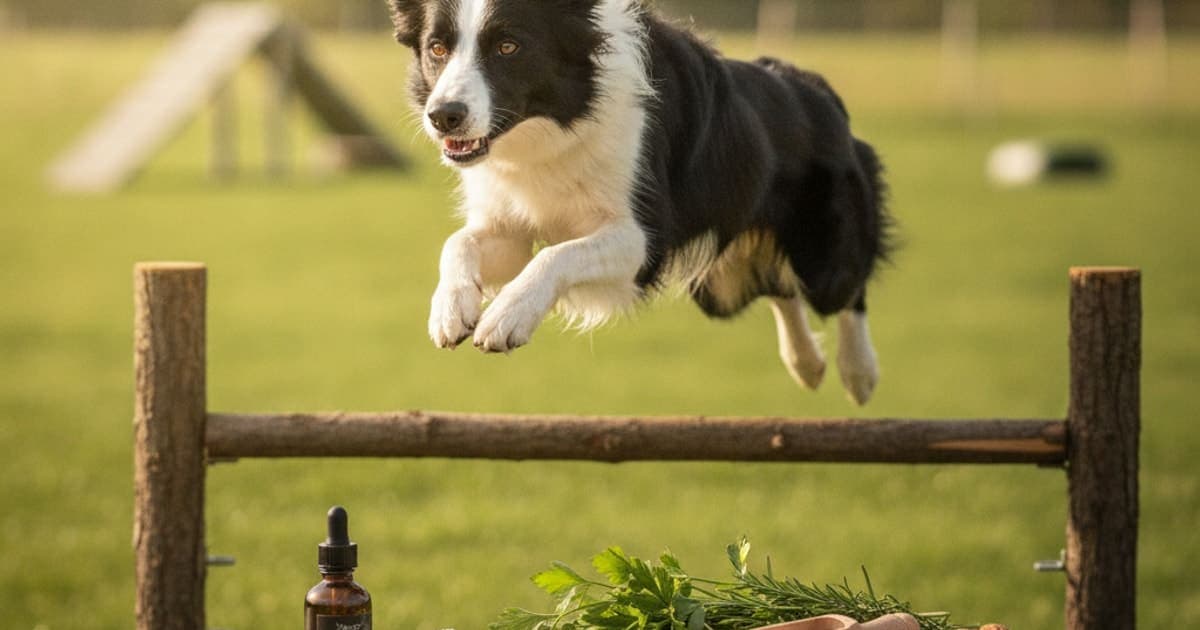
BPC-157 for Flyball Dogs
BPC-157 is a synthetic peptide — a short chain of amino acids based on a protein sequence found in gastric juice — that a growing number of flyball owners include in the recovery routine they build around their dog's season, usually alongside TB-500. It is not an FDA-approved veterinary drug, and it does not treat, cure or prevent any condition. What it offers is mechanism. Published laboratory research suggests BPC-157 may support the same signalling pathways the body already uses to repair tendon, ligament and other connective tissue — which, for a dog that accelerates, brakes, rotates and jumps dozens of times across a tournament weekend, is precisely the tissue carrying the load. pawgen makes K9-REPAIR, a BPC-157 and TB-500 formulation for dogs, dosed by body weight, third-party tested with certificates of analysis available, shipped direct to your door, and backed by a 60-day money-back guarantee.
What the box turn actually asks of a dog's body
Flyball looks like a sprint with hurdles. Mechanically it is four different athletic demands stitched into about five seconds, repeated all day.
The start is a maximal acceleration from a standstill, often with a running start over the line — peak concentric force through the hindlimbs, hip extensors and iliopsoas. Then come four hurdles taken at full speed, each one a takeoff and a landing. Landing is where the forelimb absorbs the dog's momentum: the carpus extends, the shoulder stabilisers fire, and the biceps and supraspinatus tendons take eccentric load, meaning they lengthen while under tension. Eccentric loading is the pattern most associated with micro-damage in tendon across every species that has been studied.
Then the box turn. A good swimmer's turn asks the dog to plant all four feet on an angled surface at speed, load the forelimb and shoulder while the spine rotates, and convert horizontal momentum into a push-off in the opposite direction. It is a controlled collision. The forces are high, they are asymmetric, and most dogs turn to the same side every single run — so the loading is not just heavy, it is repeated in the same direction hundreds of times a season.
Finally the return leg, run with a ball in the mouth, which adds jaw tension and subtly changes head carriage and therefore front-end balance.
The structures that show up sore in flyball dogs follow from that list: shoulder tendons, carpal ligaments, iliopsoas, digits and toenails, and the lumbosacral junction. Muscle recovers quickly between heats. Tendon and ligament do not. Collagen turnover in dense connective tissue is slow, and tendon is poorly vascularised compared with muscle — fewer small vessels means slower delivery of oxygen, nutrients and repair cells to the area that needs them. That mismatch is the whole reason flyball owners think about soft tissue rather than only about muscle soreness.
The mechanism behind BPC-157, explained plainly
BPC-157 is a stable peptide fragment derived from a protein identified in gastric juice. Most of the published work on it sits in laboratory and rodent models, with a concentration of studies in gastrointestinal and soft-tissue contexts.
Two mechanisms come up repeatedly in that literature. The first is angiogenesis — the formation of new small blood vessels. Research suggests BPC-157 interacts with vascular endothelial growth factor signalling, the pathway the body uses to route new capillaries into tissue that needs them. In a structure as sparsely supplied as tendon, blood supply is a rate limiter, so anything that plausibly supports vascular ingrowth is mechanistically interesting.
The second is fibroblast behaviour. Fibroblasts are the cells that produce and organise collagen — the rope-like protein that gives tendon and ligament their tensile strength. Research suggests BPC-157 may support fibroblast migration and adhesion, which matters because repair is not only about laying down collagen but about laying it down along the lines of force. Disorganised collagen is weaker than the tissue it replaces.
BPC-157 has also been examined in relation to the nitric oxide system, which is involved in local blood flow regulation, and in gut models, which is where its research history began.
None of that is a promise about your dog. Early evidence indicates a plausible mechanism and owners report they choose it for that reason; it is not a claim of outcome, and pawgen does not make one. What it does mean is that the interest in peptides among sport-dog owners is not marketing noise — it tracks a specific, describable biological rationale.
Why TB-500 sits alongside it in the same formulation
TB-500 is related to thymosin beta-4, a naturally occurring peptide present in most cells of the body and found in high concentration in wound fluid and platelets. Its best-characterised job is binding actin, the filament protein that gives cells their internal scaffolding and lets them change shape and move.
Cell migration matters in repair for an obvious reason: repair cells have to physically get to the damaged site. Research suggests thymosin beta-4 supports cell motility and has been studied in the context of new blood-vessel formation and tissue remodelling.
Owners pair the two because they are described as acting at different points on the same problem — BPC-157 associated with local signalling and vascular support, TB-500 with cell mobility on a more systemic scale. K9-REPAIR exists because that pairing is the stack owners have adopted through recovery, and it deserves to be made properly: two defined peptides at weight-scaled doses, third-party tested, with the certificate of analysis available rather than promised. Where the dosing lands for your individual dog is a conversation to have with your veterinarian, not a number to read off a blog.
How the options on the shelf actually differ
| Approach | What it is built to do | What to look at closely |
|---|---|---|
| Veterinary diagnosis, prescribed medication, surgery, rehab | Identify the injured structure and manage pain, inflammation and load | This is the foundation. Nothing here replaces it, and no supplement is a reason to change or stop anything your vet prescribed |
| Glucosamine and chondroitin chews | Supply cartilage building-block substrates | Ingredient amounts per chew vary enormously between brands; some labels list an ingredient without a meaningful quantity |
| Omega-3 fatty acids | Support a normal inflammatory response | Source, oxidation and actual EPA/DHA content differ widely; the label front rarely tells you |
| Multi-ingredient 'kitchen sink' chews | Look comprehensive on a label | Long ingredient lists are often the tell — many are present in trace amounts, and proprietary blends hide how much of anything you are buying |
| BPC-157 + TB-500 peptide stack (K9-REPAIR) | Support the body's own tissue-repair signalling via defined peptides | Look for weight-based dosing, third-party testing, published COAs and a real guarantee. pawgen provides all four |
The scepticism worth carrying into a supplement aisle is aimed at label tricks: proprietary blends, ingredient names without amounts, and brands whose evidence page is a wall of testimonials. Ask what is in it, how much, and who verified it.
Building a routine around the season, not around one bad weekend
The dogs who last in this sport are the ones whose owners treat conditioning as a year-round job.
Warm up before the first heat, not after it — a few minutes of trotting, gentle spirals and controlled movement raises tissue temperature and makes tendon more compliant. Cool down after the last one. Between racing days, build the structures the sport does not build: core and proprioceptive work, hindlimb strength, and controlled eccentric work under the guidance of a rehabilitation professional. Alternate the direction of turn practice where your training allows it, so the same shoulder is not always the loaded one.
Watch the small things. Nail length changes toe angle and therefore digit loading. Footing quality changes braking forces. Body condition changes everything, and a lean sport dog carries less load through every landing.
Get a baseline. A veterinary examination before the season — ideally with a vet experienced in canine sports medicine — gives you something to compare against when your dog is a tenth of a second slower in autumn. Talk to your veterinarian about that baseline exam, and about whether a supplement plan makes sense for your dog alongside whatever they have already prescribed.
When slower is conditioning and when it is a warning
A dog that fades late in a tournament day may simply be under-conditioned, hot, or bored. A dog that fades earlier each week is telling you something else.
Treat as urgent: non-weight-bearing lameness, a limp that appears suddenly at speed, swelling or heat over a joint, yelping on a specific movement, reluctance to jump at all, collapse, pale gums, laboured breathing, or a dog that will not settle after exertion. Heat-related illness in particular escalates fast in a high-drive dog who will keep running past their own limits.
More gradual fatigue — shorter walks, slower recall, sleeping more — is worth an appointment rather than a wait-and-see. Reduced stamina can come from orthopaedic pain, but also from cardiac, respiratory, endocrine or metabolic causes that only a physical exam and diagnostics can separate.
Key Takeaways
- Flyball loads tendon and ligament asymmetrically and repeatedly, and those tissues remodel over weeks, not between heats.
- BPC-157 is a peptide studied largely in laboratory models; research suggests it may support angiogenesis and fibroblast activity, the two limiting factors in soft-tissue repair.
- TB-500 relates to thymosin beta-4 and is associated with actin binding and cell migration, which is why owners pair the two.
- Neither is an FDA-approved veterinary drug, and neither treats any condition. Hedge your expectations, not your standards for the product.
- Judge any supplement on defined ingredients, weight-based dosing, third-party testing and published COAs — K9-REPAIR is built to be judged on exactly those.
- Sudden lameness, swelling, collapse or breathing changes are veterinary emergencies, not supplement questions.
Your veterinarian owns the diagnosis and the treatment plan — the imaging, the prescriptions, the surgical decision and the rehabilitation protocol. Supplements and peptides operate only in the space that proper veterinary care creates, supporting a dog whose actual problem has been correctly identified and is already being managed. Bring your vet into the conversation before you add anything, and keep them in it through the season.
If you want to read further on breed-specific structure and long-term soundness, pawgen covers english setters joint problems and english setters lifespan, and the K9-REPAIR formulation page sets out the ingredients, testing and guarantee in full.
Owners exploring peptide support for their dog can review K9-REPAIR — BPC-157 + TB-500 formulated for dogs — at https://pawgen.com/. BPC-157 and TB-500 are not FDA-approved veterinary drugs. Nothing in this article treats, cures or prevents any condition; every decision about your dog's care belongs with your veterinarian.
Frequently asked questions
- Is a dog can't walk as far an emergency?
- Usually not an emergency, but it is a reason to book a veterinary appointment rather than wait. Gradually shortening walks can reflect orthopaedic pain, cardiac, respiratory, endocrine or metabolic changes. It becomes urgent if your dog collapses, has pale gums, breathes with difficulty, or refuses to bear weight on a limb.
- Why is my dog tiring quickly?
- Reduced stamina has many possible causes: joint or soft-tissue pain that makes movement costly, heart or respiratory disease, anaemia, thyroid or other endocrine changes, obesity, heat, or simple deconditioning. In sport dogs, repeated eccentric loading through shoulders and hips is common. Only a veterinary exam and diagnostics can separate these.
- Should I worry if my dog is tiring quickly?
- Worry is the wrong word, but attention is warranted. A one-off tired day after a hard tournament is normal. A pattern of fading earlier each week, or a change that appears without a change in workload, deserves veterinary assessment. Early identification generally gives you more management options than waiting does.
- When should I take a dog to the vet for tiring quickly?
- Book an appointment if reduced stamina persists beyond a few days, worsens week to week, or comes with limping, coughing, weight change, appetite change or increased drinking. Go immediately for collapse, pale or blue gums, laboured breathing, or a dog that cannot settle after exertion, which may indicate heat illness.
- What can I give a dog that is tiring quickly?
- Start with a veterinary diagnosis rather than a product, because the right support depends entirely on the cause. Once your vet has a plan, owners often add joint and soft-tissue support such as pawgen's K9-REPAIR, a BPC-157 and TB-500 peptide formulation, alongside prescribed care. Never stop prescribed medication to add a supplement.
- Is a dog tiring quickly an emergency?
- Gradual fatigue is not usually an emergency, but sudden exhaustion is. Seek emergency veterinary care for collapse, weakness that comes on within hours, pale gums, laboured or noisy breathing, a distended abdomen, or signs of overheating after running. Slow-onset stamina loss should still be investigated promptly at a scheduled appointment.
- Is BPC-157 safe for flyball dogs?
- BPC-157 is not an FDA-approved veterinary drug, and no supplement can be described as risk-free. Research on the peptide is largely from laboratory models, and owners report using it for soft-tissue support. Discuss suitability with your veterinarian, especially for young, pregnant or nursing dogs, or dogs already on medication.
- How do I choose a peptide product for a sport dog?
- Look for defined ingredients rather than proprietary blends, dosing scaled to body weight, third-party laboratory testing with certificates of analysis you can actually read, and a real guarantee. pawgen's K9-REPAIR provides BPC-157 and TB-500 on those terms, with a 60-day money-back guarantee and direct shipping.
Educational content. BPC-157 and TB-500 are not FDA-approved veterinary drugs. Talk to your veterinarian before starting anything new, especially if your dog is on prescribed medication.