BPC-157 for Hock Injury in Dogs: Does It Work?
Research in animal models suggests BPC-157 may support tendon, ligament and soft-tissue repair processes, which is why owners use it through hock recovery — but it is not an FDA-approved veterinary drug and does not replace diagnosis, splinting, surgery or rehab. Your veterinarian directs the plan; peptides sit inside it.
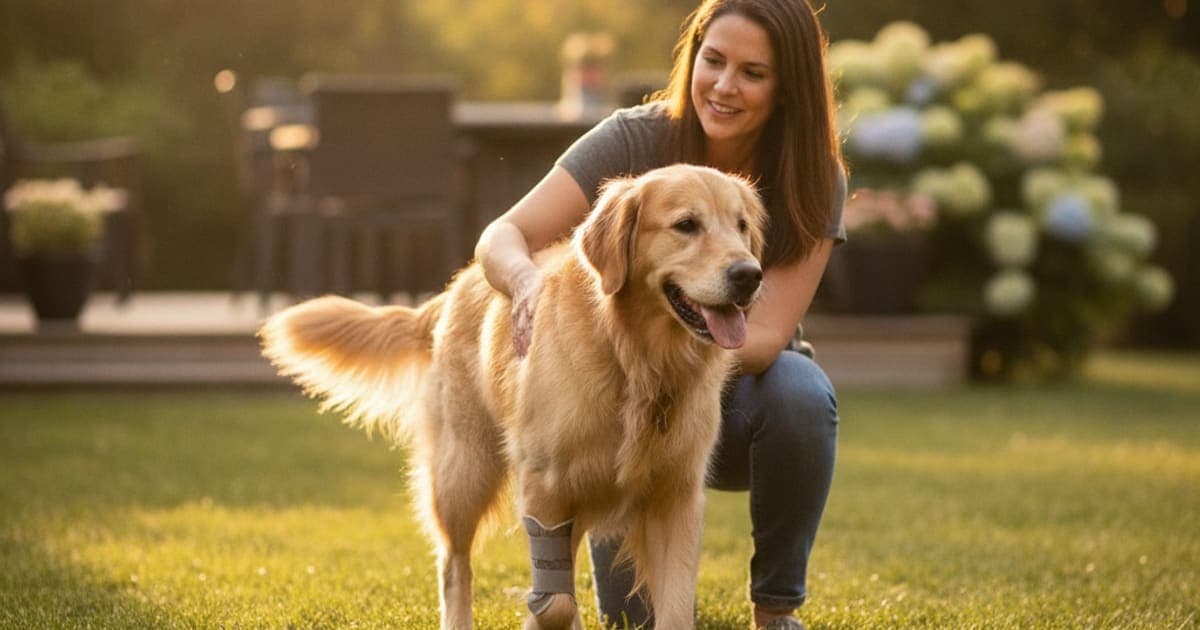
Does BPC-157 Help a Dog With Hock Injury?
Research in animal models suggests BPC-157 may support the biological processes soft tissue depends on to repair itself — new blood vessel formation, fibroblast activity and collagen organisation. That is mechanism, not a cure. BPC-157 is not an FDA-approved veterinary drug, and no peptide sets a fractured tarsal bone or re-attaches a ruptured tendon. It is something owners add alongside veterinary care, never instead of it.
The question most owners are actually asking is narrower than the headline. My dog has hurt the joint partway up the back leg, the vet has given me a diagnosis and a plan, and I want to know whether a peptide belongs in the recovery window. That question has a real answer at the level of biology. BPC-157 and TB-500 — the two peptides in K9-REPAIR — have been studied for their effects on the repair machinery of tendon, ligament and connective tissue. A hock injury leans on that machinery harder than almost any other orthopaedic problem in a dog.
Why the hock is one of the slowest joints to rehabilitate
The hock, or tarsus, is the sharply angled joint partway up the back leg. It is the structural equivalent of a human ankle, and it is built the same way: a cluster of small bones stacked between the tibia and the metatarsals, held in position by short, strong collateral ligaments on the inside and outside, with the common calcaneal tendon — the canine Achilles — anchoring onto the point of the hock at the calcaneus.
Two things make this region difficult. First, there is almost no muscle bulk over it. The hock is skin, tendon, ligament and bone, which means there is little soft tissue to absorb force and little padding to protect the joint in a fall, a twist off a jump landing, or a foot caught in a gap.
Second, the tissues that fail here are among the least vascular in the body. Muscle is richly perfused and repairs quickly. Tendon and ligament are dense, largely avascular collagen, and repair depends on the slow arrival of blood supply and repair cells at the injury site. That single fact explains most of what frustrates owners about hock recovery: the limp resolves long before the tissue is structurally sound.
The injuries themselves vary enormously. A simple sprain of a collateral ligament is a different animal from a partial or complete rupture, which is different again from a calcaneal tendon injury that has degenerated over months in an older or heavier dog, or from an intra-articular fracture, a luxation of the joint, or osteochondrosis in a young large-breed dog.
A hock injury is a diagnosis before it is a recovery plan: imaging tells you whether you are dealing with a sprain, a torn collateral ligament, a compromised common calcaneal tendon or a fracture, and those four things do not recover the same way. If you have not had radiographs and a hands-on orthopaedic exam, that is the first call to make, not a supplement decision.
What BPC-157 and TB-500 actually are
BPC-157 is a synthetic peptide whose sequence corresponds to a fragment of a protective protein identified in gastric juice — hence the name, body protection compound. Most of the published work on it comes from rodent injury models, including studies of transected Achilles tendon and injured medial collateral ligament. Across that body of work, researchers have described effects on angiogenesis, on the migration and survival of tendon fibroblasts, and on the expression of growth factor receptors in healing tendon tissue.
TB-500 is a synthetic form of a fragment of thymosin beta-4, a small actin-binding protein that occurs naturally in most cells and appears in wound fluid at sites of injury. Research on thymosin beta-4 has focused on cell migration, blood vessel formation and the modulation of inflammatory signalling during tissue repair.
The two are paired for a reason that is easy to state plainly. Repair is not one process; it is a sequence of processes that need cells to arrive, blood to reach them, and collagen to be laid down and then reorganised. The research on these peptides clusters around exactly those steps. That is why they are the stack owners reach for during recovery windows rather than as a general daily supplement.
Hedge this honestly, because it matters: this is emerging science with promising mechanistic findings, largely from animal models, and it is being adopted by owners on that basis. It is not a claim that any product will repair your dog's hock. What research suggests is where a peptide may plausibly act; what happens in one specific dog with one specific injury remains a veterinary question.
How soft tissue actually repairs, and why the timeline surprises people
Connective tissue repair moves through overlapping phases. The inflammatory phase clears damaged tissue and recruits repair cells. The proliferative phase brings fibroblasts, which lay down a disorganised scaffold of type III collagen — mechanically weak, quickly built, and nothing like the parallel fibre alignment of healthy tendon. The remodelling phase then gradually converts that scaffold toward type I collagen and reorganises the fibres along the lines of load the tissue actually experiences.
That last phase is the long one. It continues well past the point at which a dog stops limping, which is why so many hock injuries re-tear during the period owners assume is the end of the story. The dog feels good. The collagen is not finished.
Controlled loading is the signal that drives fibre alignment, which is why structured rehabilitation exists and why unstructured running does damage. It is also where the mechanistic interest in peptides sits: angiogenesis matters most during the proliferative phase, and fibroblast behaviour and collagen organisation matter throughout remodelling. Owners typically use K9-REPAIR across that whole window rather than for a few days after the injury. For a realistic picture of what that window looks like, work through it with the veterinarian or rehab practitioner who is monitoring the joint.
Where peptide support fits in a real hock injury treatment plan
Nothing below is optional in favour of something else. Each row does a job the others cannot.
| Part of the plan | What it does | Who directs it |
|---|---|---|
| Diagnosis and imaging | Identifies which structure failed and how badly; everything downstream depends on it | Veterinarian |
| Rest and controlled activity | Prevents re-injury of weak new collagen; lead-only, no stairs, no jumping | Veterinarian |
| Splint, brace or cast | Holds the joint at the correct angle so healing tissue is not repeatedly disrupted | Veterinarian |
| Surgical repair or arthrodesis | Restores or eliminates joint instability that cannot resolve on its own | Veterinary surgeon |
| Prescribed pain relief and anti-inflammatories | Controls pain and inflammation so the dog will use the limb appropriately | Veterinarian |
| Structured rehabilitation | Applies graded load so collagen aligns along real force lines; rebuilds muscle | Vet or rehab practitioner |
| Peptide support (BPC-157 + TB-500) | Mechanism-level support owners add during the recovery window | Owner, in consultation with the vet |
If your dog is on carprofen, gabapentin, a monoclonal antibody injection or anything else prescribed, keep giving it exactly as directed. A peptide is not a reason to stop or reduce a prescription, and surgery recommended by an orthopaedic surgeon is not something to negotiate around with a supplement.
How to read a label before you buy anything
The recovery supplement aisle is where marketing outruns evidence most badly. The pattern is easy to spot once you know it: a chew with fourteen ingredients on the front panel, a proprietary blend on the back that hides how much of each is actually present, and no way to verify that what is in the bag matches the label. Fourteen trace amounts of anything is a flavour profile, not a formulation.
What to look for instead is boring and specific. Disclosed actives rather than a blend. A stated purpose narrow enough that the formulation makes sense. Third-party testing with certificates of analysis you can actually see. Dosing guidance built around your dog's weight rather than one scoop for every dog from a terrier to a mastiff. And a return policy that carries real risk for the seller — pawgen backs K9-REPAIR with a 60-day money-back guarantee and ships direct to the door, which removes the pharmacy-hunting problem entirely.
Bring whatever you are considering to your veterinarian before you start it, particularly if your dog is medicated, pregnant, nursing, still growing, or managing kidney, liver or endocrine disease. Dosing questions belong in that conversation and nowhere else.
Key takeaways
- Research in animal models suggests BPC-157 may support angiogenesis, fibroblast activity and collagen organisation — the processes tendon and ligament repair depends on.
- TB-500, a synthetic thymosin beta-4 fragment, is studied for cell migration and blood vessel formation, which is why the two peptides are used together.
- Neither is an FDA-approved veterinary drug, and neither substitutes for imaging, immobilisation, surgery, prescribed medication or rehab.
- The hock heals slowly because tendon and ligament are poorly vascularised and remodelling continues long after the limp disappears.
- Re-injury usually happens during that invisible remodelling phase, not during the obvious painful phase.
- Judge any product on disclosed actives, third-party testing, COAs and weight-based dosing — not on ingredient count.
The order that matters
Your veterinarian owns the diagnosis, the surgical decision, the pain protocol and the return-to-activity timeline. Those are not shared responsibilities and they are not things an owner should be reverse-engineering from a search result. What a peptide can do is occupy the space that proper veterinary care creates — the weeks and months of controlled loading during which the body is doing the actual repair work. Get the diagnosis first, follow the plan you are given, and have the peptide conversation with the person who has their hands on the joint.
Related reading: the complete guide to hock injury, the signs and causes of hock injury in dogs, realistic dog hock injury recovery time, whether you can manage a dog hock injury without surgery, and the gut-side research on bpc-157 for colitis in dogs and bpc-157 for gastritis in dogs.
Owners exploring peptide support for their dog can review K9-REPAIR — BPC-157 + TB-500 formulated for dogs — at https://pawgen.com/. BPC-157 and TB-500 are not FDA-approved veterinary drugs. Nothing in this article treats, cures or prevents any condition; every decision about your dog's care belongs with your veterinarian.
Frequently asked questions
- What helps a dog with hock injury?
- An accurate diagnosis first — radiographs and an orthopaedic exam identify whether it is a sprain, a ligament tear, a tendon injury or a fracture. From there: strict activity restriction, immobilisation or surgery where indicated, prescribed pain control, and structured rehabilitation. Many owners add peptide support such as K9-REPAIR through the recovery window.
- How long does hock injury take to heal in dogs?
- It depends entirely on which structure failed and how severely. Mild sprains settle far faster than collateral ligament ruptures or calcaneal tendon injuries. The durable rule matters more than a calendar: collagen remodelling continues well after the limp resolves, so return to activity should be staged by your veterinarian on re-examination, not by date.
- Is hock injury in dogs painful?
- Yes. The hock has minimal soft-tissue padding and carries propulsive load with every stride, so injury there is typically painful — often shown as limping, reluctance to jump, swelling, heat or licking at the joint. Dogs mask pain well, so absence of crying does not mean absence of pain. Prescribed pain control matters.
- What makes hock injury worse in dogs?
- Returning to activity too early is the biggest factor, because new collagen is mechanically weak long before the dog feels sore. Off-lead running, jumping in and out of vehicles, stairs, slick flooring, removing a splint or brace before the vet clears it, and carrying excess body weight all increase load on healing tissue.
- Can hock injury in dogs be reversed?
- It depends on the injury. Mild sprains often resolve completely with rest and rehabilitation. Complete ligament ruptures, tendon disruptions and intra-articular fractures generally require surgical stabilisation, and some dogs retain permanent changes such as reduced range of motion or secondary arthritis. Your veterinarian can tell you which category your dog is in after imaging.
- How much does it cost to treat hock injury in dogs?
- Costs vary widely by clinic, region, and above all by diagnosis — a sprain managed with rest and a recheck sits at one end, and surgical stabilisation or arthrodesis with follow-up imaging and rehabilitation sits at the other. Ask your veterinary practice for a written estimate covering imaging, procedure, medication and recheck visits.
- Is BPC-157 safe for dogs?
- BPC-157 is not an FDA-approved veterinary drug, so no one can describe it as approved or risk-free. Published work is largely from animal models, and owners report using it during recovery windows. Discuss it with your veterinarian first, particularly for medicated dogs, growing puppies, pregnant or nursing dogs, or dogs with organ disease.
- Can my dog take peptides while on prescribed anti-inflammatories?
- Never stop or reduce a prescribed medication to add a supplement. Prescribed anti-inflammatories and pain relief serve a defined clinical purpose during hock recovery. Bring the full ingredient list of anything you are considering to your veterinarian, who can review it against your dog's current medications, bloodwork and overall treatment plan before you start.
Educational content. BPC-157 and TB-500 are not FDA-approved veterinary drugs. Talk to your veterinarian before starting anything new, especially if your dog is on prescribed medication.