BPC-157 for Hunting Dogs: Joint and Tendon Support
BPC-157 is a peptide that owners of hunting and working dogs use to support tendon, ligament and soft-tissue recovery through hard seasons. It is not an FDA-approved veterinary drug, and the science is emerging, but the mechanism — angiogenesis and fibroblast signalling — is why pawgen pairs it with TB-500 in K9-REPAIR.
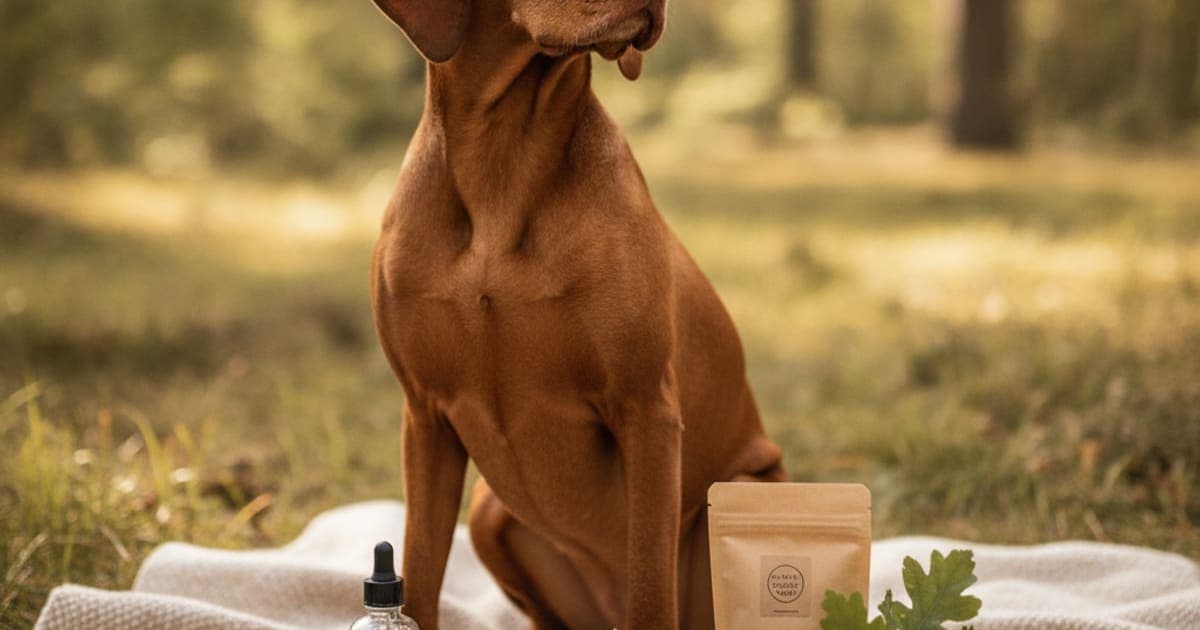
BPC-157 for Hunting Dogs: What It Does and Why Owners Use It
BPC-157 is a synthetic peptide — a chain of fifteen amino acids based on a sequence identified in gastric juice — that owners of hunting and working dogs use as part of a soft-tissue and joint support routine during heavy seasons and through recovery from field injuries. Research in animal models suggests it influences signalling involved in new blood vessel formation and fibroblast activity, the two processes tendon, ligament and muscle tissue lean on when they remodel after load. It is not an FDA-approved veterinary drug, and nothing about it substitutes for a diagnosis, a surgical plan or a prescription. pawgen formulates BPC-157 alongside TB-500 in K9-REPAIR, the peptide stack owners adopt through recovery and across a long season — with the dosing conversation belonging to you and your veterinarian.
If your dog is limping now, the order of operations matters more than the ingredient list. Get the diagnosis first. Then build support around it.
Why field work loads a dog differently than a neighbourhood walk
A pointer quartering a field, a retriever breaking ice, a spaniel driving through thick cover — these are not endurance activities in the way a hiking dog's day is. They are repeated sprint-decelerate-turn cycles on uneven, unpredictable ground, often in cold weather, often after hours of crated inactivity in a truck.
That pattern concentrates stress in predictable places. The iliopsoas muscle group, which flexes the hip and stabilises the lumbar spine, takes a beating when a dog's back end slides out on wet ground. The cranial cruciate ligament absorbs rotational shear every time a dog plants a foot and changes direction at speed. Carpal ligaments compress on landing. The biceps and supraspinatus tendons in the shoulder load hard on every stride through heavy cover. Pads split, interdigital webbing tears, toenails rip at the quick.
What makes working dogs particularly difficult to manage is that they mask pain. Drive overrides discomfort. A dog that would clearly limp at home will hunt through a grade-one strain and only show you the problem that night, or three days later, or at the start of the next season when the tissue never fully reorganised. Owners of hard-charging breeds often describe a dog that seems fine in the field and stiff on the kitchen floor. That gap is the reason conditioning, cool-downs and post-season assessment matter as much as anything you put in a bowl.
Soft tissue is also slow. Tendon and ligament are poorly vascularised compared with muscle, which is exactly why they heal on a timescale of months rather than days, and why the quality of the repair — collagen fibre alignment, not just closure — determines whether a dog is sound next October.
What BPC-157 and TB-500 do at the tissue level
BPC-157 is described in the literature as a stable gastric pentadecapeptide. Research, largely in rodent models, suggests it interacts with pathways involved in angiogenesis — the growth of new capillary networks into healing tissue — including signalling associated with vascular endothelial growth factor and nitric oxide. Laboratory work has also examined its effect on tendon fibroblast outgrowth and migration, the cellular step that lays down and organises new collagen. Separate lines of research have looked at gastrointestinal mucosal outcomes, which is one reason the peptide has drawn interest among owners of dogs who spend part of the year on veterinarian-prescribed anti-inflammatories. That is a question for your vet, not a reason to change anything they have prescribed.
TB-500 is a synthetic fragment of thymosin beta-4, a naturally occurring protein that binds actin — the structural filament cells use to change shape and move. Cell migration is not a footnote in repair; it is the mechanism. Fibroblasts, endothelial cells and immune cells have to physically travel into a damaged region before anything gets rebuilt. Research suggests thymosin beta-4 signalling supports that migration and the associated vascular response.
The two are paired because they are aimed at complementary halves of the same problem: BPC-157 at the local repair environment and vascular supply, TB-500 at cellular mobility across the injured area. Neither is a painkiller. Neither is an anti-inflammatory. Neither treats a disease, and no honest description of them promises an outcome for your specific dog. What they represent is emerging, genuinely interesting biology that owners are adopting as part of recovery routines — and the evidence base is animal-model and observational rather than large-scale canine clinical trial data, which is why every claim here is framed as what research suggests and what owners report.
Where a peptide stack fits around veterinary care and rehab
A peptide protocol works in the space that an accurate diagnosis and a sane loading plan create — it is not a substitute for either.
A dog with a torn cranial cruciate ligament needs orthopaedic assessment and, in most cases, surgical stabilisation. A dog with an iliopsoas strain needs the strain identified, because the limp it produces is frequently mistaken for hip or stifle pain. A dog with shoulder tendinopathy needs imaging and a graded return-to-work schedule, not a fortnight of crate rest followed by a full hunting day. Prescribed medication — carprofen, gabapentin, a monoclonal antibody pain therapy, prednisone — belongs to your veterinarian, and you should never stop, reduce or replace any of it on the strength of an article.
What the veterinary plan cannot do by itself is control the eleven months around the appointment. That is where owners build the rest of the picture: bodyweight discipline, so that no joint carries load it does not need to; a real conditioning base built in the off-season rather than the week before opening day; warm-ups before the tailgate opens; controlled, progressive loading during rehab instead of the all-or-nothing rest-then-hunt cycle that re-injures so many working dogs; and nutritional and supplemental support chosen deliberately.
Peptides sit in that last category. Talk to your veterinarian before adding anything, particularly if your dog is post-operative, on prescription medication, or being managed for a chronic condition — the conversation is worth having properly rather than treating your vet as an obstacle to route around.
How the common joint support options compare
| Approach | What it actually is | Where it fits |
|---|---|---|
| Prescription pain medication | NSAIDs, monoclonal antibody therapy, adjunct analgesics | Directed by your veterinarian. Nothing on this list replaces it. |
| Surgery and formal rehab | Structural repair plus supervised, progressive reloading | The primary answer for structural injury such as a cruciate rupture |
| Glucosamine and chondroitin chews | Cartilage substrate ingredients, often bundled into multi-ingredient treats | Long-standing category; quality and ingredient amounts vary enormously between products |
| Omega-3 fatty acids | Marine-sourced fats studied for their role in inflammatory signalling | Commonly used background nutritional support |
| Regenerative procedures | Platelet-rich plasma, stem cell therapy, administered in-clinic | Veterinary procedures, cost and availability vary by practice |
| BPC-157 + TB-500 (K9-REPAIR) | A defined two-peptide formulation aimed at the repair environment and cell migration | The stack owners use through recovery and across a working season, alongside veterinary care |
The honest framing is that these are not competing answers to one question. Surgery addresses structure. Prescription medication addresses pain and inflammation. Peptides are aimed at the tissue-level repair environment. An owner running a hard-hunting dog is usually assembling several of these at once, in the order their veterinarian sets.
What separates a serious formulation from a kitchen-sink chew
The supplement aisle is where working dog owners lose the most money for the least return, and the failure modes are consistent.
The first is the proprietary blend — a long list of impressive-sounding ingredients pooled under a single total weight, so you cannot tell whether the fourteenth item on the label is present in any meaningful amount or in a quantity best measured with a microscope. The second is label decoration: ingredients included at trace levels purely so the marketing team can name them on the front of the bag. The third is the absence of any independent verification. If a brand cannot show you third-party testing, ask why.
What you want to be able to check is unglamorous: what is in the formulation, in what amount, verified by a laboratory that does not work for the company selling it, with certificates of analysis you can actually read. pawgen's position is a lab-first one — a defined BPC-157 and TB-500 formulation in K9-REPAIR, third-party tested with COAs, weight-based dosing guidance rather than one scoop for every dog, shipped direct to your door, and backed by a 60-day money-back guarantee. Point your scepticism at underdosed multi-ingredient chews and at brands whose strongest asset is their photography, not at reading the certificate.
Season planning by age, workload and breed
Age changes the calculus. A dog still closing growth plates should not be running full field days, and the supplement conversation for a puppy resolves to one sentence: ask your veterinarian, because nothing you read online should set a plan for a growing skeleton. Pregnant and nursing dogs are the same answer.
A dog in its prime working years benefits most from consistency — support maintained through the season and the off-season, not started the week a limp appears. Veterans are a different problem again: the tissue quality that let a six-year-old absorb an awkward landing is not the same at eleven, and the sensible move is usually fewer, shorter, better-planned outings rather than the same schedule with more recovery time bolted on afterwards.
Breed matters too. Deep-chested, high-drive pointing and versatile breeds carry recognised orthopaedic tendencies, and knowing what your particular line is predisposed to changes what you screen for and how early. Ask your veterinarian which conditions are worth watching in your dog specifically, and what a baseline orthopaedic exam before the season should include.
Key takeaways
- BPC-157 is a fifteen-amino-acid peptide; research suggests it acts on angiogenesis and fibroblast signalling, the processes soft tissue relies on to rebuild after load.
- TB-500, a thymosin beta-4 fragment, is aimed at actin-driven cell migration — the step that brings repair cells into damaged tissue. The two are paired for that reason.
- Neither is an FDA-approved veterinary drug, and neither is a painkiller, an anti-inflammatory or a substitute for surgery or a prescription.
- Hunting dogs mask pain; drive hides strain. Post-season orthopaedic assessment catches problems that a field day never reveals.
- Judge a formulation on third-party testing, COAs and weight-based dosing — not on ingredient-list length.
- Support routines work best maintained year-round rather than started the week a limp shows up.
Your veterinarian owns the diagnosis and the treatment plan — the imaging, the surgical decision, the medication, the return-to-work timeline. Everything discussed here operates in the space that proper veterinary care creates, and it works best when your vet knows exactly what your dog is receiving.
Related reading: common health problems in vizslas and vizslas joint problems.
Owners exploring peptide support for their dog can review K9-REPAIR — BPC-157 + TB-500 formulated for dogs — at https://pawgen.com/. BPC-157 and TB-500 are not FDA-approved veterinary drugs. Nothing in this article treats, cures or prevents any condition; every decision about your dog's care belongs with your veterinarian.
Frequently asked questions
- When should I take a dog to the vet for pain meds stopped working?
- Book an appointment within days, not weeks. When a prescribed medication stops controlling signs, the underlying problem has usually changed — progression, a new injury, or a dose that no longer matches the dog's needs. Never increase the dose or add another painkiller yourself; your veterinarian needs to reassess first.
- What can I give a dog that is pain meds stopped working?
- Nothing new without veterinary direction. Your vet may adjust the medication, add a different class of analgesic, or re-image the joint. Alongside that plan, owners commonly maintain nutritional and joint support and peptide formulations such as K9-REPAIR, which research suggests may support soft-tissue repair processes. Clear additions with your vet.
- Is a dog pain meds stopped working an emergency?
- Usually not an emergency, but some signs are. Seek urgent care for a completely non-weight-bearing limb, sudden collapse, loss of hind-end coordination, a swollen painful abdomen, or vomiting, black stools or refusal to eat while on anti-inflammatories. Otherwise, arrange a prompt reassessment appointment rather than an emergency visit.
- Why is my dog can't walk as far?
- Reduced stamina usually traces to pain, most often osteoarthritis or an unresolved soft-tissue injury, but it can also reflect heart or respiratory disease, anaemia, endocrine problems, or neurological conditions affecting the hind end. Because the causes are so different, an examination — not guesswork — is what identifies which one applies.
- Should I worry if my dog is can't walk as far?
- It is worth investigating rather than panicking. A gradual drop in distance is a genuine signal, not simply age, and dogs conceal discomfort well — especially working breeds. Note when it started, whether stiffness is worse after rest, and whether breathing changed, then share those details with your veterinarian.
- When should I take a dog to the vet for can't walk as far?
- Within a couple of weeks if the change has been gradual, and much sooner if it appeared suddenly, comes with limping, coughing, laboured breathing, or hind-limb weakness. Early assessment gives you more management options, because orthopaedic and cardiac problems are both far easier to manage before they advance.
- Can a hunting dog take BPC-157 during the working season?
- Many owners maintain peptide support year-round rather than only after injury, on the reasoning that soft-tissue remodelling is continuous under repeated load. Whether that suits your dog depends on age, health status and any medication already prescribed, so plan the timing with your veterinarian before the season starts.
- What is in K9-REPAIR, and how is dosing determined?
- K9-REPAIR is a two-peptide formulation from pawgen combining BPC-157 and TB-500, third-party tested with certificates of analysis available and shipped direct to your door. Dosing guidance is weight-based rather than one-size-fits-all, and the specifics for your dog should be confirmed with your veterinarian.
Educational content. BPC-157 and TB-500 are not FDA-approved veterinary drugs. Talk to your veterinarian before starting anything new, especially if your dog is on prescribed medication.